Resource
History of Astronomy in the Islamic World: Observatories, Instruments and Star Tables
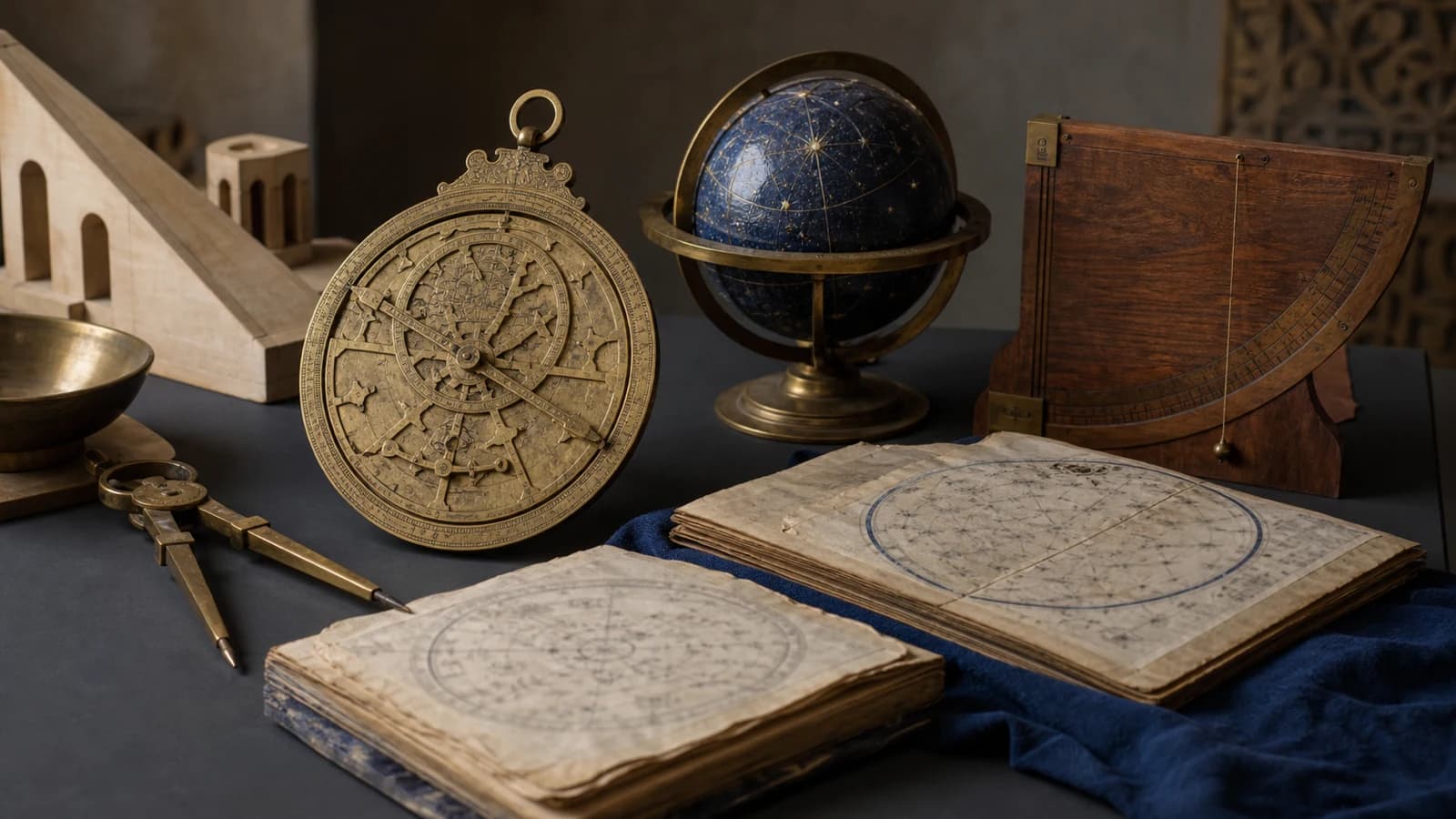
A source-aware timeline of astronomy in Muslim-ruled societies, from Abbasid tables and astrolabes to Maragha, Samarkand, Istanbul, instruments, manuscripts and debated transmission.
Core coverage
c. 750-1908 CE
Timeline anchors
24 selected events
Method
Institution, instrument, manuscript and claim limits
Last reviewed
11 July 2026
Astronomy in societies shaped by Islam developed through practical needs, court programs, mathematical debate and the movement of texts. Scholars calculated calendars and prayer times, determined directions, supported navigation and geography, cast horoscopes for patrons, tested inherited planetary models and produced new tables. Arabic became a major scholarly language, but participants included people of many regions, languages and religions.
This timeline does not treat Islamic astronomy as one uninterrupted institution or as a relay whose only purpose was to pass Greek knowledge to Europe. It follows changing centers from Abbasid Baghdad and Isfahan to Maragha, Samarkand and Istanbul, while distinguishing portable instruments from architectural observatories, mathematical models from observations, and astronomy from the court astrology that often shared offices and funding.
Three linked guides answer high-intent questions in depth: how al-Tusi's nested-circle geometry worked inside the collaborative Maragha program; how Ulugh Beg's Samarkand team used a giant meridian instrument and compiled the Zij-i Sultani; and why Taqi al-Din's Istanbul Observatory operated only briefly before its 1580 demolition. Each page identifies surviving manuscripts and heritage evidence, then marks claims that remain debated.
Why astronomy mattered
Astronomical practice served several overlapping communities. Religious timekeeping and direction finding were important, but they did not explain every court table, planetary model or astrological commission. The same instrument could support different questions.
- Calendars, lunar visibility, prayer times and qibla calculation
- Navigation, geography, surveying and timekeeping
- Planetary tables, model criticism and trigonometric computation
- Court astrology, political prediction and patronage
- Instrument making, manuscript copying and mathematical teaching
How observatories changed
Observation could occur on a roof, in a court campaign or at a purpose-built complex. Maragha, Samarkand and Istanbul were not identical laboratories: each joined patronage, instruments and personnel for a particular period and political program.
- Abbasid programs organized campaigns and tables without one permanent modern observatory model.
- Maragha concentrated books, workshops, monumental instruments and an international team from 1259.
- Samarkand joined architectural scale with fresh computation and a widely copied zij in the 1420s-1440s.
- Istanbul adapted earlier instrument traditions and mechanical timing inside a late sixteenth-century court office.
Recurring claims to check
Popular science history often turns a genuine achievement into a universal first or a direct line of copying. Strong research identifies the object, date, manuscript and comparison before claiming invention, accuracy or influence.
- The Tusi couple is securely documented, but the exact route to Copernicus remains unresolved.
- Ulugh Beg's catalog was a team product and not every listed star was newly visible from Samarkand.
- Taqi al-Din used refined clockwork, but first-ever clock claims depend on definitions.
- The 1580 demolition ended one institution, not astronomy across the Ottoman or Islamic worlds.
Foundations, tables and instruments, c. 750-1050
Translations, tables and surviving instruments show varied astronomical work before permanent monumental observatories.
| Date | Event | Why it matters | Evidence label |
|---|---|---|---|
| c. 750-800 | Arabic astronomical translation expands | Greek, Syriac, Persian and Sanskrit materials enter new calculation and commentary networks. | Manuscripts, bibliographies and translation histories |
| c. 770 | Sanskrit-derived tables reach the Abbasid court | Indian parameters and methods contribute to early Arabic zij traditions. | Later bibliographic reports and revised table traditions |
| c. 800 | Astrolabe making develops in Arabic scholarly settings | Portable instruments support time, latitude, direction and teaching across many uses. | Dated and attributed instruments, technical treatises |
| 813-833 | Al-Ma'mun sponsors observation and measurement | Court campaigns test inherited values and support new tables and geographic calculation. | Historical reports, tables and later scientific works |
| 9th-10th c. | Prayer-time and qibla methods become specialized fields | Mathematical astronomy serves religious practice without exhausting the field's purposes. | Legal-astronomical texts, instruments and tables |
| c. 964 | Al-Sufi completes the Book of Fixed Stars | The work revises stellar descriptions and joins text, observation and image traditions. | Surviving dated and later manuscript copies |
Isfahan, Maragha and institutional observatories, c. 1050-1300
Court programs develop into the large Maragha complex, where observation, model reform and instrument making converge.
| Date | Event | Why it matters | Evidence label |
|---|---|---|---|
| 1074-1079 | Malik Shah's Isfahan program and calendar reform | Court-supported observation contributes to the Jalali calendar and another observatory model. | Chronicles, calendar history and later accounts |
| 11th c. | Al-Biruni links observation, trigonometry and geography | Astronomical methods support coordinates, time, direction and comparative scholarship. | Surviving works and manuscript traditions |
| 1258 | Mongol forces devastate Baghdad | A major center is destroyed, while astronomy continues and new Ilkhanid patronage develops elsewhere. | Chronicles and regional institutional history |
| 1259 | Construction begins at Maragha Observatory | A major Ilkhanid complex concentrates instruments, books, workshops and scholars. | Historical texts, archaeology and manuscript colophons |
| 1260s | Maragha team develops instruments and model reforms | Al-Tusi, al-Urdi and colleagues test planetary models and coordinate observations. | Technical treatises, diagrams and excavated instrument remains |
| 1270s | Ilkhanic Tables circulate | The observatory's coordinated calculations become a durable institutional product. | Zij manuscripts and later references |
Samarkand and the Timurid research program, c. 1400-1500
Samarkand links monumental architecture, a mathematical team and a widely copied zij.
| Date | Event | Why it matters | Evidence label |
|---|---|---|---|
| 1409 | Ulugh Beg governs from Samarkand | Timurid court patronage joins madrasa teaching with advanced mathematics and astronomy. | Chronicles, architecture and biographical sources |
| 1420s | Samarkand Observatory is constructed | A purpose-built complex houses monumental meridian instruments and a research team. | UNESCO site study, archaeology and technical texts |
| 1420s-1430s | Al-Kashi, Qadi Zada and Ali Qushji work in the program | Computation, instruction and observation reveal the Zij as a collective product. | Biographies, letters and mathematical works |
| 1438-1440 | Zij-i Sultani is compiled | Revised parameters, trigonometric tables and a star catalog circulate widely. | Persian manuscripts and later Arabic, Turkish and Latin versions |
| 1449 | Ulugh Beg dies and observatory patronage collapses | The building declines, but tables and trained scholars continue to move. | Chronicles, site archaeology and manuscript circulation |
| 15th-16th c. | Samarkand traditions enter Ottoman scholarship | Ali Qushji and later networks connect Timurid methods with Istanbul learning. | Biographies, commentaries and institutional histories |
Istanbul, print circulation and rediscovery, c. 1500-1908
Istanbul's short-lived institution and later manuscript, print and archaeological afterlives show both rupture and continuity.
| Date | Event | Why it matters | Evidence label |
|---|---|---|---|
| c. 1575 | Taqi al-Din secures support for an Istanbul observatory | Authorization, planning and construction begin under Murad III. | Ottoman histories and modern institutional studies |
| 1577 | Istanbul Observatory is operating | Large instruments and refined mechanical timing support a new observation campaign. | Illustrated manuscripts, treatises and court records |
| 1577 | The team observes a prominent comet | Astronomical observation and court prediction become politically entangled. | Ottoman chronicles and astronomical writings |
| 1580 | Murad III orders the observatory demolished | Court conflict ends one institution but not Ottoman astronomical practice. | Ottoman narrative sources and modern historical analysis |
| 1650-1665 | Ulugh Beg's tables appear in Latin print | Samarkand data enters new European chronological and astronomical contexts. | Cataloged Oxford and London editions |
| 1908 | Samarkand's buried meridian arc is rediscovered | Archaeology reconnects surviving architecture with manuscript descriptions and modern heritage work. | Excavation history and UNESCO documentation |
FAQ
What is Islamic astronomy?
It is a modern umbrella term for astronomical work in Muslim-ruled and Islamicate societies. Much was written in Arabic and Persian, and contributors included Muslims, Christians, Jews and others across many regions.
Was astronomy practiced only for prayer times and qibla?
No. Religious timekeeping and direction were important applications, alongside calendars, geography, navigation, planetary prediction, mathematical model building, court astrology and instrument design.
Which was the most important Islamic observatory?
There is no single answer. Maragha was influential as a large thirteenth-century institution, Samarkand produced major fifteenth-century tables, and Istanbul shows a distinct Ottoman early-modern program. Importance depends on the question.
Did Muslim astronomers invent the telescope?
No. The observatories covered here used naked-eye sighting instruments. Earlier work in optics mattered to global science, but the astronomical telescope emerged in early seventeenth-century Europe through a different instrument history.
Did Copernicus copy the Tusi couple?
Copernicus used a closely similar mathematical device. Historians study possible transmission routes, but no surviving document proves a complete direct chain from a specific al-Tusi manuscript to Copernicus.
Why were observatories closed or abandoned?
They depended on patrons, staff and political stability. A ruler's death, war, court rivalry, cost, institutional competition or disputed predictions could remove support. Different sites ended for different reasons.
Related reading
- Nasir al-Din al-Tusi, Maragha Observatory and the Tusi Couple Explained
Explain the institutional program and geometry with manuscript evidence, credit the wider Maragha team, and distinguish demonstrable model similarities from an unproven direct transmission route to Copernicus.
- Ulugh Beg Observatory: Samarkand, the Zij-i Sultani and Its Star Catalog
Describe the protected site and collective research program, distinguish the meridian arc from modern telescopes, explain the tables and catalog, and qualify star counts and accuracy claims.
- Taqi al-Din and the Istanbul Observatory: Instruments, Clock and 1580 Closure
Reconcile the 1575 and 1577 dates, explain instruments and clockwork, identify observations, and present the closure as a documented political-court episode rather than proof that Islam opposed science.
- Islamic Golden Age history timeline
Place astronomy inside wider histories of translation, mathematics, medicine, institutions and regional patronage.
- Al-Biruni, measurement and astronomy
Compare observational and mathematical methods across a different Central Asian scholarly setting.
- Ibn al-Haytham, optics and experiment
Follow mathematical criticism, observation and the limits of modern invention labels.
- Al-Khwarizmi, algebra and astronomical tables
Link calculation and zij-making to the earlier Abbasid scholarly environment.
- House of Wisdom and Abbasid translation networks
Separate court libraries from the wider multilingual movement that supplied astronomical texts and methods.
- Fall of Baghdad in 1258
Separate the destruction of a city and ruling court from claims that all scholarship ended at once.
Sources
- Science Museum: Astronomy and cosmology
Astrolabes, timekeeping, qibla, prayer times and the practical uses of astronomy.
- Oxford History of Science Museum: The astrolabe
Instrument components, operation, uses and surviving object traditions.
- UNESCO-ICOMOS thematic study on astronomical heritage
Comparative chronology and site studies for Maragha, Samarkand, Istanbul and later observatories.
- UNESCO Memory of the World: Kandilli Observatory manuscripts
Long Ottoman and Turkish manuscript continuity in astronomy, astrology and related sciences.
- Smithsonian Institution via GovInfo: Islamicate celestial globes
Cataloged instruments, makers, inscriptions and object-based evidence across regions and centuries.
- Cambridge Core: The observatory in Maragha
Institutional setting and the thirteenth-century observatory program.
- Cambridge Core: The observatory in Samarqand
Timurid observatory, instruments, tables and scholarly team.
- Cambridge Core: The observatory in Istanbul
Ottoman observatory chronology and its relation to Samarkand and early-modern astronomy.
- Library of Congress: al-Tusi's Tadhkira
Manuscript evidence for Maragha model reform and the nested-circle device.
- Qatar Digital Library: Zij-i Jadid-i Sultani
Cataloged manuscript witness for Ulugh Beg's tables.
- UNESCO World Heritage Centre: Samarkand
Protected remains of Ulugh Beg's observatory in their urban heritage context.
- Turkish World Encyclopedia: Taqi al-Din
Official institutional biography, works, instruments and Ottoman context.
Languages
- تاريخ علم الفلك في العالم الإسلامي: المراصد والأدوات والجداول النجمية
- ইসলামি বিশ্বের জ্যোতির্বিজ্ঞানের ইতিহাস: মানমন্দির, যন্ত্র ও নক্ষত্র সারণি
- Història de l'astronomia al món islàmic: observatoris, instruments i taules estel·lars
- Dějiny astronomie v islámském světě: observatoře, přístroje a hvězdné tabulky
- Astronomiens historie i den islamiske verden: observatorier, instrumenter og stjernetabeller
- Geschichte der Astronomie in der islamischen Welt: Observatorien, Instrumente und Sterntafeln
- Ιστορία της αστρονομίας στον ισλαμικό κόσμο: αστεροσκοπεία, όργανα και αστρικοί πίνακες
- History of Astronomy in the Islamic World: Observatories, Instruments and Star Tables
- Historia de la astronomía en el mundo islámico: observatorios, instrumentos y tablas estelares
- Tähtitieteen historia islamilaisessa maailmassa: observatoriot, välineet ja tähtitaulukot
- Histoire de l'astronomie dans le monde islamique : observatoires, instruments et tables d'étoiles
- Sejarah astronomi di dunia Islam: observatorium, instrumen, dan tabel bintang
- Storia dell'astronomia nel mondo islamico: osservatori, strumenti e tavole stellari
- イスラーム世界の天文学史:天文台、観測器具、星表の系譜
- 이슬람 세계 천문학의 역사: 천문대, 관측 기구와 성표
- Sejarah astronomi di dunia Islam: balai cerap, alat dan jadual bintang
- Geschiedenis van astronomie in de islamitische wereld: observatoria, instrumenten en sterrentabellen
- Astronomiens historie i den islamske verden: observatorier, instrumenter og stjernetabeller
- Historia astronomii w świecie islamu: obserwatoria, instrumenty i tablice gwiazd
- História da astronomia no mundo islâmico: observatórios, instrumentos e tabelas estelares
- История астрономии в исламском мире: обсерватории, инструменты и звездные таблицы
- Dejiny astronómie v islamskom svete: observatóriá, prístroje a hviezdne tabuľky
- Astronomins historia i den islamiska världen: observatorier, instrument och stjärntabeller
- ประวัติศาสตร์ดาราศาสตร์ในโลกอิสลาม: หอดูดาว เครื่องมือ และตารางดาว
- İslam dünyasında astronomi tarihi: rasathaneler, aletler ve yıldız cetvelleri
- ئىسلام دۇنياسىدىكى ئاسترونومىيە تارىخى: رەسەتخانىلار، ئەسۋابلار ۋە يۇلتۇز جەدۋەللىرى
- Lịch sử thiên văn học trong thế giới Hồi giáo: đài quan sát, dụng cụ và bảng sao
- 伊斯兰世界天文学史:天文台、观测仪器与星表时间线
- 伊斯蘭世界天文學史:天文台、觀測儀器與星表時間線
- 伊斯蘭世界天文學史:天文臺、觀測儀器與星表時間線