Nasir al-Din al-Tusi, Maragha Observatory and the Tusi Couple Explained
A source-aware guide to Nasir al-Din al-Tusi, the Maragha Observatory, the Tusi couple geometry, manuscripts, collaborative astronomy and the debated connection to Copernicus.
Quick facts
- Al-Tusi was born in Tus in 1201 and wrote in Arabic and Persian across mathematics, astronomy, ethics, philosophy and theology.
- He lived for years in Ismaili strongholds before entering Hulagu's Ilkhanid service during the Mongol conquest period.
- Construction at Maragha began in 1259; the complex supported observation, calculation, instrument making, books and collaboration.
- The Tusi couple combines two circular motions to create a point that moves back and forth on a straight line.
- Copernicus used a mathematically similar configuration, but no surviving document completes a direct chain of borrowing.
Who was al-Tusi before Maragha?
Al-Tusi's biography is inseparable from the political upheavals of the thirteenth century. After early study in Khurasan, he spent a substantial part of his career under Ismaili patronage, including at Alamut. When Hulagu's forces dismantled the Nizari state, al-Tusi entered the Mongol ruler's service. Later biographies disagree about how freely he moved through these transitions and about his role around the 1258 conquest of Baghdad. It is safer to state the documented sequence than to make him either a powerless captive or the hidden architect of every Ilkhanid decision.
Why was the Maragha Observatory built?
The observatory answered several linked court and scholarly needs: more consistent astronomical tables, calendrical and astrological calculation, testing of inherited parameters, and the prestige of a visible research program. Hulagu provided patronage while al-Tusi organized the work. The site west of Maragha developed into more than an observing platform. Archaeology and texts point to a central tower, monumental instruments, subsidiary rooms, a foundry or workshop activity, residential or service spaces and a major book collection. Construction began in 1259, but observation and calculation unfolded over years.
Maragha was a team, not a one-person invention
Mu'ayyad al-Din al-Urdi designed instruments and developed planetary models; Qutb al-Din al-Shirazi studied astronomy and optics; specialists from several regions participated in observation, computation and copying. The resulting Ilkhanic Tables are associated with al-Tusi's leadership, yet institutional products cannot be reduced to one hand. Maragha's durable importance lies partly in this concentration of salaried or patron-supported expertise, books, large instruments and sustained comparison of observations with mathematical models.
How does the Tusi couple work?
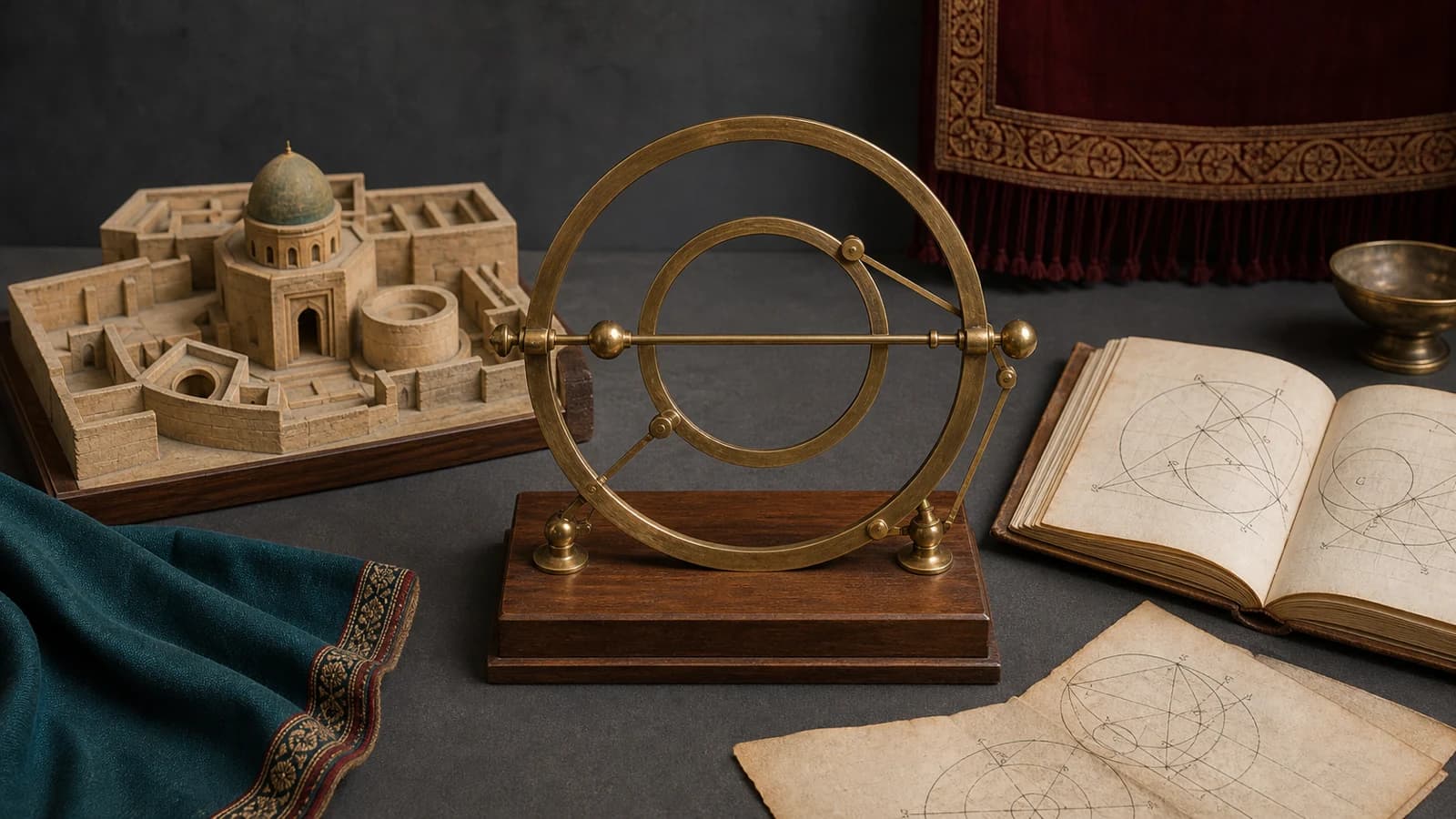
Imagine a smaller circle whose diameter equals the radius of a larger circle. The smaller circle rolls inside the larger while rotating in the opposite direction at twice the angular rate. A marked point on the smaller circle then moves back and forth along a diameter of the larger circle. The geometry converts two uniform circular motions into an oscillating straight line. Manuscripts of al-Tusi's Tadhkira preserve the construction. The modern label Tusi couple is convenient, but the historical object is a diagram and modeling method, not a surviving brass machine.
What problem did the geometry address?
Ptolemaic astronomy predicted planetary positions effectively but used devices, especially the equant, that troubled scholars who wanted all celestial motion to be represented by uniform circles around appropriate centers. Al-Tusi's construction helped produce apparent linear oscillation without abandoning circular components. Maragha astronomers developed several model reforms; they did not propose one modern heliocentric system. Their goal was to repair tensions between inherited mathematical prediction and accepted physical principles within the astronomy of their time.
What do the manuscripts prove?
Cataloged copies of the Tadhkira show that the diagram circulated, was recopied and remained intelligible to later readers. A Qatar Digital Library copy dated 1289 includes numerous diagrams; the Library of Congress and Vatican exhibition identifies the nested-circle construction in another early manuscript tradition. Manuscripts can establish the form and textual context of a model. They do not by themselves prove that every later astronomer saw a particular copy or learned through one route.
Did the Tusi couple influence Copernicus?
Copernicus used a closely similar geometric arrangement, and other parallels connect European astronomy with model reforms associated with Maragha. Historians have proposed routes through Byzantine Greek texts, travelers, multilingual scholars and Mediterranean manuscript networks. These are plausible research paths, not a complete documentary chain. The responsible conclusion has two parts: the similarity is historically significant and older Eurocentric isolation stories are inadequate; direct personal borrowing from a named Arabic manuscript has not been demonstrated.
Claims to qualify
- 'Al-Tusi invented straight-line motion': the construction has earlier geometric precedents, while his astronomical use and surviving presentation are distinctive.
- 'Maragha was the first observatory': earlier court observation programs existed; Maragha was unusually large, durable and institutionally influential.
- 'Al-Tusi single-handedly produced the Ilkhanic Tables': the observatory depended on multiple observers, calculators and instrument makers.
- 'He saved 400,000 books from Baghdad': viral versions attach precise numbers and actions not supported by secure contemporary evidence.
- 'Copernicus copied al-Tusi': mathematical similarity is clear, while the exact route and degree of dependence remain debated.
How to research al-Tusi responsibly
Separate biography, institution, geometry and reception. Anchor the observatory in dated construction and excavated features; name collaborators when discussing products; inspect a cataloged Tadhkira rather than a redrawn meme; and state what a transmission argument requires. Similar diagrams can overturn a story of isolated civilizations without automatically proving who copied whom. That distinction gives al-Tusi and the Maragha program a stronger, more credible place in global history.
What an observatory meant at Maragha in 1259
Maragha should not be imagined as a modern telescope dome. The observatory began before optical telescopes existed and depended on large sighting instruments, graduated arcs, repeated naked-eye observations, written tables and mathematical comparison. Its central tower and associated buildings gave instruments stable alignments and created working space for observers, calculators, copyists and instrument makers. A foundry and workshop evidence also matter because precision astronomy required material production as well as abstract geometry.
The program’s scale made long observation series possible, but no medieval institution measured everything continuously. Weather, instrument construction, patronage and the length of a scholar’s stay limited the record. The Ilkhanic Tables combined observations with inherited parameters and mathematical correction; they were not a raw data dump from one instrument. Calling Maragha an observatory is accurate when the term includes this institutional mixture of measurement, calculation, books and teaching.
Why the Tusi couple was not a heliocentric theory
The Tusi couple solved a geometric problem inside models that still placed a stationary Earth at the center of the cosmos. It showed how linked uniform circles could generate an apparent straight-line oscillation and helped astronomers avoid features of Ptolemy’s equant that conflicted with their physical expectations. That is a major model-building achievement, but the construction does not by itself put Earth in motion or place the Sun at the center.
This distinction improves the comparison with Copernicus. A later heliocentric author could use a mathematical device created for a geocentric framework because geometry is portable between cosmologies. Similar diagrams therefore establish an important shared technical problem and make total European isolation implausible. They do not erase the different physical systems around the diagram. The strongest historical question is how mathematical techniques crossed languages and manuscript networks, not who can be assigned the entire Copernican system by anticipation.
Related research guides
- History of astronomy in the Islamic world — Follow observatories, instruments, star tables and manuscript transmission from Abbasid foundations to Maragha, Samarkand and Istanbul.
- Ulugh Beg, Samarkand and the Zij-i Sultani — See how a large meridian instrument and a team of mathematicians produced influential tables and a star catalog.
- Taqi al-Din and the Istanbul Observatory — Examine the observatory's dates, instruments, clockwork, observations and politically contested closure without a simple religion-versus-science slogan.
- Islamic Golden Age history timeline — Place astronomy inside wider histories of translation, mathematics, medicine, institutions and regional patronage.
- Al-Biruni, measurement and astronomy — Compare observational and mathematical methods across a different Central Asian scholarly setting.
- Ibn al-Haytham, optics and experiment — Follow mathematical criticism, observation and the limits of modern invention labels.
- Al-Khwarizmi, algebra and astronomical tables — Link calculation and zij-making to the earlier Abbasid scholarly environment.
- House of Wisdom and Abbasid translation networks — Separate court libraries from the wider multilingual movement that supplied astronomical texts and methods.
- Fall of Baghdad in 1258 — Understand a catastrophic conquest without treating it as the end of astronomy across all Muslim-ruled regions.
Sources
- Library of Congress: Mathematics in the Vatican exhibition — Used for the Tadhkira manuscript and the nested-circle device that generates straight-line motion from circular motions.
- Library of Congress: Collection of the Treatises of al-Tusi — Used for al-Tusi's biography, the start of observatory construction in 1259 and the Ilkhanid setting.
- Library of Congress: Arabic astronomy and mathematics manuscript — Used for al-Tusi's commentary on the Almagest, directorship at Maragha and the modern name Tusi couple.
- Encyclopaedia Iranica: al-Tusi as mathematician and astronomer — Used for al-Tusi's mathematical and astronomical works, model building and the wider Maragha school.
- Encyclopaedia Iranica: Ilkhanid architecture — Used for excavated features of the Maragha complex, including the central tower, instrument remains, foundry and associated buildings.
- Qatar Digital Library: al-Tusi's Tadhkira fi ilm al-haya — Used as cataloged manuscript evidence for a 1289 copy with astronomical diagrams, including the nested-circle configuration.
- Cambridge Core: The observatory in Maragha — Used for institutional context, observational goals and Maragha's place in the history of Islamic astronomy.
- UNESCO-ICOMOS thematic study on astronomical heritage — Used for the sequence of Islamic observatories and the institutional influence from Maragha to Samarkand and later centers.


