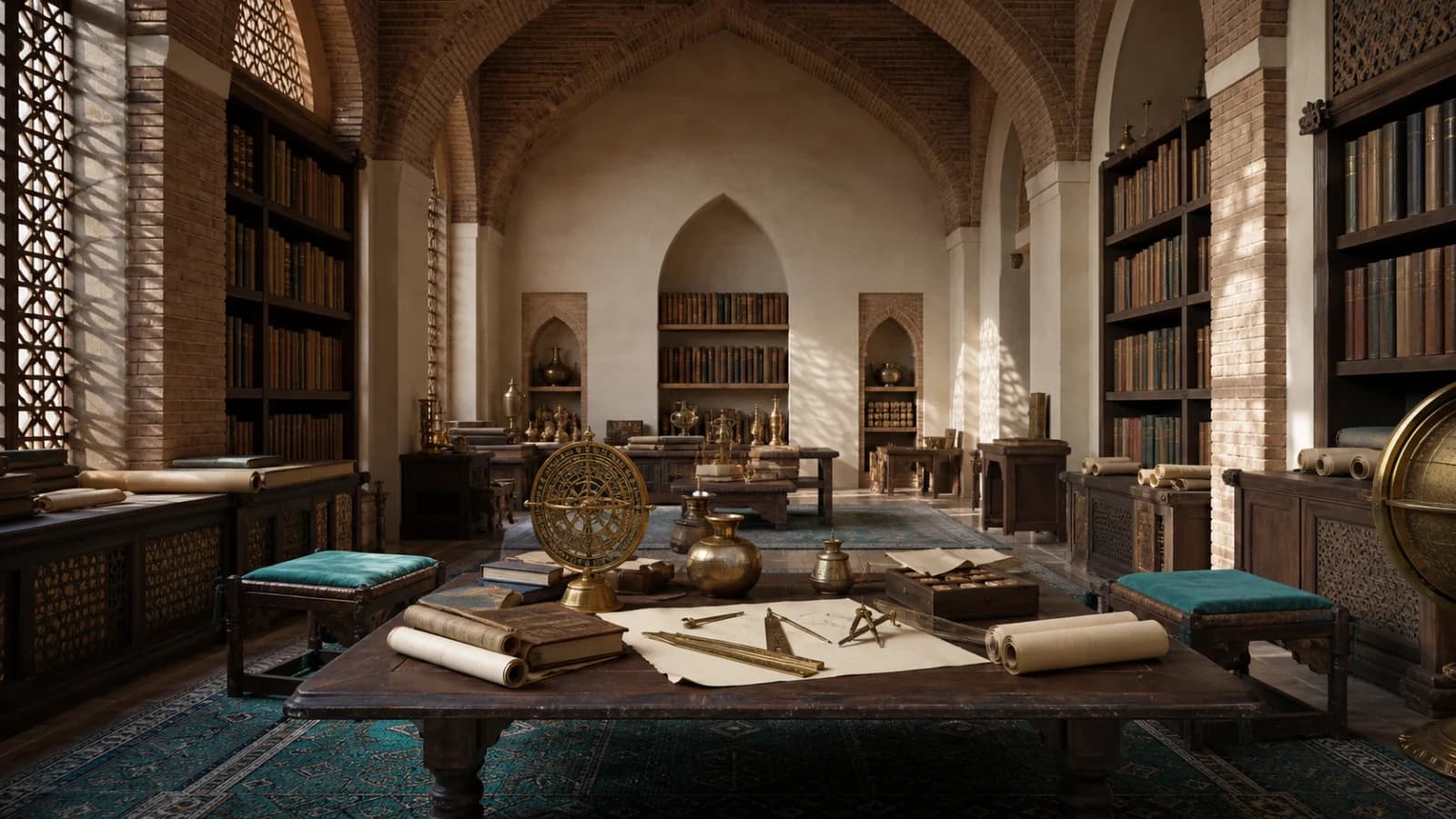
House of Wisdom in Baghdad: History, Translation Movement and the 1258 Myth
A source-aware guide to Baghdad's House of Wisdom: Bayt al-Hikma, Abbasid patronage, translators, al-Ma'mun, uncertain institutional claims, decline and the 1258 destruction story.
The House of Wisdom in Baghdad, usually rendered from Arabic as Bayt al-Hikma, was connected with Abbasid books, court scholarship and scientific work, especially under Caliph al-Ma'mun in the early ninth century. It is also one of the most mythologized institutions in Islamic history. Popular accounts often describe a single public university, translation factory and world library founded on an exact date and operating continuously until Mongol troops destroyed it in 1258. The evidence supports a more careful and more interesting story: a court library or collection within a much larger multilingual network whose exact structure, name and lifespan remain debated.
Quick answer: what was the House of Wisdom?
- Arabic name: Bayt al-Hikma, with related expressions such as Khizanat al-Hikma appearing in historical discussion.
- Best-supported setting: Abbasid Baghdad, with particular prominence under al-Ma'mun, who ruled from 813 to 833.
- Likely functions: collecting and copying books, court scholarship, astronomy, geography and some translation-related work.
- What it was not proven to be: one modern centralized university employing every famous Abbasid translator and scientist.
- Important distinction: Baghdad's translation movement was larger than Bayt al-Hikma and continued through dispersed patrons, workshops and scholarly families.
Who founded Bayt al-Hikma?
Different modern accounts credit al-Mansur, Harun al-Rashid or al-Ma'mun. These answers often combine several stages: al-Mansur founded Baghdad in 762 and sponsored learned work; traditions associate Harun's court with book collections; and the clearest account in the Cambridge synthesis places a translation and research program around al-Ma'mun's library called Bayt al-Hikma. A responsible answer therefore avoids a ceremonial founding date. It says that Abbasid court collections and patronage developed over time and that Bayt al-Hikma is most securely linked to al-Ma'mun's early ninth-century program.
Why the institution is difficult to reconstruct
No surviving campus plan, employment register or complete institutional archive lets historians describe Bayt al-Hikma like a present-day university. Short references use terms that can mean a library, treasury of books or house of knowledge. Later retellings sometimes gather every translator, physician and mathematician in Baghdad under one roof. Recent scholarship has challenged that picture and traced how translation choices and modern cultural ambitions enlarged the institution. This does not make Abbasid scholarship imaginary; it changes the unit of analysis from one legendary building to a citywide and interregional knowledge economy.
The Arabic translation movement was larger than one building
From the eighth through tenth centuries, texts and techniques moved into Arabic from Greek, Syriac, Persian and Sanskrit traditions. Translators, editors, physicians, astronomers, scribes, booksellers, court officials and private patrons all participated. Christian scholarly families, Muslims, people linked to Harran and scholars from Iranian and Central Asian backgrounds worked within overlapping networks. Translation was not passive storage: terminology had to be created, variant manuscripts compared and difficult arguments explained. Scholars then criticized, reorganized and extended inherited material.
Paper and a growing book market helped this work circulate. The British Museum's Silk Roads guide places Baghdad inside routes connecting Central Asia, Iran, the Mediterranean and the Indian Ocean. The Met likewise stresses that Baghdad was a major center but not the only one: Cairo, Rayy, Isfahan and other courts supported astronomy and related sciences. Calling the whole process the work of the House of Wisdom hides the mobility that made it possible.
What kinds of work are securely connected?
Al-Khwarizmi provides a concrete anchor. His work in mathematics, astronomy and geography belongs to the courtly Baghdad environment of al-Ma'mun, and later sources connect him with Bayt al-Hikma. Astronomical observations and geographic measurement also fit al-Ma'mun's research interests. Yet even here, association does not prove that every surviving page was translated or written inside a specific room. The strongest history begins with named works and people, then describes the institution at the level the sources allow.
Was it the world's first university?
That label is an analogy, not a secure institutional classification. A modern university normally has durable corporate organization, defined admission and teaching structures, credentials and an archive of governance. Bayt al-Hikma may have supported study, research, books and court experts, but the surviving evidence does not establish those modern features. The comparison can help a reader imagine concentrated learning, yet it becomes misleading when presented as a legal ranking of the world's first university.
Did the House of Wisdom survive unchanged until 1258?
The New Cambridge History of Islam says Bayt al-Hikma declined into obscurity around the 850s, after the court's theological and political direction changed. The intellectual consequences of earlier translation became especially visible in the tenth and eleventh centuries, when Baghdad was no longer the only political center and many leading scholars worked elsewhere. This chronology directly challenges the simple image of one institution operating at full scale for four centuries until a single day of destruction.
What happened in 1258?
Mongol forces under Hulegu captured and devastated Baghdad in 1258. People, buildings, books and collections were lost, and the Abbasid ruling court in Baghdad ended. The familiar image of books turning the Tigris black is powerful historical memory, but it is not a measured inventory of every library. More importantly, the sparse evidence for Bayt al-Hikma does not justify treating it as one unchanged institution awaiting destruction. The conquest was a catastrophe without being the instant end of mathematics, medicine or scholarship across every Muslim society.
A compact chronology
- 762: al-Mansur founds Baghdad as an Abbasid imperial capital.
- Late eighth century: court collections, paper use and book culture expand through several forms of patronage.
- 813-833: al-Ma'mun sponsors translation, astronomy and scientific work around his Baghdad library.
- c. 820-830: al-Khwarizmi produces major mathematical, astronomical and geographic works in this environment.
- Mid-ninth century: Bayt al-Hikma fades from prominence in the historical record.
- Tenth-eleventh centuries: intellectual work flourishes in Baghdad and many other centers.
- 1258: Baghdad is conquered and devastated by Mongol forces.
How to research the House of Wisdom
Separate three questions. First, what do medieval sources actually call Bayt al-Hikma? Second, how did the wider translation movement operate through patrons, languages and mobile experts? Third, how did nineteenth-, twentieth- and twenty-first-century writers turn the institution into a civilizational symbol? Use manuscript catalogs and named works for concrete claims, academic histories for institutional reconstruction and museum pages for public interpretation. Whenever a source says 'first', 'largest' or 'destroyed completely', ask what contemporary record supports the superlative.
Related research guides
- Islamic Golden Age history timeline: Follow translation, mathematics, medicine and institutions without treating a modern period label as one uniform civilization.
- Al-Khwarizmi, algebra and algorithms: Trace surviving works, uncertain biography, mathematical method and the distinct routes of the words algebra and algorithm.
- Bimaristan and medieval Islamic hospitals: Understand hospitals as changing institutions of care, charity and medical practice rather than identical copies of a modern medical center.
- Islamic history timeline: Place intellectual history inside a wider political and regional chronology.
- Fall of Baghdad in 1258: Distinguish the Mongol destruction of Baghdad from claims that all Islamic scholarship ended in one event.
- Islamic world map: Locate Baghdad, Cairo, Damascus, Khwarazm and other centers without projecting fixed modern borders backward.
- AI prompts for Islamic history research: Test dates, institutional labels, manuscripts and invention claims before repeating them.
Sources
- The New Cambridge History of Islam: introduction excerpt: Used for al-Ma'mun's Baghdad library and research program, the Bayt al-Hikma's decline into obscurity around the mid-ninth century, and later intellectual flourishing beyond that institution.
- Routledge: The Abbasid House of Wisdom - Between Myth and Reality: Used for modern historiographical reassessment of mistranslations, institutional myths and claims built from limited Arabic evidence.
- KAUST Museum of Science and Technology in Islam: House of Wisdom: Used as an institutional account of Abbasid patronage, books, paper, translation and the modern public memory of Bayt al-Hikma.
- Isis: Mobilities of Science - The Era of Translation into Arabic: Used for the scale and social geography of the Abbasid translation movement rather than reducing it to one building.
- British Museum: Silk Roads large print guide: Used for Baghdad's multicultural scholarly environment, paper, translated works and al-Khwarizmi in the wider movement of knowledge.
- The Metropolitan Museum of Art: Astronomy and astrology in the medieval Islamic world: Used for Abbasid patronage in Baghdad and the simultaneous importance of Cairo, Rayy, Isfahan and other centers.
- Library of Congress: The Compendious Book on Calculation by Completion and Balancing: Used for al-Khwarizmi's work under al-Ma'mun and his association with Baghdad's House of Wisdom tradition.
- The Cambridge World History: Baghdad, an Imperial Foundation: Used for Baghdad's 762 foundation, imperial urban role and long history before the Mongol conquest.
- Cambridge Core: The Mongol conquest of Baghdad in 1258: Used to separate the documented thirteenth-century destruction of Baghdad from the much earlier decline of Bayt al-Hikma as a named institution.


