Resource
Islamic Golden Age Timeline: Key Figures and Discoveries
An 8th–13th century timeline of key scholars, discoveries, manuscripts and institutions across Baghdad and beyond, including what changed after 1258.
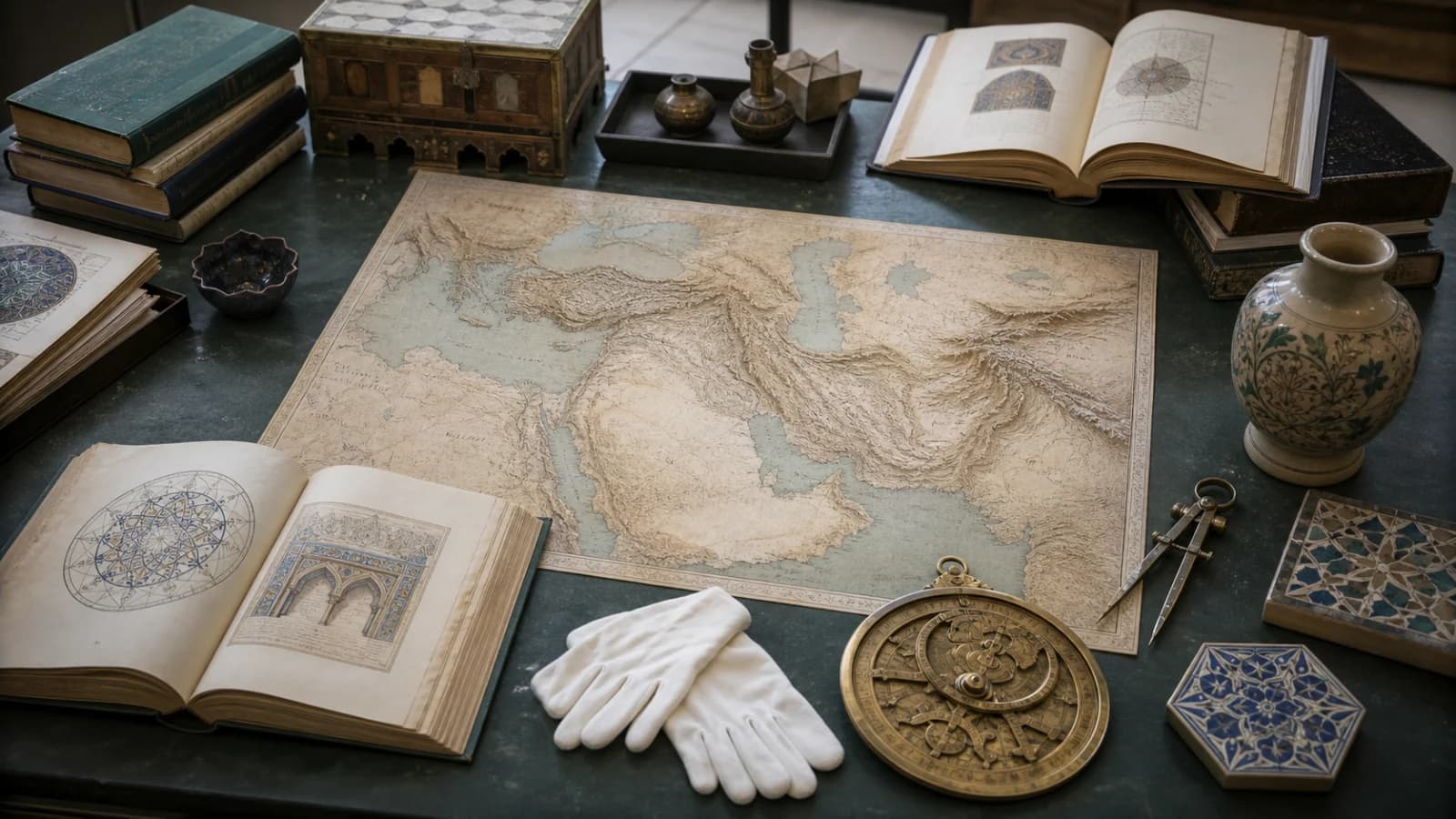
Core coverage
c. 750-1300 CE
Timeline anchors
28 selected events
Method
Chronology plus source and claim limits
Last reviewed
31 August 2026
The Islamic Golden Age is a useful search term for periods of major intellectual, artistic and economic activity in societies shaped by Islam, especially from the eighth through thirteenth centuries. It is not a name medieval scholars used for one fixed era, and its dates vary by subject and region. Baghdad was a major early center, but work also flourished in Khwarazm, Bukhara, Rayy, Isfahan, Cairo, Damascus, Cordoba, Palermo and many other places.
This timeline follows translation, books, mathematics, astronomy, geography, medicine and hospitals. It treats Arabic as a major scholarly language without assuming every Arabic-writing scholar was Arab or Muslim. Persian, Central Asian, Syriac Christian, Jewish, Sabian, Greek, Indian, North African and Andalusi people and traditions participated in different ways. Court patronage mattered alongside merchants, families, religious institutions, endowments, workshops and mobile scholars.
The three linked guides answer high-intent questions with clear evidence boundaries: what Baghdad's House of Wisdom probably was, what al-Khwarizmi actually contributed to algebra and arithmetic, and how bimaristans functioned as changing medical and charitable institutions. The goal is neither a triumphalist list of inventions nor a decline story ending all knowledge in 1258, but a chronology of texts, institutions, people and transmission.
What period does the Islamic Golden Age cover?
The Islamic Golden Age usually refers to major intellectual and cultural activity from roughly the eighth through thirteenth centuries, but it has no universally agreed start or end date. Political history, mathematics, medicine, book production and institutional history follow different timelines. This resource uses c. 750–1300 as a practical frame while showing earlier foundations and later continuities. The label is modern: medieval scholars did not experience one uniform era called a Golden Age, and no single event ended every scholarly network at once.
- c. 750–850: Abbasid state formation, Baghdad, paper and translation patronage.
- c. 850–1000: expanding book culture, mathematics, medicine and distributed scholarly centers.
- c. 1000–1200: influential work across Central Asia, Iran, Egypt, Syria, al-Andalus and Sicily.
- c. 1200–1300: institutional and intellectual change before and after the Mongol conquest of Baghdad.
Baghdad, translation and the limits of the House of Wisdom
Baghdad became an Abbasid capital in 762 and an important center of administration, books, translation and court-supported research. Greek, Syriac, Persian and Sanskrit materials entered Arabic through multilingual networks of patrons, physicians, translators, scribes and families. Bayt al-Hikma was connected with court books and research, especially under al-Ma'mun, but the evidence does not support treating it as one modern university that directed the entire translation movement or operated unchanged until 1258. Translation took place across a much wider social and geographic system.
Mathematics: al-Khwarizmi, algebra and calculation
Al-Khwarizmi worked in the Abbasid scholarly environment of ninth-century Baghdad. His algebra treatise organized verbal methods for linear and quadratic problems, while other works helped transmit arithmetic using Indian numerals, astronomical tables and geographic coordinates. The English words algebra and algorithm have distinct routes through his writings and Latin transmission. Calling him a foundational figure is justified; saying that he invented zero, every algebraic technique or the modern computer algorithm is not. The timeline links claims to surviving works, manuscript catalogs and later transmission rather than to invention slogans.
Astronomy, geography and instruments
Astronomical work combined inherited tables, new observations, mathematical models and instrument making. Abbasid patronage mattered, but important activity also took place in Rayy, Isfahan, Cairo, Maragha, Samarqand, al-Andalus and Sicily. Scholars revised coordinates, calculated calendars, studied planetary motion and produced geographic works for courts, travel and administration. An object, table or map should be dated to its actual manuscript or material witness; a modern composite image cannot automatically stand in for a lost medieval original.
Medicine, manuscripts and bimaristans
Arabic and Persian medical writing translated, criticized and reorganized Greek, Syriac and other traditions while adding clinical, pharmacological and institutional knowledge. Urban bimaristans linked charitable funding, treatment, medicines, paid staff and, in some settings, teaching. They varied by city and century and should not be described as identical copies of a modern hospital. Sources also differ: foundation documents describe intended rules, medical biographies emphasize physicians, manuscripts preserve learned texts and later accounts may project idealized practices backward.
Optics, observation and Ibn al-Haytham
Ibn al-Haytham's work on vision and light is a central example of mathematical reasoning joined to controlled observation. His writings belong to a longer history of Greek, Arabic and later Latin optics, not to a simple story in which one person invented the scientific method. The useful question is narrower: what problem did a specific text address, what demonstrations or experiments did it describe, and how did later readers transmit or revise it? That method produces a stronger historical answer than assigning modern disciplinary titles retroactively.
A multilingual and multi-religious scholarly network
Arabic became a major scholarly language, but Arabic-writing scholars were not all Arab or Muslim. Persian, Central Asian, Syriac Christian, Jewish, Sabian, Greek, Indian, North African and Andalusi participants contributed in different roles. Translation was selective and argumentative: scholars compared manuscripts, created technical vocabulary, corrected earlier results and extended inherited methods. Court patronage operated alongside merchants, private libraries, religious institutions, endowments, workshops, hospitals and mobile families of translators or physicians.
Centers beyond Baghdad
Baghdad was crucial, especially in the early Abbasid period, but it never contained the whole intellectual history represented by the term Islamic Golden Age. Bukhara, Khwarazm, Rayy, Isfahan, Cairo, Damascus, Cordoba, Palermo and other centers supported different combinations of books, astronomy, medicine, philosophy and education. Political fragmentation could damage institutions, but it could also multiply courts and patrons. A geographic timeline therefore avoids turning one capital's rise or fall into a universal measure of knowledge across three continents.
What changed after the fall of Baghdad in 1258?
The Mongol conquest devastated Baghdad, killed many residents and ended the Abbasid ruling court there. It was a major political and urban rupture, not a synchronized end to scholarship everywhere. Learning and institutions continued in Cairo, Damascus, Iran, Anatolia, Central Asia, India and the western Islamic world, while Baghdad itself later recovered parts of its scholarly life. The historical task is to identify which people, collections and institutions were destroyed, displaced, rebuilt or transformed instead of using 1258 as a universal stop date.
How to check invention, decline and 'first' claims
Start with the exact person, work, object or institution behind a claim. Then separate the date of composition from the date of the surviving copy, and distinguish a contemporary source from a later biography or modern popular summary. Words such as invented, first, university, hospital and scientific method require defined criteria. Likewise, decline must name a field, region and time span. This source-checking approach preserves real achievements while preventing civilizational scorekeeping and viral claims from replacing evidence.
- Identify the named text, manuscript, object or institution.
- Record the source date, geographic scope and level of uncertainty.
- Separate translation, criticism, synthesis and original extension.
- Check whether a superlative depends on a modern definition.
- Treat 1258 as a major rupture with regional limits, not an automatic universal endpoint.
Abbasid foundations, Baghdad and translation, c. 750-850
Court histories, manuscripts and material evidence document Baghdad's rise without reducing translation to one building.
| Date | Event | Why it matters | Evidence label |
|---|---|---|---|
| 750 | Abbasid rule begins | New political networks and eastward-facing court connections reshape patronage across the caliphate. | Dynastic chronicles, documents and modern political history |
| 762 | Baghdad is founded as an Abbasid capital | The new imperial city becomes a major center of administration, trade, books and scholarship. | Urban chronicles, archaeology and Cambridge historical synthesis |
| c. 770 | Indian astronomical materials reach the Abbasid court | Sanskrit-derived astronomy contributes to new Arabic tables and calculation traditions. | Later bibliographic reports and surviving revised astronomical traditions |
| Late 8th century | Paper and book production expand around Baghdad | Cheaper writing material supports administration, copying, markets and scholarly circulation. | Material history, book history and Silk Roads synthesis |
| 786-809 | Harun al-Rashid's reign supports court learning | Later traditions connect his court with book collections, physicians and scholarly patronage. | Court chronicles, later library traditions and modern reassessment |
| c. 800-830 | Translation into Arabic accelerates | Greek, Syriac, Persian and Sanskrit works move through multilingual patronage and expert networks. | Translated texts, bibliographies, manuscript study and social history |
| 813-833 | Al-Ma'mun sponsors translation and scientific research | His Baghdad program links Bayt al-Hikma, astronomy, geography and court debate. | Arabic historical references and Cambridge synthesis |
| c. 820-830 | Al-Khwarizmi writes his algebra treatise | General verbal methods for linear and quadratic problems help establish algebra as a teachable field. | Surviving Arabic manuscript tradition and later translations |
Distributed scholarship and medical institutions, c. 850-1000
The named Bayt al-Hikma fades while books, medicine and scholarship continue through wider networks.
| Date | Event | Why it matters | Evidence label |
|---|---|---|---|
| c. 830 | Al-Khwarizmi develops arithmetic, astronomy and geography | His wider corpus connects Indian numerals, astronomical tables and coordinate-based mapping. | Arabic and Latin textual witnesses, catalogs and scholarly reconstruction |
| c. 830s | Al-Ma'mun's astronomical observations and measurements | Court-supported observation tests inherited astronomical and geographic knowledge. | Later scientific reports, tables and history of astronomy |
| c. 850s | Bayt al-Hikma declines into obscurity | The named institution fades while translation and intellectual work continue through other networks. | New Cambridge History of Islam synthesis |
| Mid-9th century | Hunayn ibn Ishaq and colleagues translate medical works | Greek and Syriac medical texts are compared, revised and rendered into influential Arabic terminology. | Translation colophons, bibliographies, manuscripts and medical history |
| 9th century | Major bimaristan patronage develops in Baghdad | Urban hospitals connect physicians, treatment, charity and court or elite funding. | Medical biographies and later institutional history; exact origins debated |
| 872-873 | Ibn Tulun bimaristan is founded in Fustat | A clearer named Egyptian hospital becomes an important reference in histories of organized care. | Historical descriptions and institutional reconstruction |
| c. 865-925 | Al-Razi writes and practices medicine | Clinical observation, compilation and hospital-linked biography shape later Arabic and Latin medicine. | Attributed works, manuscript traditions and medical biographies |
| c. 950-1050 | Intellectual activity flourishes across multiple centers | Ibn Sina, al-Biruni, Ibn al-Haytham and others work beyond a single Baghdad institution or unified state. | New Cambridge History of Islam and surviving works |
Regional expansion of science and learning, c. 1000-1200
Political fragmentation and multiple courts expand the geography of patronage and institutions.
| Date | Event | Why it matters | Evidence label |
|---|---|---|---|
| 965-1040 | Ibn al-Haytham advances optics and mathematical inquiry | Work associated with Basra and Cairo illustrates scientific activity beyond Abbasid court geography. | Surviving optical works, biographies and UNESCO synthesis |
| c. 1000 | Paper, libraries and scholars connect regional courts | Political fragmentation can multiply patronage rather than produce one synchronized intellectual decline. | Manuscripts, library history, court records and book circulation |
| c. 1025 | Ibn Sina completes the Canon of Medicine | The synthesis becomes influential in Islamic lands and later Latin medical education. | Manuscripts, Latin editions and National Library of Medicine history |
| 1065-1067 | Nizamiyya teaching institution opens in Baghdad | A later form of endowed education shows that Baghdad learning did not depend on Bayt al-Hikma alone. | Institutional chronicles and history of madrasa patronage |
| 1154 | Al-Idrisi completes a major geography in Sicily | Arabic geographic knowledge develops through Mediterranean court patronage far from Baghdad. | Surviving geographic text, maps and court history |
| 1154 | Nuri bimaristan is founded in Damascus | The monumental hospital links urban charity, medicine, architecture and political patronage. | Building fabric, endowment history and Cambridge institutional study |
| 12th century | Arabic mathematics and medicine circulate in Latin | Works linked to al-Khwarizmi, Ibn Sina and others enter changing European manuscript traditions. | Surviving Latin translations, catalogs and textual comparison |
Continuity and change across 1258, c. 1200-1300
The conquest of Baghdad is a major rupture, not a universal end point for science, medicine or education.
| Date | Event | Why it matters | Evidence label |
|---|---|---|---|
| 1206 | Al-Jazari completes his book of mechanical devices | Artuqid court engineering demonstrates technological work beyond conventional Golden Age end dates. | Surviving illustrated manuscript tradition and object history |
| 1224 | Illustrated Arabic Dioscorides manuscript is produced | A Baghdad or northern Jazira manuscript shows continued translation-based medicine and book art. | Dated manuscript folios and Metropolitan Museum cataloging |
| 1233 | Mustansiriya institution opens in Baghdad | Endowed teaching and urban scholarship remain active shortly before the Mongol conquest. | Architecture, inscriptions and institutional histories |
| 1258 | Mongol forces capture and devastate Baghdad | The Abbasid ruling court ends in Baghdad, but knowledge production continues across many regions. | Multiple chronicles, literary memory and modern source criticism |
| 1284 | Mansuri bimaristan is founded in Cairo | A major Mamluk hospital shows institutional development after 1258 and outside Baghdad. | Endowment evidence, architecture and Cambridge hospital history |
FAQ
When was the Islamic Golden Age?
Many summaries use roughly the eighth through thirteenth centuries, but historians choose different boundaries by region and field. Important scholarship continued well after 1258, while political fragmentation began much earlier.
Was the Golden Age only in Baghdad?
No. Baghdad was a major Abbasid center, especially for early translation and court science, but scholars and institutions flourished across Central Asia, Iran, Egypt, Syria, North Africa, al-Andalus, Sicily and beyond.
Was every scholar Muslim and Arab?
No. Arabic intellectual culture included Muslims of many backgrounds as well as Christian, Jewish, Sabian and other scholars. Persian, Syriac, Greek, Indian and additional traditions shaped the work.
Did the House of Wisdom create the translation movement?
It was connected with Abbasid books and research, especially under al-Ma'mun, but translation involved a much wider network of patrons, families, scribes, physicians and workshops across Baghdad and other cities.
Did Islamic scholarship end when Baghdad fell in 1258?
No. The conquest devastated Baghdad and ended its Abbasid ruling court, but scholarship and institutions continued in many places, including Cairo, Damascus, Iran, Anatolia, Central Asia, India and the western Islamic world.
What sources are best for this history?
Combine cataloged manuscripts, contemporary or near-contemporary texts, institutional and endowment records, surviving objects and buildings, and modern histories that identify uncertainty and later mythmaking.
Related reading
- House of Wisdom in Baghdad: History, Translation Movement and the 1258 Myth
Distinguish the documented Abbasid library and court research program from Baghdad's much wider translation economy, explain uncertain founding labels and the mid-ninth-century decline in references, and keep the 1258 conquest separate from later legend.
- Al-Khwarizmi: Algebra, Algorithms, Biography, Works and Legacy
Give a manuscript-aware biography, explain rhetorical algebra and practical applications, distinguish the word origins of algebra and algorithm, and credit Indian, Greek and later Arabic-Latin transmission without reducing the history to one inventor slogan.
- Bimaristan: History of Hospitals in the Medieval Islamic World
Explain varied bimaristans through urban history, charity, waqf, medicine and patient experience; compare earlier institutions and later examples; and reject universal claims about free care, licensing, music therapy or direct modern-hospital descent when evidence varies.
- Islamic history timeline
Place intellectual history inside a wider chronology with multiple political and regional centers.
- Islamic world map
Use geography alongside chronology.
- Fall of Baghdad in 1258
Separate the destruction of a city and ruling court from claims that all scholarship ended at once.
- Ibn al-Haytham: Optics, Camera Obscura, Scientific Method and Biography
Explain what survives in Ibn al-Haytham's works, distinguish secure optical contributions from later biography, and replace single-inventor slogans with a source-aware account of experiment, mathematics and transmission.
- Ibn Sina (Avicenna): Canon of Medicine, Biography, Contributions and Legacy
Map the Canon's five books, manuscript and translation history, Ibn Sina's wider philosophy and the medieval limits of his medicine without turning historical authority into clinical advice.
- Al-Biruni: Earth Radius, India, Astronomy, Biography and Methods
Explain the geometry behind his horizon-dip method, qualify the famous numerical result, place the India study in its political and linguistic context, and separate evidence from modern hero stories.
- Al-Zahrawi: Al-Tasrif, Surgery, Instruments, Biography and Legacy
Explain the surviving text and manuscript evidence, distinguish illustrations from invention claims, place al-Zahrawi in Cordoba and earlier medical traditions, and keep medieval procedures separate from current medical advice.
- Ibn al-Nafis: Pulmonary Circulation, Biography and Canon Commentary
Describe the surviving anatomical argument in medieval terms, distinguish pulmonary transit from a complete modern circulation model, explain the Canon commentaries and avoid unsupported claims of direct European copying.
- Jabir ibn Hayyan: Alchemy, Chemistry, the Jabirian Corpus and Biography
Separate biography from attributed corpus, explain medieval alchemy and laboratory operations without anachronism, distinguish Arabic and Latin textual traditions, and correct viral invention lists.
- Abbasid Revolution, 747-750: Causes, Timeline, Battle of the Zab and Aftermath
Explain the coalition and source problems, trace the 747-750 sequence, distinguish the Battle of the Zab from the whole revolution, and show both political change and continuity without sectarian or ethnic slogans.
- Founding of Baghdad in 762: The Round City, al-Mansur, Plan and Legacy
Explain al-Mansur's imperial foundation, distinguish Madinat al-Salam from the expanding metropolis, describe the textual evidence and four-gate plan, and avoid treating reconstructions as surviving archaeology.
- Battle of Talas, 751: Tang-Abbasid Conflict, Significance and the Paper Myth
Reconstruct the encounter with uncertain numbers and location, place Tang withdrawal in wider context, and separate a later captive-papermaker story from evidence that paper already circulated in Central Asia before 751.
- History of Astronomy in the Islamic World: Observatories, Instruments and Star Tables
Open a source-aware timeline of observatories, instruments and star tables, with detailed guides to Maragha, Samarkand and Istanbul.
- History of Islamic Education: Mosques, Madrasas and Universities Timeline
Open a source-aware timeline of mosque circles, kuttab schools, waqf-funded madrasas and modern university reforms, with detailed guides to Qarawiyyin, Al-Azhar and the Nizamiyya.
- Muslim travelers and geographers timeline
Follow how travel writing, route books, astronomy and geographic knowledge moved between scholarly centers.
- House of Wisdom in Baghdad: History, Translation Movement and the 1258 Myth
A source-aware guide to Baghdad's House of Wisdom: Bayt al-Hikma, Abbasid patronage, translators, al-Ma'mun, uncertain institutional claims, decline and the 1258 destruction story.
Connected by House of Wisdom.
- What al-Khwarizmi Actually Contributed to Algebra and Algorithms
A manuscript-aware account of al-Khwarizmi’s verbal algebra, six equation types, Indian arithmetic, astronomy, geography, Latin transmission and invention myths.
Connected by al-Khwarizmi.
- Why Arabic Numerals Began in India and Reached Europe Through Arabic Scholarship
Trace the Indian place-value system and zero through Arabic scholarship, al-Khwarizmi's arithmetic, early European evidence and Fibonacci, with the limits of each source clear.
Connected by al-Khwarizmi.
Sources
- The New Cambridge History of Islam: introduction excerpt
Bayt al-Hikma, al-Ma'mun, paper and the broader chronology of tenth- and eleventh-century intellectual culture.
- Routledge: The Abbasid House of Wisdom - Between Myth and Reality
Historiographical reassessment of institutional claims and later misconceptions.
- Isis: Mobilities of Science - The Era of Translation into Arabic
The Abbasid translation movement as a large, mobile and socially distributed process.
- British Museum: Silk Roads large print guide
Baghdad, paper, multilingual transmission, al-Khwarizmi and diverse court networks.
- UNESCO: Science and Technology in Islam, Volume IV Part I
Institutional overview of mathematics, astronomy, physics and natural sciences in Islamic history.
- UNESCO History of Civilizations of Central Asia: The achievements
Mathematics, astronomy, medicine, philosophy and education across Central Asian and Islamicate settings.
- Library of Congress: Al-Khwarizmi's book of algebra
Cataloged manuscript evidence for al-jabr, al-Khwarizmi and Abbasid Baghdad.
- University of St Andrews MacTutor: Al-Khwarizmi
Biography, algebra, arithmetic, astronomy, geography and transmission limits.
- US National Library of Medicine: Medieval Islam and medicine
Arabic and Persian medical literature, translated traditions and later European circulation.
- Cambridge Core: The Medieval Islamic Hospital
Bimaristans, patients, charity, urban institutions and practice-oriented medicine.
- The Metropolitan Museum of Art: Medieval Islamic astronomy
Baghdad and the wider regional geography of scientific patronage and instruments.
- UNESCO Silk Roads: Exchange and medical sciences
Medical knowledge exchange among Greek, Mesopotamian, Iranian and wider Asian traditions.
Languages
- الخط الزمني للعصر الذهبي الإسلامي: بغداد والترجمة والعلوم والطب
- ইসলামের স্বর্ণযুগের সময়রেখা: বাগদাদ, অনুবাদ, বিজ্ঞান ও চিকিৎসা
- Cronologia de l'edat d'or islàmica: Bagdad, traducció, ciència i medicina
- Časová osa islámského zlatého věku: Bagdád, překlad, věda a medicína
- Tidslinje over islams guldalder: Bagdad, oversættelse, videnskab og medicin
- Zeitleiste des islamischen Goldenen Zeitalters: Bagdad, Übersetzung, Wissenschaft und Medizin
- Χρονολόγιο της ισλαμικής Χρυσής Εποχής: Βαγδάτη, μετάφραση, επιστήμη και ιατρική
- Islamic Golden Age Timeline: Key Figures and Discoveries
- Cronología de la Edad de Oro islámica: Bagdad, traducción, ciencia y medicina
- Islamin kultakauden aikajana: Bagdad, kääntäminen, tiede ja lääketiede
- Chronologie de l'âge d'or islamique : Bagdad, traduction, sciences et médecine
- Linimasa Zaman Keemasan Islam: Baghdad, penerjemahan, sains, dan kedokteran
- Cronologia dell'età d'oro islamica: Baghdad, traduzione, scienza e medicina
- イスラム黄金時代の年表:バグダード、翻訳、科学、医学
- 이슬람 황금시대 연표: 바그다드, 번역, 과학과 의학
- Garis masa Zaman Keemasan Islam: Baghdad, penterjemahan, sains dan perubatan
- Tijdlijn van de islamitische gouden eeuw: Bagdad, vertaling, wetenschap en geneeskunde
- Tidslinje for islams gullalder: Bagdad, oversettelse, vitenskap og medisin
- Oś czasu islamskiego złotego wieku: Bagdad, przekład, nauka i medycyna
- Cronologia da Idade de Ouro islâmica: Bagdade, tradução, ciência e medicina
- Хронология исламского золотого века: Багдад, переводы, наука и медицина
- Časová os islamského zlatého veku: Bagdad, preklad, veda a medicína
- Tidslinje över islams guldålder: Bagdad, översättning, vetenskap och medicin
- เส้นเวลายุคทองของอิสลาม: แบกแดด การแปล วิทยาศาสตร์ และการแพทย์
- İslam'ın Altın Çağı zaman çizelgesi: Bağdat, tercüme, bilim ve tıp
- ئىسلام ئالتۇن دەۋرى ۋاقىت جەدۋىلى: باغداد، تەرجىمە، ئىلىم ۋە تېبابەت
- Dòng thời gian Thời hoàng kim Hồi giáo: Baghdad, dịch thuật, khoa học và y học
- 伊斯兰黄金时代时间线:翻译、数学、医学与1258年之后
- 伊斯蘭黃金時代時間線:巴格達、翻譯、科學與醫學
- 伊斯蘭黃金時代時間軸:巴格達、翻譯、科學與醫學