Jabir ibn Hayyan: Alchemy, Chemistry, the Jabirian Corpus and Biography
A source-aware guide to Jabir ibn Hayyan: disputed biography, Jabirian corpus, alchemy and laboratory operations, father-of-chemistry claim, Geber, Pseudo-Geber and myths.
Quick answer: was Jabir ibn Hayyan the father of chemistry?
- The name Jabir is attached to a highly influential Arabic alchemical corpus describing materials, theories, apparatus and operations.
- The full corpus could not have been written by one eighth-century person and contains layers from later centuries.
- Medieval alchemy involved practical material work but also cosmology, astrology, medicine, transmutation and religious or esoteric ideas.
- Latin Geber texts include works by later European authors now distinguished as Pseudo-Geber.
- 'Father of chemistry' is a modern honorific, useful only when its limits are stated.
Biography: what can be said securely?
Traditional dates place Jabir around 721 to 815. Sources variously connect his birth with Tus in Khurasan or Kufa in Iraq and link him with the early Abbasids and Jafar al-Sadiq. The earliest substantial bibliographic biography is in Ibn al-Nadim's tenth-century al-Fihrist and contains legendary material. This gap does not prove that no historical Jabir existed, but it prevents a modern-style life story from being treated as certain. Dates, teachers, ethnicity, court service and the list of personal inventions all require source labels.
What is the Jabirian corpus?
The name Jabir is attached to works on alchemy, natural properties, medicine, philosophy, astrology, mathematics, magic and religious doctrine. Catalogues report thousands of titles or treatises. Paul Kraus argued that the writings could not be the work of one person, and recent Cambridge scholarship studies a Jabirian community operating in the ninth and tenth centuries. 'Corpus Jabirianum' therefore names a textual tradition. Individual treatises may still preserve older layers, but attribution must be examined work by work rather than assumed from the name on a later copy.
Alchemy, materials and laboratory operations
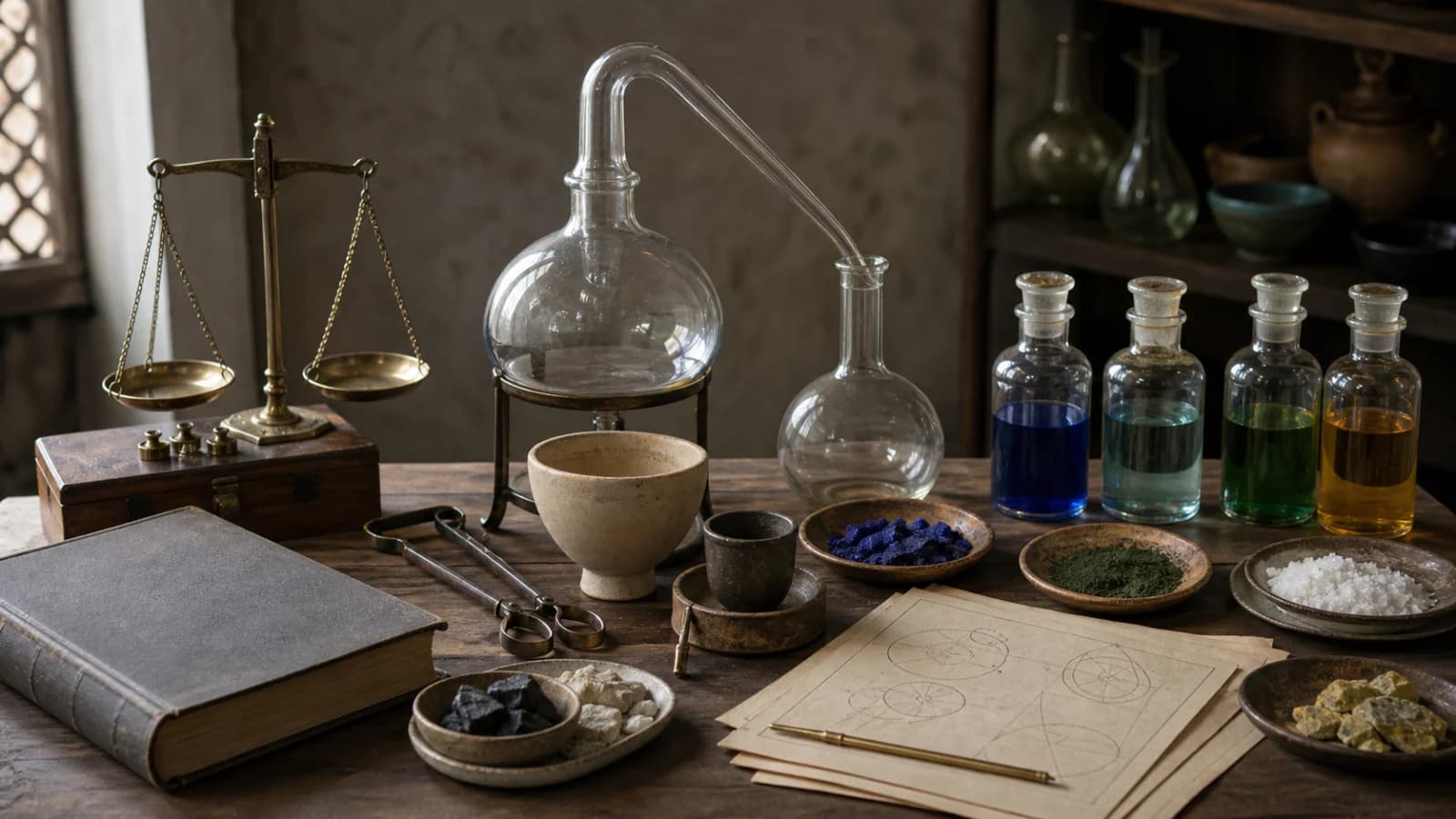
Jabirian writings describe distillation, calcination, sublimation, dissolution, crystallization and the handling of minerals, salts and other substances. Manuscripts also connect material procedures with theories of qualities, balances and the transformation of metals. Such operations contributed to durable laboratory skills, equipment and vocabularies. They were not identical to modern controlled chemistry: quantities, purity, instruments, explanatory theories and aims differed, while transmutation, medicine, astrology and esoteric meaning could share the same intellectual space.
Did Jabir invent the alembic, acids and experimental chemistry?
Online lists often assign Jabir the invention of the alembic, distillation itself, hydrochloric acid, nitric acid, sulfuric acid, aqua regia and the scientific laboratory. These claims usually combine several Arabic and Latin texts without checking dates or authorship. Distillation apparatus and practices had earlier histories. Some acid descriptions belong to later Latin Pseudo-Geber or other traditions. A responsible claim names the exact treatise, manuscript language, date, substance description and modern identification instead of treating every Geber title as an eighth-century autograph.
Jabir, Geber and Pseudo-Geber
Geber is a Latin form of Jabir, but not every Latin Geber work translates an Arabic Jabirian text. The influential Summa perfectionis and related thirteenth- and fourteenth-century Latin works are commonly assigned to Pseudo-Geber; scholarship has associated the Summa with Paul of Taranto. Other printed collections mix attributions and texts. This distinction changes the timeline of specific chemical claims by centuries. It also shows how a prestigious Arabic name became an authorizing identity within European alchemy.
What do surviving manuscripts prove?
A manuscript is evidence for a text's circulation at the time it was copied, not automatically for its original composition. Qatar Digital Library catalogs a fourteenth-century Arabic copy of Kitab al-khawass al-kabir, the Great Book of Properties, attributed to Jabir and divided into many books. The Library of Congress presents a 1935 scholarly selection edited by Kraus, while a 1531 Latin printed volume records a different stage of Geber reception. Comparing these objects prevents a late copy, modern edition and early author from collapsing into one date.
Common claims that need qualification
- 'Jabir wrote 3,000 books': thousands of titles are attributed to the name, not securely authored by one person.
- 'He invented chemistry': alchemy and chemistry have long, multi-regional histories and changing disciplinary boundaries.
- 'Geber always means Jabir': some Latin Geber works are later Pseudo-Geber compositions.
- 'Every acid in a viral list appears in his Arabic books': exact text, date and chemical identification must be demonstrated.
- 'Alchemy was only failed chemistry': it combined material practice with medical, cosmological, artisanal and esoteric goals of its own period.
How to research Jabir responsibly
Begin with a named treatise and catalog record. Record the manuscript or print date, language, editor and whether scholarship treats it as Arabic Jabirian, translated Geber or Latin Pseudo-Geber. Translate historical substance names cautiously and do not reproduce hazardous procedures as instructions. For biography, distinguish the later al-Fihrist account from claims inferred from the corpus. This approach preserves the Jabirian tradition's real importance while replacing anachronistic invention lists with evidence.
Related research guides
- Islamic Golden Age history timeline: Place medicine, surgery and alchemy inside changing networks of courts, manuscripts, hospitals and languages.
- Al-Zahrawi, al-Tasrif and surgery: Read the surgical volume, instrument illustrations and later reception without treating every object as a solitary invention.
- Ibn al-Nafis and pulmonary circulation: Distinguish his rejection of invisible septal pores and pulmonary route from a complete modern circulation model.
- Ibn al-Haytham, optics and experiment: Compare another major scholar whose modern father and inventor labels require precise definitions.
- Ibn Sina and the Canon of Medicine: Understand the Canon that Ibn al-Nafis summarized and criticized, and keep medieval medicine separate from clinical advice.
- Al-Biruni, Earth measurement and India: Compare multilingual observation and calculation with another biography shaped by modern superlatives.
- House of Wisdom in Baghdad: Keep Abbasid translation networks separate from claims that every famous scholar belonged to one institution.
- Al-Khwarizmi, algebra and algorithms: Compare manuscript evidence, uncertain biography and the routes by which Arabic works acquired Latin names.
- Bimaristan and medieval Islamic hospitals: Connect medical writing to institutions of care without projecting modern hospital systems backward.
- Islamic history timeline: Place intellectual history inside a wider political and regional chronology.
Sources
- Library of Congress: Selected Treatises by Jabir ibn Hayyan: Used for uncertain birthplace and biography, the thousands of attributed titles, Paul Kraus's edition and the corpus or school attribution problem.
- Qatar Digital Library: From alchemy to chemistry: Used for medieval al-kimiya, materials, measurement, repeatable procedures and the Great Book of Properties manuscript.
- Qatar Digital Library: The Three Books on Alchemy by Geber: Used for the later Latin printed object, operations attributed to the corpus and the warning that the complete body could not be one person's work.
- Cambridge Core: Jabir and Pseudo-Geber: Used to distinguish the Arabic Corpus Jabirianum from influential thirteenth- and fourteenth-century Latin works written under the name Geber.
- Cambridge Core: The Jabirian community and corpus: Used for recent scholarship treating the corpus as a developing community of authors in a ninth- and tenth-century Shiite intellectual setting.
- Qatar Digital Library: The Great Book of Properties manuscript: Used as catalog evidence for a fourteenth-century Arabic manuscript attributed to Jabir and its diverse material, occult and natural subjects.
- Cambridge Arabic Sciences and Philosophy: Reactive substances in Jabirian alchemy: Used for interpreting laboratory operations within the corpus's own alchemical logic rather than rewriting them as modern chemistry experiments.
- US National Library of Medicine: A note on Jabir ibn Hayyan: Used for the long-running single-author attribution debate, Kraus's corpus thesis and NLM's cataloged holdings of twenty-five different attributed treatises.


