How Bimaristans Organized Care in the Medieval Islamic World
What medieval bimaristans did, how waqf funding, physicians, pharmacies, teaching and mental-health care varied, and why they were not simply modern hospitals.
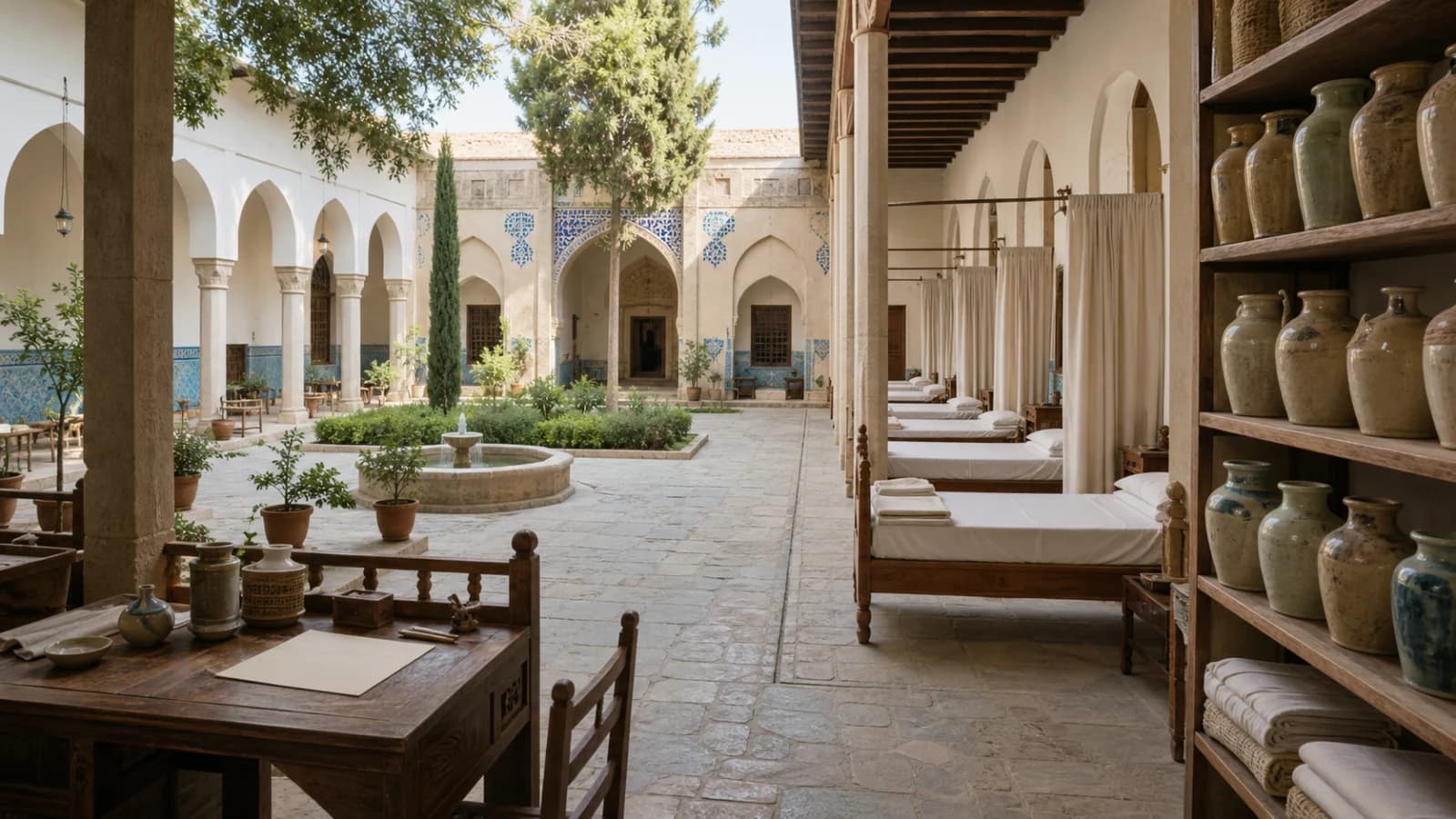
A bimaristan, also written maristan, was a hospital or place for the sick in parts of the medieval Islamic world. Major examples in Baghdad, Fustat and Cairo, Damascus and other cities provided organized settings for medical care, charity and professional practice. They were important institutions, but not identical across centuries and not simply modern hospitals transported backward in time. Claims that they were always free, universally open, fully licensed teaching hospitals or the world's first psychiatric centers must be tested against the records for a named place and date.
Quick answer: what does bimaristan mean?
- Word origin: a Persian compound commonly explained as a place of the sick.
- Common Arabic alternatives: maristan and dar al-shifa, or house of healing, in different regions and periods.
- Core function: an institution where patients could receive organized medical attention, not only lodging.
- Support: rulers, officials, wealthy patrons and charitable endowments could fund buildings, salaries, food and medicines.
- Variation: services, admission, teaching, pharmacy, mental-health provision and longevity differed substantially.
Did Muslims invent the hospital?
There was no single first hospital unless the term is defined very narrowly. Temples, military facilities, charitable houses, infirmaries and Byzantine institutions cared for sick people before the Abbasid period. Sasanian and Syriac Christian medical networks also shaped the regions absorbed into Islamic rule. Historians identify a distinctive Islamic hospital model in its urban emphasis on medical cure, physicians and organized services, but this model emerged through adaptation as well as innovation. The strongest claim is institutional development, not creation from nothing.
Early bimaristans and uncertain dates
Accounts often list a seventh-century mobile tent, an Umayyad foundation in Damascus or an early Baghdad hospital as the first. The evidence behind these claims is uneven and sometimes late. PubMed's historical review places the rise of the Islamic hospital in the larger urbanization of the first Abbasid century. By the ninth century, Baghdad supported major medical patronage, and the Ibn Tulun hospital in Fustat, usually dated 872-873, provides a clearer named institution. A timeline should label conventional dates instead of turning every origin tradition into a verified opening day.
How were hospitals funded and governed?
A ruler or elite patron could establish a hospital as an act of charity, political legitimacy and urban improvement. A waqf, or endowed property arrangement, might direct revenue toward staff, medicines, food, maintenance and patients. Surviving endowment deeds are especially valuable because they describe intended services, but they are normative documents: they tell us what a founder ordered, not automatically what happened every day for centuries. Hospitals could prosper, change function, lose revenue or be rebuilt.
What happened inside a bimaristan?
Evidence from buildings, chronicles, biographies, formularies and travel accounts points to wards, physicians, attendants, medicines, food and sometimes separate areas for different conditions or sexes. Some institutions offered outpatient attention as well as beds. Pharmacies and dispensatories helped organize compound remedies. Water, courtyards and gardens could serve practical and architectural purposes. The presence of these features in one famous foundation does not prove an identical checklist for every hospital from al-Andalus to Central Asia.
Who received care?
Cambridge's institutional history emphasizes sick and poor patients and the relationship between hospitals and charity. Some endowments describe care without direct payment, food, clothing or support after discharge. Yet universal claims require caution: admission rules, capacity, gender, legal status, social connections and the difference between an endowment's promise and routine practice are not always documented. Enslaved people, servants, travelers and the urban poor appear differently across source genres. 'Free for everyone' is therefore a claim to attribute, not a default fact.
Physicians, pharmacy and medical teaching
Hospitals created settings where physicians treated patients, consulted colleagues and could teach students. Medical biographies describe careers linked to court and hospital appointments, while formularies preserve recipes associated with dispensaries. Later institutions sometimes connected hospitals and madrasas. This resembles parts of a teaching hospital, but the analogy has limits: there was no single empire-wide curriculum, residency match or licensing board. Famous stories of examinations should be tied to a specific ruler, city and source.
Mental-health care: evidence and exaggeration
Historical evidence indicates that major hospitals included facilities for people described as mentally ill. Travel accounts and endowment material record confinement, daily oversight and treatment in institutions at Fustat, Cairo and Damascus, with probable precedents in Baghdad. This matters in the history of care. It does not justify claiming that every bimaristan practiced modern psychiatry or that music, fountains and humane therapy were universal. Confinement, restraint and social control were also part of medieval realities, and patient voices rarely survive directly.
Medical knowledge was translated and transformed
The National Library of Medicine describes an extensive Arabic and Persian medical literature built through engagement with Hippocrates, Galen and Alexandrian learning, then reorganized and expanded in new encyclopedias, commentaries and practical works. Iranian, Mesopotamian, Indian and other knowledge also moved through these networks. Religious ethics, charitable duty, court patronage and professional medicine interacted without becoming one thing. Prophetic medicine formed another literary current and should not be confused with every physician's hospital practice.
Major examples and dates
- Ninth century: major hospital patronage develops in Abbasid Baghdad, although individual founding stories vary in reliability.
- 872-873: the Ibn Tulun bimaristan is conventionally founded in Fustat, Egypt.
- 1154: Nur al-Din establishes the famous Nuri bimaristan in Damascus.
- Twelfth-fourteenth centuries: hospitals become prominent urban institutions across Egypt and the Levant.
- 1284: the Mansuri bimaristan of Qalawun is founded in Cairo with a detailed charitable and monumental setting.
- Later centuries: buildings, endowments and medical functions change; some names continue after the original service model does not.
Are bimaristans the direct ancestors of modern hospitals?
They belong in the global history of organized medical institutions and share recognizable features with later hospitals: wards, paid staff, medicines, teaching and charitable finance. Direct descent is harder to prove. Byzantine, Islamic, Latin Christian and other hospital traditions developed through contact and parallel change. Modern hospitals also arose from early modern states, religious orders, colonial systems, public health and laboratory medicine. The accurate legacy is influence and comparison across multiple lineages, not one straight family tree.
How to research a bimaristan responsibly
Start with a named institution and date. Ask whether the evidence is an endowment deed, surviving architecture, medical biography, pharmacy text, traveler description or much later local tradition. Separate the founder's intended rules from observed practice. Identify who authored patient descriptions and whose voice is absent. When using the modern words hospital, medical school or psychiatry, state which features justify the analogy. This method preserves real achievement while removing viral superlatives.
What surviving buildings can reveal
Architecture can test claims that literary descriptions leave vague. Archnet's record for the fourteenth-century Bimaristan Arghun al-Kamili in Aleppo identifies an outpatient examination area, inpatient rooms, service spaces, a pharmacy and storage near the entrance, courtyards, bathrooms, and more secluded wings. It also describes areas associated with contagious disease and mentally ill patients. This is strong evidence for the organization of that named Mamluk institution. It is not a floor plan for every earlier hospital in Baghdad, Cairo or Damascus. A surviving building answers questions about movement, separation and services better than it answers how consistently care was delivered or how patients experienced it.
Endowment rules are plans rather than daily observation
A waqf deed can identify funded posts, eligible beneficiaries, food, medicines, maintenance and the founder's desired duration. That makes it one of the best sources for institutional design. It remains a normative text. Revenue might decline, administrators could interpret rules, political authority could change and a hospital might operate at a different scale from the one promised. When an article says a bimaristan provided free treatment, it should name the institution and point to the relevant endowment or historical account. A clause in one foundation cannot establish a universal admission policy for the medieval Islamic world.
Why the patient's experience is hardest to reconstruct
Most surviving evidence was created by patrons, administrators, physicians, biographers, travelers or later historians. These sources tell us a great deal about buildings, reputations, appointments and intended charity, but much less about pain, consent, family contact, waiting, failed treatment or life after discharge. Medical case material may describe symptoms through a practitioner's categories rather than a patient's own words. Responsible history therefore separates the presence of organized care from a claim that every encounter was effective or humane. The scarcity of first-person testimony is itself part of the evidence boundary.
Related research guides
- Islamic Golden Age history timeline — Follow translation, mathematics, medicine and institutions without treating a modern period label as one uniform civilization.
- House of Wisdom in Baghdad — Separate the documented Abbasid library and court program from later claims about one university that survived unchanged until 1258.
- Al-Khwarizmi, algebra and algorithms — Trace surviving works, uncertain biography, mathematical method and the distinct routes of the words algebra and algorithm.
- Islamic history timeline — Place intellectual history inside a wider political and regional chronology.
- Fall of Baghdad in 1258 — Distinguish the Mongol destruction of Baghdad from claims that all Islamic scholarship ended in one event.
- Islamic world map — Locate Baghdad, Cairo, Damascus, Khwarazm and other centers without projecting fixed modern borders backward.
Sources
- Cambridge Core: The Medieval Islamic Hospital — Used for hospitals in Egyptian and Levantine cities, charity networks, political patronage, patients and practice-oriented medicine.
- US National Library of Medicine: Islamic Medical Manuscripts — Used for the manuscript corpus and the range of Persian and Arabic medical and scientific writing.
- US National Library of Medicine: Medieval Islam and medicine — Used for translated medical traditions, systematic Arabic medical literature and its later circulation in Europe.
- PubMed: The origins of the Islamic model of hospital — Used for the rise of cure-oriented urban bimaristans in the context of early Abbasid urbanization.
- NCBI Bookshelf: The practice of medicine through Uyun al-anba — Used for the Persian term bimaristan, physicians, hospitals and the need to distinguish later institutional ideals from earlier practice.
- The Metropolitan Museum of Art: Court and Cosmos — Used for hospitals, physicians, medical teaching and manuscript evidence in later medieval Islamic lands.
- Medical History: Insanity and its treatment in Islamic society — Used for evidence of mental-health wards in Baghdad, Fustat, Cairo and Damascus without romanticizing treatment conditions.
- UNESCO Silk Roads: Exchange and the development of medical sciences — Used for Greek, Mesopotamian, Iranian and wider Asian knowledge exchange through Baghdad and Cairo.
- Cambridge Core: The clinic in three medieval societies — Used to compare Islamic maristans with Byzantine and Latin institutions without calling every charitable facility the same kind of hospital.
- Archnet, Bimaristan Arghun al-Kamili — Used for the 1354 Aleppo building's outpatient area, inpatient rooms, pharmacy, storage, service spaces and more secluded wings without projecting that plan onto every bimaristan.
- Wellcome Collection, Islamic Science Crossroad of Cultures — Used as a catalogued exhibition source for Ibn Butlan's medical work and his reported role advising or supervising hospital foundations in Aleppo and Antioch.


