Shah Abbas I, Isfahan, New Julfa and the Safavid Silk Trade
How Shah Abbas I reshaped Safavid Iran through military and court reform, Isfahan, Meidan Emam, New Julfa, Armenian merchant networks and the silk trade.
Shah Abbas I is often called the greatest Safavid ruler because he restored territory, reorganized the state and made Isfahan an imperial capital of exceptional scale. Those achievements rested on more than architectural taste. His government reduced rival military power, redirected revenue, moved populations, cultivated Armenian merchant networks and used silk and diplomacy across Eurasia. A complete account holds monumental beauty and coercive monarchy in the same frame.
Quick facts
- Life: 1571-1629; reign: 1587-1629.
- Early challenge: internal Qizilbash competition and wars on Ottoman and Uzbek frontiers.
- Capital: transferred from Qazvin to Isfahan in 1597-1598.
- Meidan Emam: connected palace, mosques, bazaar, ceremony and urban commerce.
- New Julfa: established after the forced displacement of Armenians in 1604-1605.
- Trade: silk was a major export and royal revenue tool within wider Asian and global exchange.
How did Shah Abbas secure the throne?
Abbas became shah amid factional conflict and territorial loss. He accepted an unfavorable peace with the Ottomans in 1590, giving time to confront Uzbek pressure and consolidate the court. Over the following years he recovered lands and rebalanced political forces. The sequence matters: later victories were enabled by a temporary retreat, administrative work and control of resources, not by uninterrupted conquest from the day of accession.
What did his military and court reforms change?
The shah reduced the autonomy of major Qizilbash chiefs and expanded cavalry, infantry and artillery linked more directly to the crown. Ghulams of Caucasian origin served in military and civil offices, while crown lands increased court revenue. Historians debate how complete or novel these reforms were, but their political direction is clear: more authority and fiscal capacity moved toward the monarch. That strengthened the state while making power more personal and succession more dangerous.
Why move the capital to Isfahan?
Isfahan stood farther from the vulnerable northwestern frontier and closer to routes linking central Iran, the Persian Gulf and the interior. The move in 1597-1598 did not create an empty city. Abbas added a new royal district beside an older urban and religious landscape. Gardens, avenues, palaces, markets and waterworks turned the capital into an instrument for organizing court movement, commerce and ceremonial visibility.
What was Meidan Emam designed to do?
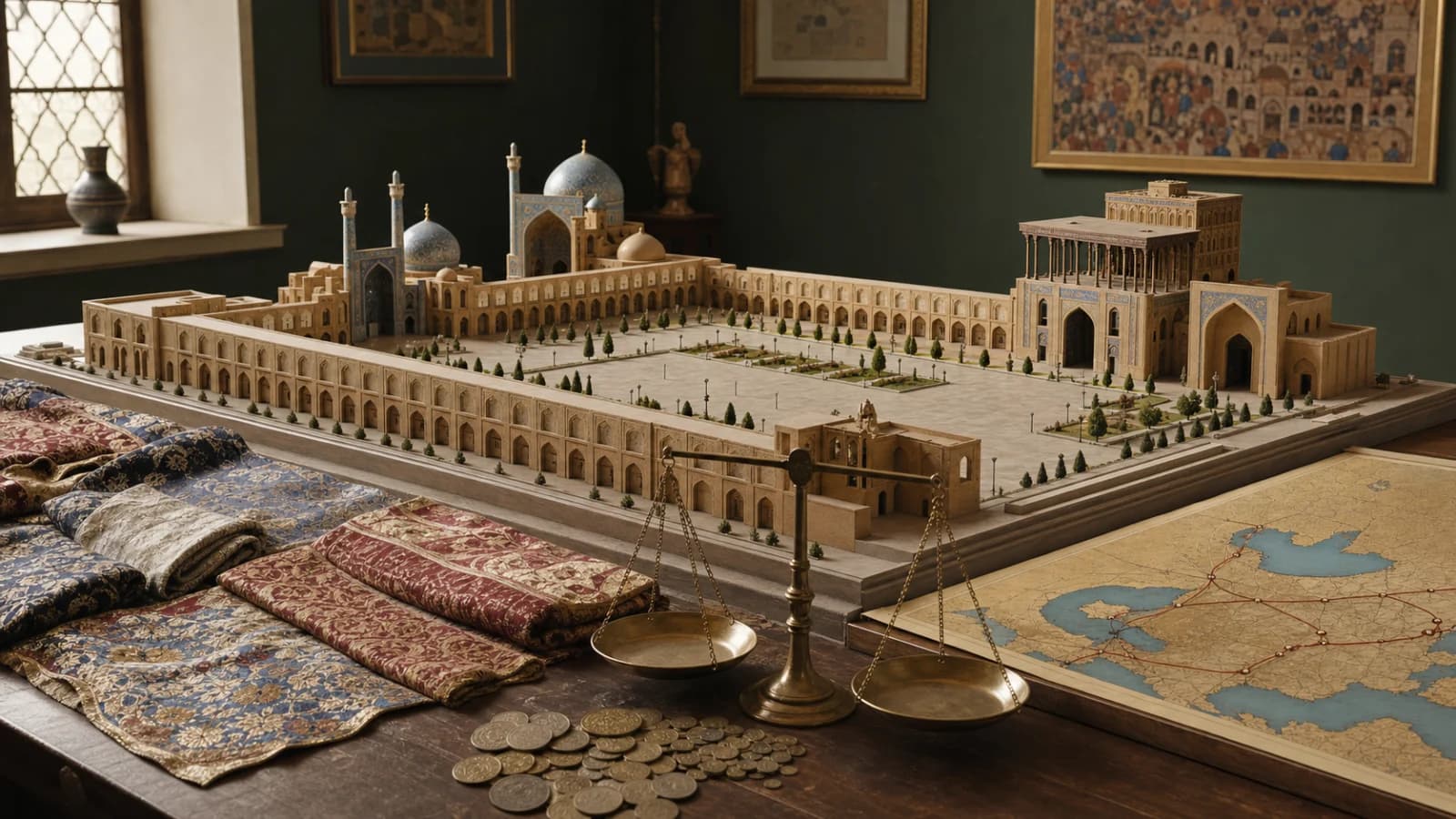
The immense square, also known as Naqsh-e Jahan, joined four major fronts: the Ali Qapu palace gateway, the Qeyssariyeh bazaar portal, the Sheikh Lotfallah Mosque and the Royal Mosque. Arcades held shops, while the open space accommodated ceremonies, polo, audiences and displays of authority. UNESCO emphasizes the ensemble's coherent plan. It was not only a beautiful backdrop; it connected government, worship, court access and market revenue.
How was New Julfa created?
During war with the Ottomans, Shah Abbas ordered populations removed from frontier districts in 1604. Armenians from Old Julfa were among those displaced south. Many rebuilt communal institutions in New Julfa across the river from Isfahan and received commercial privileges, but later success should not erase the coercion and loss that preceded it. Forced relocation and protected merchant autonomy were two parts of the same state strategy.
Why were Armenian merchant networks important?
Julfan merchants already possessed skills and contacts in long-distance trade. From New Julfa they organized partnerships extending through India, Russia, the Ottoman lands, Mediterranean ports and Europe. Their networks moved Iranian raw silk and returned silver and other goods. They were not simply agents of Europeans or passive servants of the shah; wealthy Armenian firms negotiated with courts and companies while operating within privileges and constraints established by Safavid power.
Was silk the whole Safavid economy?
Silk from Caspian regions was crucial to royal foreign exchange, and Abbas declared an export monopoly in 1619. Yet a Europe-facing export story is incomplete. Iran traded with India, Central Asia, the Ottoman world, Arabia and maritime ports, exchanging textiles, horses, spices, metals, coin and bullion. European companies entered an existing commercial system; they did not create it. State monopoly also changed over time and was abandoned after Abbas's death.
Diplomacy, Hormuz and global routes
Abbas sent and received embassies seeking alliances and commercial advantage against Ottoman and Portuguese power. In 1622 Safavid forces, aided at sea by the English East India Company, captured Hormuz from the Portuguese. The event redirected Gulf commerce but did not place trade under simple English control. Safavid officials, Armenian merchants, Indian ports, Arab communities and European companies all pursued different interests within the same routes.
Art, architecture and royal power
Mosques, palaces, gardens, carpets, ceramics, metalwork and single-page paintings flourished under court and urban patronage. Their beauty was also political. Building framed the shah's audiences, connected markets to the palace, supported religious legitimacy and advertised skilled production to visitors. Objects now dispersed through museums should be read with their original workshop, patronage and exchange histories, not only as isolated masterpieces.
The costs of centralization
The same monarchy that funded Isfahan used forced migration, frontier destruction, executions and dynastic confinement. Abbas blinded or killed potential rivals within his family, leaving a fragile succession. New military servants could check Qizilbash chiefs but remained dependent on court favor. Calling the reign a golden age can identify cultural and fiscal concentration; it should not turn subjects' losses into decorative background.
Did decline begin when Abbas died?
Later rulers faced succession constraints and changing military, fiscal and commercial pressures, but the empire did not collapse in 1629. Abbas II governed effectively in several areas, Isfahan remained important and Safavid institutions endured for nearly a century. The 1722 fall followed Afghan rebellion, siege, court weakness and regional pressures. A single great-man explanation understates both the resilience and the structural problems of the state.
Claims to qualify
- 'Shah Abbas built Isfahan from nothing': he added a new royal city to an older urban landscape.
- 'New Julfa was simply a generous gift': commercial privilege followed forced displacement.
- 'Europe created Safavid trade': Armenian and Asian networks predated and outmatched many company ambitions.
- 'Silk explains the whole economy': it was crucial, not exclusive.
- 'The empire collapsed immediately after Abbas': Safavid rule continued until the 1722 fall of Isfahan.
How to research an Isfahan claim
Name the building, neighborhood, date and patron. Distinguish UNESCO's surviving ensemble from the larger seventeenth-century city. For trade, ask who produced, transported, financed and taxed the commodity and which route is meant. For New Julfa, keep forced movement and merchant agency together. Finally, compare royal chronicles and European travel accounts with Armenian records, objects, inscriptions and urban archaeology.
Related research guides
- Safavid Empire history timeline: Trace the Safavid order, state foundation, Ottoman rivalry, religious institutions, Isfahan, trade and the fall of the capital in 1722.
- Shah Ismail I and the Battle of Chaldiran: Separate the 1501 foundation of the state from the 1514 Ottoman victory and from later stories about technology and identity.
- How Safavid Iran became Twelver Shi'i: Follow declaration, coercion, patronage, legal institutions, clerical migration and evidence that change was gradual and uneven.
- Islamic history timeline: Place Safavid Iran beside Ottoman, Mughal and wider intellectual and religious change without treating Islamic history as one empire.
- Mughal Empire history timeline: Compare two early modern Persianate empires while keeping their institutions, dynasties and religious politics distinct.
- Ottoman conquest of Constantinople in 1453: Establish the Ottoman imperial context that preceded Safavid-Ottoman rivalry and the Battle of Chaldiran.
- Akbar's religious policy and imperial theology: Compare another early modern ruler's sacred kingship and governance without treating inclusion and conversion as the same policy.
- Muslim travelers and geographers timeline: Connect Isfahan, diplomatic travel and merchant routes to the history of travel writing and geographic reconstruction.
- Islamic education institutions timeline: Place Safavid clerical networks, legal learning and endowed institutions inside a longer history of education.
Sources
- UNESCO World Heritage Centre: Meidan Emam, Esfahan: Used for the square's early seventeenth-century plan, monuments, arcades and combined political, economic, religious and social functions.
- British Museum: Shah Abbas I: Used for the 1587-1629 reign, consolidation, territorial recovery, 1598 capital transfer and 1604 resettlement of Julfa Armenians.
- British Museum: Safavid dynasty: Used for the wider dynastic chronology, Isfahan's capital status and the eventual 1722 collapse.
- Metropolitan Museum of Art: The Art of the Safavids before 1600: Used for Shah Abbas's reforms, capital project, court patronage, European trade and silk as a major export.
- Encyclopaedia Iranica: Abbas I: Used for military and political consolidation, Isfahan industries, silk monopoly, merchants and the costs of centralizing monarchy.
- Encyclopaedia Iranica: Julfa in the Safavid period: Used for forced relocation, New Julfa's institutions, Armenian merchant networks, silk trade and changing conditions under later rulers.
- Encyclopaedia Iranica: Isfahan in the Safavid period: Used for the capital's urban development, palace and bazaar setting, and the relationship between old and new Isfahan.
- Cambridge Core: The Shah's Silk for Europe's Silver: Used for Armenian commercial organization, New Julfa and the importance of silk to Safavid foreign exchange.
- Cambridge Core: Safavid Iran's search for silver and gold: Used to qualify a Europe-only silk story and place exports within wider two-way Asian and global trade.


