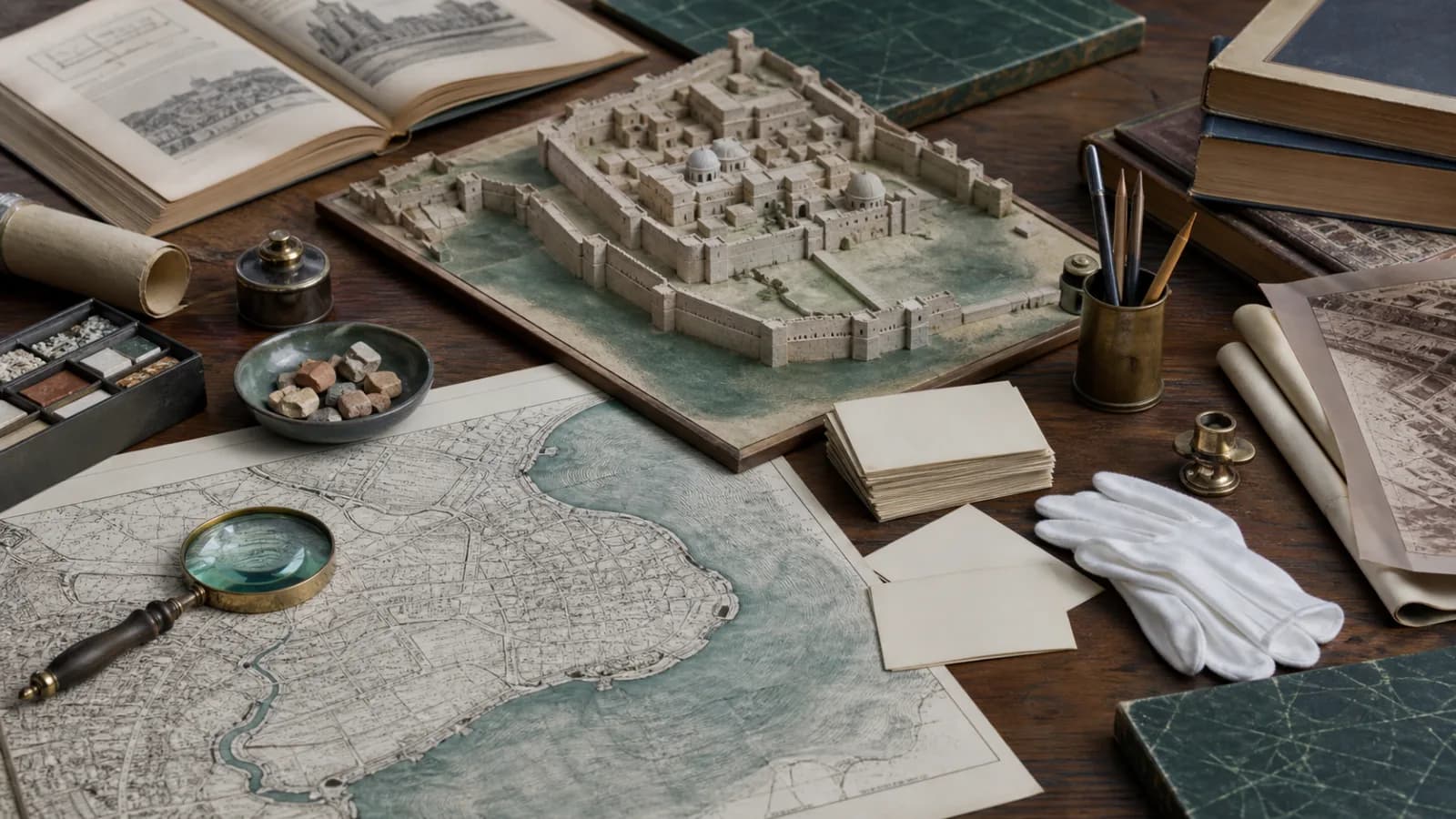
Fall of Constantinople 1453: Date, Siege Timeline, Forces and Aftermath
A source-led history of the 1453 siege: why Constantinople mattered, Mehmed II and Constantine XI, walls, cannon, ships in the Golden Horn, the final assault, casualties, rebuilding and persistent myths.
1453 siege: dates and facts at a glance
| Date or question | Evidence-based answer |
|---|---|
| Ottoman preparations | Rumeli Hisarı was built on the Bosporus in 1452 to tighten control of movement and supplies. |
| Formal siege | 6 April–29 May 1453, about 53 days. |
| Commanders | Sultan Mehmed II and Emperor Constantine XI; Giovanni Giustiniani directed much of the land-wall defense. |
| Forces | Roughly 7,000–8,500 defenders is a defensible range; Ottoman totals are disputed, with cautious modern estimates often in the tens of thousands rather than the enormous figures in some chronicles. |
| Decisive pressures | Artillery, trenches, mining, blockade, ships moved into the Golden Horn, exhaustion and repeated assaults acting together. |
| Final result | The land-wall defense broke during the pre-dawn assault on 29 May; Constantine XI died and the city was captured. |
| Immediate aftermath | Killing, enslavement, plunder and displacement were followed by Mehmed’s effort to stop disorder, claim the capital and begin reconstruction and repopulation. |
| Long-term meaning | End of the Roman imperial polity in Constantinople and creation of a new Ottoman center; not a single switch that alone ‘ended the Middle Ages’ or began the Renaissance. |
What happened on 29 May 1453?
Before dawn on 29 May, the Ottoman besiegers launched a coordinated final attack against the western land defenses of Constantinople. Successive waves tested already damaged positions around the Lycus valley and the St Romanus sector. The defenders had repaired breaches night after night for nearly eight weeks, but they were short of rested troops and had to cover walls, harbor defenses and vulnerable gates at once. When Giustiniani was seriously wounded and removed from the fighting, cohesion at a critical point deteriorated. Ottoman troops forced their way through and over the defenses; resistance continued in places, but the city could no longer be held.
Constantine XI disappeared in the fighting. Several later stories give him a final speech, a last heroic charge or a miraculous future return, but no securely identified body and no single eyewitness sequence settles his last minutes. What can be stated safely is that he did not surrender the imperial office and did not survive the capture. His death made the conquest both a military victory and the institutional end of the Roman imperial line that had ruled from Constantinople in changing forms for more than eleven centuries.
Why Constantinople still mattered in 1453
The late Byzantine Empire was territorially tiny. Its effective possessions were largely Constantinople, nearby districts and the Morea ruled by imperial relatives. Yet the capital was not an irrelevant ruin. It controlled a strategic meeting point between the Black Sea and Mediterranean and between southeastern Europe and Anatolia. Its harbor, diplomatic symbolism, fortifications, churches, relics and claim to Roman legitimacy mattered far beyond the amount of land the emperor governed directly.
The city was also weaker than its monumental past suggested. The Fourth Crusade’s capture in 1204, Latin rule until 1261, civil wars, territorial losses, fiscal weakness and the Black Death had reduced population and resources. Districts inside the walls contained gardens and open ground, while Genoese Galata across the Golden Horn possessed commercial weight of its own. This contrast—formidable walls and unmatched prestige, but a small tax base and limited army—explains both the defense’s resilience and its vulnerability.
The two rulers and the coalition around each
Mehmed II was about twenty-one and had returned to the Ottoman throne in 1451 after an earlier brief reign. Conquest promised strategic control, religious and dynastic prestige, and freedom from a Byzantine enclave that could shelter rival Ottoman claimants or invite foreign intervention. He prepared methodically: treaties reduced immediate threats, roads and bridges were readied for artillery, a fleet was assembled, and Rumeli Hisarı on the European Bosporus shore complemented Anadolu Hisarı to the east.
Constantine XI Palaiologos had become emperor in 1449. He sought aid from Latin Europe and accepted a controversial reunion of the Greek and Latin churches, but substantial relief did not arrive. The defense nevertheless crossed political and religious boundaries. Greeks fought alongside Genoese and Venetians; Giustiniani arrived with several hundred experienced men; Cardinal Isidore and other foreigners participated; crews guarded the Golden Horn. The siege was therefore not a simple encounter between two homogeneous civilizations. It involved Ottoman Christians and Muslims, Byzantine Greeks, Italian maritime communities and the calculations of neutral or divided neighbors.
How many soldiers and ships were there?
Exact figures are impossible. Chroniclers wrote for different patrons, used hearsay and often magnified an enemy army to emphasize either terror or miraculous resistance. A frequently cited defender count is just under 5,000 armed Greeks plus roughly 2,000 foreigners; other reconstructions produce totals closer to 8,000 or 8,500 when sailors and smaller contingents are included. The useful conclusion is not a false exact number but the scale problem: a few thousand effective defenders had to hold a very long perimeter.
Ottoman numbers range wildly in the sources, sometimes reaching 160,000 or more. Modern discussions commonly reduce the field army to something like 60,000–80,000, but even this remains an estimate and depends on whether irregulars, laborers, naval crews and camp followers are counted. Fleet totals likewise vary because sources mix war galleys, smaller vessels, transports and support craft. The Ottomans unquestionably enjoyed a large manpower advantage and could rotate units, dig, haul guns and renew attacks in ways the defenders could not.
The Theodosian walls were a system, not one wall
The western approach was protected by the Theodosian land-wall system, first built in the early fifth century and repeatedly repaired. An attacker faced a moat, an outer wall and a taller inner wall strengthened by towers. The layout created depth: even if troops crossed the moat or damaged an outer section, they remained exposed before the inner defenses. Along the Sea of Marmara and Golden Horn, lower sea walls were backed by currents, shore conditions and defenders’ vessels.
Gunpowder had not made these fortifications instantly obsolete. Earth, rubble, timber and wool bales could absorb impact or close a breach; defenders repaired damage after dark. Ottoman cannon inflicted cumulative structural harm and forced constant labor, but assault troops still had to cross difficult ground under missile fire and fight at barricades. The siege shows a transition in fortification warfare, not a magical moment when medieval masonry ceased to function.
Cannon mattered, but the ‘one giant gun’ story is misleading
Mehmed employed a train of bombards and smaller artillery pieces. The founder commonly called Orban or Urban produced a celebrated large bombard, while other Ottoman specialists also cast guns. Very large cannon could throw heavy stone balls and damage towers, but they were slow to move, slow to reload, difficult to cool and vulnerable to mechanical failure. Smaller pieces could maintain more useful pressure. Artillery’s main contribution was sustained: shaking masonry, opening and reopening damage, exhausting repair crews and shaping where assaults would be concentrated.
The city did not fall the first time the great bombard fired. Defenders survived weeks of cannonade, repelled attacks and repeatedly rebuilt obstacles. Nor was artillery uniquely ‘European technology hired by Asia’: expertise, metal, gunners and military ideas circulated across frontiers. Mehmed’s achievement lay in financing and integrating weapons into a combined siege plan with labor, infantry, trenches, mines and naval operations.
The Golden Horn chain and the naval contest
A heavy boom or chain across the mouth of the Golden Horn, supported by allied ships, prevented the main Ottoman fleet from simply sailing into the harbor. On 20 April, a small group of supply ships fought through the Ottoman blockade and reached safety behind the barrier. The spectacle was a serious embarrassment for Mehmed and demonstrated that numerical superiority at sea did not automatically produce tactical control.
The Ottoman response was operational rather than merely technological. During the night of 21–22 April, vessels were hauled on a prepared route over the heights behind Galata and launched into the Golden Horn above the barrier. The exact number differs by source, but the effect is clear: defenders had to watch another stretch of wall, the harbor was no longer a protected rear area, and attempts to burn the transferred ships failed. A floating bridge and artillery positions further tightened pressure. The maneuver did not by itself capture the city, but it redistributed scarce Byzantine manpower and altered morale.
Siege timeline from 1452 to the final assault
- Spring–summer 1452: Mehmed builds Rumeli Hisarı to command the Bosporus and prepares roads, guns, supplies and fleet assets.
- 2–5 April 1453: Ottoman forces assemble outside the land walls; the defenders close entrances and organize sectors.
- 6 April: the formal siege and artillery bombardment begin.
- 12 April: the Ottoman fleet establishes pressure outside the Golden Horn; the harbor chain remains closed.
- 18 April: a major night attack is repelled at damaged land-wall positions.
- 20 April: four supply vessels break through a hard-fought naval interception and enter the Golden Horn.
- 21–22 April: Ottoman vessels cross overland behind Galata and are launched inside the Golden Horn.
- Late April–mid-May: defenders defeat a fireship attempt, assaults, mines and a siege tower, but bombardment and fatigue continue.
- 23–26 May: negotiations and war councils fail to produce surrender or withdrawal; Mehmed resolves on a general assault.
- 28 May: the Ottomans rest and prepare while Christians in the city hold services and organize the last defense.
- Before dawn, 29 May: successive attacks culminate in a breakthrough; Giustiniani is wounded, Constantine XI dies and Ottoman forces occupy the city.
Why the final assault succeeded
The last attack combined accumulated damage with unequal reserves. Irregular troops and provincial forces engaged the defenders before elite formations entered the fight. This sequence should not be imagined as three perfectly clean waves everywhere, but it captures the Ottoman ability to keep pressure on positions whose defenders could not be replaced. Fighting concentrated near the Lycus valley, where terrain lowered the wall line and bombardment had created vulnerable zones.
Giustiniani’s injury mattered because he commanded experienced troops at the most threatened sector. Sources disagree about the wound and criticize or defend his withdrawal, so it is unsafe to turn one man into the sole cause. Other factors converged: breaches, fatigue, confusion at entrances, Ottoman troops gaining the inner line and the absence of a strategic reserve. The Kerkoporta story—an accidentally open small gate through which decisive troops supposedly entered—is vivid but contested and cannot carry the entire explanation.
Death, captivity and the sack
Capture exposed soldiers and civilians to killing, enslavement, plunder and forced separation. People sheltering in churches, including Hagia Sophia, were taken captive. Houses and religious institutions were stripped, and many survivors entered slave markets or depended on ransom. Contemporary accounts differ on totals, and later national or confessional narratives sometimes inflate or minimize suffering. The honest conclusion is that mass coercion and human loss were central to the immediate conquest, even though no exact casualty ledger survives.
Medieval siege custom allowed victorious soldiers expectations of booty after a refused surrender, but that norm does not erase victims’ experience. Accounts often refer to a promised three-day sack; in practice Mehmed moved to secure valuable property and restore control, and scholars debate how long uncontrolled plunder lasted. Readers should therefore avoid both sanitized triumphalism and unsupported arithmetic. The city was not physically annihilated, but its inhabitants experienced death, captivity, dispossession and a violent change of sovereignty.
Hagia Sophia and religious change
Hagia Sophia, built under Justinian I in the sixth century, had been the ceremonial center of eastern Roman Christianity. After the conquest it became an imperial mosque. That conversion proclaimed Ottoman possession of the city and linked Mehmed’s authority to its greatest monument. Other churches were converted over time, while some Christian institutions continued in altered circumstances.
Mehmed supported the reestablishment of an Orthodox patriarchate under Gennadios Scholarios, but later claims about a complete, fixed ‘millet system’ created at a single meeting project later administrative forms backward. The early arrangement was political and evolving: it helped govern Orthodox Christians and presented the sultan as imperial protector, while Christians still faced legal inequality, fiscal burdens and the losses produced by conquest. Continuity and subordination existed together.
From conquered city to Ottoman capital
Mehmed did not inherit a fully functioning metropolis. War damage, prior population decline and the removal of captives left neighborhoods underoccupied. The state ordered people from different parts of Anatolia and the Balkans—Muslims, Christians and Jews—to settle in the capital; some moved voluntarily for opportunity, others under coercive sürgün policies. Markets, water systems, walls and harbors were repaired. The Old Palace, later Topkapı Palace, Fatih Mosque complex and new endowed institutions gave the city administrative, educational, religious and commercial infrastructure.
This rebuilding was neither pure erasure nor simple preservation. Byzantine streets, cisterns, churches, columns and commercial locations were reused, renamed or transformed. New Ottoman complexes drew on Turkic, Persianate, Islamic, Byzantine and European repertoires. Population estimates remain approximate, but records show rapid growth by the late fifteenth century. The conquest’s durable result was therefore not just a new flag over old ruins; it was the deliberate production of an imperial center.
Why the Ottomans won—and why the defense was not pointless
Ottoman victory came from combined advantages: a large treasury and field army, siege labor, artillery of several sizes, control of surrounding territory, a fleet, capacity to replace losses, and a ruler willing to continue after reverses. Constantinople was diplomatically isolated. Venice, Genoa, the papacy and other powers had conflicting interests, slow decision-making and forces elsewhere. The 1444 defeat of a crusading army at Varna and later regional politics limited realistic rescue options.
Yet inevitability is a conclusion drawn after the event. The walls held for weeks; defenders defeated mines and assaults; supply ships entered; the Ottoman council debated the costs; a major relief force or prolonged failure could have changed Mehmed’s political position. Recent scholarship stresses that the defenders pursued a rational strategy. Their failure shows the limits of resources and alliances, not that courage and technical competence were irrelevant.
Consequences for the Ottoman, Byzantine and European worlds
For the Ottomans, 1453 strengthened Mehmed’s prestige and changed the scale of dynastic ambition. Istanbul became a base for campaigns, diplomacy, law, scholarship and artistic patronage. Control of the straits improved strategic integration between Balkan and Anatolian possessions, although Ottoman power still faced Venetian fleets, Hungarian resistance, Anatolian rivals and internal politics.
For Byzantine political history, the conquest ended the imperial government at Constantinople, although successor territories such as the Despotate of the Morea and the Empire of Trebizond survived briefly before Ottoman annexation. Orthodox communities, Greek learning and Roman memory continued under new governments and across a diaspora. In Latin Europe the fall generated sermons, crusade projects, diplomatic activity, apocalyptic writing and a large literature about the ‘Turk.’ Cambridge research shows that it also intersected with institutional politics inside the Holy Roman Empire, not merely a moment of generalized fear.
Did 1453 start the Renaissance or the Atlantic voyages?
Greek scholars and manuscripts had been moving west before 1453, especially through Italian–Byzantine contacts and the Council of Florence. The fall accelerated some migrations and gave cultural memory a dramatic date, but the Italian Renaissance was already well underway. Saying that fleeing scholars ‘caused the Renaissance’ erases decades of prior translation, patronage, education and movement between Greek, Latin, Arabic and other intellectual worlds.
The claim that the Ottomans suddenly blocked all Asian trade, forcing Europeans to find sea routes, is also too simple. Mediterranean commerce through Alexandria, Beirut, the Black Sea and Ottoman territories continued, often through negotiation and taxation. Portuguese Atlantic and African exploration began before 1453 and had multiple motives. The conquest altered strategic calculations and later became part of explanations for European expansion; it was not a single closed gate that automatically produced Columbus or Vasco da Gama.
Common myths and what the evidence supports
- Myth: one giant cannon shattered an invincible wall in a day. Evidence: weeks of bombardment, repair, mining, naval pressure and infantry attacks were required.
- Myth: the defenders were only Greeks and the attackers only Turks. Evidence: both coalitions included people of different origins, loyalties and religions.
- Myth: Ottoman troop numbers are exactly known. Evidence: narrative sources disagree and often exaggerate; ranges are more honest than a precise total.
- Myth: an open Kerkoporta alone lost the city. Evidence: the gate story is disputed and cannot explain the broader collapse of the land-wall defense.
- Myth: Constantine XI’s exact last words and burial are known. Evidence: his death in the fighting is secure, but the final scene and body identification are not.
- Myth: Constantinople was immediately and officially renamed Istanbul on 29 May. Evidence: several names coexisted for centuries; Istanbul had older Greek linguistic roots and became the Republic of Turkey’s formal international usage much later.
- Myth: 1453 by itself ended the Middle Ages. Evidence: it is a useful conventional marker, but political, economic and cultural periodization differs by region.
How to read the evidence for the siege
No surviving account is a neutral camera. Barbaro was a Venetian medical practitioner inside the city and wrote with Venetian assumptions. Sphrantzes was close to the Byzantine court but the longer chronicle once attributed to him contains later material. Kritovoulos wrote under Ottoman rule and framed Mehmed as an imperial conqueror. Doukas, Chalkokondyles, Latin letters, Ottoman chronicles and later traditions preserve different access, purposes and silences.
A reliable reconstruction compares accounts against topography, weapon performance, administrative records and what each author could actually observe. Where testimony conflicts—army size, the exact route of entry, Giustiniani’s wound, the length of the sack—the article should preserve uncertainty. That approach does not make the event vague. It separates the firm chronology and structural causes from details that became vehicles for heroism, blame or nationalist memory.
Frequently asked questions about Constantinople in 1453
On what date did Constantinople fall?
Ottoman forces captured Constantinople on Tuesday, 29 May 1453. The formal siege began on 6 April, so it lasted about 53 days.
Who conquered Constantinople?
The Ottoman sultan Mehmed II directed the conquest. Emperor Constantine XI led the Byzantine defense, with Giovanni Giustiniani commanding an important Genoese contingent at the land walls.
How old was Mehmed II during the conquest?
Mehmed was twenty-one. His youth contributed to opponents underestimating him, but his preparations showed access to experienced officials, engineers, gunners, sailors and commanders.
Did cannon alone defeat the walls?
No. Artillery caused serious cumulative damage and exhaustion, but defenders repaired breaches for weeks. Blockade, manpower, ships in the Golden Horn, mining, repeated attacks, fatigue and the final infantry breakthrough were all necessary.
Was Constantinople renamed Istanbul immediately?
No single overnight renaming occurred. Constantinople, Kostantiniyye, Istanbul and other forms circulated in different languages and official settings. Istanbul derives from a Greek phrase used before the conquest and became the Republic of Turkey’s standard international form in the twentieth century.
Why is the fall of Constantinople important?
It ended the Byzantine imperial state, gave the Ottomans an unmatched capital and strategic center, reshaped regional diplomacy and became a powerful symbol in Muslim, Orthodox and western European memory. Its significance is real without claiming it single-handedly began the modern world.
Continue reading
- Ottoman Empire timeline — the dynasty from 1299 to 1922
- Islamic history timeline — the wider chronology around 1453
- Ottoman decline or transformation? — why later Ottoman history cannot be reduced to a simple fall
- How Ottoman succession worked — dynastic institutions after Mehmed II
- The Ottoman külliye — how mosque complexes organized urban services
- Ottoman coffeehouses — public life in the later imperial capital
Sources
This article prioritizes current academic synthesis, primary-source gateways, UNESCO, government heritage records and museum scholarship. Numerical claims are presented as ranges when chronicles conflict, and later memory is separated from what contemporary evidence can establish.
- Oxford Academic: 1453 — The Conquest and Tragedy of Constantinople — The newest full scholarly reconstruction used for the strategy of both sides, eyewitness testimony, captivity and the warning that the defense was not simply hopeless from the start.
- Fordham University Medieval Sourcebook: Byzantium and 1453 sources — University index to contemporary and near-contemporary accounts by Nicolò Barbaro, George Sphrantzes, Kritovoulos and others, used to distinguish testimony from later legend.
- UNESCO World Heritage Centre: Historic Areas of Istanbul — Authoritative reference for the Bosporus–Golden Horn geography, the fifth-century Theodosian walls and the layered Byzantine and Ottoman heritage of the historic peninsula.
- The Metropolitan Museum of Art: Constantinople after 1261 — Museum scholarship used for the city’s contraction before 1453, plague and commercial pressures, and its demographic and economic recovery under Ottoman rule.
- The Metropolitan Museum of Art: The Art of the Ottomans before 1600 — Used for Mehmed II’s imperial rebuilding program, Hagia Sophia’s new role, the palaces and Fatih complex, and the synthesis of Byzantine, Persianate, Turkic and European forms.
- Republic of Türkiye Ministry of Culture: Turks Enter Istanbul — Official Turkish account used for Rumeli Hisarı, the date of entry, organized resettlement and the continuity and transformation of the city’s commercial and monumental fabric.
- Republic of Türkiye Ministry of Culture: Dolmabahçe Palace history — Official site history used for the remembered route by which Ottoman vessels were hauled overland and refloated inside the Golden Horn.
- Cambridge University Press: Scholars in Mehmed II’s Nascent Imperial Bureaucracy — Scholarly evidence for how conquest was followed by institutions: madrasas, scholar-bureaucrats, legal hierarchy and deliberate construction of an imperial capital.
- Cambridge Core: The Fall of Constantinople and the Holy Roman Empire — Peer-reviewed study used to explain the political response in the Holy Roman Empire, crusading rhetoric and institutional consequences beyond a vague claim that Europe was simply shocked.
- The National Gallery: Gentile Bellini’s Sultan Mehmet II — Museum record used for Mehmed’s later diplomacy with Venice, his interest in European portraiture and the imperial image built after 1453.


