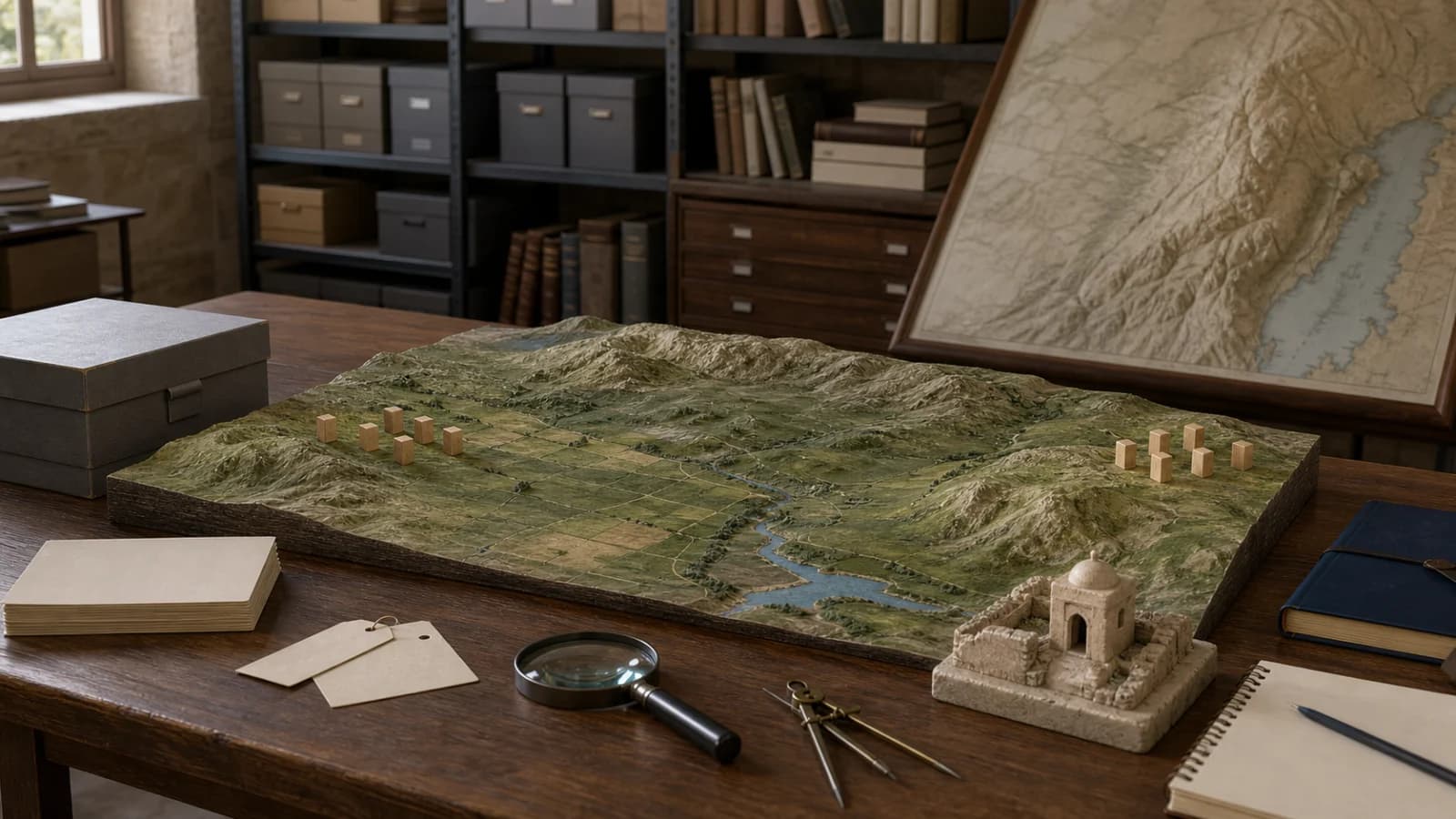
Battle of Ain Jalut 1260: Qutuz, Baybars, Kitbuqa, Tactics and Myths
A detailed, source-critical guide to Ain Jalut on 3 September 1260: the road from Baghdad, Hülegü’s withdrawal, Qutuz and Baybars, Kitbuqa’s force, uncertain numbers, battlefield accounts, Mamluk rule in Syria and myths about Mongol defeat and gunpowder.
Ain Jalut: dates and conclusions at a glance
| Question | Evidence-based answer |
|---|---|
| Date | 3 September 1260; sources and calendar conversions differ between 25 and 26 Ramadan 658 AH. |
| Place | ʿAyn Jālūt, ‘Spring of Goliath,’ in the Jezreel Valley region of northern Palestine. |
| Commanders | Sultan Qutuz and Baybars for the Mamluks; Kitbuqa or Ketbugha for the Mongol force. |
| Background | Mongol capture of Baghdad in 1258 and Aleppo and Damascus in 1260, followed by Hülegü’s withdrawal. |
| Forces | A seasoned but mixed Mamluk coalition against a reduced Mongol regional army; exact totals are not secure. |
| Outcome | Kitbuqa’s army was broken and he was killed or executed; Mamluks recovered Damascus and most of Syria. |
| Long war | Mongol armies returned repeatedly; major conflict continued through 1281, 1299–1300 and 1303. |
| Main correction | A major strategic turning point, not the first defeat of any Mongol force and not a firearms miracle. |
What happened on 3 September 1260?
A Mamluk army advancing from Egypt met Kitbuqa’s Mongol-led force near ʿAyn Jālūt. Baybars commanded an important forward element, while Qutuz exercised the authority of sultan and commander in chief. Accounts describe hard fighting, a Mamluk withdrawal or feigned retreat and a counterattack from concealed or reserve forces. The Mongol formation eventually broke. Kitbuqa was captured and executed or killed in combat, depending on the tradition, and survivors fled east.
The victory opened the road to Damascus. Mamluk authority rapidly replaced the short Mongol occupation in major Syrian centers. The outcome was not preordained: Qutuz’s regime was young, the Mamluk elite was divided and Mongol campaigns had recently destroyed powerful states. Yet the battle was also not a clash between a full Mongol imperial host and Egypt alone. Both armies reflected withdrawals, alliances, defections and regional constraints.
Date, name and location
The secure common date is 3 September 1260. Modern works variously equate it with 25 or 26 Ramadan 658 because medieval reporting and calendar conversion do not always align. Stating both alternatives is more accurate than forcing a false precision. The place name means the Spring of Goliath and appears in several transliterations: Ain Jalut, Ayn Jalut and ʿAyn Jālūt all identify the same battle.
The site lies in the Jezreel Valley region, near routes connecting the Jordan Valley, Damascus, Acre and the Palestinian interior. Its water, grazing and enclosed terrain mattered to mounted armies. The location also placed the Mamluks within reach of Frankish coastal territory while confronting a Mongol force coming from Syria. Geography helps explain the campaign; it should not be transformed into a perfectly known tactical diagram.
From Baghdad in 1258 to Damascus in 1260
Hülegü’s westward campaign had already transformed the region. Baghdad fell in February 1258, ending direct Abbasid caliphal rule there. Later accounts give enormous and incompatible death tolls; the scale of killing and destruction was severe, but source criticism is necessary. The Mongol army then turned toward the Ayyubid-ruled cities of Syria. Aleppo was captured in early 1260, and Damascus submitted soon afterward.
The advance brought Mongol, Armenian, Georgian and other allied forces into a landscape divided among Ayyubid princes, Frankish states and the new Mamluk rulers of Egypt. Communities did not act as fixed religious blocs. Some rulers cooperated with Hülegü, some submitted, some waited and some fled. Ain Jalut emerged from this fractured political order rather than from a simple two-civilization frontier.
Why Hülegü withdrew most of his army
Great Khan Möngke died in 1259. News of his death created a succession crisis across the Mongol world, and Hülegü withdrew the greater part of his force toward Azerbaijan and Iran. He needed access to pasture and supplies and had to protect his position as rival Chinggisid princes maneuvered. His relationship with the Golden Horde was deteriorating, adding another strategic concern.
It is too simple to say that every soldier rushed east to vote for a new khan, just as it is wrong to ignore the succession altogether. Logistics, season, intra-Mongol politics and the requirements of governing conquered lands converged. Hülegü left Kitbuqa in Syria with a real field army, not a ceremonial guard, but far less than the invasion force that had taken Baghdad and Aleppo. This reduction created the opportunity Qutuz chose to exploit.
Who was Kitbuqa?
Kitbuqa, also written Ketbugha, was an experienced Naiman commander and a Christian associated with the Church of the East. His religion has attracted later attention because several Christian rulers allied with the Mongols, but religious identity alone did not determine policy. He served Hülegü’s imperial project and commanded troops of varied origin.
Descriptions of him as either a monstrous invader or a romantic Christian hero reproduce partisan medieval memory. Militarily, he had to hold Syria, watch rival rulers and respond to a Mamluk advance with reduced resources. His decision to offer battle may reflect confidence, imperfect intelligence, political need and the difficulty of abandoning recent conquests. Sources disagree on whether he died fighting or delivered a defiant speech before execution; neither version should be quoted as a stenographic record.
Qutuz, Baybars and a divided Mamluk elite
The Mamluk Sultanate had existed for only a decade. Its military elite came from purchased or captured young men trained in elite households, converted to Islam, manumitted and incorporated into networks of loyalty. This system produced formidable cavalry commanders but also intense competition. Qutuz seized the throne in November 1259, arguing that the emergency required an experienced adult rather than the young al-Mansur Ali.
Baybars belonged to the Bahri faction that had been driven from Egypt after the murder of Sultan Aybak. The Mongol threat encouraged reconciliation. Qutuz allowed exiled commanders to return, and Baybars became central to the campaign. Their cooperation was real but temporary. Treating Baybars as the sole victor erases Qutuz’s political mobilization; treating Qutuz as an uncontested ruler erases the factional bargain that made the army possible.
What kind of army did the Mamluks field?
The core consisted of highly trained mounted mamluks skilled with composite bow, lance and sword and accustomed to disciplined maneuver. The army also included commanders’ retainers, Egyptian troops, Bedouin or other auxiliaries and Ayyubid or Syrian horsemen who joined as the political balance shifted. Some men had previously fought the Mongols or shared steppe languages and practices.
Calling the force a ‘slave army’ without explanation is misleading. Elite mamluks were legally enslaved during training but normally manumitted before mature military and political careers. They formed a ruling military household system, not an undifferentiated mass of coerced infantry. At Ain Jalut, their experience in mounted archery and tactical control helped them meet an opponent whose methods were related but not identical.
The Mongol force was reduced, not insignificant
Kitbuqa commanded Mongol troops and allied contingents left to secure Syria. Later estimates often cite ten or twenty thousand, but source categories are unclear: a decimal unit was not always at full paper strength, and texts may count only Mongols or include auxiliaries. Losses, garrison duties and detachments further altered the number available on the day.
The safest conclusion is comparative. Kitbuqa’s force was much smaller than Hülegü’s main army but capable of offensive operations and frightening enough to threaten Egypt. Qutuz probably sought a concentration that gave him parity or local advantage. Describing the contest as a tiny Mongol patrol accidentally defeated understates Mamluk risk; describing it as the destruction of the Mongol Empire mistakes one regional army for a continental political system.
Why the Franks of Acre allowed passage
To reach the battlefield, the Mamluks moved north through or beside territory controlled by the Frankish coastal states. Leaders at Acre feared both Mongol expansion and Mamluk power. After debate, they maintained a form of neutrality and allowed passage and access to markets or supplies rather than joining Kitbuqa. This reduced the danger that Qutuz would face an attack from the coast.
It is often called a Crusader–Mamluk alliance, but that wording is stronger than the evidence. No unified Christian front fought beside Qutuz at Ain Jalut. Political self-preservation produced temporary accommodation between habitual enemies. The episode is important precisely because it shows that thirteenth-century strategy did not follow a simple Muslim-versus-Christian line.
How did the battle unfold?
A common reconstruction has Baybars leading the Mamluk vanguard into contact and then withdrawing, drawing the Mongols toward a main force positioned in broken or concealed ground. Kitbuqa pressed the attack; the Mamluk left came under severe pressure; Qutuz rallied troops and committed reserves. A counterstroke, possibly aided by defections from Syrian contingents serving the Mongols, turned the fight. Kitbuqa’s force was surrounded or broken during its retreat.
This sequence fits Mamluk tactical capabilities and several narratives, but the sources were written after the event and shaped by the reputations of Qutuz and Baybars. ‘Feigned retreat’ can become a universal steppe-warfare cliché. We can reasonably say that the Mamluks used advance elements, controlled withdrawal, terrain and reserves; we cannot verify every location, shouted phrase or perfectly timed ambush. The battle was won through command and cohesion under pressure, not one theatrical trick.
Was gunpowder decisive at Ain Jalut?
Modern retellings sometimes claim that Mamluks used hand cannons to frighten Mongol horses and thereby won the battle. The claim often relies on ambiguous references to explosive devices or on projecting later firearms backward. Gunpowder mixtures and incendiary or explosive weapons were known across Eurasia, but secure evidence for battlefield hand cannons at Ain Jalut is lacking and terminology is contested.
Noise, drums, arrows, dust and disciplined cavalry maneuvers all affected horses and men. Unless a source can identify the device, date the text and demonstrate its tactical role, ‘first cannon victory’ should not be repeated. Removing the firearms miracle leaves a more convincing explanation: intelligence, local concentration, experienced mounted troops, use of terrain, reserves and the Mongol decision to engage without Hülegü’s main army.
Immediate aftermath: Syria and the murder of Qutuz
After victory, Mamluk forces entered Damascus and reestablished authority across much of Syria. A smaller Mongol force or allied remnant was defeated near Homs later in 1260. Qutuz appointed or confirmed officials and distributed rewards, but disputes over patronage and the governorship of Aleppo sharpened tension with Baybars and other Bahri commanders.
On the return journey to Cairo in October, Qutuz was assassinated. Sources connect Baybars to the plot, and some give him the fatal blow, but individual details differ. Baybars then became sultan. The transition shows the paradox of Ain Jalut: cooperation saved the regime, yet victory did not erase the political violence built into elite competition. Later Baybars-centered memory could celebrate the campaign while reducing the murdered sultan’s role.
What Baybars built after the victory
Baybars ruled from 1260 to 1277 and transformed the emergency coalition into a stronger Egypt–Syria state. He fortified frontiers, expanded intelligence and postal networks, campaigned against Frankish strongholds and Mongol positions, and managed alliances with the Golden Horde. He installed an Abbasid claimant as caliph in Cairo, creating ceremonial legitimacy without restoring Baghdad’s political caliphate.
His patronage of mosques, madrasas, bridges and other institutions helped make victory visible in the built environment. These developments were not all caused by one battle; they drew on Ayyubid practices, Egyptian revenue and continuing war. Ain Jalut nevertheless supplied legitimacy. A military elite that had seized power could present itself as the defender of Egypt, Syria and the holy cities against an existential threat.
Why Mongol attacks did not end in 1260
Hülegü still ruled a major state in Iran and Iraq, soon known as the Ilkhanate. He attempted renewed action, while his successors repeatedly contested Syria. Battles at Homs in 1281, Wadi al-Khaznadar in 1299 and Marj al-Saffar in 1303 show that Ain Jalut did not close the frontier. The Mongols even occupied Damascus briefly after their 1299 victory.
What changed was the strategic baseline. Egypt remained a secure fiscal and military center, while the Mamluks held or could recover Syria. Neither side easily sustained conquest across the frontier and its seasonal logistical limits. Diplomacy, espionage, defections and alliances with other Mongol khanates accompanied raids and major invasions. A settlement came only in the fourteenth century, after decades of war.
Was this the first Mongol defeat?
No. Mongol armies and detachments had suffered reverses before 1260, including failed operations, defeats by rival steppe forces and the death of commanders. The empire’s extraordinary expansion created an image of invincibility, and chroniclers after Ain Jalut had reasons to emphasize that image so the Mamluk achievement appeared greater.
A better claim is specific: Ain Jalut was the first major defeat of Hülegü’s forces in the Syrian campaign and a victory that stopped their immediate advance toward Egypt. It produced a durable regional outcome because the Mamluk state could exploit it. Historical significance depends on consequences, not on an inaccurate ‘first ever’ label.
Sources, speeches and inflated numbers
Arabic, Persian, Syriac, Armenian and Frankish writings preserve different angles. Many were composed after the event, under Mamluk or Ilkhanid rule, and authors shaped narratives around divine favor, legitimate kingship and exemplary courage. Famous ultimatums, Qutuz’s rallying cry and Kitbuqa’s last speech may preserve memories, but their polished wording belongs to literary history unless independently supported.
Army and casualty figures are especially unstable. Medieval numbers can be symbolic, copied or based on theoretical units. Historians test them against travel speed, pasture, supply, command structure and parallel campaigns. Admitting uncertainty does not make both sides equal or the outcome unclear. It prevents rhetorical totals from replacing analysis of why the Mamluk coalition held together and Kitbuqa’s did not.
Why a relatively small battle had large consequences
Ain Jalut may have involved fewer men than many famous medieval battles, but it decided who could mobilize the resources of Syria at a critical moment. If Kitbuqa had won, the route toward a politically divided Egypt would have opened and Mamluk legitimacy might have collapsed. Instead, the Mamluks gained Syrian cities, taxation, recruitment and strategic depth.
The battle also coincided with fragmentation inside the Mongol imperial order. Hülegü could not simply repeat the 1258 concentration without considering the Golden Horde, the succession and regional logistics. Qutuz’s victory turned a temporary opportunity into a new balance of power. Scale on the field and scale in history are not the same.
A balanced verdict on Ain Jalut
The Mamluks earned a genuine and difficult victory. Qutuz accepted the risk of marching out of Egypt, Baybars handled a crucial operational role, and their diverse force defeated Kitbuqa’s experienced army. The result secured Egypt and transferred Syria to Mamluk rule. It deserves its place among the major turning points of thirteenth-century West Asian history.
Its importance survives correction. Hülegü’s withdrawal created the opportunity; the Mongol Empire was not destroyed; wars continued; firearms are unproven; and the victors soon murdered their sultan. These complications do not diminish Ain Jalut. They explain how contingency, institutions, logistics and political violence combined to make one day strategically decisive.
Frequently asked questions
Who won the Battle of Ain Jalut?
The Mamluk army led by Sultan Qutuz, with Baybars in a leading command, defeated Kitbuqa’s Mongol-led field force on 3 September 1260.
Why was Hülegü absent?
After Great Khan Möngke’s death, Hülegü withdrew most of the main army toward Azerbaijan amid succession politics, logistical needs and rivalry with other Mongol powers. Kitbuqa remained with a reduced regional force.
How large were the armies?
Exact figures are not reliable. The Mongol force was much smaller than the army that invaded Syria, and the Mamluks concentrated a seasoned but mixed coalition. Specialist work emphasizes modest scale and major consequences.
Did Baybars use a feigned retreat?
A controlled withdrawal by Baybars’s forward troops is a plausible and common reconstruction. The later sources do not justify a perfectly detailed tactical script, so terrain, reserves and cohesion must also be included.
Did cannons frighten the Mongol horses?
There is no secure evidence that hand cannons decided the battle. Claims about gunpowder devices depend on ambiguous terminology and later projection. Conventional mounted tactics offer a stronger explanation.
Did Ain Jalut stop the Mongols forever?
No. It stopped the immediate drive into Egypt and enabled Mamluk control of Syria. Ilkhanid armies returned several times, including major campaigns in 1281, 1299 and 1303.
Continue the history
- Mamluk Sultanate timeline — from military households to the Ottoman conquest
- Fall of Baghdad in 1258 — the campaign that preceded the Syrian invasion
- History of al-Azhar — Cairo’s institutions before and after Mamluk rule
- Islamic history timeline — place 1260 in a wider chronology
- Seljuk Empire timeline — earlier Turkic states and the road to Mongol rule
- Ottoman Empire timeline — the power that conquered the Mamluk state in 1516–1517
Related Muslim Post guides
- What the Battle of Manzikert Changed After Romanos IV Was Captured in 1071
- Why the Baptistère de Saint Louis Is a Mamluk Basin
- Why the Ottoman Empire Did Not Simply Decline After Süleyman
Sources
This account prioritizes specialist Mamluk–Mongol research and institutional sources. It separates the secure date and outcome from disputed troop numbers, later speeches, contradictory reports of Kitbuqa’s death and modern firearm claims.
- Cambridge University Press: The Mamluk Sultanate — A History (excerpt) — Core chronology for Hülegü’s withdrawal, 3 September battle, Mamluk coalition, continued Mongol intervention and Qutuz’s assassination.
- Reuven Amitai: Back to ʿAyn Jālūt, Again — Specialist reassessment emphasizing relatively limited forces but exceptional strategic consequences and careful comparison of sources.
- Cambridge Core: The Kipchak Connection, the Ilkhans, the Mamluks and Ayn Jalut — Used for the political and personal networks linking Mamluk commanders, the steppe and the later Ilkhanid conflict.
- Encyclopaedia Iranica: Hülegü Khan — Used for Hülegü’s campaign, Möngke’s death, withdrawal toward Azerbaijan and the formation of Ilkhanid power.
- Cambridge Core: Mongol Raids into Palestine in 1260 and 1300 — Used to distinguish the 1260 campaign from raids and later Mongol returns rather than declaring the frontier closed forever.
- Cambridge Core: The Age of the Mamluks, 1250–1516 — Used for the young sultanate’s institutions, Qutuz’s emergency rule, Baybars’s accession and the political meaning of victory.
- The Metropolitan Museum of Art: The Art of the Mamluk Period — Used for mamluk military training, manumission, Baybars’s patronage and the state built after the battle.
- Egypt Ministry of Tourism and Antiquities: Bahri Mamluks — Official Egyptian chronology for the Bahri military household, Qutuz, Baybars and early Mamluk rule.
- Cambridge Core: Mongols and Mamluks — The Secret War — Used for intelligence, envoys, defections and the diplomatic contest that accompanied open warfare.
- Cambridge Core: Plague and the Mongol Conquest of Baghdad — A Reevaluation — Used as a model for source criticism around 1258 and for avoiding inflated casualty and catastrophe claims in the road to 1260.


