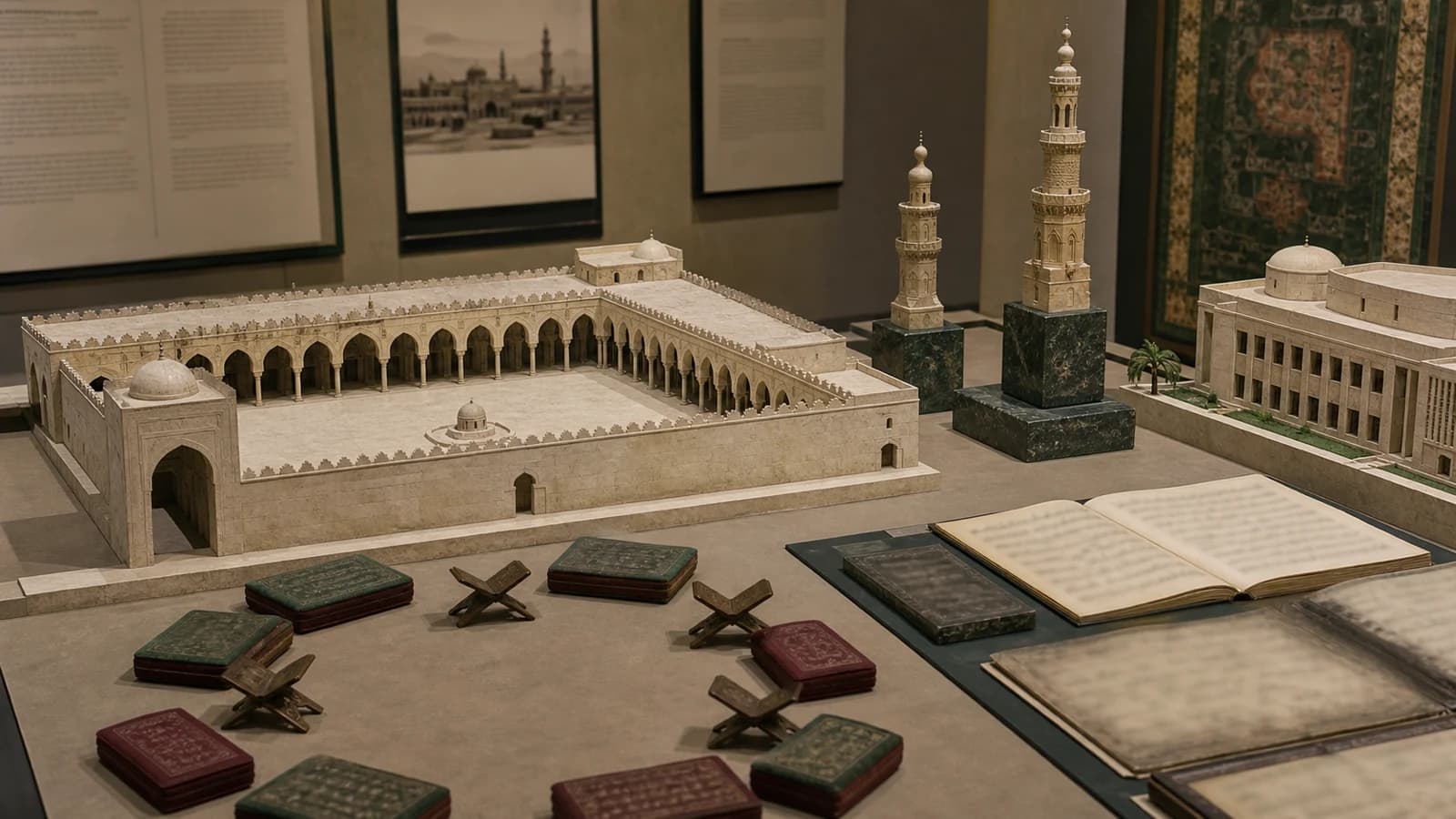
Al-Azhar Mosque and University History: What Happened in 970, 972 and 975?
Why is Al-Azhar dated to 970, 972 or 975? A documented timeline of mosque construction, first Friday prayer, teaching circles, later reforms and the 1961 university law.
Quick date guide
- 970: construction began under the Fatimids in their new capital, Cairo.
- 972: the completed congregational mosque held its first Friday prayer.
- 975: Al-Azhar's official history records the first teaching circle, associated with Ismaili jurisprudence.
- 1930: a law established university colleges for theology, sharia and Arabic.
- 1961: Law No. 103 reorganized Al-Azhar and added modern scientific, professional and women's faculties.
Why was Al-Azhar built?
The Fatimids established Cairo after taking Egypt in 969. Their commander Jawhar al-Siqilli began Al-Azhar as the new regime's congregational mosque. It supported worship and public legitimacy, and its early teaching promoted Ismaili learning within a population that included other Muslim traditions, Christians and Jews. Calling the first building a university obscures its primary form; describing it only as a place of prayer misses how quickly organized teaching became part of its role.
What happened in 970, 972 and 975?
Construction is an interval, not a single instant. Official Al-Azhar chronology places work from 359 to 361 AH, broadly 970 to 972 CE. The first Friday prayer on 7 Ramadan 361 AH marks the mosque's liturgical opening. In 365 AH, corresponding to October 975 in the official account, chief judge Abu al-Hasan Ali ibn al-Numan delivered a teaching session on Ismaili law. Historians can therefore use 970 for foundation or construction, 972 for opening and 975 for the earliest recorded formal lesson, provided the label is explicit.
Did teaching continue unchanged?
No institution remains unchanged for a millennium. When Salah al-Din ended Fatimid rule in 1171, Al-Azhar's official Ismaili position changed and Friday prayer was redirected for a period. Teaching did not fit one simple on-or-off switch, but the institution lost status before later revival, particularly under the Mamluks. Scholars, students, endowed spaces and study circles returned in changing arrangements. That history supports meaningful continuity while ruling out the idea of one unbroken administrative corporation identical to today's university.
How did the mosque-university work?
For long periods, teaching centered on recognized scholars and circles in and around the mosque. Students studied Quran, hadith, jurisprudence, Arabic, theology, logic and other subjects in variable programs. Residential quarters associated with regions and communities supported an international student body. Authority depended on teachers and scholarly recognition as much as a central timetable. The term mosque-university is useful when it signals advanced learning; it is misleading if it suggests modern departments, tuition rules and standardized institutional degrees already existed in the tenth century.
Reform before 1961
Egypt's nineteenth-century state schools in medicine, engineering, languages and military subjects changed Al-Azhar's place in education. Reformers argued over examinations, curriculum, employment and the independence of the ulama. Examinations for teaching qualifications appeared in the 1870s, and laws in 1911, 1930 and 1936 formalized administration and study stages. The 1930 law created three university colleges: Islamic Theology, Sharia and Arabic Language. Modernization was therefore a long contested process, not one decree imposed on a frozen medieval school.
What did the 1961 law change?
Law No. 103, issued on 5 July 1961, reorganized Al-Azhar. Its official university history lists new faculties such as commerce, medicine, engineering and agriculture and a women's college with religious, humanities and professional fields. Students in general faculties also encountered Arabic and Islamic study. The reform greatly expanded scale and subject range. It also tied Al-Azhar more closely to the Egyptian state, turning many scholars into public officials and reducing older forms of institutional autonomy. Both educational expansion and political centralization belong in the account.
Is Al-Azhar the oldest university?
Al-Azhar is among the oldest surviving centers of higher Islamic learning and has an unusually long teaching history. A universal ranking is harder. If the criterion is an ancient mosque with durable advanced teaching, Al-Azhar is a leading case. If the criterion is a self-governing corporate university, a continuously standardized degree system or a modern legal university, other dates and institutions enter the comparison. UNESCO and Al-Azhar use strong continuity language; responsible writing preserves that significance while naming the criterion.
Claims to qualify
- 'Al-Azhar was founded in one undisputed year': 970, 972 and 975 label construction, worship and recorded teaching.
- 'It was always Sunni': its foundation and early teaching were Fatimid Ismaili; its later authority became predominantly Sunni.
- 'It has operated unchanged since 970': political transitions, interruptions, reforms and new legal structures matter.
- '1961 simply modernized the curriculum': it also expanded state control and reorganized religious authority.
- 'Oldest university' is a fact needing no definition: the answer changes with the institutional feature being compared.
How to cite Al-Azhar's founding date
For a short description, write that Al-Azhar was founded as a Fatimid mosque in Cairo beginning in 970, opened for Friday prayer in 972 and hosted its first recorded teaching circle in 975. Then state that its modern university system emerged through later reforms, especially the 1930 college law and the 1961 reorganization. This wording resolves the apparent date conflict and respects both its deep teaching tradition and its changing institutional form.
Related research guides
- History of Islamic education institutions: Trace mosque circles, kuttab schools, madrasas, waqf support, ijaza practice and modern university reforms without treating them as one unchanged system.
- Al-Qarawiyyin, Fatima al-Fihri and the oldest-university claim: Separate the 859 mosque-founding tradition, later documented teaching and the twentieth-century modern university from a viral one-line record claim.
- Nizamiyya of Baghdad, Nizam al-Mulk and al-Ghazali: Follow the 1065 foundation, 1067 inauguration, waqf-supported teaching and the institution's real importance without calling it the first madrasa.
- Islamic Golden Age history timeline: Place schools and teaching institutions beside translation, medicine, mathematics, libraries and shifting political patronage.
- House of Wisdom: institution, translation and myth: Compare a court library and translation setting with mosques and madrasas instead of folding every Abbasid scholar into one academy.
- Al-Khwarizmi, algebra and scholarly networks: Connect mathematical work to courts, books and teachers without assigning every Abbasid scholar to one university.
- Ibn Sina, medicine and learned mobility: Compare a scholar's court, library and medical career with the narrower institutional work of a law college.
- Bimaristans, medicine and waqf: Compare madrasa learning with hospitals, clinical practice and another form of endowed institution.
- Fall of Baghdad in 1258: See why the destruction of one capital did not erase education across every Muslim-ruled region.
Sources
- Al-Azhar official site: Al-Azhar Mosque: Used for the Fatimid foundation and the first recorded teaching circle in 365 AH / October 975.
- Al-Azhar official site: About Al-Azhar: Used for construction from 970, the first Friday prayer in 972 and later institutional transformations.
- Al-Azhar official site: Al-Azhar University: Used for the 1930 colleges and Law No. 103 of 1961, including scientific faculties and women's higher education.
- UNESCO World Heritage Centre: Historic Cairo: Used for Al-Azhar's place in Fatimid Cairo and UNESCO's description of its long religious and academic importance.
- Cambridge Core: History and Continuity - Al-Azhar and Egypt: Used to treat continuity as a history of repeated political and institutional change rather than an unchanged organization.
- Cambridge Core: Al-Azhar University - A Historical Sketch: Used for the assembly-mosque origin, Fatimid context and later international teaching influence.
- Cambridge Core: The Azhar Strike of 1909: Used for nineteenth- and early twentieth-century examinations, curriculum reform and disputes over institutional modernization.
- Cambridge Core: State-provided Islamic education and the 1961 law: Used for the effects of the 1961 reorganization on state control and the expansion of general and professional subjects.
- Library of Congress: Classroom at Al-Azhar, Cairo: Used as a cataloged c. 1898 visual record of students gathered around a teacher before the twentieth-century faculty reorganizations.
- UNESCO-IIEP Planipolis: Egypt Education Sector Plan 2023-2027: Used for the present-day place of Al-Azhar education within Egypt's parallel national education systems.


