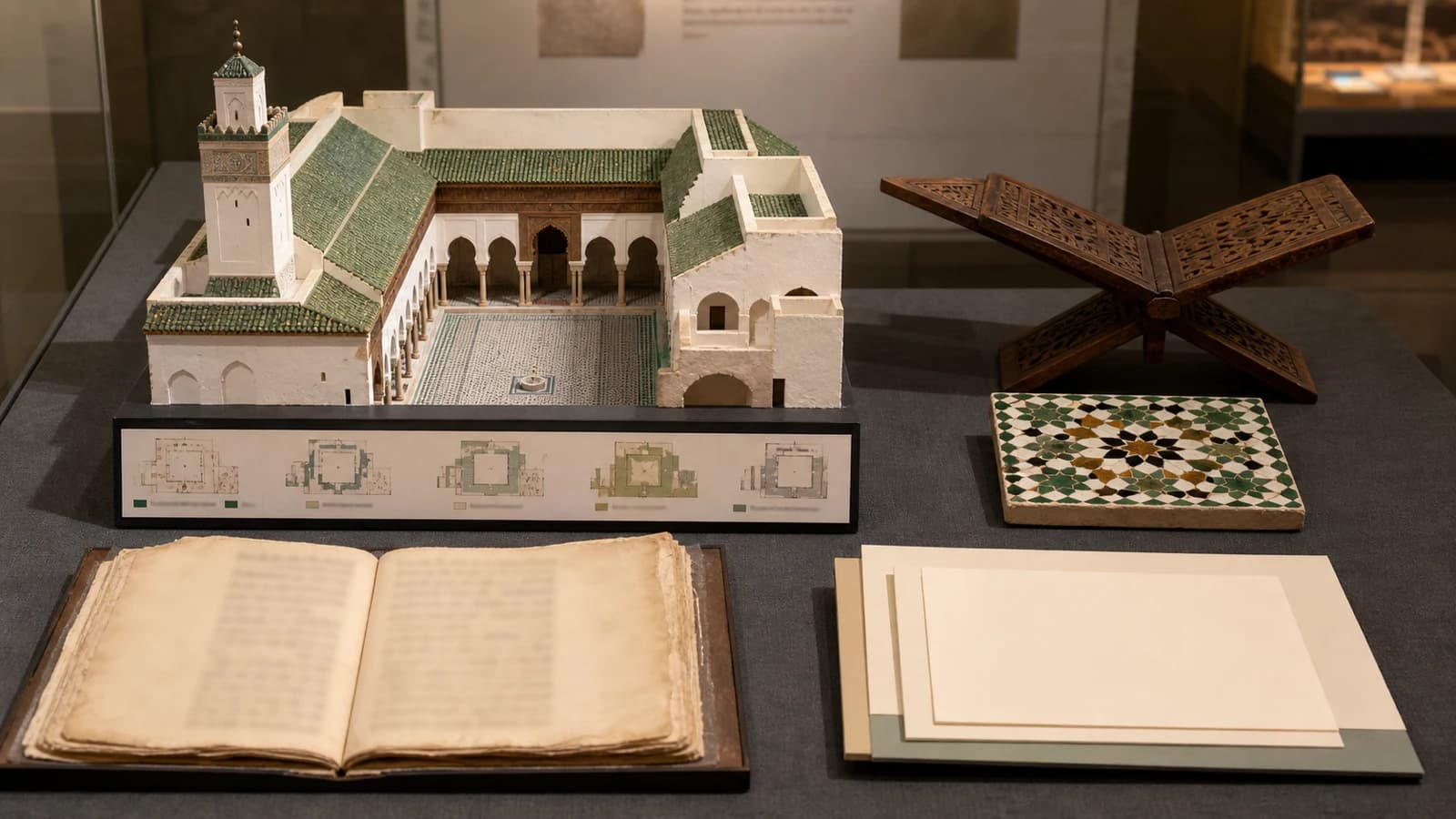
Al-Qarawiyyin, Fatima al-Fihri and the World's Oldest University Claim
Was al-Qarawiyyin founded in 859 by Fatima al-Fihri, and is it the world's oldest university? A source-aware guide to the mosque, teaching tradition, record claim and 1963 reform.
Quick answer
- The traditional founding date is 859 CE in Fez, under the Idrisid-era urban setting recognized by UNESCO.
- The best-known narrative says Fatima al-Fihri used inherited wealth to found the mosque, but the detailed account comes from a chronicle written centuries later.
- Guinness uses the category 'oldest existing and continually operating higher-learning institution,' which is not the same as universal agreement over the first university.
- Higher teaching developed around the mosque through scholars, circles, texts and permissions; it did not begin with a modern faculty charter in 859.
- The modern University of Al-Qarawiyyin took shape through Moroccan state reforms, with 1963 a key institutional date.
What does the 859 date mean?
The date 859 refers to the traditional foundation of the Qarawiyyin mosque, not to a surviving ninth-century document that lays out a modern university. Fez itself emerged in the ninth century, and UNESCO treats its medina as an exceptionally important historic city. A mosque could host worship, teaching, legal consultation, copying and charitable activity, but these functions grew over time. The date is therefore a meaningful origin marker while remaining different from the date when every later academic function became visible in the record.
What do we know about Fatima al-Fihri?
The widely told account describes Fatima, a migrant family's daughter, financing the mosque from an inheritance and supervising its construction. Her story carries real cultural importance, especially as an example of women's patronage. The source problem is chronological: the detailed narrative is associated with Ibn Abi Zar's Rawd al-Qirtas, compiled roughly five centuries after 859. That distance does not automatically make the tradition false, but it prevents historians from treating every modern biographical detail as contemporary evidence. Claims that she studied particular sciences, founded a university library in 859 or designed a complete curriculum go beyond what the evidence can securely establish.
Why does Guinness call it the oldest?
Guinness now labels al-Qarawiyyin the oldest existing and continually operating higher-learning institution. That is a recognizable and useful record category. It combines antiquity, education and continuity. It does not settle every historian's definition of a university, nor does it prove that the institution had the same governance, degrees or curriculum for more than eleven centuries. UNESCO pages in several languages and many academic works also use oldest-university language, but record and heritage descriptions should be quoted as claims with stated criteria.
Mosque-university is not a modern university
Calling Qarawiyyin a mosque-university can describe a major center where recognized scholars taught advanced religious and linguistic disciplines. Students gathered around teachers, studied named books and could receive an ijaza, often a teacher's permission to transmit or teach a particular text. That relationship differs from an institution centrally issuing standardized degrees after a fixed course. The word 'university' can be a reasonable bridge for present-day readers if the institutional differences are disclosed; it becomes misleading when it erases them.
What was taught and who controlled it?
Qarawiyyin became renowned for Quranic studies, hadith, Maliki law, Arabic grammar and related fields, while logic, calculation and other subjects appeared in changing combinations. Teaching authority rested heavily with scholars and scholarly lineages. Rulers, endowments and urban elites still shaped appointments, buildings and resources. This was neither a completely autonomous campus nor a single state curriculum. The balance changed under dynasties, colonial pressure and modern Moroccan administration.
Why does 1963 matter?
After Moroccan independence, state reforms reorganized Qarawiyyin as a modern university. The 1963 date marks a decisive legal and administrative transformation, with faculties and contemporary systems placed inside a national higher-education order. It should not be used to deny the older teaching tradition. Conversely, 859 should not be used to imply that today's organizational form existed from the first day. Both dates answer different questions.
Claims to qualify
- 'Fatima founded the first university in 859': the tradition concerns a mosque foundation, while detailed biography and later higher teaching have separate evidence histories.
- 'It issued the world's first degrees': an ijaza was often personal and text-specific, not automatically equivalent to a modern institutional degree.
- 'It has been unchanged and continuous': continuity can survive closure, reform, relocation or altered governance; the relevant criterion must be stated.
- 'European universities prove Qarawiyyin is not a university': that simply imposes one regional legal history as the only possible category.
- 'Every famous medieval thinker studied there': omit celebrity lists unless each person's attendance has strong, specific evidence.
A better answer to the oldest-university question
Al-Qarawiyyin has a credible claim to extraordinary institutional longevity and is officially recognized in record and heritage narratives as an ancient center of higher learning. The founding tradition connects the mosque to Fatima al-Fihri in 859, though the detailed story is preserved in much later sources. Advanced teaching developed around the mosque, and the institution was reorganized as a modern university in 1963. Whether it is 'the first university' depends on whether the comparison means a continuous higher-learning site, a self-governing medieval corporation, a degree-granting body or a modern state university. Name the definition and the history becomes clearer.
Related research guides
- History of Islamic education institutions: Trace mosque circles, kuttab schools, madrasas, waqf support, ijaza practice and modern university reforms without treating them as one unchanged system.
- Al-Azhar Mosque and University timeline: Distinguish construction in 970, first Friday prayer in 972, the first recorded teaching circle in 975 and modern reorganization in 1961.
- Nizamiyya of Baghdad, Nizam al-Mulk and al-Ghazali: Follow the 1065 foundation, 1067 inauguration, waqf-supported teaching and the institution's real importance without calling it the first madrasa.
- Islamic Golden Age history timeline: Place schools and teaching institutions beside translation, medicine, mathematics, libraries and shifting political patronage.
- House of Wisdom: institution, translation and myth: Compare a court library and translation setting with mosques and madrasas instead of folding every Abbasid scholar into one academy.
- Al-Khwarizmi, algebra and scholarly networks: Connect mathematical work to courts, books and teachers without assigning every Abbasid scholar to one university.
- Ibn Sina, medicine and learned mobility: Compare a scholar's court, library and medical career with the narrower institutional work of a law college.
- Bimaristans, medicine and waqf: Compare madrasa learning with hospitals, clinical practice and another form of endowed institution.
- Fall of Baghdad in 1258: See why the destruction of one capital did not erase education across every Muslim-ruled region.
Sources
- UNESCO World Heritage Centre: Medina of Fez: Used for the ninth-century urban setting of Fez and UNESCO's heritage framing of the Qarawiyyin complex.
- Guinness World Records: Oldest higher-learning institution: Used for the current record wording: an existing and continually operating higher-learning institution founded in 859, not a universal scholarly definition of university.
- Cambridge University Press: Regulating Islam excerpt: Used for al-Qarawiyyin as a classical mosque-university and for modern Moroccan reforms and state administration.
- Cambridge Core: Islamic Scholarship in Africa introduction: Used to place Qarawiyyin among mosques, Quranic schools, colleges and scholarly networks rather than a single European-style institutional category.
- Brill: African higher education and al-Qarawiyyin: Used for the twentieth-century transition into the modern University of Al-Qarawiyyin and the 1963 reorganization date.
- SciELO: Fatima al-Fihri in historical memory: Used for the later biographical tradition about Fatima al-Fihri and the need to distinguish memory from contemporary ninth-century documentation.
- World History Encyclopedia: Fatima al-Fihri and al-Qarawiyyin: Used to trace the familiar account to Ibn Abi Zar's much later Rawd al-Qirtas narrative and to explain source distance.
- Cambridge Core: Constructions of Academic Freedom: Used as evidence that modern academic writing also repeats earliest-degree or university claims, which still require definitions and source qualification.


