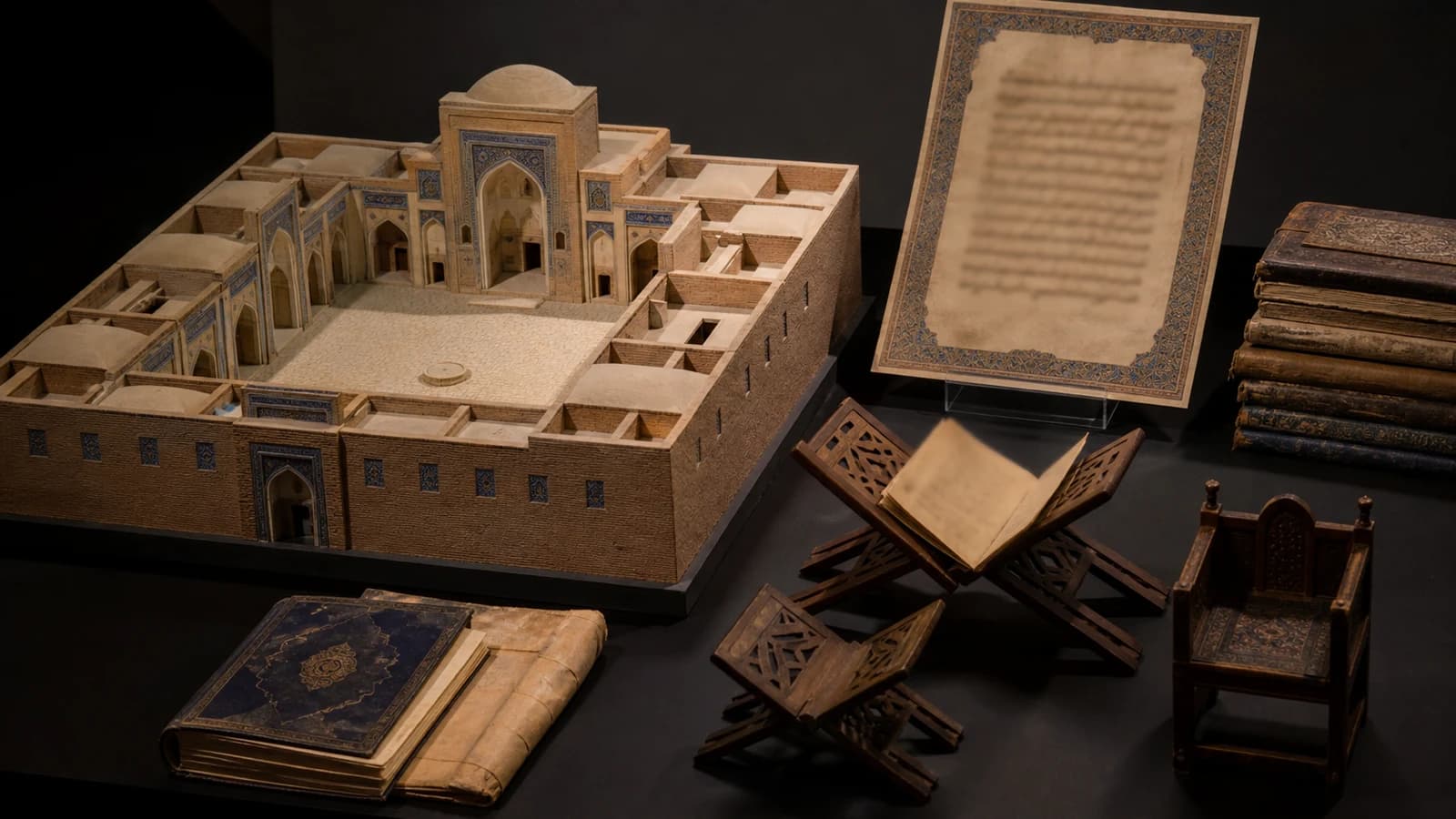
Nizamiyya of Baghdad: 1065 Foundation, 1067 Opening and al-Ghazali
A source-aware history of the Nizamiyya madrasa in Baghdad, its 1065 and 1067 dates, Nizam al-Mulk, waqf funding, curriculum, al-Ghazali and first-university myths.
The Nizamiyya of Baghdad was the most famous college in a network associated with the Seljuq vizier Nizam al-Mulk. It was founded in 457 AH / 1065 and inaugurated in 459 AH / 1067, which explains why both dates appear. Its fame came from durable endowment, a prestigious teaching chair, student support and its place in Seljuq-era Sunni scholarship. It was highly influential, but it was not the first madrasa, a modern state university or the only important school in Baghdad.
Quick facts
- 1065: the Baghdad institution was founded and construction or endowment arrangements began.
- 13 October 1067: sources place its formal inauguration and Abu Ishaq al-Shirazi's opening lecture here.
- Nizam al-Mulk supported related colleges across the eastern Seljuq realm; they were linked by patronage, not one central university administration.
- The Baghdad endowment supported Shafii legal teaching, staff, students, books and lodging.
- Al-Ghazali became its celebrated professor in 1091 and left Baghdad in 1095.
Why are 1065 and 1067 both correct?
A foundation date can mark authorization, endowment or the beginning of construction, while an opening date marks teaching in an operating building. George Makdisi's Cambridge study gives 457/1065 for foundation and 459/1067 for inauguration. A biographical account of Abu Ishaq al-Shirazi places the inaugural lecture on 13 October 1067. Good timelines therefore retain both dates instead of choosing one and treating the other as an error.
Who was Nizam al-Mulk?
Nizam al-Mulk was the powerful vizier of the Great Seljuq rulers Alp Arslan and Malik Shah. He sponsored colleges in cities including Nishapur, Baghdad and Isfahan, recruited prominent Sunni scholars and used patronage to support legal and administrative elites. Calling the Nizamiyyas a state-university chain is too neat. Political power enabled them, but individual waqf deeds, local professors and separate institutions mattered. The network expressed shared patronage more than centralized academic governance.
How did the Baghdad college open?
Abu Ishaq al-Shirazi, a renowned Shafii jurist, was selected for the principal teaching position. Sources preserve complications around his acceptance and the first lecture, reminding readers that an endowed chair depended on a particular scholar's reputation. The opening was a public institutional event, not the first time anyone had taught law in Baghdad. Mosques, homes, libraries and earlier colleges already supported learning throughout the city.
What did the waqf pay for?
A waqf dedicated revenue-producing property to specified charitable purposes. At a major madrasa, income could maintain the building, pay a professor and staff, provide books, offer student stipends and support lodging or food. The deed also constrained appointments and beneficiaries. This created continuity beyond one patron's daily spending, yet it could bind the school to a legal school or founder's conditions. Waqf was therefore both a resource and a governance mechanism.
What was taught?
Shafii jurisprudence stood at the center of the Baghdad Nizamiyya, accompanied by Quran, hadith, Arabic, legal theory and disputation according to teacher and period. Logic and theology could intersect with this work, and individual scholars knew much more than one syllabus. Viral lists sometimes add medicine, astronomy and every known science to create a medieval comprehensive university. The surviving institutional evidence does not justify that standardized modern curriculum. Other settings, including hospitals, courts and private circles, carried different fields.
Al-Ghazali at the Nizamiyya
Nizam al-Mulk appointed Abu Hamid al-Ghazali to the Baghdad chair in 1091. It was one of the most prestigious scholarly posts of the period and placed him near Seljuq and Abbasid political power. He lectured on law and theology while engaging deeply with philosophy. In 1095, amid a spiritual and physical crisis, he left the position and Baghdad. His later account of that departure shows that a celebrated professorship could bring authority, wealth and moral anxiety at the same time.
Was it the first madrasa or university?
No. Earlier madrasas and mosque-based colleges are documented, especially in eastern Iran, and Baghdad already possessed a dense landscape of teaching. The Nizamiyya's importance lies in scale, endowment, reputation, political sponsorship and the visibility of its professors. Comparisons with universities can illuminate residential study and endowed teaching, but medieval madrasas did not form one corporate system identical to Bologna, Paris or a modern ministry-regulated university. Priority claims hide the more interesting institutional differences.
What happened later?
The Baghdad Nizamiyya continued after the deaths of Nizam al-Mulk and Malik Shah in 1092, but appointments, finances and political conditions shifted. Its name remained prestigious while other madrasas multiplied. Baghdad suffered conflict, floods and finally the Mongol conquest of 1258. The original building has not survived as a securely reconstructable monument, so vivid online floor plans should be treated cautiously. Its strongest legacy is documentary: the model of endowed teaching, the careers attached to it and later debate over madrasa organization.
Claims to qualify
- 'Founded in 1067': 1065 is the foundation date; 1067 is the inauguration date.
- 'The first madrasa in history': earlier institutions existed, and the Cambridge study explicitly places it among a wider educational landscape.
- 'A centralized state university system': Seljuq patronage mattered, but waqf deeds and local institutions were legally and administratively distinct.
- 'It taught every science': the core institutional purpose was Shafii legal and associated religious learning.
- 'Al-Ghazali founded it': he accepted its most prestigious chair in 1091, decades after the foundation.
Why the Nizamiyya still matters
The Nizamiyya shows how scholarship, charitable law, urban life and state power could reinforce one another without becoming the same thing. It offered sustained resources to teachers and students, enhanced one legal tradition and made scholarly appointments politically visible. Its history is more valuable when freed from first-university mythology: an influential eleventh-century madrasa can be studied on its own terms and compared carefully with mosques, hospitals, libraries and universities.
Related research guides
- History of Islamic education institutions: Trace mosque circles, kuttab schools, madrasas, waqf support, ijaza practice and modern university reforms without treating them as one unchanged system.
- Al-Qarawiyyin, Fatima al-Fihri and the oldest-university claim: Separate the 859 mosque-founding tradition, later documented teaching and the twentieth-century modern university from a viral one-line record claim.
- Al-Azhar Mosque and University timeline: Distinguish construction in 970, first Friday prayer in 972, the first recorded teaching circle in 975 and modern reorganization in 1961.
- Islamic Golden Age history timeline: Place schools and teaching institutions beside translation, medicine, mathematics, libraries and shifting political patronage.
- House of Wisdom: institution, translation and myth: Compare a court library and translation setting with mosques and madrasas instead of folding every Abbasid scholar into one academy.
- Al-Khwarizmi, algebra and scholarly networks: Connect mathematical work to courts, books and teachers without assigning every Abbasid scholar to one university.
- Ibn Sina, medicine and learned mobility: Compare a scholar's court, library and medical career with the narrower institutional work of a law college.
- Bimaristans, medicine and waqf: Compare madrasa learning with hospitals, clinical practice and another form of endowed institution.
- Fall of Baghdad in 1258: See why the destruction of one capital did not erase education across every Muslim-ruled region.
Sources
- Cambridge Core: Muslim institutions of learning in eleventh-century Baghdad: Used for the Baghdad Nizamiyya's foundation in 457/1065, inauguration in 459/1067 and its place among many learning institutions.
- Encyclopaedia Iranica: The medieval madrasa: Used for madrasa development, waqf financing, stipends, lodging, Shafii teaching and the limits of modern university analogies.
- Encyclopaedia Iranica: Nizam al-Mulk: Used for the vizier's network of institutions, patronage goals, private endowments and the Baghdad college's later reputation.
- Encyclopaedia Iranica: Abu Ishaq al-Shirazi: Used for the first professorship and the inaugural lecture on 13 October 1067, including source-critical complications.
- Encyclopaedia Iranica: Baghdad before the Mongols: Used for the city's Seljuq-era setting and confirmation of the Nizamiyya foundation in 457/1065.
- Encyclopaedia Iranica: Madrasas of Isfahan: Used for the wider Nizamiyya network and the distinction between political sponsorship and legally private waqf support.
- Cambridge Core: The Nizamiya Madrasa at Baghdad: Used for the institution's building, endowment and teaching history as reconstructed from medieval texts.
- Stanford Encyclopedia of Philosophy: Al-Ghazali: Used for al-Ghazali's 1091 appointment, 1095 departure and the relationship between scholarly prestige, court patronage and personal crisis.
- UNESCO Silk Roads: Development of education, maktab and madrasa: Used for evidence of numerous eastern madrasas before Baghdad and for the Nizamiyya's 1065 foundation within an older institutional tradition.
- Brill: A Critical Companion to the Mirrors for Princes: Used to cross-check Nizam al-Mulk's patronage and al-Ghazali's teaching at the Baghdad Nizamiyya from a separate academic publisher.


