Resource
Mughal Empire Timeline (1526–1857): Emperors, Wars and Succession
A complete Mughal succession guide from Babur and Humayun through Akbar, Aurangzeb and Bahadur Shah Zafar, with the Suri interruption, key wars, institutions and the political end in 1857–1858.
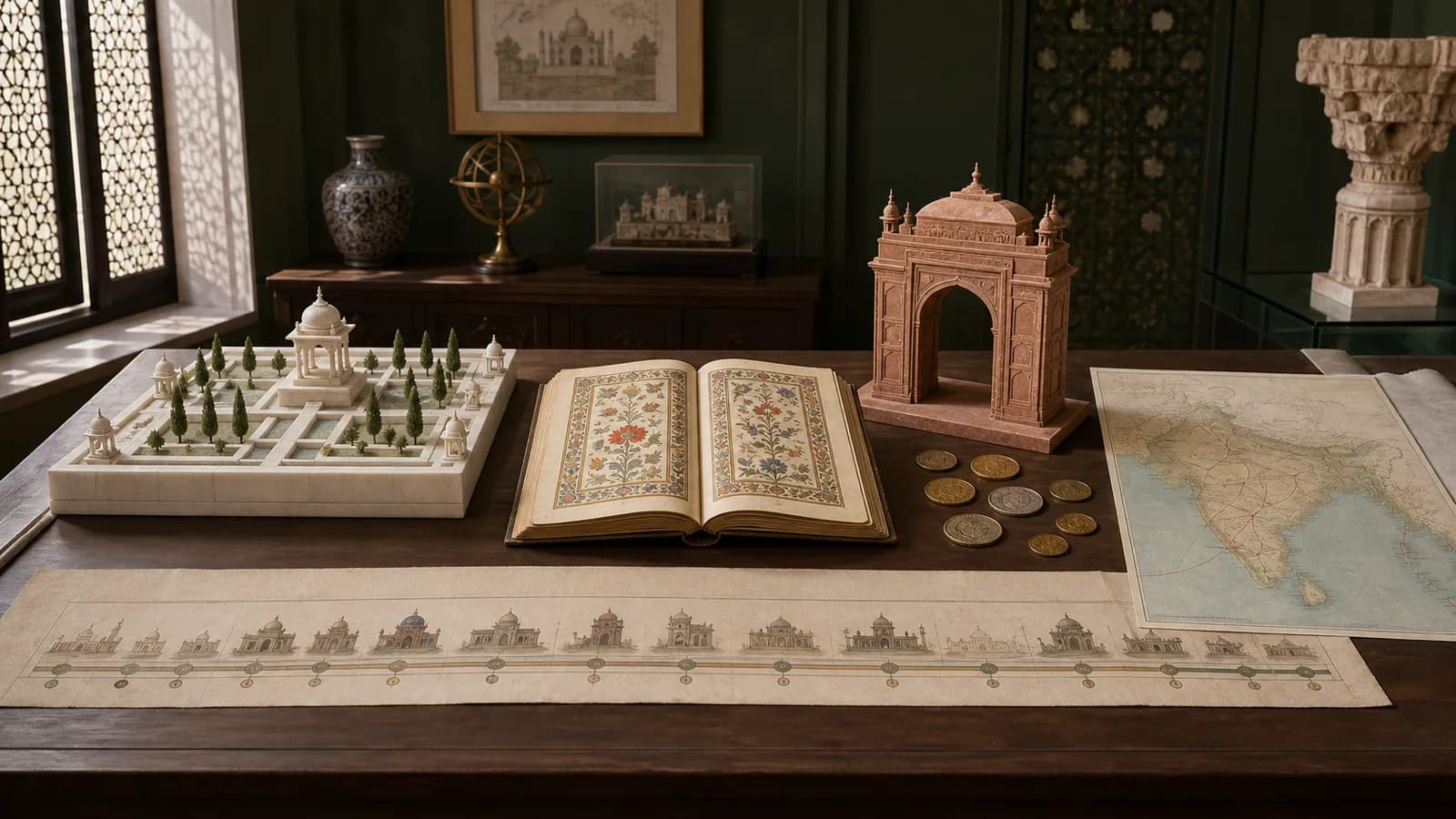
The Mughal Empire is conventionally dated from Babur’s victory at Panipat in 1526 to the removal of Bahadur Shah Zafar after the 1857 uprising. The sequence was not continuous: Humayun lost North India to the Suris from 1540 to 1555, and after 1707 Mughal emperors increasingly shared or lost effective power while retaining dynastic legitimacy.
What dates define the Mughal Empire?
The most useful classroom frame is 1526–1857, but each endpoint needs explanation. The First Battle of Panipat on 21 April 1526 gave Babur a base at Delhi and Agra; it did not instantly create every institution later associated with Mughal rule. The dynasty was driven from North India in 1540, restored in 1555 and consolidated under Akbar after 1556. In 1857 rebel soldiers in Delhi proclaimed the elderly Bahadur Shah Zafar their symbolic leader. His British trial and exile in 1858 ended the throne. A timeline should therefore distinguish military foundation, restoration, territorial high points, loss of effective sovereignty and formal dynastic abolition.
Why the emperor list needs an interruption
Lists that run straight from Babur to Akbar conceal the Suri state. Sher Shah Suri defeated Humayun, governed North India and developed practices in roads, currency, revenue and administration that later Mughal rulers encountered and adapted. Humayun’s return depended on changing regional alliances and support connected to Safavid Iran. He recovered Delhi and Agra in 1555 but died in January 1556. Akbar inherited a restored yet insecure monarchy. Keeping the 1540–1555 interruption visible prevents a dynasty chart from becoming a myth of inevitable expansion.
Babur founded a dynasty, not a finished empire
Babur was a Timurid prince from Central Asia who took Kabul in 1504 and turned toward North India after repeated struggles for Samarkand. At Panipat his forces defeated Ibrahim Lodi, but army-size figures vary and should be attributed rather than repeated as exact totals. The 1527 campaign at Khanwa and subsequent operations defended the conquest against powerful rivals. Babur died in 1530, leaving Humayun territory but no automatic succession rule or fully stabilized state. His Chagatai memoir, later translated and illustrated under Akbar, is evidence for Babur’s own world and for how later Mughals reconstructed their founder.
Akbar’s consolidation was political and institutional
Akbar became emperor in 1556 while still young, with Bairam Khan initially directing the regency. Over a long reign he expanded through war, diplomacy and alliances while developing the mansab ranking system, jagir assignments, provincial administration and more standardized revenue practices. Rajput rulers and many other groups entered imperial service through unequal but consequential partnerships. Court debates, Ajmer pilgrimages, the Ibadat Khana and the policy vocabulary of sulh-i kull belonged to sacred kingship as well as religious encounter. Calling Akbar merely tolerant or secular misses how inclusion, hierarchy and state capacity reinforced one another.
Jahangir and Shah Jahan were not a pause between great rulers
Jahangir inherited mature institutions in 1605 and produced his own memoir, while painters, natural-history observation and court portraiture developed in new directions. Nur Jahan exercised major influence through family networks, patronage and access to the emperor; describing this only as a ruler’s weakness ignores the workings of court politics. Shah Jahan secured the throne after another succession contest in 1628. His reign joined military campaigns and fiscal pressure to a highly ordered language of architecture. The Taj Mahal was one riverfront funerary complex within a wider program, not a monument detached from imperial sovereignty.
Aurangzeb, expansion and the limits of a territorial peak
Aurangzeb defeated his brothers and deposed Shah Jahan in 1658. His reign lasted nearly fifty years and extended Mughal military presence far into the Deccan. A larger map, however, does not prove equally strong administration everywhere. Long wars strained revenue and military systems, regional powers adapted, and imperial officers pursued their own interests. Religious policy also changed across time and place; selected temple destructions, grants, taxation and legal patronage require evidence-specific treatment rather than a single verdict. Aurangzeb’s death in 1707 opened another succession war, but it did not make the empire disappear overnight.
What happened after Aurangzeb died in 1707?
Later Mughal history was not an empty decline. Emperors, ministers, regional governors, bankers, military entrepreneurs and successor states renegotiated power. Bahadur Shah I won the first succession struggle, followed by rapid turnovers and the influence of kingmakers such as the Sayyid brothers. Muhammad Shah’s long reign included significant court culture even as Nadir Shah’s 1739 invasion exposed military weakness and devastated Delhi. Awadh, Bengal, Hyderabad, Maratha formations, Afghan rulers and other powers used, challenged or reworked Mughal titles and fiscal practices. Fragmentation redistributed sovereignty; it did not erase Mughal political language.
How did the East India Company acquire power?
Company rule did not replace the Mughal Empire in one battle. Commercial privileges, private armies, alliances and victories accumulated over decades. After the Battle of Plassey in 1757 and the Battle of Buxar in 1764, the Company received the diwani, or revenue-collection authority, for Bengal, Bihar and Orissa from Shah Alam II in 1765. The arrangement used imperial legitimacy while transferring fiscal power. By 1803 Company forces controlled Delhi, but Mughal court ritual and the emperor’s name still carried meaning. Effective coercion, revenue authority, legal claims and symbolic sovereignty therefore changed at different speeds.
Why 1857 and 1858 are both end dates
In May 1857 soldiers rebelling at Meerut moved to Delhi and proclaimed Bahadur Shah Zafar as an emblematic sovereign. The uprising drew in soldiers, princes, landlords, peasants, artisans and urban groups for different reasons; it was not controlled by one unified Mughal command. British forces retook Delhi in September. Zafar was tried in 1858 and exiled to Rangoon, while the British Crown replaced East India Company government. Thus 1857 marks the collapse of the last political restoration attempt and 1858 the legal-punitive abolition of the throne. Both dates are valid when their meanings are stated.
Administration, revenue and the mansab system
Mughal power rested on people and revenue, not only emperors and battles. Mansab ranks organized status and service; jagirs assigned claims on revenue rather than simple private ownership of land. Provincial officials, zamindars, merchants, cultivators, soldiers and court households negotiated assessment and collection. Systems changed across reigns and regions, and the state never possessed identical reach in every village. Agricultural production and commercial networks funded armies and patronage, while extraction could be burdensome. A serious timeline connects institutional capacity to expansion and shows why fiscal pressure mattered during later regionalization.
Languages, religions and court culture
The dynasty was Muslim and Timurid, but its empire was built in a diverse South Asian world. Persian became a major language of administration and elite history; Babur wrote in Chagatai; regional languages and Sanskrit traditions interacted with court projects; and Urdu developed through changing urban and military settings. Muslims, Hindus, Jains, Christians and others served, traded, petitioned and produced knowledge under unequal conditions. Court paintings, architecture and manuscripts were collaborative objects shaped by patronage and workshop hierarchy. They cannot be treated as transparent photographs of society, yet they preserve evidence unavailable in political chronicles.
How to read Mughal sources without repeating a court myth
Start by identifying who produced the evidence and for whom. The Baburnama is a ruler’s memoir whose later Persian translation and illustrations belong to Akbar’s court. The Akbarnama used records and testimony but also presented Abu’l Fazl’s theory of kingship. Jahangir’s memoir, European visitor reports, regional histories, paintings, coins, inscriptions and buildings answer different questions. Colonial archives describe the dynasty through the needs of conquest and punishment. Compare dates, patronage and genre before accepting claims about army size, private belief, architectural authorship or a single cause of decline.
Mughal emperors and succession, 1526–1857
This table follows the principal throne sequence. It separates Humayun’s interrupted reign and the Suri interregnum, while excluding short-lived rebels who never secured broad recognition as emperor.
| Ruler or interruption | Reign | What changed | Qualification |
|---|---|---|---|
| Babur | 1526–1530 | Won at Panipat and established a Timurid foothold in North India. | Foundation did not yet mean durable control. |
| Humayun | 1530–1540 | Inherited a contested empire and lost it to Sher Shah Suri. | First reign ended in exile. |
| Suri interregnum | 1540–1555 | Sher Shah and his successors ruled much of North India. | Not a Mughal reign; essential to the chronology. |
| Humayun restored | 1555–1556 | Recovered Delhi and Agra shortly before his death. | Second reign lasted less than a year. |
| Akbar | 1556–1605 | Expanded territory and consolidated fiscal, military and political institutions. | Bairam Khan initially acted as regent. |
| Jahangir | 1605–1627 | Maintained the imperial system while court factions and Nur Jahan gained influence. | Court politics cannot be reduced to imperial passivity. |
| Shah Jahan | 1628–1658 | Developed a highly ordered court and major architectural program. | Deposed and confined after the succession war. |
| Aurangzeb | 1658–1707 | Extended rule deep into the Deccan during a long and costly reign. | Territorial reach and administrative control were not identical. |
| Bahadur Shah I | 1707–1712 | Won the succession struggle but ruled a less cohesive imperial field. | Often called Shah Alam I in some records. |
| Jahandar Shah | 1712–1713 | Brief reign exposed the power of military and court coalitions. | Defeated by Farrukhsiyar. |
| Farrukhsiyar | 1713–1719 | Ruled with the powerful Sayyid brothers before being deposed. | Imperial authority depended heavily on kingmakers. |
| Rafi ud-Darajat | 1719 | One of two very short-lived emperors installed by the Sayyid brothers. | Reign lasted only months. |
| Shah Jahan II | 1719 | Succeeded Rafi ud-Darajat during the same succession crisis. | Also known as Rafi ud-Daulah. |
| Muhammad Shah | 1719–1748 | Long reign included cultural vitality and the 1739 invasion of Nadir Shah. | The Delhi sack did not instantly end the dynasty. |
| Ahmad Shah Bahadur | 1748–1754 | Court conflict deepened as regional and military powers expanded. | Effective authority was narrower than the imperial title. |
| Alamgir II | 1754–1759 | Reigned amid Afghan, Maratha and factional pressure. | Killed during a struggle dominated by powerful ministers. |
| Shah Alam II | 1759–1806 | Survived changing alliances and Company expansion; returned to Delhi in 1772. | The 1765 diwani marked a major Company fiscal transfer. |
| Akbar II | 1806–1837 | Retained a court and symbolic authority under Company dominance. | Sovereignty was highly constrained. |
| Bahadur Shah II | 1837–1857/1858 | Became the symbolic leader proclaimed by rebels in Delhi in 1857. | Tried and exiled in 1858; the throne ended. |
Ten turning points in the Mughal timeline
These dates distinguish conquest, restoration, institutional consolidation, fragmentation and the final abolition of the throne.
| Date | Turning point | Why it belongs in the timeline |
|---|---|---|
| 21 April 1526 | First Battle of Panipat | Babur defeated Ibrahim Lodi and gained Delhi and Agra. |
| 1540 | Humayun lost North India | The Suri interruption disproves a simple uninterrupted 1526–1857 line. |
| 1555–1556 | Restoration and Akbar’s accession | The dynasty returned, then faced another vulnerable succession. |
| 1570s–1580s | Akbar’s institutional consolidation | Revenue, rank, provincial government and court ideology developed together. |
| 1605 | Jahangir succeeded Akbar | The first mature transfer of the consolidated imperial system. |
| 1628 | Shah Jahan took the throne | A succession conflict preceded the architectural high point of his reign. |
| 1658 | Aurangzeb won the succession war | Shah Jahan was deposed and imperial priorities shifted. |
| 1707 | Aurangzeb died | Regionalization accelerated, although Mughal legitimacy remained important. |
| 1739 | Nadir Shah sacked Delhi | The invasion exposed weakness and redistributed wealth and prestige. |
| 1857–1858 | Uprising, trial and exile | Bahadur Shah Zafar’s removal ended the Mughal throne. |
FAQ
Who founded the Mughal Empire?
Babur founded Mughal rule in North India after defeating Ibrahim Lodi at Panipat in 1526. Humayun restored the dynasty after the Suri interruption, and Akbar built the durable imperial system, so foundation, restoration and consolidation are separate stages.
How many Mughal emperors were there?
A principal throne sequence from Babur to Bahadur Shah II contains eighteen named emperors if Humayun’s two reigns are counted as one person and the Suri interruption is listed separately. Totals differ when historians include disputed or briefly proclaimed claimants, so a table should state its rule for inclusion.
Did the Mughal Empire end in 1707?
No. Aurangzeb’s death accelerated succession conflict and regionalization, but later Mughal emperors retained political and symbolic authority. The throne ended only after the 1857 uprising, Bahadur Shah Zafar’s 1858 trial and exile.
Was the Mughal Empire continuously ruled from 1526 to 1857?
No. Humayun lost North India in 1540, and the Suri rulers governed until Mughal restoration in 1555. After the eighteenth century, emperors also retained titles while effective territorial and fiscal power contracted.
Who was the last Mughal emperor?
Bahadur Shah II, better known as Bahadur Shah Zafar, was the last emperor. Rebels in Delhi proclaimed him their symbolic leader in 1857; the British tried and exiled him in 1858.
Related reading
- Babur and the First Battle of Panipat
Examine the 1526 foundation battle and the limits of army-size claims.
- Akbar’s religious policy
Separate sulh-i kull, court debate and later claims about Din-i Ilahi.
- Taj Mahal construction history
Follow the phased construction, full complex and collaborative design evidence.
- Islamic history timeline
Place Mughal South Asia beside other regional and institutional histories.
- Ottoman Empire timeline
Compare two early modern empires without treating their institutions as interchangeable.
- Safavid Empire timeline
Trace the Iranian power that shaped Humayun’s restoration and Mughal diplomacy.
- The Mughal Family Tree Explained: From Babur to Bahadur Shah II
A source-based guide to the Mughal imperial line, major father-son links, contested successions and why the family tree is not a simple eldest-son list.
Connected by Babur.
- How Akbar Joined Religious Inclusion to Imperial Power
How Ajmer pilgrimages, the Ibadat Khana, the 1579 mahzar and sulh-i kull shaped Akbar's rule, and why Din-i Ilahi was not a mass organized religion.
Connected by Akbar.
- How Akbar's Hamzanama became a 1,400-painting manuscript
What Akbar's Hamzanama depicted, how its unusually large paintings were made, why museum dates and surviving-folio counts differ, and what individual leaves can prove.
Connected by Akbar.
- Babur and the First Battle of Panipat, 1526: Mughal Foundation and Facts
A source-aware guide to Babur, the battle of 21 April 1526, Kabul and North India, the limits of army-number claims, Mughal consolidation and the Baburnama.
Connected by Babur.
Sources
- Cambridge Core: The Mughal Empire
Broad political, institutional, fiscal and world-historical framework from creation through breakup.
- Metropolitan Museum of Art: The Art of the Mughals before 1600
Babur, Humayun, Akbar, early consolidation, court workshops and Fatehpur Sikri.
- Metropolitan Museum of Art: The Art of the Mughals after 1600
Jahangir, Shah Jahan, Aurangzeb, later court patronage and fragmentation.
- Panipat District Government: First Battle of Panipat
Official local account of the 21 April 1526 foundation battle.
- Cambridge Core: Babur, Timurid Prince and Mughal Emperor
Dynastic identity, Central Asian background and evidence from Babur's own writing.
- Smithsonian National Museum of Asian Art: Making the Baburnama
Memoir, Persian translation and illustrated manuscript transmission.
- Cambridge Core: Safavid, Mughal and Ottoman Empires
Akbar's administration, Ibadat Khana and development of sulh-i kull.
- Victoria and Albert Museum: The arts of the Mughal Empire
Akbarnama, imperial workshop, religious encounter and Mughal visual culture.
- UNESCO World Heritage Centre: Taj Mahal
Construction chronology, full complex, artisans, architecture and heritage protection.
- Government of India Taj Mahal portal: Creation history
Design team, construction phases and specialist roles.
- Cambridge Core: The 1857 Indian Uprising and the British Empire
Bahadur Shah Zafar's symbolic leadership, the fall of Delhi and the political end of Mughal sovereignty.
- Cambridge Core: Trials of Sovereignty
Trial, punishment and colonial transformation of the last Mughal sovereign after 1857.
- Cambridge Core: The Princes of the Mughal Empire, 1504–1719
Used for succession practice from Babur through Aurangzeb and the difference between an open Timurid contest and automatic primogeniture.
- Cambridge Core: Mughal historians on the making of imperial paramountcy
Used to compare Babur, the Suri interruption, Akbar, Jahangir, Shah Jahan and Aurangzeb without reducing the empire to a ruler list.
Languages
- الخط الزمني لإمبراطورية مغول الهند (1526–1857): الأباطرة والخلافة
- মুঘল সাম্রাজ্য ১৫২৬–১৮৫৭: সময়রেখা, সম্রাট ও উত্তরাধিকার
- Cronologia de l'Imperi mogol (1526–1857): emperadors i successió
- Časová osa Mughalské říše (1526–1857): císaři a nástupnictví
- Mughalrigets tidslinje (1526–1857): Kejsere og tronfølge
- Zeittafel des Mogulreichs (1526–1857): Kaiser und Nachfolge
- Αυτοκρατορία των Μουγκάλ 1526–1857: χρονολόγιο και αυτοκράτορες
- Mughal Empire Timeline (1526–1857): Emperors, Wars and Succession
- Cronología del Imperio mogol (1526–1857): emperadores y sucesión
- Mogulivaltakunnan aikajana 1526–1857: hallitsijat ja perimys
- Chronologie de l’Empire moghol (1526–1857) : empereurs et succession
- Linimasa Kekaisaran Mughal (1526–1857): Kaisar dan Suksesi
- Cronologia dell’Impero Moghul (1526–1857): imperatori e successione
- ムガル帝国の年表(1526–1857年):皇帝の順番と継承
- 무굴 제국 연대표(1526–1857): 황제 순서와 계승
- Garis Masa Empayar Mughal (1526–1857): Maharaja dan Penggantian
- Tijdlijn van het Mogolrijk (1526–1857): keizers en opvolging
- Mughalrikets tidslinje (1526–1857): Keisere og arvefølge
- Imperium Mogołów (1526–1857): chronologia cesarzy i sukcesji
- Cronologia do Império Mogol (1526–1857): imperadores e sucessão
- Империя Великих Моголов (1526–1857): хронология и правители
- Časová os Mughalskej ríše (1526–1857): cisári a nástupníctvo
- Mughalrikets tidslinje (1526–1857): Kejsare och tronföljd
- จักรวรรดิโมกุล ค.ศ. 1526–1857: ลำดับเวลาและจักรพรรดิ
- Babür İmparatorluğu Kronolojisi (1526–1857): Hükümdarlar ve Taht Sırası
- موغۇل ئىمپېرىيەسى 1526–1857: ۋاقىت جەدۋىلى ۋە پادىشاھلار
- Dòng thời gian Đế quốc Mughal (1526–1857): hoàng đế và kế vị
- 莫卧儿帝国时间线(1526—1857):皇帝、战争与继承顺序
- 莫臥兒帝國時間線(1526—1857):皇帝、戰爭與繼承順序
- 蒙兀兒帝國時間線(1526—1857):皇帝、戰爭與繼承順序