How Ibn Battuta's Journeys Became the Rihla
A dated reconstruction of Ibn Battuta's travels from 1325 to 1354, how Ibn Juzayy shaped the Rihla, and which routes, distances and passages remain disputed.
The journey and the book at a glance
| Question | What the evidence supports |
|---|---|
| Where did he begin? | Tangier in the western Maghreb, initially intending to visit Mecca and Medina. |
| When did he leave? | 2 Rajab 725 AH, conventionally converted to 14 June 1325. |
| When did the journeys end? | Early 1354; his 1349 return to Morocco was not his final journey. |
| Who produced the surviving narrative? | Ibn Battuta supplied the travel account; Ibn Juzayy shaped the written work under Sultan Abu Inan's patronage. |
| Is every reported stop equally secure? | No. Specific passages require separate tests of chronology, geography, textual borrowing and corroboration. |
| What does the familiar distance mean? | About 75,000 miles is a reconstruction of an itinerary, not an odometer reading from the fourteenth century. |
The distinction between a journey and its surviving account explains much of the book's value. A traveler can remember a conversation accurately while confusing a date; an editor can preserve useful local information while incorporating earlier literature. Confidence therefore belongs to particular statements and route segments, rather than to one verdict on the entire work.
From a pilgrimage to a much larger itinerary
The opening of the Rihla, available in H. A. R. Gibb's 1929 translation through Fordham's Medieval Sourcebook, names Tangier and gives the departure date in the Islamic calendar. It also describes the pain of leaving his parents and an initial absence of traveling companions. That personal beginning should not make the subsequent journey appear solitary: he soon joined other travelers, merchants and official parties.
His intended destination was the pilgrimage, not a prearranged tour of dozens of modern countries. Opportunities, advice, danger, illness and patronage repeatedly changed his direction. In the Egyptian portion, an attempted Red Sea crossing at Aydhab became impossible because of conflict. The narrative then follows a return toward Cairo and travel through Syria to the Hijaz. A map that draws only a straight Tangier–Mecca line erases this important example of a route changing in response to conditions.
The calendar also needs care. The account gives his age in lunar years; a modern solar-year calculation produces a different number. Similar conversion problems affect later dates. Where editions disagree about a particular day, preserve the Islamic date and identify the conversion being used instead of silently choosing a more dramatic precision.
A chronology with different levels of certainty
| Period | Principal phase | How to read it |
|---|---|---|
| 1325–1326 | North Africa, Egypt, Syria and the first pilgrimage to Mecca | The departure is explicitly dated; the narrative includes delays and a changed Egyptian route. |
| 1326–1327 | Iraq and western Persia, including Baghdad and Tabriz, followed by another pilgrimage | The account describes movement with official parties and the Baghdad pilgrimage caravan. |
| Late 1320s–early 1330s | Further stays in Mecca and journeys around the Red Sea, Arabia and East Africa | Treat this as a phase, rather than assuming every leg has an uncontested modern date. |
| Early 1330s | Anatolia, the Black Sea and Golden Horde networks before the journey toward India | Some reported detours, especially Bulghar, are contested. |
| 1333–1341/1342 | A long stay in the Delhi Sultanate | Research places him in India from 1333; the endpoint depends on reconstruction. |
| 1340s | Indian Ocean journeys, including the Maldives and Sri Lanka, and accounts extending toward China | The broader maritime world and every claimed eastern visit are different evidentiary questions. |
| November 1349–early 1354 | Return to Morocco, then al-Andalus and the western Sudan, including Mali in 1352–1353 | Returning home did not end the itinerary; the later African journey belongs in any complete overview. |
This chronology groups journeys that the narrative spreads across many episodes. It should not be used to calculate a daily speed or to give every city an exact arrival date. Longer residence, a second visit, travel interrupted by illness and an editor's arrangement can all make a simple arrow sequence misleading.
Caravans, ships and the people who made travel possible
The practical details are often more informative than a total distance. The Egyptian route describes accommodation, provisioning and border inspection. The Baghdad passages describe a governor providing transport and supplies, and a caravan leader caring for Ibn Battuta when he became ill. These are accounts of travel through relationships and institutions, not proof that crossing political boundaries was effortless.
Pilgrimage combined religious purpose with logistics: water, animals, food, protection, departure schedules and leadership. The mahmal and official Hajj caravan guide explains the ceremonial representation of a sponsoring ruler. That background helps separate the symbolism of an official caravan from the practical assistance described in the Rihla. It does not establish that a particular mahmal accompanied each of Ibn Battuta's journeys.
Sea travel introduced another set of dependencies. A ship's departure, weather and available passage could determine where a traveler went next. In the Red Sea account, unfamiliar vessels and rough conditions make his anxiety visible. Those observations help explain why a modern itinerary should preserve returns, interruptions and changes of transport rather than represent travel as continuous progress eastward.
Learning and court service were part of the itinerary
Ibn Battuta traveled as a Muslim scholar, sought out learned people and religious figures, and became involved in court service. Such identities could help secure hospitality and introductions. They also positioned him within a particular social world: a legal scholar welcomed by patrons did not see a town in the same way as a porter, farmer, enslaved person or local woman.
Christine Chism's chapter in The Cambridge Guide to Global Medieval Travel Writing interprets his changing roles as a means of gaining access across social thresholds. This is a modern reading of the narrative, not a medieval passport document. It encourages a useful question: what relationship made an encounter possible, and what remained outside the narrator's access?
The guide to ijaza, teaching permission and scholarly transmission supplies another relevant distinction. A teacher's permission could concern a particular text or activity; it was not automatically a standardized degree. That helps explain the importance of named teachers and learning networks without claiming that every scholarly meeting in the Rihla produced a surviving license.
The extended Delhi stay makes the difference between tourism and employment especially clear. Claudia Maria Tresso's research places Ibn Battuta there during the reign of Muhammad ibn Tughluq, from 1333 to about 1341–1342. Years within a political environment can produce detailed information, but court proximity also shapes what a narrator knows, fears and chooses to report.
Baghdad and Mali show the limits of a traveler's viewpoint
In the Baghdad account, destruction and continued urban activity coexist. The narrative describes damaged institutions alongside bridges, markets and bathhouses. It also relates gifts and arrangements for departure. The passage should not be reduced either to a flourishing city untouched by conquest or to an empty ruin with no subsequent life. A city can lose political centrality and still sustain residents, institutions and travel networks.
The Mali journey offers a different set of observations. The narrative describes salt mining and exchange, guides, food supplies, hospitality and the court of Mansa Sulayman. His comparisons reveal both curiosity and frustration. Being present is valuable evidence, but his judgments about gifts, manners and women's conduct are shaped by his own expectations. Reported custom, moral evaluation and an estimate of market exchange are not interchangeable kinds of information.
For the larger political setting, read the history of the Mali Empire, its trade and gradual fragmentation. For an earlier journey in the opposite direction, the Mansa Musa pilgrimage source guide examines the 1324–1325 royal pilgrimage. Ibn Battuta visited Mali decades later, after Musa's death: he was not an eyewitness to Musa's Cairo gold distribution.
Material history can test the scope of a comparison. The Metropolitan Museum's record for a Fulbe hoddu discusses mid-fourteenth-century references to related lutes by al-Umari and Ibn Battuta. The museum object and its scholarly interpretation illuminate a musical tradition. They do not prove the whole itinerary, and the displayed instrument must not be described as one personally carried by Ibn Battuta.
How recollections became the Rihla
After the journeys, Sultan Abu Inan commissioned the account and Ibn Juzayy worked on its written form. Tresso's discussion distinguishes completion in December 1355 from final work recorded in February 1356. Those are dates in the book's production, not extra years of travel. The precise division of work between narrator and editor remains difficult to establish.
The full title is commonly rendered as A Gift to Those Who Contemplate the Wonders of Cities and the Marvels of Traveling. The shorter name Rihla means a journey or travel account. It places the book within a literary practice in which description, learning, religious visitation, marvels and remembered encounters could share a narrative. Expecting a modern field notebook obscures that form.
We cannot reconstruct a complete set of original travel notes from the surviving work. This does not justify asserting that he never used notes. The defensible distinction is between an unknown working record and the later written narrative that survives through manuscripts and editions. Memory, oral narration, editorial selection and copying each present different questions.
Manuscripts and editions are separate layers of evidence
The nineteenth-century Arabic–French edition by Charles Defrémery and Beniamino Raffaello Sanguinetti was published from 1853 to 1858. The Bibliothèque nationale de France catalog records a 1968 facsimile of that edition. A facsimile's date and the underlying edition's date should therefore both be identified; neither is a date for Ibn Battuta's departure or the first writing of the work.
Tresso identifies BnF Arabe 2291 as containing a signature attributed to Ibn Juzayy and a February 1356 date. Other manuscript witnesses are later copies. A witness associated with the editor and a later complete copy serve different purposes: the former is important for textual history, while the latter may preserve passages or readings absent from an incomplete earlier witness.
The Library of Congress record describes a 1904 Arabic printed edition digitized from a resource at the Bibliotheca Alexandrina. Its catalog description is useful for identifying that edition. The digitization is not the original manuscript, and this article does not claim to have collated its hundreds of Arabic pages. Readers comparing editions should record the language, translator, selection, page numbering and editorial notes before treating a difference as a change in the medieval account.
Borrowed passages and disputed visits require local tests
Amikam Elad's study argues that substantial sections of the Palestine description derive from al-Abdari's earlier travel writing. This is a specific textual argument. It means that the description cannot always be treated as an independent second eyewitness to a building or practice. It does not, on its own, prove that every journey or observation in the Rihla was invented.
Bulghar provides a different test. Stephen Janicsek's 1929 article compares the reported detour with distance, duration, river crossings and the absence of expected detail. His argument challenges the visit's credibility. It illustrates how a chronology can be questioned through several kinds of evidence together; merely finding an unfamiliar place name would be a much weaker objection.
The China passages have also generated disagreement. Elad's notes document different scholarly positions rather than one settled verdict. A responsible overview should say that the reported eastern reach is contested and distinguish the existence of maritime connections from proof of every claimed personal visit. Neither a confident modern route map nor an inconsistent passage can replace a case-by-case examination.
| Evidence type | What it can establish | What it cannot establish alone |
|---|---|---|
| A dated departure in the narrative | What the account explicitly says about its starting point | Independent confirmation of all later dates |
| A borrowed description | A literary relationship between texts | The complete absence of personal travel |
| A plausible ship or caravan route | How a journey could have happened | That this traveler followed every proposed leg |
| A manuscript signature or colophon | Evidence about a particular textual witness | A travel diary for all the preceding decades |
Distances and modern country counts depend on reconstruction
The approximately 75,000-mile total appears in modern scholarly summaries, including Chism's chapter. It expresses the extraordinary scale of the reconstructed travels. It does not carry the precision of a measured track. Choosing a different disputed detour, identifying a medieval locality differently or handling repeat journeys differently can change a total.
Country counts introduce an additional problem. Fourteenth-century courts, cities, regions and travel corridors do not coincide with today's borders. A single political or commercial network may now cross several states. An attractive claim such as “visited forty countries” needs a stated map, counting method and treatment of disputed stops before it can be compared with another count.
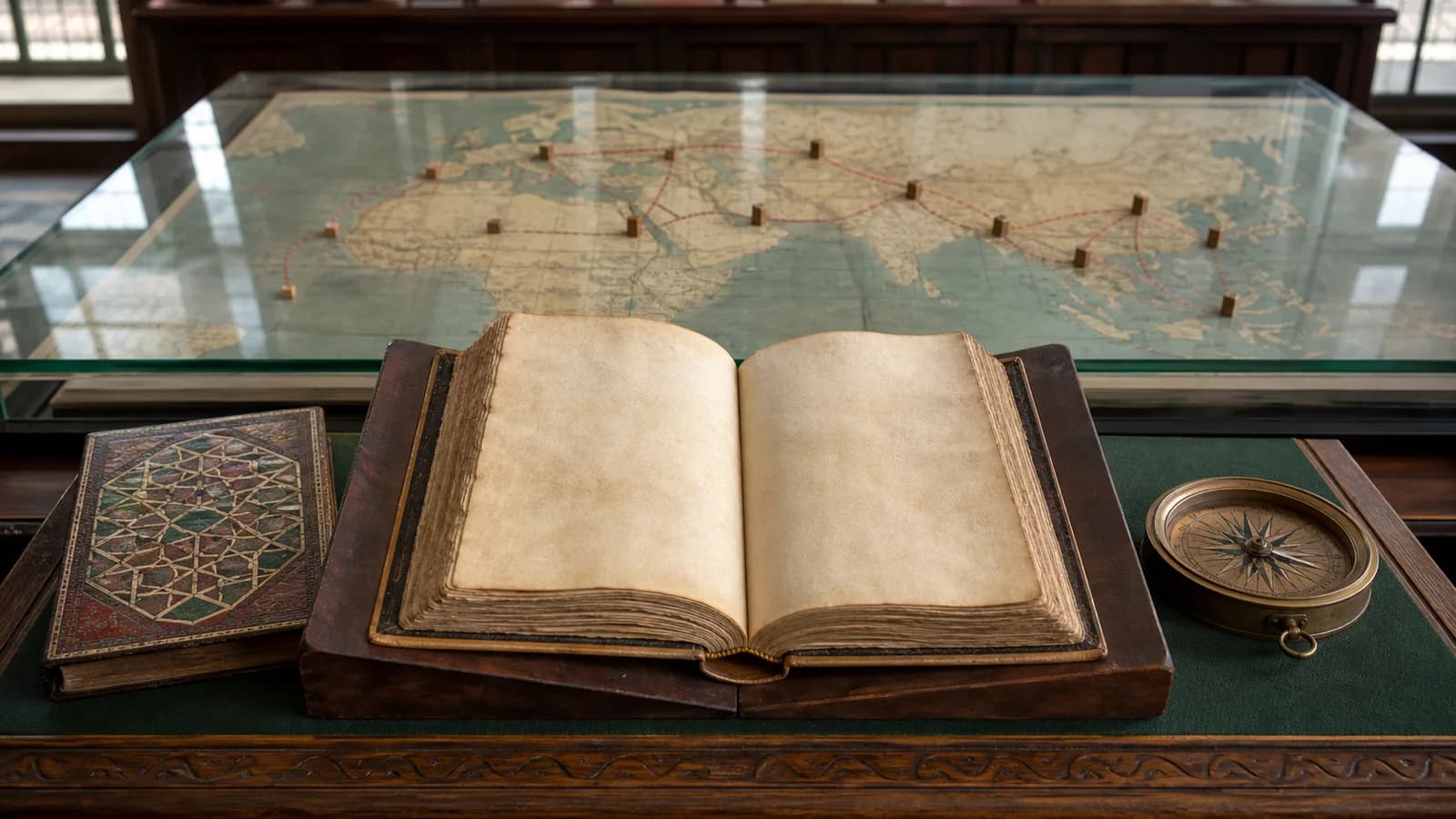
For a defensible map, distinguish secure chronological anchors, broad reconstructed corridors and contested extensions with a visible legend. Show repeated visits rather than erasing them, and explain whether the map follows the text's narrative order or a historian's revised chronology. For a classroom quotation, cite the edition and page, identify whether the passage records observation or reported information, and keep the narrator's judgment separate from the historian's conclusion.
Sources
These references have different functions. A translated primary account supplies reported experiences; research tests particular passages; catalog and museum records establish the identity and limits of particular editions or objects. The three Cambridge research articles and the Cambridge book chapter share a publisher and should not be counted as four independent institutions.
- Ibn Battuta, Travels in Asia and Africa, 1325–1354, translated and edited by H. A. R. Gibb (1929), via Fordham's Medieval Sourcebook: the primary-account selection used for departure, the changed Egyptian route, Baghdad caravan assistance and Mali observations. It remains an edited translation, rather than an unmediated transcript.
- Claudia Maria Tresso, “India's epidemics in the Riḥla of Ibn Baṭṭūṭa: plague, cholera or lexical muddle?”: its introductory and manuscript discussion supports the Delhi period, narrative production dates and Arabe 2291 witness. Its main research concerns epidemic terminology, not verification of every route.
- Amikam Elad, “The description of the travels of Ibn Baṭṭūṭa in Palestine: is it original?”: the extract argues for borrowing from al-Abdari; the visible notes document competing judgments about disputed visits. The entire paywalled article was not inspected.
- Stephen Janicsek, “Ibn Battuta's Journey to Bulghar: Is it a Fabrication?” (1929), Hungarian Academy of Sciences library scan: the distance, timing and geographic arguments are used to explain why this detour is contested, without extending that conclusion to the whole book.
- Christine Chism, “Ibn Battuta,” The Cambridge Guide to Global Medieval Travel Writing: the accessible summary supplies the approximately 75,000-mile reconstruction and an interpretation of changing traveler identities; the full chapter was not inspected.
- Bibliothèque nationale de France, catalog record for Voyages d'Ibn Battûta: identifies the 1968 facsimile and its relationship to the 1853–1858 Arabic–French edition. A bibliographic record does not independently verify a medieval stop.
- Library of Congress, Ibn Battuta's Rihla: the official catalog record identifies the 1904 Arabic print and its Bibliotheca Alexandrina provenance; the record was read through the library's JSON endpoint after the ordinary page failed to load.
- The Metropolitan Museum of Art, “Hoddu (Xalam)”: its object interpretation discusses medieval lute references. It is used for the scope of material-cultural comparison, not as evidence for every journey.
- University of Chicago Press, David Waines, The Odyssey of Ibn Battuta: the publisher's description and contents introduce a modern study of travel, hospitality and the narrator's worldview. They are a further-reading guide; the complete book was not read for this article.


