Mansa Musa’s Hajj (1324–1325): Route, Gold in Cairo and Evidence
A source-critical guide to Mansa Musa’s 1324–1325 pilgrimage, including Cairo, the uncertain route, caravan numbers, gold-price claims, Timbuktu and the modern net-worth myth.
Who was Mansa Musa?
Mansa Musa ruled the Mali Empire in the early fourteenth century, when its authority connected Mande political centers, Niger River towns, agricultural zones, gold-producing regions and trans-Saharan commerce. Mansa was a title of rulership, not a surname. Musa was Muslim and undertook the hajj as both a religious obligation and a royal journey. External writers knew relatively little about Mali before the expedition. His passage through Cairo created a body of remembered reports that made Mali more visible in Arabic geography and later European cartography. That visibility explains why the pilgrimage dominates his modern biography, but it should not erase government, agriculture, trade or earlier West African Islam.
Why the date is written as 1324–1325
The expedition belongs to 724–725 AH and crossed parts of two Common Era years. Musa reached Cairo in 1324 and continued to the Hijaz; the journey, pilgrimage and return cannot be compressed into one modern calendar year without losing chronology. Recent research also emphasizes how poorly documented parts of the Arabian itinerary remain. The safest label is therefore the 1324–1325 hajj, while using Cairo in 1324 as the strongest external anchor. Pages that present one departure day, every stop and an exact return date often create precision not present in the surviving records.
What route did the caravan take?
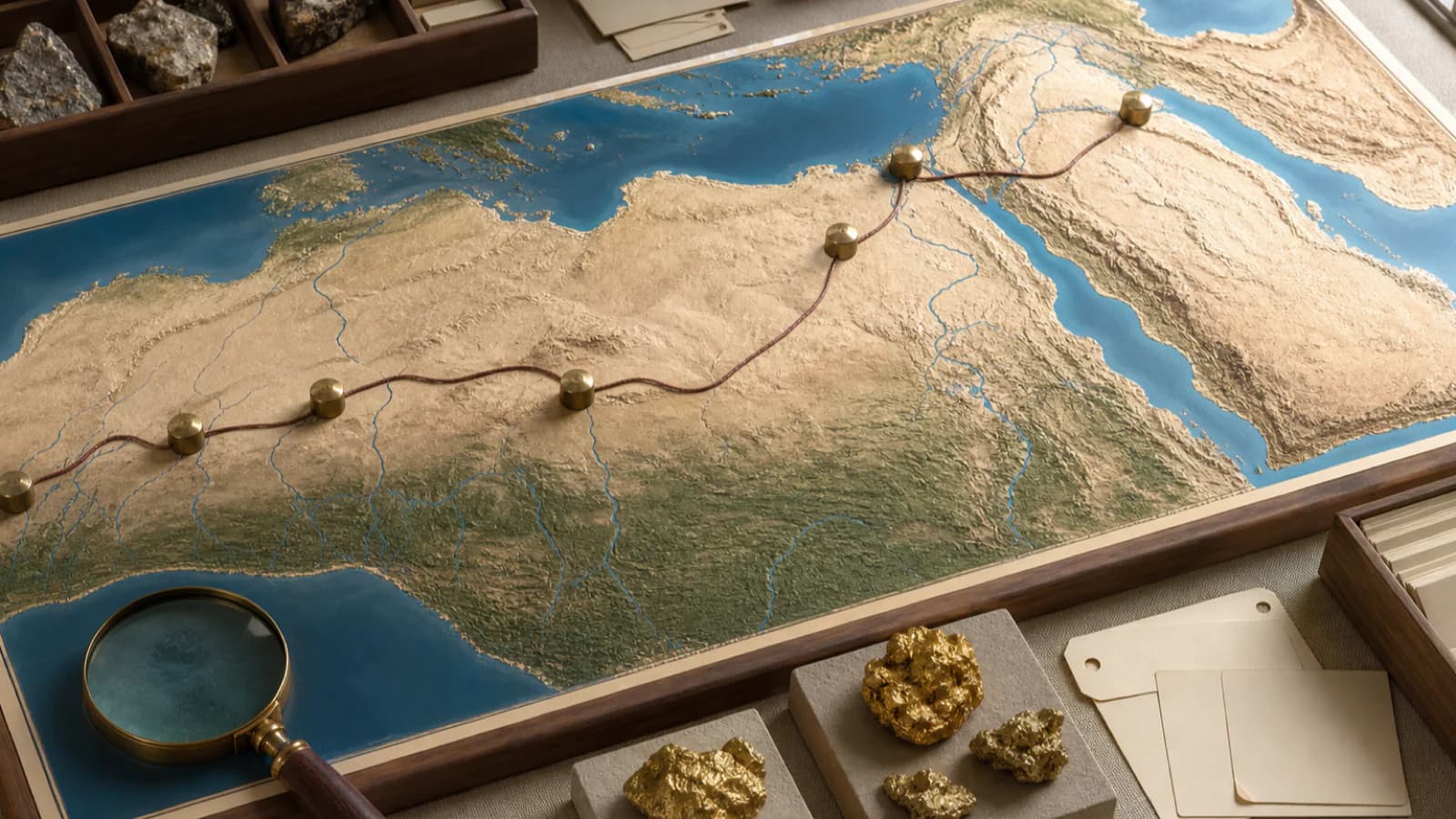
Musa’s party moved from Mali across Saharan routes to Egypt, then from Cairo toward the Hijaz and Mecca. Those broad stages are secure. A precise line depends on reconstructing corridors used by other caravans, later descriptions and uncertain place identifications. The expedition required water planning, food, pack animals, guides, guards and coordination across political frontiers. Its logistics demonstrate state resources even if the highest reported entourage number is rejected. A responsible map should draw a broad probable corridor, mark Cairo and Mecca as firm anchors, and label proposed Saharan and Arabian stages with confidence rather than presenting a single GPS-like track.
What happened in Cairo?
Al-Umari visited Cairo after Musa’s journey and recorded reports from people who remembered the royal party. The narratives describe formal interaction with the Mamluk sultan al-Nasir Muhammad, questions of court protocol and conspicuous gifts and spending. Musa’s reluctance or negotiation over prostration before the sultan appears within a literary account of sovereignty and etiquette, not a transcript. Cairo is crucial because it provides externally remembered detail close to the event. It is still mediated testimony collected later, so speeches, motives and exact quantities require more caution than the basic facts of the visit and display.
How many people and camels traveled with Musa?
Popular accounts repeat 60,000 people, 12,000 enslaved attendants and long lines of camels carrying gold. Surviving traditions transmit several large totals, and medieval numbers can signal magnitude, order and magnificence as well as a census. Copying the largest number into an infographic removes attribution and uncertainty. What the evidence can sustain is that Musa traveled with an exceptionally large courtly, devotional and logistical party that included officials, guards, servants, enslaved people, merchants and animals. Enslaved participants must not disappear behind the spectacle. Exact totals should remain quotations from identified sources, not a reconstructed headcount.
How much gold did Mansa Musa carry?
Mali’s power was connected to gold-producing regions and the taxation and protection of trade, but rulers did not necessarily own every mine or nugget as private property. Reports agree that Musa brought and distributed extraordinary quantities of gold. They disagree on loads, bearers and gifts. Weight conversions also depend on what a source meant by a dinar, mithqal or load. The sound conclusion is qualitative and comparative: the caravan displayed resources on a scale that impressed Cairo and affected Mali’s international reputation. A single tonnage should appear only with its source and the conversion assumptions beside it.
Did Mansa Musa crash Cairo’s economy?
Al-Umari associated Musa’s generosity and spending with a lower value of gold relative to silver in Cairo. This supports a significant disturbance in the local gold market. It does not by itself prove that every Egyptian price rose, that the entire economy collapsed or that one measured effect lasted exactly twelve years. Gold and silver exchange, commodity prices, credit and state finance were related but not identical. Later retellings turn a reported monetary effect into a modern macroeconomic disaster because the larger claim is more dramatic. The accurate formulation is narrower: Musa’s release of gold was remembered as affecting Cairo’s gold value, while the scale and duration remain debated.
Was Mansa Musa the richest person in history?
No reliable historical method can rank Musa against industrialists, monarchs and billionaires from other centuries. Medieval sovereignty joined tribute, taxation, land, trade access, gifts and household resources in ways that do not equal a modern personal investment portfolio. Mali left no complete state accounts or personal asset register for Musa. Exchange-rate calculations cannot convert political authority over gold networks into a 2026 dollar net worth. Calling him exceptionally wealthy and able to mobilize major resources is supported. Calling him worth exactly 400 billion dollars is a modern media construction, not a result found in al-Umari, Ibn Khaldun or an audited medieval ledger.
What changed for Mali after the pilgrimage?
The hajj increased Mali’s visibility in North Africa, the Mediterranean and the wider Islamic world. Diplomatic, commercial and scholarly connections deepened, and later mapmakers represented a gold-holding ruler in West Africa. Traditions associate Musa’s return with mosque patronage at Gao and Timbuktu, including Djingareyber, and with the movement of scholars and builders. Those connections require qualification: West African earthen architecture had local histories, and Timbuktu’s later scholarly prominence grew through many patrons, families and political periods. Musa amplified networks; he did not single-handedly import civilization into an empty region.
What do the Catalan Atlas and later images prove?
The 1375 Catalan Atlas famously depicts a crowned ruler holding gold in West Africa. It demonstrates that knowledge of Mali’s wealth circulated in Mediterranean Europe decades after the hajj. It is not a portrait made from life, a scale map of Mali’s borders or proof of Musa’s clothing and face. Museum objects and maps reveal the routes through which outsiders imagined African power. They should be read beside Arabic reports, West African oral traditions, archaeology and heritage evidence. An image’s fame often tells us as much about later reception as it does about the original event.
Which sources are closest to the event?
Al-Umari’s account is central because he collected memories in Cairo within a generation of the visit, although he did not accompany Musa from Mali to Mecca. Ibn Khaldun wrote later and helps reconstruct the succession of Mali rulers. Ibn Battuta visited Mali in 1352–1353, after Musa’s reign, and offers direct observation of a later court rather than eyewitness testimony about the hajj. Later West African chronicles and oral traditions preserve other knowledge but have their own transmission histories. Good research labels whether a writer witnessed, interviewed, compiled or interpreted.
How to cite the hajj without repeating viral myths
Keep the two-year date visible; separate the broad route from speculative stops; attribute every entourage or gold total; describe the Cairo effect as a gold-market claim rather than an entire economic collapse; and do not convert royal resources into a personal dollar net worth. When discussing mosques, distinguish Musa’s patronage traditions from later rebuilding and local architectural practice. Use the Catalan Atlas as evidence of European reception, not a photograph. Most importantly, place the journey inside Mali’s agriculture, governance, trade and religious networks rather than treating one spectacular caravan as the whole history of West Africa.
Mansa Musa hajj claims: evidence strength
The labels describe the surviving evidence, not the importance of the story. A weakly documented detail can still be famous.
| Claim | Assessment | Why |
|---|---|---|
| Musa performed the hajj in 724–725 AH / 1324–1325 CE. | Strong | Multiple Arabic source traditions and modern chronology agree on the expedition. |
| He passed through Cairo in 1324. | Strong | Cairene reports collected by al-Umari provide the main external anchor. |
| The full route can be mapped stop by stop. | Weak | The Arabian and return portions contain major documentary gaps. |
| Exactly 60,000 people traveled with him. | Weak | Surviving reports transmit different large and rhetorical numbers. |
| He distributed extraordinary quantities of gold. | Strong in general, uncertain in total | Independent traditions agree on conspicuous gold, but totals vary. |
| His spending affected Cairo’s gold market. | Plausible to well supported | Al-Umari linked the visit to a lower gold value relative to silver. |
| He crashed Egypt’s whole economy for twelve years. | Overstated | The source supports a gold-price disturbance, not a measured collapse of every market. |
| He was worth exactly $400 billion. | Not historically calculable | No medieval balance sheet or valid cross-century conversion exists. |
What can be reconstructed about the 1324–1325 route?
This itinerary uses confidence labels so a modern map does not turn probable corridors into exact GPS points.
| Stage | What can be said | Confidence |
|---|---|---|
| Mali to the Sahara | A royal caravan left the Mali Empire and entered trans-Saharan routes. | High for the broad movement; low for a complete stop list. |
| Saharan crossing | The party required large supplies, guides, animals and organized logistics. | High in general; exact caravan composition disputed. |
| Cairo | Musa met the Mamluk court and his gold distribution impressed witnesses. | High. |
| Cairo to the Hijaz | The caravan continued through established pilgrimage corridors toward Mecca. | High for direction; incomplete for every station and date. |
| Mecca and the hajj | The pilgrimage was completed during 724–725 AH. | High for the event; weaker for the detailed stay. |
| Return to Mali | Traditions connect the return with scholars, builders and patronage. | High for return; individual recruitment stories need source qualification. |
Frequently asked questions
When did Mansa Musa go on hajj?
He performed the pilgrimage in 724–725 AH, corresponding to 1324–1325 CE. Cairo in 1324 is the strongest external chronological anchor.
What route did Mansa Musa take to Mecca?
He traveled from Mali across the Sahara to Cairo and then toward the Hijaz and Mecca. The broad corridor is secure, but the complete stop-by-stop Arabian and return routes are not.
Did Mansa Musa really lower the price of gold in Cairo?
Al-Umari linked Musa’s spending and gifts to a lower value of gold relative to silver. That supports a market disturbance, but not the stronger claim that he destroyed Egypt’s entire economy for an exactly measured period.
How many people were in Mansa Musa’s caravan?
Sources transmit very large and differing numbers. They show an exceptional royal expedition, not a reliable passenger census; every exact total should be attributed and qualified.
Was Mansa Musa worth 400 billion dollars?
That figure cannot be established from medieval evidence. No complete fiscal record or valid cross-century conversion can turn his political and commercial resources into a modern personal net worth.
Related reading
- Mali Empire history — Place the pilgrimage within Mali’s government, economy and gradual fragmentation.
- Islam in medieval West Africa timeline — Follow trade, conversion, states and scholarship across a longer chronology.
- Timbuktu manuscripts and Sankore — Separate Musa’s patronage traditions from Timbuktu’s later scholarly ecosystem.
- Muslim travelers and geographers timeline — Compare itinerary reconstruction and source types across documented journeys.
- Islamic world map — Use modern geography without projecting current borders backward onto medieval Mali.
Sources
- Cambridge Core: Mansa Musa’s pilgrimage in 724–725 AH / 1324–1325 — Used for the two-year chronology and the poorly documented Arabian part of the route.
- Cambridge Core: The thirteenth- and fourteenth-century kings of Mali — Used to distinguish al-Umari, Ibn Battuta and Ibn Khaldun as different Arabic source layers.
- Metropolitan Museum of Art: The trans-Saharan gold trade — Used for Mali’s gold networks and the reported Cairo market effect.
- Metropolitan Museum of Art: Sahel — Art and Empires — Used for Sahelian states, Islamic networks and the international visibility of Mali.
- British Museum: African kingdoms timeline — Used for an institutional chronology of Mali, Mansa Musa, Timbuktu and Songhai.
- British Museum: Asante Ewer and the circulation of West African gold — Used for the Catalan Atlas context and the long-distance circulation of West African gold.
- UNESCO World Heritage Centre: Timbuktu — Used to qualify the relationship between Musa’s patronage tradition and Timbuktu’s later scholarly history.
- Smithsonian Institution: Djinguereber Mosque, Timbuktu — Used for the museum record connecting the mosque’s patronage tradition with Musa’s return.


