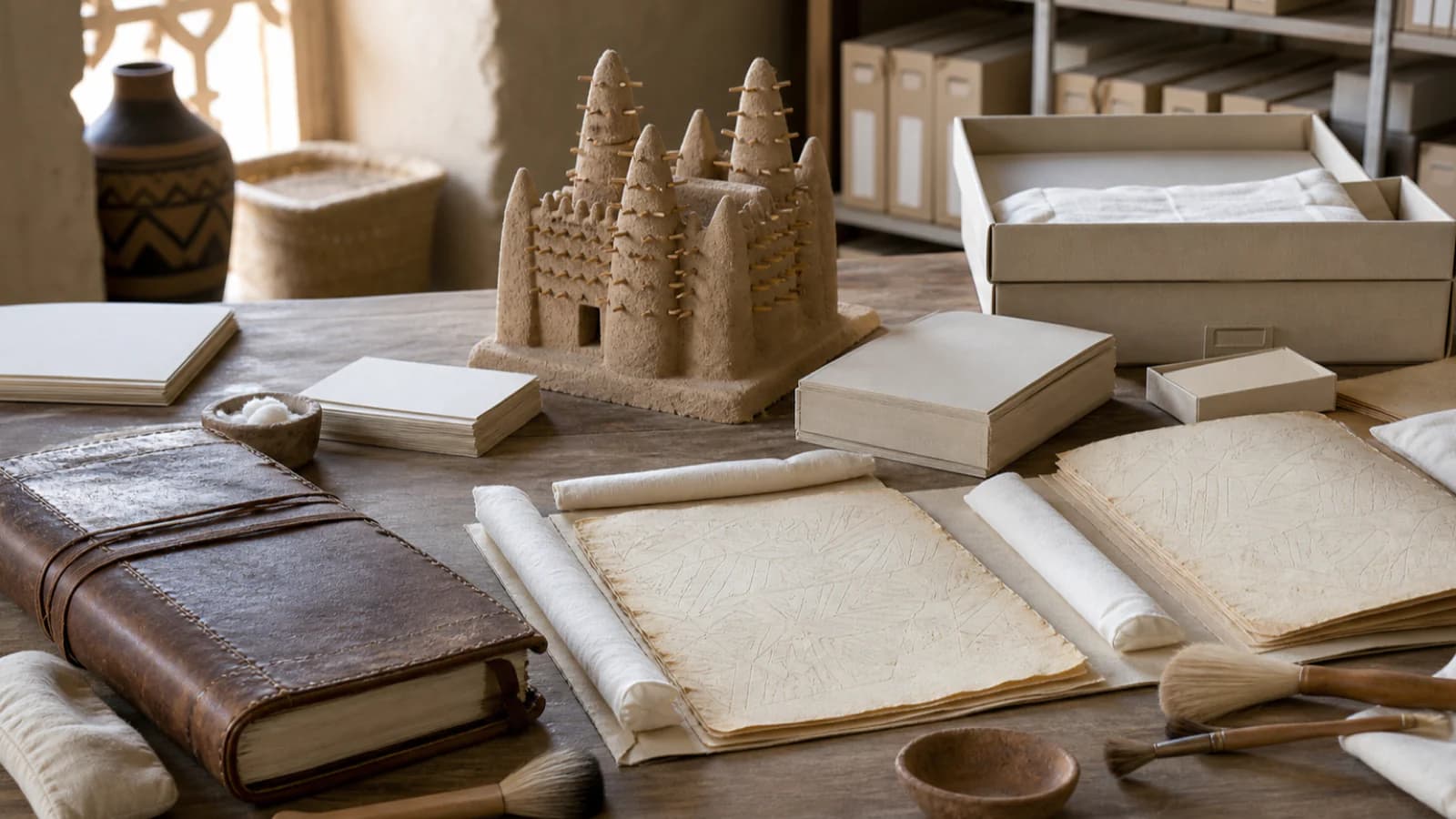
Timbuktu Manuscripts and Sankore: History, Contents, Rescue and Preservation
A detailed guide to Timbuktu's manuscripts and Sankore: the city's history, mosque-based learning, real manuscript contents, the 2012 rescue, digitization and preservation.
Timbuktu manuscripts at a glance
| Question | Evidence-based answer |
|---|---|
| Where? | Timbuktu near the Niger bend in Mali, with collections also dispersed among families, institutions and other West African towns. |
| When? | Most surviving holdings are early modern or later, while the scholarly tradition reached a celebrated height in the fifteenth and sixteenth centuries. |
| What do they contain? | Especially law, Quranic learning, theology and grammar, plus poetry, history, astronomy, medicine, commerce and documentary records. |
| What was Sankore? | A historic mosque and a cluster of teachers, students and libraries—not a centralized degree-granting university in the modern sense. |
| Were they destroyed in 2012? | Most were secretly evacuated; thousands at the Ahmed Baba Institute were burned, stolen or lost, but the famous total destruction story is false. |
| Are they digitized? | Large projects have created millions of images, but cataloging, conservation, ownership and meaningful access remain ongoing work. |
1. Why Timbuktu became a center of exchange
Timbuktu developed near the Niger River's great bend, where river traffic from the south could connect with camel routes crossing the Sahara. Its precise beginnings are less certain than popular foundation legends suggest, but by the Mali and Songhai periods it had become an important market for salt, gold, grain, textiles, books and many other goods. Its location did not guarantee prosperity: political protection, water, regional food supplies and merchant relationships made the crossroads work.
Intellectual life grew inside these commercial and devotional networks. Books traveled with merchants and pilgrims; scholars studied abroad and returned; wealthy families commissioned copies; judges and teachers needed legal and linguistic works. Timbuktu was not alone—Djenné, Walata, Gao and many smaller communities participated in West African scholarship—but unusually large surviving collections made it a global symbol.
2. Mali, Songhai and Morocco in the city's history
Timbuktu entered the orbit of the Mali Empire in the fourteenth century and was later contested by Tuareg and Songhai powers. Under the Songhai Empire in the fifteenth and sixteenth centuries, the city became especially renowned for commerce and learning. Political control changed, while merchant and scholarly families could maintain connections that outlasted a dynasty.
In 1591 a Moroccan expedition defeated Songhai forces and imposed authority over Niger cities. The subsequent arrest and exile of the scholar Ahmad Baba symbolize the disruption, yet scholarship did not simply end that year. Networks contracted, shifted and persisted under new conditions. Describing a single golden age followed by total darkness hides the later copying, teaching and collecting visible in the manuscripts themselves.
3. The three historic mosques
UNESCO highlights Djingareyber, Sankore and Sidi Yahya as the three great mosques associated with Timbuktu's religious and intellectual identity. Their earthen architecture requires recurring community maintenance; the buildings seen today contain many phases of rebuilding. Legends link patrons and famous figures to particular constructions, but an architectural history must distinguish an original commission from centuries of skilled local repair.
Mosques supplied places for prayer, teaching and scholarly association. Instruction could also occur in a teacher's home or courtyard. A student attached himself to recognized teachers, read selected texts, copied works and might receive authorization connected to a book or discipline. The system was personal and distributed, not organized by one registrar controlling a standardized campus curriculum.
4. What Sankore was—and was not
Calling Sankore a “university” can communicate its importance to a modern audience, but it easily imports the wrong institution. Sankore was a mosque surrounded by scholars, students, households and book collections. There was no evidence of a single corporate university owning all Timbuktu manuscripts, employing every teacher, counting every student or awarding one uniform degree.
The more accurate model is a mosque-centered scholarly network. Reputation attached to individual teachers and lineages. Study could progress from Quran, Arabic grammar and jurisprudence to advanced commentaries, logic or other fields according to access and purpose. This model was neither primitive nor a copy of Paris or Oxford; it was a different institutional ecology whose traces survive in licenses, notes, chains of teaching and family libraries.
5. Teachers, students and the Aqit family
Learned families gave continuity to Timbuktu's intellectual life by transmitting books, legal offices and teaching relationships. The Aqit family produced judges and scholars, among them Ahmad Baba, born in 1556, whose writings and library became famous. His exile to Marrakesh after the Moroccan conquest connected him painfully to a wider scholarly world and generated valuable biographical testimony.
A student did not enroll in “Sankore University” through a centralized admissions process. Study depended on family resources, patronage, residence and access to a teacher. Memorization and oral explanation accompanied reading. Manuscripts were tools: a concise text supported memorization, a commentary unpacked it, and marginal notes recorded comparison, correction or ownership.
6. How manuscripts were made and circulated
Paper arrived through trade and was also reused carefully because it was valuable. Scribes copied texts by hand in local and imported papers, using inks whose recipes and durability varied. A manuscript might be a polished commissioned volume, a student's working copy, a few unbound gatherings or a single document. Leather covers, wrappers, chests and niches offered protection, but heat, dust, insects, flooding and handling all left marks.
Books moved through purchase, gift, inheritance, copying and scholarly travel. Colophons may name a scribe, date or place, while ownership notes chart later movement. Many items remain undated, and a late copy can transmit an older work. “Ancient manuscript” should therefore not confuse the date of a composition with the date of the surviving physical object.
7. Languages: Arabic and African Ajami traditions
Arabic was the main language of learned writing in the collections, linking West African scholars to a vast textual tradition. Yet the manuscripts also preserve African languages written in adapted Arabic script, commonly described as Ajami. Catalogs identify materials in Fulfulde, Songhai, Bambara and other languages, sometimes as interlinear glosses, marginal notes, poems or independent texts. French appears in later materials.
This multilingual evidence undermines the notion that literacy was merely imported and remained culturally foreign. Scholars localized the script, annotated Arabic works for new readers and used writing for regional concerns. Cataloging Ajami accurately requires language expertise; an uncataloged note may be invisible to a researcher who recognizes Arabic script but not the language encoded by it.
8. What the manuscripts actually contain
Surveys of private libraries find a strong concentration in Islamic law, Quranic study, theology, devotional writing, Arabic grammar and related teaching disciplines. Poetry, praise literature, history, biography, logic and ethics also appear. Other manuscripts address astronomy, calendars, medicine, remedies, mathematics, commerce or divination, while letters, contracts, legal opinions and ownership records illuminate social life.
Popular lists often imply that every library held equal shelves of physics, surgery, women's rights and planetary science. That is not what catalog-level evidence shows. Scientific and documentary items are important precisely because they can be identified and studied, not because they need to dominate the collection. Genre proportions vary between family libraries, and many catalog descriptions remain preliminary.
9. Astronomy, medicine and mathematics without exaggeration
Astronomical materials could support prayer times, calendars, astrology or mathematical learning. Medical works joined humoral traditions, local remedies, prayers and copied authorities in combinations that require item-level study. Arithmetic mattered to inheritance, trade and instruction. A diagram or technical term alone does not prove an isolated West African “discovery” of a modern scientific theory.
The right way to establish significance is to identify a manuscript, date its physical copy and underlying work, transcribe its language and compare it with related traditions. Doing so reveals active selection and adaptation. It also prevents celebratory claims from making the real scholarship vulnerable: once a viral assertion collapses, skeptics may wrongly dismiss the entire archive.
10. Law, trade and everyday documents
Jurisprudence was not abstract theology detached from life. Legal texts and opinions addressed worship, marriage, inheritance, sales, debt, land, slavery and public conduct. Judges and scholars interpreted Maliki legal works for local cases. Commercial records, correspondence and marginal notes can identify networks of trust, prices, family relations and disputes that narrative chronicles overlook.
Not every manuscript is a bound treatise. A fragmentary letter or contract may answer questions unavailable in a famous book. Preservation programs face a difficult choice: stabilize attractive volumes first, or also catalog fragile everyday papers whose historical value becomes visible only after patient reading. A research-centered approach protects both.
11. Family libraries, not one hidden archive
The phrase “the library of Timbuktu” is misleading. Collections belonged to families, mosques, scholars and later public institutions. Learned households preserved books across generations, sometimes concealing them during insecurity or selling and dispersing them under economic pressure. The Ahmed Baba Institute became an important public repository, while dozens of private libraries retained distinct histories.
Counts are consequently estimates. The same object can be counted as one manuscript, several texts or many digital images; fragments complicate totals; uncataloged chests may enter a project later. “Hundreds of thousands” is a defensible scale, but a single exact citywide number is not. Provenance—who preserved an item and how it moved—is as important as the headline count.
12. Famous numbers and the 25,000-student claim
Accounts often say Timbuktu had 100,000 residents and 25,000 university students at its peak. Medieval population and enrollment records do not securely support that precision. Such figures may derive from later estimates repeated without their assumptions. The city clearly attracted many scholars and supported substantial book culture, but no registrar produced a surviving census of everyone learning through its distributed institutions.
Rejecting the exact number does not diminish Timbuktu. On the contrary, it redirects attention to evidence that survives: named teachers, works copied, legal careers, mosque communities, book prices and networks linking the city to North and West Africa. Historical importance does not require a modern enrollment statistic.
13. Colonial collecting and twentieth-century preservation
European explorers and colonial officials helped construct the image of Timbuktu as a mysterious endpoint, even though regional communities had long known and used the city. Manuscripts were collected, purchased or removed under unequal conditions. After independence, Malian institutions and international partners expanded documentation and conservation, including the center later named for Ahmad Baba.
Private owners often had good reasons to distrust projects that seemed to transfer control away from families. Successful partnerships therefore require consent, attribution, local training and clarity about where physical items and digital files reside. Preservation is not only a technical operation; it is a relationship involving property, religious responsibility, research benefit and cultural authority.
14. The 2012 occupation and manuscript rescue
Armed groups occupied northern Mali in 2012 and damaged shrines and cultural sites. Librarians, owners, drivers, families and public officials moved manuscripts from Timbuktu in metal trunks, boats and vehicles, often secretly, to safer locations including Bamako. UNESCO reports that more than 300,000 were moved and that about ninety percent of the manuscript heritage was saved.
When militants withdrew in 2013, images of burned holdings at the Ahmed Baba Institute prompted reports that Timbuktu's manuscripts had been destroyed. The reality was both less total and still painful: many holdings had already been evacuated, while 4,203 items at the institute were burned, stolen or lost according to UNESCO's reconstruction account. “All saved” erases losses; “all burned” erases the rescue.
15. Why the rescue created new conservation risks
Evacuation protected books from deliberate destruction, but tightly packed trunks and Bamako's more humid climate introduced mold, heat and ventilation risks. Removing a manuscript from immediate danger is only the first phase. Conservators need safe storage, condition surveys, dry cleaning, insect management, appropriate enclosures and plans for emergencies and controlled access.
Mass treatment can itself damage fragile paper if performed without item assessment. Projects must prioritize while recording what they do. Training Malian conservators and supporting sustainable facilities matters more than a short exhibition-oriented intervention. Climate change and political insecurity make distributed backups and preparedness increasingly important.
16. Digitizing 308,000 manuscripts
The Hill Museum & Manuscript Library reports that work with Malian partners from 2013 through 2024 digitized approximately 308,000 manuscripts from more than thirty libraries, producing about 4.35 million unique image files. This scale is extraordinary, but an image count is not a text count: one manuscript may require many photographs, and a codex may contain several works.
Photography preserves an informational surrogate and reduces some handling, but it does not repair the original, identify an author or make handwriting searchable. File integrity, redundant storage, metadata and permissions all require continuing resources. Cataloging remains ongoing because each object may need language identification, titles, names, dates and subject analysis before researchers can find it meaningfully.
17. Access, ownership and digital ethics
Open online access can expand scholarship and connect descendants to collections, but not every item is automatically free of restrictions. Families may regard manuscripts as property, religious trust or a source of livelihood. Sensitive personal, ritual or legal material may require care. A digital platform should name the holding library and local custodians rather than presenting images as ownerless global data.
Projects also need to return useful copies, catalogs and skills to the communities that made access possible. Metadata in Arabic, French and relevant African languages broadens participation. Researchers should cite shelfmarks and repositories, share corrections, and avoid extracting spectacular images while ignoring the labor of preservation.
18. What the Timbuktu manuscripts prove—and do not prove
The collections decisively refute the claim that West Africa lacked extensive written intellectual traditions. They document scholars who taught, argued, copied, traded books and addressed local and transregional questions. Together with oral and archaeological evidence, they reveal a literate world connected across the Sahara yet rooted in African families and institutions.
They do not prove that Sankore was identical to a modern university, that every manuscript is medieval, or that Timbuktu alone produced all West African knowledge. Their importance needs no embellishment. The careful work ahead—conservation, cataloging, transcription, translation and comparison—will yield more than a mythology of hidden scientific wonders because it allows the actual voices, genres and material histories to emerge.
Frequently asked questions about the Timbuktu manuscripts
How many Timbuktu manuscripts are there?
Hundreds of thousands is the safest scale. HMML reports digitizing about 308,000 from more than thirty Malian libraries, while citywide estimates vary because collections, fragments, texts and image files are counted differently.
How old are the manuscripts?
The works and physical copies have different dates. Scholarship flourished in the fifteenth and sixteenth centuries, but many surviving copies are seventeenth century or later, and some transmit older compositions.
Was Sankore the world's first university?
That claim applies a modern institutional category too rigidly. Sankore was a major mosque-centered teaching community within a distributed network of teachers, students and libraries, not a single centralized university.
What language are the manuscripts written in?
Most are in Arabic, with African languages such as Fulfulde, Songhai and Bambara also written in adapted Arabic script, plus later French and multilingual notes.
Were the manuscripts burned in 2012?
Most were evacuated by local custodians, but thousands at the Ahmed Baba Institute were burned, stolen or lost. Both total-destruction and no-loss versions are wrong.
Can the manuscripts be read online?
Selected Library of Congress items and growing HMML Reading Room catalogs are accessible online. Access varies by repository, ownership agreement and cataloging status, and a digital image may still need expert transcription and translation.
Explore Timbuktu and medieval West Africa
- Islam in medieval West Africa — See the larger network of trade, courts and scholarship.
- Mansa Musa's hajj — Trace the pilgrimage that made Mali famous beyond the Sahara.
- The Mali Empire — Understand the political and economic setting of fourteenth-century Timbuktu.
- Timbuktu manuscripts and Sankore — Return to this evidence-led guide to collections and preservation.
- Islamic history timeline — Place Songhai, Morocco and Timbuktu in wider chronology.
- Islamic world map — Locate West African cities and trans-Saharan connections.
Sources
The article prioritizes collection catalogs, content surveys and institutional preservation records. Counts are labeled as estimates because manuscripts, component texts, fragments and digital images are different units.
- UNESCO World Heritage Centre: Timbuktu — Used for the city’s trading, spiritual and intellectual importance and its three historic mosques.
- UNESCO: Mali — Timbuktu Manuscripts — Used for public and private collections, deterioration risks, access and preservation partnerships.
- UNESCO: Re-building Cultural Heritage in Mali — Used for the 2012 rescue, loss estimates, community action, Bamako storage and conservation needs.
- Library of Congress: Ancient Manuscripts from the Desert Libraries of Timbuktu — Used for manuscript chronology, private libraries, scholarly families and the breadth of written subjects.
- Library of Congress: Islamic Manuscripts from Mali — Used for digitized examples from family collections and specific records in law, astronomy, medicine and commerce.
- Cambridge Core: What’s in the Manuscripts of Timbuktu? — Used to replace subject-list mythology with a survey of actual contents, functions, teaching and private libraries.
- HMML Global Operations: Mali — Used for the 2013–2024 digitization of about 308,000 manuscripts into 4.35 million images and ongoing cataloging.
- HMML: Bibliothèque al-Cady al-Aqib at Sankore — Used for a cataloged Sankore Mosque library, dates, core curriculum and Arabic-script African languages.
- HMML: Bibliothèque des Manuscrits al-Wangari — Used for the Sidi Yahya mosque library, 2,343 preserved objects and its multilingual catalog.
- Oxford Academic: Islamic Scholarship and Historical Writing in West Africa before 1800 — Used to place Timbuktu within a larger network of West African scholarly towns rather than as an isolated miracle.


