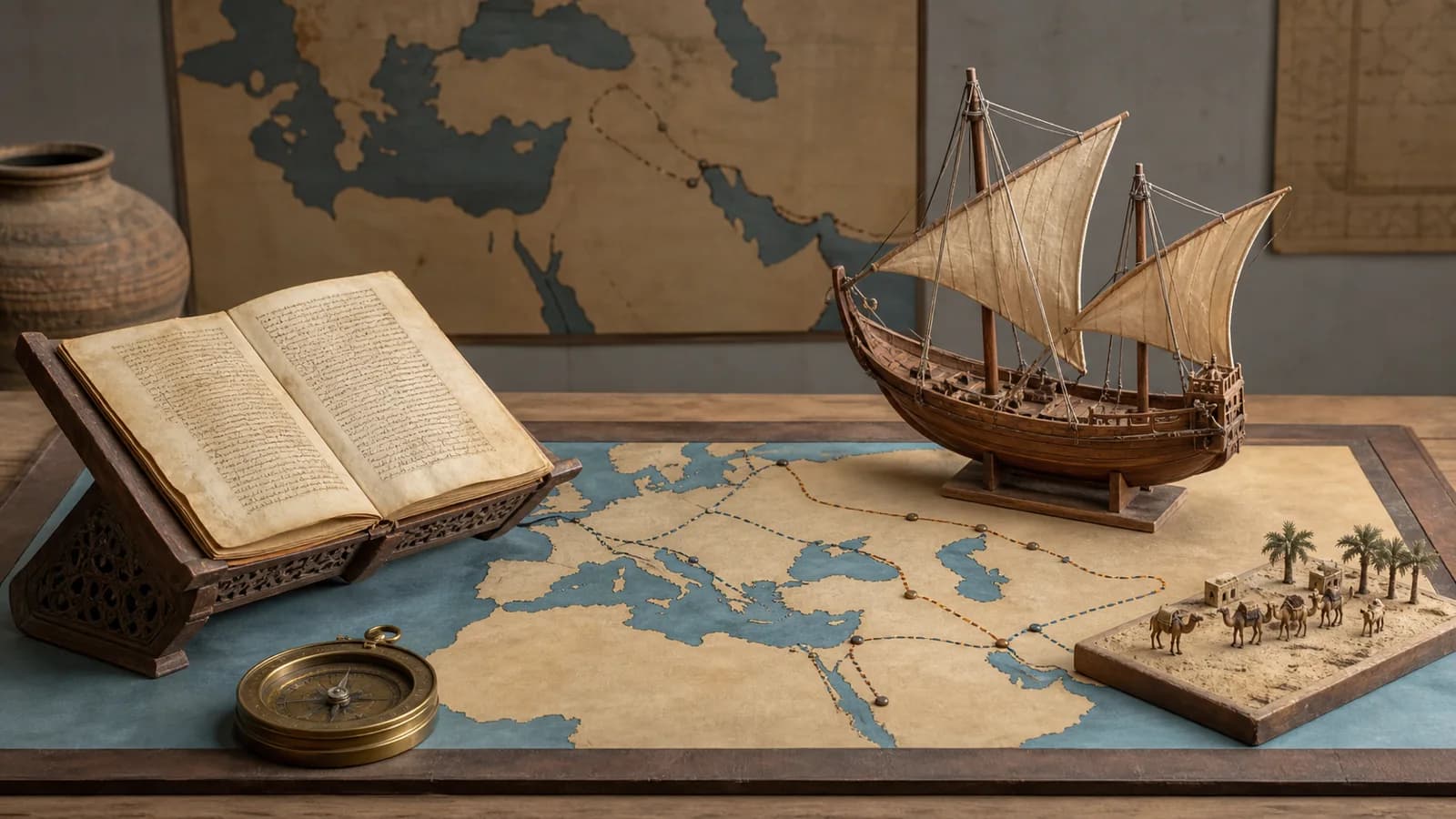
Ibn Jubayr's Rihla and Hajj Route, 1183-1185: Egypt, Acre and Sicily
A documented guide to Ibn Jubayr's 1183-1185 Hajj journey, route through Egypt, Arabia, Baghdad and Damascus, Frankish Acre, Norman Sicily, manuscripts and literary viewpoint.
Quick facts
- Born in Valencia in 1145 and associated with Almohad administration in Granada.
- Began the first recorded journey on 3 February 1183 and returned in spring 1185.
- Traveled through Egypt, the Hijaz, Iraq, Syria, the Crusader coast and Norman Sicily.
- His Rihla combines itinerary, pilgrimage guidance, urban description, wonder and moral judgment.
- The standard edition depends on a later manuscript in Leiden, not an autograph notebook from the journey.
Why did he leave?
Later biographical tradition says a ruler forced Ibn Jubayr to drink wine and then gave him money, prompting a penitential Hajj. It is a memorable story, but the Rihla itself should remain the primary evidence for the journey. What can be stated securely is that he was a literate official from al-Andalus, undertook pilgrimage in 1183 and converted the experience into an influential travel account. A moral origin story should not replace the dated itinerary.
The outward route to Mecca
Ibn Jubayr crossed from the western Mediterranean toward Alexandria. He traveled through Ayyubid Egypt, observed Cairo and Upper Egyptian sites and faced the demanding Red Sea passage through Aydhab toward Jeddah. He reached Mecca for the 1183 Hajj and spent months recording the sanctuary, ceremonies, water, lodging, markets and pilgrims. His attention to services and abuses makes the text both a sacred journey and an audit of pilgrimage infrastructure.
Medina, Iraq and Syria
After the pilgrimage, the route continued through Medina and northward into Iraq. Ibn Jubayr described Kufa, Baghdad and other cities before moving through Mosul, Aleppo and Damascus. He noticed mosques, tombs, schools, hospitals, markets, walls, gardens and charitable provisions. His praise or criticism reflects local conditions and his own religious ideals. It should not be mistaken for a complete census of each city.
What did he see in Crusader territory?
On the route to Acre, Ibn Jubayr entered lands governed by the Franks. He expressed hostility toward Christian rule, yet also reported commerce, taxation and Muslim agricultural communities continuing under it. These passages are often quoted either as proof of perfect coexistence or relentless persecution. Neither captures the text. He observed practical accommodation while judging it through a pilgrim's fear that comfortable life under non-Muslim rulers could test religious loyalty.
The winter in Norman Sicily
Travel disruption brought Ibn Jubayr to Sicily in the winter of 1184-1185. He encountered a Norman kingdom that retained Arabic-speaking officials, Muslim courtiers and Islamic cultural practices under William II. He admired aspects of royal organization and hospitality while worrying about conversion, vulnerability and the future of Muslim inhabitants. His Sicily is therefore neither a simple tolerance success story nor a description of uniform oppression.
What kind of book is the Rihla?
The text preserves a dated sequence and firsthand detail, but it is also crafted prose. Places become evidence in a moral geography: good government supports pilgrims and scholars, while corrupt officials, dangerous routes or religious compromise reveal disorder. Words such as fitna change meaning as the journey moves between political settings. Readers should ask what Ibn Jubayr saw, what he heard and what literary purpose a scene serves.
Manuscript and edition history
The journey occurred in the twelfth century, but the best-known surviving manuscript witness is later. William Wright's nineteenth-century Arabic edition was made from a manuscript in Leiden University Library and revised by M. J. de Goeje. University and CSIC catalog records preserve that edition history. A manuscript copied long after the route can still transmit an earlier work, but copy date, omissions and editorial normalization must be stated.
Did Ibn Battuta copy Ibn Jubayr?
Later travel writers reused established descriptions, vocabulary and route conventions. Scholars have identified passages in the Rihla associated with Ibn Battuta that resemble or derive from Ibn Jubayr and other predecessors. Medieval reuse does not automatically mean one traveler never visited a place. It shows that eyewitness memory and literary inheritance could coexist. Each borrowed passage needs its own textual comparison.
Claims to qualify
- 'A wine incident certainly caused the journey': the famous story belongs to later biography and should be labeled as tradition.
- 'The Rihla is a neutral travel diary': it is dated testimony shaped by literary and religious argument.
- 'Crusader lands were peaceful or intolerable': Ibn Jubayr records practical coexistence and profound confessional anxiety together.
- 'Norman Sicily was fully tolerant': court inclusion did not erase pressure and insecurity among Muslim communities.
- 'The Leiden manuscript is Ibn Jubayr's original': it is a later witness used for modern editions.
Why the journey matters
Ibn Jubayr gives a rare connected view of the late twelfth-century Mediterranean and Middle East just before major political changes. His route links Almohad al-Andalus, Ayyubid Egypt, pilgrimage Arabia, Abbasid Baghdad, Zengid and Ayyubid Syria, Crusader ports and Norman Sicily. The value lies not only in where he went but in how one educated Muslim traveler compared institutions, minorities and power across them.
Related research guides
- Muslim travelers and geographers timeline: Trace pilgrimage, travel writing, route books and maps while separating actual journeys from later manuscripts and modern route reconstructions.
- Ibn Battuta, the Rihla and his routes: Follow the journeys from Tangier and examine how Ibn Juzayy shaped the surviving travel account.
- Al-Idrisi and the 1154 Book of Roger: Understand the seventy sectional maps, south-up orientation and the difference between manuscript maps and modern composites.
- Islamic history timeline: Place travelers and maps inside wider political, religious and institutional change.
- Al-Andalus history timeline: Connect Ibn Jubayr and al-Idrisi to Iberian and western Mediterranean history without treating al-Andalus as isolated.
- Islam in medieval West Africa: Use regional history to evaluate Ibn Battuta's Mali narrative and later route maps.
- Mansa Musa's Hajj route and sources: Compare another famous pilgrimage route while keeping contemporary and later witnesses separate.
- Mali Empire history: Place Ibn Battuta's later visit within a fuller account of Mali's rulers, trade and scholarly networks.
- House of Wisdom and Baghdad knowledge networks: Compare court libraries and translation with the route books, reports and travel writing that carried geographic knowledge.
Sources
- Cambridge Core: Arabia and Ibn Jubayr's 1183-1185 Rihla: Used for the journey dates, pilgrimage context and Ibn Jubayr's place in Arabic travel writing.
- Cambridge Core: Fitna in the Travels of Ibn Jubayr: Used for his bureaucratic background, two-year journey and changing descriptions across Muslim polities, the kingdom of Jerusalem and Norman Sicily.
- Cambridge Core: Egypt and Palermo in Ibn Jubayr's travelogue: Used for the political setting of the 1183 departure and the Rihla as a major literary model.
- Cambridge Core: Ibn Jubayr in Norman Sicily: Used for his winter 1184-1185 stay and observations about Muslim minorities and the court of William II.
- CSIC Simurg: The Travels of Ibn Jubayr: Used for the cataloged edition made from a manuscript in Leiden University Library.
- Complutense University of Madrid: Rihlat Ibn Jubayr: Used as a university digital-heritage record for the printed Arabic travel text.
- Leiden University Libraries: Middle Eastern manuscripts in open access: Used for the manuscript-collection context and the distinction between a medieval journey and later surviving copies.
- Brill: Ibn Jubayr and illumination in travel writing: Used to cross-check the text's edition history and its literary treatment of observed places.


