Resource
Al-Andalus Timeline 711–1492 from Conquest to Córdoba and Granada
Follow 28 dated events in al-Andalus from the 711 conquest to Córdoba’s caliphate and Granada’s 1492 surrender, with evidence labels and source limits.
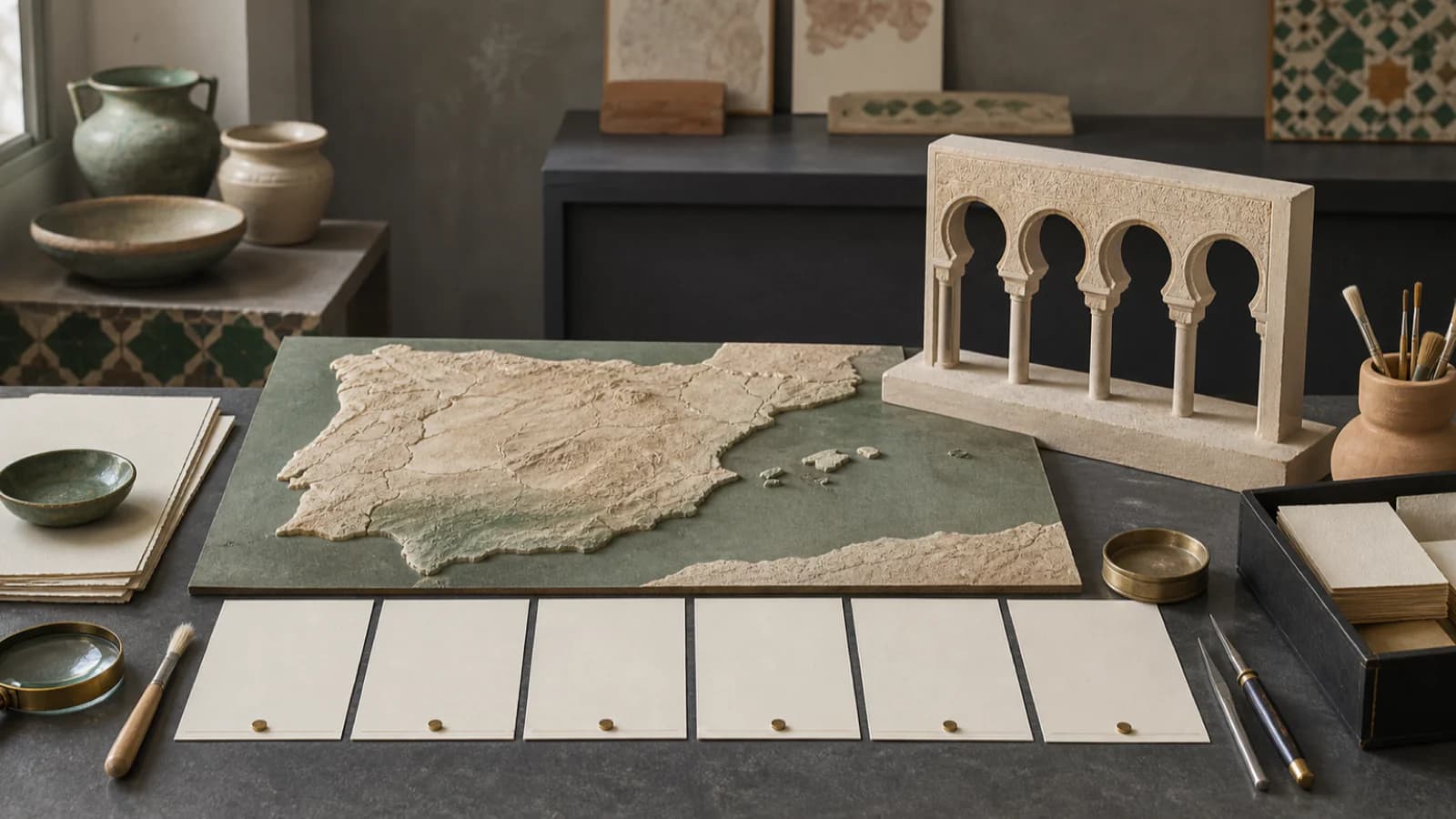
Political coverage
711-1492 CE
Timeline anchors
28 selected events
Method
Chronology plus evidence labels
Last reviewed
2 October 2026
Al-Andalus was the changing part of the Iberian Peninsula ruled by Muslim governments between the campaigns that began in 711 and the surrender of Nasrid Granada on 2 January 1492. It was never one state with an unchanging border. This timeline follows 28 selected political and material landmarks: conquest and negotiated submission, the Umayyad emirate and caliphate in Córdoba, independent taifa courts, Almoravid and Almohad rule, and the Nasrid kingdom.
Read a date as the date of a particular event, not as the moment everyone in a region changed language, religion or legal status. Some early conquest dates survive mainly in later narratives; 25 November 1491 and 2 January 1492 have a different documentary basis in Spain's archival catalogue. Where historians disagree, the row says so. The four tables give a route through the chronology; the sections below explain what changed, what remained, and how the sources can support each claim.
What does al-Andalus name?
Al-Andalus names Muslim-ruled territory and its societies in medieval Iberia, but the territory did not have a single permanent outline. A map for about 750 would cover a different political landscape from one for 1100 or 1400. The term is useful for the history of governments and communities within those shifting lands; it does not mean that every inhabitant was Muslim or that a modern Spanish or Portuguese border existed. Córdoba was a major Umayyad center, while Toledo, Seville, Zaragoza, Valencia and Granada mattered under different rulers. This geographical caution is essential when a brief timeline compresses nearly eight centuries into a few rows. The Legacy of al-Andalus offers a broad chronology, while individual monuments and records fix particular places and dates.
How did the conquest begin in 711?
A force led by Ṭāriq ibn Ziyād crossed from North Africa in 711 and defeated the Visigothic king Roderic, conventionally placed in July. Mūsā ibn Nuṣayr arrived with a further force in 712. The advance involved fighting, the capture of political centers and negotiated arrangements. The 713 agreement associated with Tudmir is especially useful because it shows a form of submission with stated obligations and protections, although the surviving text reached us through later transmission. Francisco Franco-Sánchez’s manuscript study compares two transmission lines of the treaty; its public abstract identifies the agreement with 713. The exact site of Roderic’s defeat and the sequence at every town cannot be pinned down as neatly as a modern campaign map might suggest. Cambridge’s account of western Iberia describes the mostly Berber first force and the expansion that followed. The tale that Ṭāriq burned his ships should be identified as later tradition, not used as a contemporary battle report.
What happened between conquest and the independent emirate?
The conquest created a province within the wider Umayyad world, followed by contested appointments, regional resistance and military rivalries. Control over towns and countryside took different forms; a row marked 711–712 cannot prove that identical arrangements began everywhere on one day. The northern polity later centered in Asturias developed outside enduring Andalusi control, but the early chronology associated with Covadonga remains disputed. Revolt in North Africa and factional conflict in the 740s also affected Iberian rule. These changes explain why the arrival of a new Umayyad ruler in 756 was a political break rather than merely another point in an uninterrupted conquest. Early Arabic and Latin narratives were written and preserved under later conditions, so historians compare their details with coins, buildings and the geography of settlements.
Why did Córdoba become an Umayyad capital?
ʿAbd al-Raḥmān I established an independent Umayyad emirate in 756 with Córdoba as its leading center. Independence here describes practical political authority; it should not be confused with the later caliphal title. Successive rulers developed institutions, networks of patronage and a monumental urban setting. The Great Mosque began under ʿAbd al-Raḥmān I in the late eighth century and received major later additions. The surviving fabric and UNESCO’s account of the historic center show a building history rather than one fixed design created in a single reign. Córdoba’s political prominence did not erase other cities or the importance of rural production and connections across the strait. It is equally misleading to treat the emirate as a uniform golden age or to interpret every surviving object as evidence of the same social experience.
What changed when the caliphate was proclaimed in 929?
ʿAbd al-Raḥmān III began ruling as emir in 912 and adopted the caliphal title in 929. The declaration asserted an Umayyad claim to wider religious and political legitimacy amid competing caliphal powers. His government built the palatine city of Madīnat al-Zahrāʾ, or Medina Azahara, near Córdoba from the middle of the tenth century. UNESCO dates the site to this caliphal setting and records its devastation in the civil war of 1009–1010. Archaeology reveals its plan, elite spaces and material culture; it cannot by itself verify every claim made by court chroniclers. Under al-Ḥakam II, who ruled from 961 to 976, manuscript culture and building patronage were prominent. Political centralization, artistic production and scholarship were real, but access to power and resources was unequal.
How did the caliphate break apart?
After al-Ḥakam II died in 976, the young Hishām II succeeded as caliph. The Metropolitan Museum dates al-Manṣūr’s ascendancy to 978–1002 and distinguishes it from Hishām’s interrupted caliphate, which continued beyond 1002. The civil war, or fitna, began in 1009. Rival claimants and armed factions fought over Córdoba, and UNESCO dates the palatine city’s devastation to 1009–1010. In 1031 Cordoban authorities formally ended the caliphal office. These dates identify stages of political disintegration; they do not describe an overnight loss of every Andalusi school, craft or urban habit. Provincial centers had their own resources and courts, and some had already gained autonomy. Material evidence from Medina Azahara documents a particular site, whereas the motives and alignments of participants require careful reading of chronicles written from particular political positions. The distinction helps avoid turning a long civil conflict into a simple moral lesson about decline.
What were the taifa states and North African dynasties?
Following the caliphate’s collapse, regional taifa rulers governed centers such as Seville, Toledo and Zaragoza. Alliances, warfare, payments and court patronage varied among them; there was no single replacement capital. Alfonso VI’s conquest of Toledo in 1085 reshaped the balance of power. The Almoravids crossed from North Africa in 1086 and subsequently absorbed many taifa governments. Their rule was later replaced across much of Muslim Iberia by the Almohads, another North African imperial movement. Both linked Iberia to wider Maghribi politics, and neither erased local history. The defeat of an Almohad army at Las Navas de Tolosa in 1212 was consequential but did not end Muslim sovereignty in the peninsula. Granada continued as a Muslim-ruled kingdom for nearly three more centuries.
How did Nasrid Granada endure?
The Nasrid dynasty took shape in the 1230s under Muḥammad I, with Granada becoming its center. Ferdinand III’s conquest of Córdoba in 1236 and Seville in 1248 left the Nasrid kingdom as the principal surviving Muslim state in Iberia. Its rulers negotiated, fought and paid tribute within an unstable regional order while also maintaining connections across the western Mediterranean. The Alhambra and Generalife preserve evidence of court architecture and later modification, not an untouched picture of every household in the kingdom. The Metropolitan Museum’s Nasrid essay and UNESCO’s Granada listing help anchor artistic and material history in this political period. Their descriptions of palaces should not substitute for a history of farming, taxation, conflict, migration or the kingdom’s changing relations with Castile.
What happened in 1491 and 1492?
The Granada War ran from 1482 to 1492, according to Spain’s PARES archival authority record. Successive sieges and political divisions within the Nasrid state preceded the capitulations agreed on 25 November 1491, which set terms for surrender and initial guarantees to Muslim residents. On 2 January 1492 Muḥammad XII surrendered Granada to Ferdinand and Isabella, ending Nasrid political sovereignty. These are distinct stages: the agreement did not itself constitute the January transfer of the city. PARES supplies an official catalogue chronology, not the full text of every surviving treaty article. The 1491 terms and later implementation must also be kept separate: subsequent coercion and forced conversion belong to a longer chronology. The 1492 endpoint is accurate for the Nasrid state, but inaccurate if used to claim that all Muslims left Iberia that day. Jewish expulsion and Atlantic exploration were distinct events in the same year.
How should the evidence in this timeline be read?
The evidence column is a guide to what each claim rests on, not a promise that every type of source survives for every row. Later chronicles provide narratives and sometimes conflicting details. Coins and inscriptions can anchor rulers, titles and circulation, while archaeology locates structures and material changes. UNESCO records describe the surviving sites and their heritage significance; they cannot prove an unrecorded speech or exact battlefield. The Spanish archival catalogue supports documentary dates for the capitulations and surrender, but any interpretation of their later legal effect needs further records. Modern scholarly syntheses connect these fragments and state where certainty ends. Read an approximate date as approximate, a conventional battle label as a reconstruction, and a precisely dated agreement as one piece of evidence in a wider sequence. This is a selected political timeline, not a census or a complete social history.
Conquest and Umayyad province, 711-756
Early conquest dates combine later written narratives with archaeology, coins and modern reconstruction.
| Date | Event | Why it matters | Evidence label |
|---|---|---|---|
| Spring 711 | Tariq ibn Ziyad crosses into Iberia | A mostly Berber force crossed from North Africa near the strait later associated with Jabal Tariq. | Later Arabic and Latin texts; modern synthesis; logistics debated |
| July 711, conventional | Roderic defeated in southern Iberia | The Visigothic king's defeat opened routes toward major cities; the exact battlefield remains disputed. | Later narratives and modern reconstruction |
| 711-712 | Cordoba, Toledo and other centers enter the new order | Campaigns and local agreements changed sovereignty at different speeds. | Later chronicles, coins, archaeology and local records |
| 712 | Musa ibn Nusayr arrives with another force | Further campaigns expanded control and linked the conquest to Umayyad North Africa. | Arabic narrative tradition and modern synthesis |
| 713 | Pact associated with Tudmir | A negotiated submission illustrates that conquest included agreements as well as battles. | Documentary tradition with textual transmission questions; Franco-Sánchez’s manuscript study |
| c. 718-722 | Northern resistance and the Covadonga tradition | A northern polity developed outside durable Andalusi control; exact early chronology is debated. | Later Christian and Arabic narratives |
| 740s | Berber revolt and factional conflict | North African revolt and military rivalries destabilized provincial rule in al-Andalus. | Chronicles and modern political reconstruction |
Umayyad emirate and Caliphate of Cordoba, 756-1031
Emirate, caliphate and civil-war dates are political anchors, not a complete social history.
| Date | Event | Why it matters | Evidence label |
|---|---|---|---|
| 756 | Abd al-Rahman I establishes an independent Umayyad emirate | Cordoba became the center of a dynasty independent in practice from Abbasid rule. | Chronicles, coins, monuments and modern synthesis |
| 784-786 | First phase of Cordoba's Great Mosque | The congregational mosque became a central institution and was expanded by later rulers. | Standing fabric, archaeology and textual record |
| 912 | Abd al-Rahman III begins rule as emir | He rebuilt central authority before adopting the caliphal title. | Chronicles, coins and modern synthesis |
| 929 | Caliphate of Cordoba proclaimed | Abd al-Rahman III asserted an independent Umayyad caliphate. | Court chronicles, titulature, coins and material record |
| 936 onward | Medina Azahara constructed | The palatine city expressed and administered caliphal power near Cordoba. | Archaeology, architecture and textual record |
| 961-976 | Caliphate of al-Hakam II | Court patronage, book culture, diplomacy and mosque expansion marked the reign. | Chronicles, manuscripts, objects and monuments |
| 976-1002 | Hisham II succeeds in 976; al-Mansur dominates in 978-1002 | This selected interval combines accession and the chamberlain’s ascendancy. Hisham’s interrupted caliphate extended beyond 1002. | Court chronicles, coins and modern political analysis; Met museum chronology |
| 1009 | Fitna begins | Rebellion and rival claimants opened a prolonged civil war over Cordoba and the caliphate. | Multiple chronicles, archaeology and numismatics |
| 1009-1010 | Medina Azahara devastated | The caliphal city was destroyed and abandoned during the civil war. | UNESCO record, archaeology and texts |
Taifas, Almoravids and Almohads, 1031-c. 1230
Regional states and North African dynasties changed borders and centers repeatedly.
| Date | Event | Why it matters | Evidence label |
|---|---|---|---|
| 1031 | Caliphate abolished; taifa period formalized | Cordoban notables ended the office as regional rulers consolidated independent states. | Chronicles, coins and political reconstruction |
| 1085 | Toledo conquered by Alfonso VI | The loss altered the balance between taifa states and expanding Christian kingdoms. | Christian and Arabic chronicles; documentary record |
| 1086 onward | Almoravid intervention and rule | A North African dynasty first intervened against Alfonso VI and later absorbed taifa states. | Chronicles, coins, architecture and modern synthesis |
| 1140s-1170s | Almohad conquest of al-Andalus | Another North African empire replaced Almoravid authority across much of Muslim Iberia. | Chronicles, inscriptions, coins and monuments |
| 1212 | Battle of Las Navas de Tolosa | Almohad defeat accelerated political contraction, though Muslim rule continued for centuries in Granada. | Arabic and Latin chronicles; modern military history |
Nasrid Granada and the 1492 transition
The 1492 surrender ended Nasrid sovereignty, not Muslim residence on one day.
| Date | Event | Why it matters | Evidence label |
|---|---|---|---|
| 1232-1238 | Nasrid state forms and Granada becomes its center | Muhammad I established the dynasty that ruled the last Muslim state in Iberia. | Chronicles, treaties, coins and material record |
| 1236 | Cordoba conquered by Ferdinand III | Former Umayyad capital entered Castilian rule; the Great Mosque became a cathedral. | Royal, ecclesiastical, architectural and chronicle records |
| 1248 | Seville conquered by Ferdinand III | Castilian expansion left Nasrid Granada as the principal Muslim-ruled state in Iberia. | Chronicles, charters and material record |
| 1340 | Battle of Rio Salado | Defeat of Nasrid and Marinid forces reduced the prospect of major North African military support. | Arabic and Christian chronicles; modern synthesis; Spanish Army Museum historical account |
| 1482-1492 | Granada War | Military campaigns and Nasrid dynastic division led to the November 1491 capitulations and the January 1492 surrender. | Royal accounts, chronicles, letters and material evidence; PARES authority chronology |
| 25 November 1491 | Capitulations for Granada agreed | Negotiated articles set terms for surrender and initial protections for Muslim residents. | Spanish archival record and transmitted legal texts |
| 2 January 1492 | Nasrid Granada surrenders | Muhammad XII transferred sovereignty to Ferdinand and Isabella, ending the Nasrid state. | Royal, archival and chronicle records |
FAQ
What does al-Andalus mean?
It is the Arabic historical name for changing Muslim-ruled territories and societies in the Iberian Peninsula. It should not be treated as one fixed modern border.
Was al-Andalus one country for nearly 800 years?
No. The period included a province, Umayyad emirate and caliphate, taifa states, Almoravid and Almohad rule, and Nasrid Granada, with borders and centers changing repeatedly.
Did Muslim rule begin everywhere in Iberia in 711?
No. The 711 crossing began a campaign whose military advances and negotiated settlements unfolded over several years, while northern regions followed different trajectories.
Was Cordoba always the capital of al-Andalus?
Cordoba was the leading center of the Umayyad emirate and caliphate. After 1031, political authority fragmented among taifa capitals and later dynastic centers.
Was convivencia complete religious equality?
No. Exchange and shared urban life existed alongside legal hierarchy, taxation, restrictions, conflict and conditions that varied by period and place.
Did all Muslims leave Spain in 1492?
No. Nasrid sovereignty ended in 1492, but most Muslims in the former kingdom initially remained. Forced conversion, Morisco history and final expulsion belong to a longer sixteenth- and early-seventeenth-century chronology.
Related reading
- The 711 conquest of Iberia
A closer look at the early campaigns, Ṭāriq and the limits of later narratives.
- The fall of Granada in 1492
Separates the capitulations, surrender and longer aftermath.
- Islamic Golden Age history timeline
A wider, selective chronology of scholarly institutions and material evidence.
- Islamic world map
Modern geography for orientation; its current borders do not represent medieval al-Andalus.
- Hypostyle Mosque Plan: Columns, Courtyard and Qibla Hall
How hypostyle mosques use repeated columns and roof bays, why the plan expanded easily, and how Kairouan and Córdoba turned repetition into monumentality.
Connected by Córdoba.
- When Did Granada Fall? The 1491 Capitulations, the 1492 Surrender and What Followed
Granada surrendered on 2 January 1492, after capitulations agreed on 25 November 1491. Follow the Nasrid kingdom’s last years, the treaty’s protections and their later reversal.
Connected by Granada.
- Andalusi Ivory Pyxides from Umayyad Córdoba
Compare the Louvre’s dated al-Mughira pyxis with two distinct Met examples, and learn what their ivory, inscriptions, carvings and missing lids actually reveal.
Connected by Córdoba.
- How Córdoba’s Caliphate Rose and Broke Apart, 929–1031
Explore Córdoba’s caliphate from the declaration of 929 to its breakup in 1031, through rulers, Medina Azahara, mosque architecture and dated court objects.
Connected by Córdoba.
Sources
- The Legacy of al-Andalus: History of al-Andalus
Overview defining al-Andalus as changing Iberian territories under Muslim power from 711 to 1492.
- The Legacy of al-Andalus: Chronology
Institutional chronology for the major political periods and transitions.
- Cambridge Core: Diversity in Medieval Spain
Used for changing Muslim control and a cautious account of religious and social plurality.
- Cambridge Core: Spanish-Islamic Civilization
Used for the long chronology and cultural, economic and intellectual context.
- The Metropolitan Museum of Art: The Umayyad period in Spain
Material and political context for 711-1031.
- The Metropolitan Museum of Art: The Nasrid period
Material and political context for Nasrid Granada, 1232-1492.
- UNESCO World Heritage Centre: Historic Centre of Cordoba
Surviving urban and architectural layers of Cordoba.
- UNESCO World Heritage Centre: Caliphate City of Medina Azahara
The tenth-century caliphal city and its destruction in 1009-1010.
- UNESCO World Heritage Centre: Alhambra, Generalife and Albayzin
Nasrid and later urban layers in Granada.
- UCL Discovery: Al-Andalus: Archaeology, History and Memory
The introduction, especially printed pages 1–3, discusses changing political formations and the need to compare written history with archaeology. It is not used to settle every date in the event tables.
- Cambridge Core: Gharb al-Andalus
The 711 conquest and western Iberian chronology.
- PARES, Spanish State Archives: Granada War authority record
Official archival catalogue chronology gives the 25 November 1491 capitulations and 2 January 1492 surrender; it does not itself reproduce the full treaty.
- Spanish Army Museum: The Battle of Río Salado
The institutional historical account dates the battle to 1340 and describes North African intervention and the wider struggle around the strait. Its commemorative page date is not the medieval event date.
- Francisco Franco-Sánchez: Transmission of the Treaty of Tudmīr
The public research abstract identifies the treaty with 713 and compares its two manuscript transmission lines. It supports treating the text as transmitted evidence rather than an untouched original document.
Languages
- تاريخ الأندلس من 711 إلى 1492، من الفتح إلى سقوط غرناطة
- আল-আন্দালুস ইতিহাসের সময়রেখা: ৭১১-১৪৯২, রাজবংশ, নগর ও উৎস
- Història d’al-Àndalus del 711 al 1492, de la conquesta a Granada
- Časová osa al-Andalusu: 711-1492, dynastie, města a prameny
- Al-Andalus 711–1492 fra erobringen til Granadas overgivelse
- Geschichte von al-Andalus 711 bis 1492 – von der Eroberung bis Granada
- Χρονολόγιο της αλ-Ανταλούς: 711-1492, δυναστείες, πόλεις και πηγές
- Al-Andalus Timeline 711–1492 from Conquest to Córdoba and Granada
- Cronología de al-Ándalus de 711 a 1492, de la conquista a Granada
- Al-Andalusin aikajana: 711-1492, dynastiat, kaupungit ja lähteet
- Chronologie d’al-Andalus de 711 à 1492, de la conquête à Grenade
- Sejarah al-Andalus 711–1492 dari penaklukan hingga penyerahan Granada
- Storia di al-Andalus dal 711 al 1492, dalla conquista alla resa di Granada
- アル=アンダルス史年表:711-1492年の王朝・都市・史料
- 알안달루스 역사 연표: 711-1492년 왕조, 도시와 사료
- Sejarah al-Andalus 711–1492 dari penaklukan hingga penyerahan Granada
- Geschiedenis van al-Andalus 711–1492, van de verovering tot Granada
- Al-Andalus 711–1492 fra erobringen til overgivelsen av Granada
- Oś czasu al-Andalus: 711-1492, dynastie, miasta i źródła
- Linha do tempo de al-Andalus de 711 a 1492, da conquista a Granada
- Хронология аль-Андалуса: от завоевания 711 года до падения Гранады
- Časová os al-Andalusu: 711-1492, dynastie, mestá a pramene
- Al-Andalus historia 711–1492 från erövringen till överlämnandet av Granada
- เส้นเวลาอัลอันดะลุส: ค.ศ. 711-1492 ราชวงศ์ เมือง และหลักฐาน
- Endülüs tarihi 711–1492, fetihten Gırnata’nın teslimine uzanan zaman çizelgesi
- ئەندەلۇس تارىخى ۋاقىت جەدۋىلى: 711-1492، سۇلالىلەر، شەھەرلەر ۋە مەنبەلەر
- Dòng thời gian al-Andalus: 711-1492, triều đại, thành phố và nguồn tư liệu
- 安达卢斯711至1492年时间线:征服、科尔多瓦与格拉纳达
- 安達盧斯歷史時間線:711年征服至1492年格拉納達交城
- 安達盧斯711至1492年時間線:征服、科爾多瓦與格拉納達