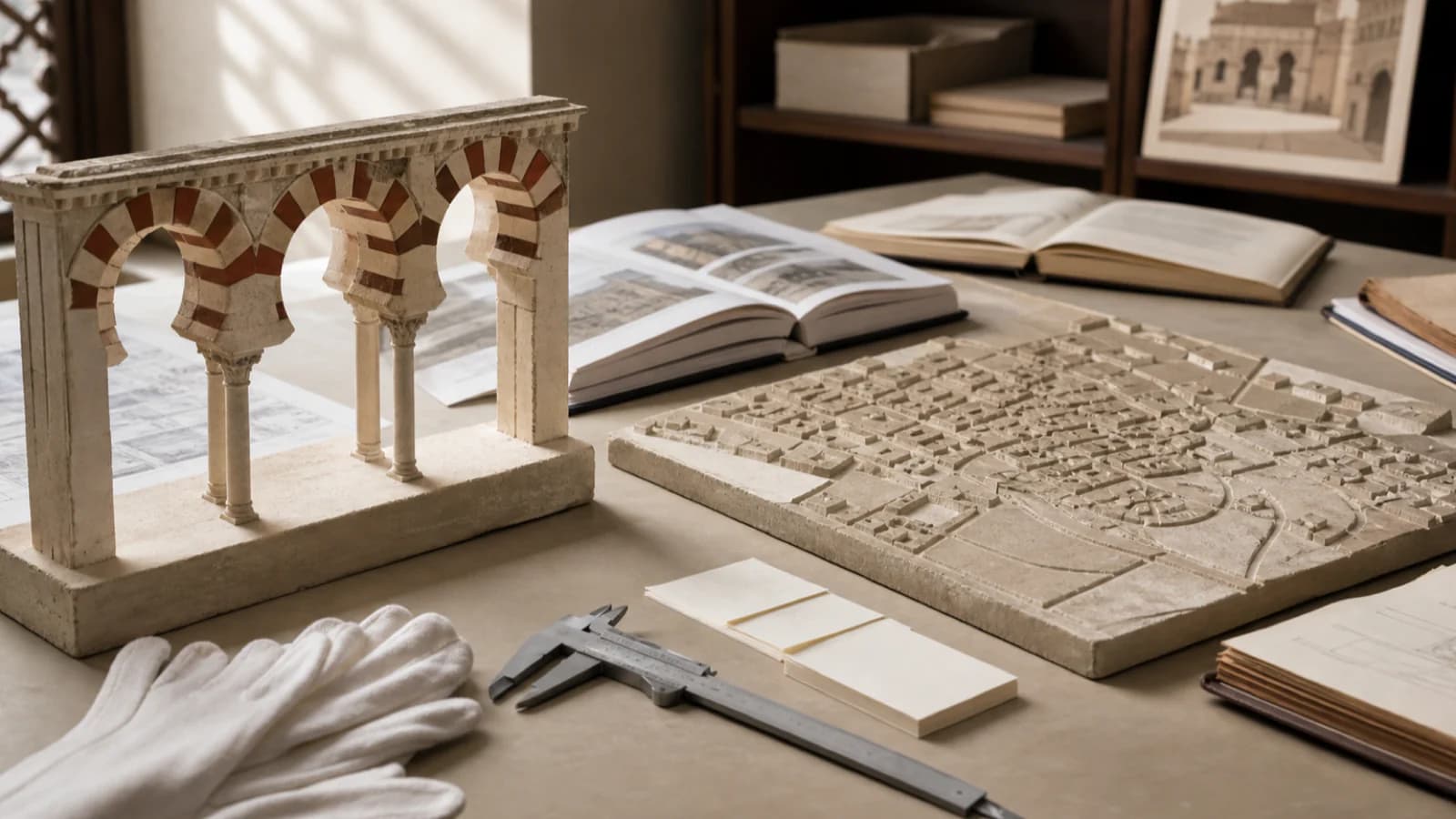
How Córdoba’s Caliphate Rose and Broke Apart, 929–1031
Explore Córdoba’s caliphate from the declaration of 929 to its breakup in 1031, through rulers, Medina Azahara, mosque architecture and dated court objects.
The Caliphate of Córdoba lasted from 929 to 1031 CE. Abd al-Rahman III adopted the caliphal title in 929; civil war began in 1009, and the institution ended in 1031. Its history includes a powerful court and army, the palace city of Medina Azahara, major mosque construction and luxury objects that still preserve names and dates. The political breakup created a different landscape of regional states; it did not erase the people, buildings or cultural practices of al-Andalus.
A timeline with four different beginnings and endings
The dates make sense when the event behind each is stated. The Metropolitan Museum’s history of Umayyad Spain distinguishes provincial rule, the emirate and the caliphate. The Andalusian public foundation El legado andalusí supplies a longer chronology that continues through regional kingdoms and the later Christian conquests.
| Date or period, CE | Event | What the date tells us |
|---|---|---|
| 711 | Muslim forces entered Iberia from North Africa. | The beginning of a much longer history of Muslim rule, rather than the foundation of Córdoba’s tenth-century caliphate. |
| 756–929 | The Umayyad emirate ruled from Córdoba. | The dynasty and its capital preceded adoption of the caliphal title. |
| 929 | Abd al-Rahman III declared himself caliph. | The starting point of the caliphate as a distinct political institution. |
| 961–976 | Al-Hakam II ruled. | A major period of caliphal patronage, including the mosque expansion. |
| 976 | Hisham II succeeded al-Hakam II. | The later distinction between the caliph’s title and al-Mansur’s effective authority becomes essential. |
| 1009 | The fitna, or civil war, began. | Fragmentation developed over time before the final institutional endpoint. |
| 1031 | The caliphate ended. | The conventional endpoint for the institution and transition to the taifa political landscape. |
| 1236 | Ferdinand III of Castile took Córdoba. | The conquest of the city occurred long after the caliphate’s dissolution. |
The table draws on the Met’s periodization, El legado andalusí’s chronology and the Cathedral Chapter’s architectural history. It is a selection of turning points, rather than a list of every ruler or military campaign. The distinction between a dynasty, an office and a city prevents a common mistake: a ruler’s defeat or a building’s destruction does not automatically date the end of all three.
For the earlier crossing, our study of the Muslim entry into Iberia in 711 separates the broad sequence from much later stories about speeches and burned ships. Córdoba’s caliphal declaration belongs more than two centuries after that expedition.
What changed when Abd al-Rahman III became caliph?
Abd al-Rahman III had ruled since 912. Taking the title in 929 therefore changed the claim made by an existing ruler. The Met places this western Umayyad state alongside Abbasid power in the east and the Fatimid caliphate established in North Africa in 909. Córdoba claimed caliphal authority while other Muslim dynasties also claimed it. A map containing several capitals is consequently more useful than imagining one uninterrupted government stretching from Iberia to Baghdad.
Political rivalry also coexisted with artistic contact. The Met describes Córdoba’s court using forms associated with eastern Mediterranean courts and the earlier Umayyads of Syria. Rejecting another dynasty’s authority did not require rejecting every object, craft or visual tradition associated with its lands. The distinction helps explain why the material record can show connections across political divisions.
NYU’s Institute for the Study of the Ancient World presented this setting in its 2024–2025 Medina Azahara exhibition. Its account brings scholars, artists and diplomats into the history of the palace city, and identifies the expression of royal power as a reason for its international tastes. The caliph’s claim was communicated through places, ceremonies and objects as well as a title.
Medina Azahara made government visible
Medina Azahara, also written Madinat al-Zahra, stood near Córdoba. The Junta de Andalucía places its foundation within Abd al-Rahman III’s caliphal program, giving 936 or 940 for the start. The Met’s capital catalogue uses 936. The records support a mid-tenth-century foundation while leaving a variation in the proposed year.
The Junta identifies the palace sector as the ruler’s residence, accommodation for dignitaries and a seat of state administration transferred from Córdoba. Such functions help explain a palace city’s spatial organization: residence, offices and the management of access could occupy related spaces.
UNESCO’s record widens the picture beyond the palace. Roads, bridges, water systems, buildings, architectural decoration and everyday objects form part of the surviving urban complex. Its significance lies in that combination. A richly carved stone can show the investment in a particular room; a road or water channel asks how the settlement worked beyond that room. Together they give a more concrete account of state resources than an unsupported ranking of the richest cities in the world.
The Met’s marble capital 25.120.508, dated approximately 960, offers a smaller point of comparison. A capital is an architectural element at the top of a column, not a royal crown. The museum places it within the story of the palace city and notes that sculpture from the site was reused in later churches and secular buildings. Reuse explains why a caliphal architectural fragment can survive outside its original setting. That general history does not establish every later location of this individual object.
Al-Hakam II’s mosque expansion had a specific shape
The Great Mosque in Córdoba began before the caliphate and was enlarged by successive patrons. Al-Hakam II’s contribution is a particular intervention within that longer building history. The Cathedral Chapter dates this expansion to 962–966. Its dedicated account describes twelve additional sections extending the prayer space southward, with the maqsura and mihrab as focal points.
The mihrab marks the direction of prayer. The Cathedral Chapter’s description of this mihrab identifies a small octagonal room, covered by a shell-shaped dome, within the maqsura area. Its architectural form helps explain why a visitor’s gaze is drawn toward this part of the extension.
Four skylights help organize the extension: one at its entrance and three before the mihrab. The account describes intersecting arches, marble, mosaics and stylized plant ornament. These are observable architectural choices, not a general claim that the entire building was constructed at once by one caliph. When looking at the monument, a useful first task is to locate the expansion and follow how light and the sequence of spaces draw attention toward its southern end.
The distinction also changes the meaning of a photograph. A view containing tenth-century arches, later fittings and modern barriers records the building as it now survives. It cannot by itself reconstruct how every worshipper moved through the space in 965. Dating a feature is the beginning of an interpretation; it does not date everything visible beside that feature.
UNESCO’s Historic Centre of Córdoba account describes the mosque’s conversion to a cathedral in the thirteenth century. The present monument consequently carries several histories. The caliphal expansion can be studied within it, while later Christian use and additions remain part of the building’s material record.
An ivory box records a name, a script and a year
Portable objects offer evidence different from a building plan. The Louvre catalogues the pyxis of al-Mughira, OA 4068, as an elephant-ivory container from Madinat al-Zahra, dated 968. Its Arabic inscription names al-Mughira as the son of the commander of the faithful and gives the year 357 of the Islamic calendar. The catalogue identifies the writing as Kufic and locates it around the lower edge of the lid.
The catalogue’s headline date is 968; its inscription field also gives the Gregorian range 967–968 for AH 357. The Islamic lunar year and a Gregorian calendar year do not have identical boundaries. Keeping both the inscribed year and the catalogue’s conventional date explains the small difference without inventing an exact manufacturing day.
That inscription is a strong anchor for the object’s dating and named recipient. It does not identify everything that the box once held or prove a particular gift ceremony. A container’s material, text, shape and decoration can answer different questions, and some answers remain uncertain even when one date is unusually clear.
Our comparison of Andalusi ivory pyxides examines the Louvre object beside examples that have lost their original lids. That difference matters because a lost lid may also mean a lost inscription. The guide to Kufic and other Arabic-script traditions explains why identifying the writing style and identifying the language are separate tasks. Here, the Louvre explicitly records both Arabic and Kufic.
Wealth and learning depended on people and institutions
Hugh Kennedy’s public Cambridge chapter summary connects state strength around 1000 to prosperous agriculture, a cash economy, taxation, a professional army and a literate bureaucracy. These resources supported officials and armed forces. The account provides an institutional explanation of court power alongside the evidence of costly architecture and objects.
The summary also distinguishes the caliphs’ authority from al-Mansur’s effective military rule under Hisham. A caliphal title and actual command could belong to different men. Identifying both gives a clearer picture of how power operated.
Intellectual and artistic exchange also extended beyond a single court. Ira Lapidus’s publicly available chapter summary treats Spanish-Islamic civilization across a much longer period, mentioning poetry, irrigation, philosophy and the transmission of Greek philosophy through the Arabic world. Its broad geographical and chronological scope needs care: an achievement of later al-Andalus cannot automatically be assigned to Córdoba in 950.
The NYU exhibition supplies a closer material example. Its featured architectural arch carries an inscription naming al-Hakam as heir and Ja‘far as director, dated 961–962, or AH 350. Named participants and dated work make the organization of patronage more tangible. They do not provide a census of artisans or a complete inventory of a library. This account uses such identifiable evidence without repeating enormous population or book totals as established measurements.
Why do 1009, 1010–1013 and 1031 all appear?
The fitna was the civil war that began in 1009. A political chronology can identify that beginning and the caliphate’s final endpoint in 1031, while an archaeological description concentrates on what happened to a particular settlement during the fighting. They describe different scales of change.
UNESCO’s short Medina Azahara account places its devastation in the civil war of 1009–1010. The Junta de Andalucía dates the beginning of abandonment and plundering to 1010–1013, followed by quarrying. Both descriptions place destruction and loss of function in the early conflict. Their different ranges do not establish a single documented day of destruction.
They also should not replace the caliphate’s 1031 endpoint. The Met uses 929–1031 for the caliphal period, while El legado andalusí moves from the civil war to the taifa kingdoms in its chronology. The regional political landscape emerged from fragmentation; a date used to organize a historical period is not proof that every local authority became independent on that same day.
The division between caliphal title and effective command helps frame the succession problem. A state could be powerful without ensuring who would control it next. This is an interpretation of the political contrast, rather than a complete causal account of the war. The chronology establishes a civil-war breakup in the eleventh century and a later Castilian conquest in 1236.
What survived the caliphate’s breakup?
The palace city’s abandonment and the mosque’s continued life produced very different records. UNESCO describes Medina Azahara as a surviving urban archaeological ensemble. Córdoba’s historic center, by contrast, preserves a city altered by later periods, including the cathedral within the former mosque. Neither record is a complete portrait of every person who lived under the caliphate, but each preserves evidence that a political endpoint alone cannot explain.
Objects also have histories beyond the regime that commissioned them. The Met’s account of reused architectural sculpture is an example of material survival through changed settings. The dated pyxis supplies a different connection to the tenth century: a portable object still carrying its inscription. Survival is selective. The buildings and court possessions discussed here make elite patronage particularly visible; they do not represent everyone’s standard of living.
Later Muslim-ruled states in Iberia belong to their own periods. The Nasrid kingdom at Granada, for example, ended centuries after Córdoba’s caliphate. Our study of Granada’s 1491 capitulations and 1492 handover follows that much later settlement and its aftermath. Reading the two together shows why “the end of Muslim Spain” is too imprecise to answer a question about Córdoba in 1031.
The clearest summary is therefore institutional and concrete: 929 marks the caliphal claim, 1009 the opening of civil war, and 1031 the caliphate’s endpoint. Medina Azahara, the mosque expansion and dated objects reveal how authority was expressed and what survives. The subsequent history of those places and objects explains why the end of the institution was not the end of Andalusi history.
Sources
- Metropolitan Museum of Art: The Art of the Umayyad Period in Spain. Supports the distinction between emirate and caliphate, the major rulers and courtly artistic connections. Its civilizational superlatives are not used as measurements.
- El legado andalusí: Chronology. Supplies selected political turning points from the emirate to the fitna, taifa period and 1236 conquest of Córdoba. It is a condensed institutional chronology, not a complete list of rulers.
- Junta de Andalucía: Ciudad Califal de Medina Azahara. Used for the 936-or-940 foundation qualification, residence and government functions, early-eleventh-century abandonment and subsequent reuse.
- UNESCO: Caliphate City of Medina Azahara. Used for urban infrastructure and archaeological survival, retaining the record’s particular destruction range rather than using it to redetermine the caliphate’s endpoint.
- Metropolitan Museum of Art: Capital, 25.120.508. Records an approximately 960 marble architectural fragment and explains reuse of sculpture from the palace city. It does not document every later location of this individual capital.
- Cathedral Chapter of Córdoba: Expansion of Al-Hakam II. Supports the additional southern sections, skylights, materials and architectural focal points.
- Cathedral Chapter of Córdoba: The history. Used for the 962–966 expansion range. Its large library total is not treated as a verified count.
- UNESCO: Historic Centre of Cordoba. Supports the later conversion of the mosque and the historic center’s layered character; citywide population totals are not inferred from the listing.
- Louvre: Pyxide au nom d’al-Mughira, OA 4068. Used for material, catalogue origin, recipient, Arabic/Kufic inscription and the AH357/968 dating, including the catalogue’s Gregorian range.
- Hugh Kennedy: Muslim Spain and Portugal, Cambridge chapter. The public summary supports the economy, army, bureaucracy and relationship between al-Mansur and Hisham; unexposed portions of the chapter are not cited as read.
- Ira Lapidus: Spanish-Islamic Civilization, Cambridge chapter. Its public summary supplies the wider cultural frame; achievements spanning later centuries are not assigned wholesale to the tenth-century caliphate.
- NYU ISAW: Madinat al-Zahra exhibition. The 2024–2025 exhibition account supports the international court setting and the dated arch naming al-Hakam and Ja‘far. It is used as a historical exhibition record, not a current event listing.
- Cathedral Chapter of Córdoba: Mihrab. Supports the prayer-direction function and the small octagonal room within the maqsura, giving concrete meaning to the architectural terminology.


