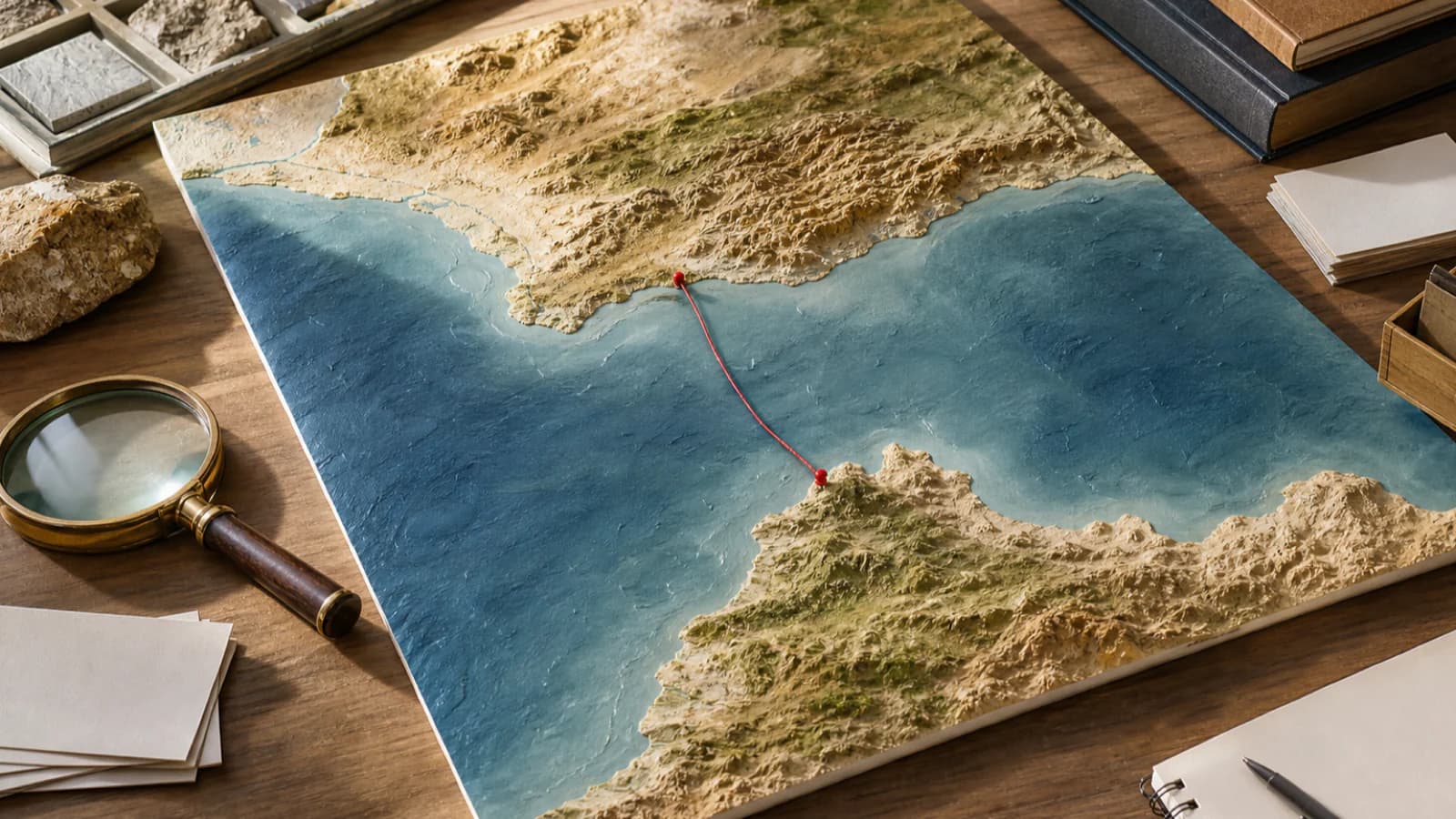
What Happened When Muslim Armies Entered Iberia in 711
A source-aware account of Tariq ibn Ziyad's 711 crossing, Roderic's defeat, Musa ibn Nusayr's campaign, negotiated settlements and the later burned-ships legend.
The Muslim conquest of Iberia began in 711 CE, when a mainly Berber force commanded by Tariq ibn Ziyad crossed from North Africa into the Visigothic kingdom. Tariq's victory over King Roderic in southern Iberia broke the kingdom's field leadership and opened routes toward major cities. Musa ibn Nusayr arrived with another army in 712, while military advances and negotiated agreements continued over the next several years. The sequence is secure in outline. Exact troop totals, a single agreed location for the battle, secret invitations, a polished pre-battle speech and the claim that Tariq burned his ships are much less secure because the detailed narratives were written long after the events.
This distinction matters. “The conquest happened in 711” is useful shorthand for the decisive beginning, not a claim that one battle instantly changed the language, religion, law and daily life of everyone on the peninsula. Political sovereignty could change quickly; settlement, taxation, religious affiliation, intermarriage and cultural practice changed at different speeds in different places.
The 711 to 716 sequence at a glance
| Date | Event | What can safely be said |
|---|---|---|
| 710 | A smaller reconnaissance or raiding expedition is reported | Later sources connect Tarif ibn Malluk with a preliminary crossing, but its details should not be treated as contemporary reporting. |
| Spring 711 | Tariq ibn Ziyad crosses the strait | Modern scholarship describes his expedition as mainly Berber and operating under the authority of Musa ibn Nusayr. |
| July 711, conventionally | Roderic is defeated in southern Iberia | The decisive battle is commonly called Guadalete, although the exact battlefield and some chronological details remain debated. |
| Late 711 to 712 | Forces move toward Cordoba, Toledo and other centres | The broad advance is clear, but many route stories depend on later Arabic accounts. |
| 712 | Musa ibn Nusayr arrives with another army | The conquest was not the achievement of Tariq alone; Musa and other commanders extended and organized control. |
| 713 to 716 | Campaigns and agreements consolidate a new province | By 716, most core strategic and population centres of the former kingdom had been brought under the new order, while northern frontiers remained unstable. |
The political setting before Tariq crossed
The invasion followed decades of Umayyad expansion across North Africa. Musa ibn Nusayr governed Ifriqiya for the Umayyad caliphate, and Tariq served within that command structure. North Africa was not an empty launch pad: Arab and Berber groups had distinct political experiences, and incorporating Berber fighters into Umayyad armies did not erase those differences. Calling the invading army simply “Arab” hides the important Berber component; calling it an independent Berber migration ignores the caliphal state and Musa's authority.
The Visigothic kingdom also had internal strains. Roderic's accession followed a disputed succession, and the monarchy depended on regional elites whose cooperation could not be assumed. Later sources tell dramatic stories about Count Julian, the family of the previous king Wittiza and invitations sent to the invaders. These stories may preserve memories of elite division, but they do not prove one neat conspiracy. The speed of the collapse is better explained by the interaction of an effective expedition, the defeat of the royal field army, contested Visigothic authority and local decisions made after the battle.
Who Tariq ibn Ziyad was and what remains uncertain
Tariq ibn Ziyad was a commander subordinate to Musa ibn Nusayr and is consistently associated with the 711 crossing. Scholarship commonly describes his force as predominantly Berber. The historical place-name Jabal Tariq, “mountain of Tariq,” survives in the name Gibraltar and anchors his association with the strait.
Beyond those points, a complete modern-style biography is impossible. Later texts differ over Tariq's ancestry, whether he had once been enslaved, his precise relationship with Musa and what happened after the commanders were summoned east. Those variants should be reported as source traditions rather than fused into one confident life story. Tariq was central to the opening campaign, but neither the conquest nor the creation of al-Andalus was the work of one heroic individual.
The crossing and the limits of the fleet stories
Crossing a narrow strait still required vessels, pilots, embarkation points, landing space, supplies and communication with North Africa. The CSIC study of the conquest fleet is valuable because it treats ships as a logistical problem rather than scenery for a legend. The available evidence does not provide a complete manifest or a contemporary operational report. Even apparently precise claims about the number of ships or repeated crossings depend on reconstruction.
Geography also shaped the campaign after landfall. The area around Gibraltar and Algeciras offered access to roads into Baetica. The invaders needed to move and feed a force while monitoring the strait behind them. That practical dependence makes the famous claim that Tariq destroyed all his transport strategically questionable, though logistical implausibility alone is not proof that an event did not happen.
What is known about the battle called Guadalete
Modern accounts usually place the decisive encounter in July 711 in southern Baetica. “Battle of Guadalete” is the conventional name, but proposed locations include areas associated with the Guadalete and Barbate river systems and the vicinity of Medina-Sidonia. It is more accurate to retain the familiar label while acknowledging that the exact field has not been securely identified.
Roderic's army was defeated, and the king disappeared from secure political history. Later texts supply enormous troop totals, betrayals during battle and day-by-day combat narratives, but these details vary. What the outcome demonstrates is more important than an invented precision: the king could no longer coordinate resistance, members of the political elite were killed or dispersed, and Tariq's army gained access to the kingdom's road and urban network.
Why the conquest advanced beyond one battlefield
A royal defeat did not automatically deliver every city. Forces moved toward important centres, garrisons were established, and local leaders chose among resistance, flight and agreement. Toledo's political importance made its occupation symbolically and administratively significant. Accounts of how Cordoba was entered are especially useful warnings: historians have shown that later Arabic writers shaped the city's conquest story around the later prestige and concerns of a provincial capital.
Military victory worked together with existing infrastructure. Roman and Visigothic roads, cities, estates and tax practices did not vanish. New rulers could use some of them while changing who received revenue and who held authority. This is one reason the campaign could transform government faster than it transformed society.
Musa ibn Nusayr and the campaigns after 711
Musa crossed in 712 with another force. Later narratives often turn his arrival into a personal rivalry with Tariq, complete with anger, punishment and competition for treasure. Some tension between commanders is possible, but the theatrical details cannot be accepted simply because they make a memorable story. Musa's arrival also had a straightforward political meaning: the governor was taking direct control of an unexpectedly successful and expanding campaign.
Musa, Tariq, Musa's son Abd al-Aziz and other commanders extended the new order through further expeditions and settlements. By about 716, core centres of the former Visigothic kingdom had been subdued, although “subdued” did not mean permanent control of every valley. The northern and northeastern frontiers remained fluid. Al-Andalus emerged as a province tied to the Umayyad caliphate, not yet the independent Cordoban emirate founded in 756.
The 713 Pact of Tudmir shows conquest by agreement
The agreement associated with Theodemir, rendered Tudmir in Arabic, is dated to April 713 and concerns several towns in southeastern Iberia. Its surviving Arabic versions were transmitted in later works rather than as an untouched original sheet. Scholars therefore study both the terms and the document's transmission. That caution does not make the pact useless; it makes clear what sort of evidence it is.
The terms preserve Theodemir's local position and promise security for people, property and churches under conditions that include loyalty, non-assistance to enemies and annual payments in money and produce. The document shows that submission could be negotiated rather than produced by a siege in every locality. It does not prove that every town received identical conditions, that power was equal between the parties or that religious policy never changed afterward.
Why the written sources do not tell one simple story
The conquest has an unusual evidence problem. A Latin chronicle completed in 754 stands relatively close to the events, but it has its own viewpoint and limited coverage. The most detailed surviving Muslim accounts are much later, with important narratives composed or compiled from the tenth century onward. They can preserve earlier information while also reflecting the political, legal and literary needs of later communities.
Historians therefore compare Arabic and Latin texts with coins, seals, settlement evidence, buildings, burials and changing material culture. The UCL archaeological study stresses that identity formation and Islamization cannot be inferred from a battle date alone. The Cambridge study on “staying Roman after 711” likewise directs attention to continuity across a political rupture. Where evidence types disagree, the answer is not to choose the most colourful narrative but to state the disagreement.
Did Tariq burn his ships and give the famous speech
There is no secure contemporary evidence that Tariq burned his fleet. The story appears in later literary tradition, often paired with an elegant speech built around the image of the sea behind the soldiers and the enemy before them. The episode communicates courage and irreversible commitment, which explains its lasting appeal, but literary usefulness is not the same as eyewitness confirmation.
The responsible wording is: later tradition says Tariq burned the ships. It should not be written as an established event, and the speech should not be presented as a verbatim transcript. The same rule applies to precise private conversations, secret motives and exact army numbers. A source-aware history can remain vivid without giving later storytelling the status of a contemporary record.
What changed quickly and what changed over generations
Visigothic royal rule collapsed across most of Iberia, and a new provincial government linked the peninsula to North Africa and the wider Umayyad world. Political appointments, taxation, military settlement and long-distance connections changed. Arabic increasingly became a language of power and culture, and Islamic religious and legal institutions developed.
Conversion to Islam was not instantaneous. Christians and Jews remained in al-Andalus under legal and fiscal arrangements that varied by period and place. Arabic language adoption, intermarriage and new identities unfolded over generations. Archaeology also records continued use of settlements and practices inherited from late Roman and Visigothic society. “Conquest,” “Arabization” and “Islamization” name related but different processes.
How to use the terms Iberia, Spain and al-Andalus
Iberia or the Iberian Peninsula is the clearest geographic term for the events of 711. “Spain” is common in older scholarship and remains understandable, but it can suggest a modern nation-state that did not exist. Al-Andalus was the Arabic name for territories under Muslim rule, and its borders changed substantially. It should not be treated as one state occupying the same area continuously from 711 to 1492.
Ethnic labels also need care. Arab, Berber, Goth, Hispano-Roman, Christian and Jewish could indicate ancestry, language, political affiliation, legal status or an author's classification, not modern race or nationality. “Moors” is especially imprecise when used for everyone on the Muslim side. Naming the actor and the period—Tariq's mainly Berber expedition, an Umayyad governor, or a later Andalusi dynasty—usually produces better history.
Answers to common questions
Was Iberia conquered in a single year?
No. The decisive crossing and battle occurred in 711, but campaigns and agreements continued. By roughly 716, most core strategic and population centres had entered the new order, while northern frontiers remained contested.
Was Tariq's army Arab or Berber?
Modern scholarship describes the 711 expedition as mainly Berber, commanded within an Umayyad system led in North Africa by Musa ibn Nusayr. Both parts of that description matter.
Did the conquest immediately make the population Muslim?
No. Government changed far faster than the religious identity of the whole population. Conversion, Arabic language use and new social identities developed over generations.
Is Guadalete the certain location of the battle?
No. Guadalete is the conventional name. The battle occurred in southern Iberia, probably in July 711, but historians continue to debate its exact location.
Related research guides
- Al-Andalus history timeline from 711 to 1492 — separates the conquest, province, emirate, caliphate, taifa states and later dynasties.
- Caliphate of Cordoba from 929 to 1031 — explains why the caliphate began more than two centuries after the crossing.
- Fall of Granada in 1492 — distinguishes surrender terms from the coercive changes that followed.
- Islamic history timeline — places Iberia alongside Umayyad, Abbasid and North African developments.
- Islamic world map — compares historical regions without projecting modern borders backward.
Sources
- Cambridge University Press, Gharb al-Andalus — supports the mainly Berber force, spring 711 crossing, probable July battle, Musa's 712 arrival and consolidation by about 716.
- CSIC, The Fleet of the Conquest of Hispania in 711 — provides the focused scholarly analysis used to separate crossing logistics from later stories about the fleet.
- Spanish Ministry of Culture, Jabal Tariq — documents the historical toponym connecting Gibraltar with Tariq ibn Ziyad.
- Cambridge Core, Medieval Arabic Accounts of the Conquest of Cordoba — shows how later conquest narratives were shaped by the status and priorities of Cordoba.
- Metropolitan Museum of Art, The Umayyad Period in Spain — supports the 711 starting point, seven-year expansion frame and the distinction between the province and later Cordoban emirate.
- UCL Discovery, Al-Andalus and Hybridization — supplies archaeological context for gradual social and religious change after the political conquest.
- Cambridge Core, Staying Roman after 711 — supports the discussion of institutional and material continuity across the change in sovereignty.
- National Endowment for the Humanities, Treaty of Tudmir — provides an English translation and identifies the April 713 capitulation terms, protected interests and required payments.
- Transmediterrane Geschichte, The Treaty of Tudmir — assesses the pact's later textual transmission, authenticity questions and value for reconstructing negotiated submission.
- Complutense University of Madrid, Transmission of the Treaty of Tudmir — compares the two principal Arabic transmission lines instead of treating the surviving text as an untouched original.


