Resource
Safavid Empire History Timeline from Shah Ismail to Isfahan and 1722
A source-aware Safavid Empire timeline covering the Ardabil order, Shah Ismail, Chaldiran, Twelver institutions, Shah Abbas, Isfahan, New Julfa, silk trade and the fall of the capital in 1722.
Core coverage
1301-1722, with later afterlives
Timeline entries
24 source-labeled turning points
Editorial method
Separates order, movement, dynasty, state institutions, religious change, battlefield result and later memory
Last reviewed
12 July 2026
The Safavid Empire was not born as a finished state in 1501. A Sufi order based at Ardabil became a militant and messianic movement, Shah Ismail took Tabriz with Qizilbash support, and campaigns extended dynastic power across Iran. The 1514 defeat at Chaldiran exposed military and frontier pressures but did not end the dynasty. Under Tahmasp, the court managed Qizilbash factions, Ottoman and Uzbek threats, and the slower creation of fiscal and religious institutions.
Religious transformation also followed more than one timetable. Ismail proclaimed Twelver Shiism as the state religion, while early Qizilbash belief differed from the juristic tradition later supported by scholars and courts. Public ritual, education, law, translation, patronage, discrimination and coercion reshaped institutions over generations. Evidence for Sunni survival and varied minority experience prevents either an overnight-conversion story or a sanitized account of state pressure.
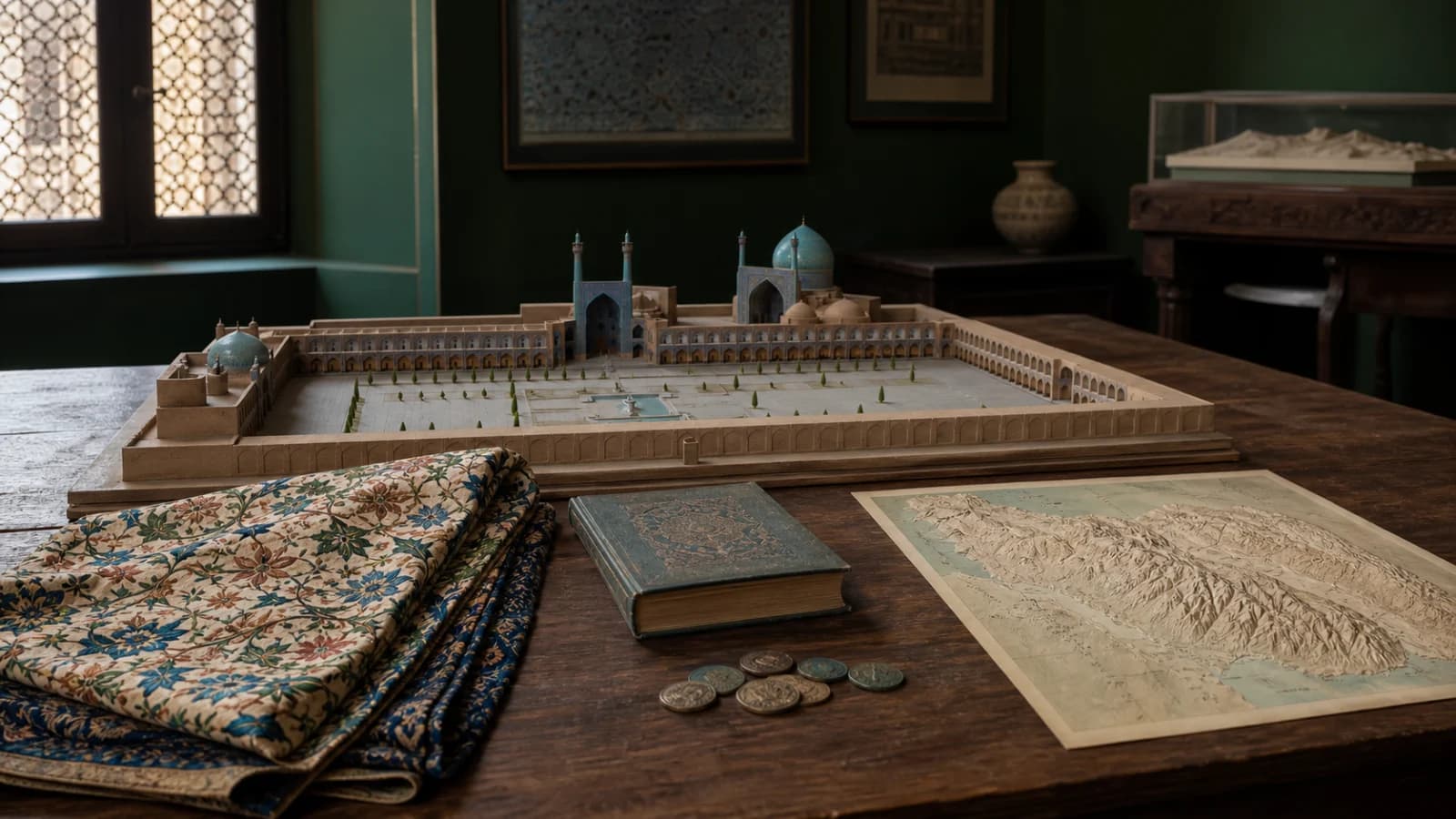
Shah Abbas I recovered territory, concentrated royal authority and transferred the capital to Isfahan. Meidan Emam joined palace, mosques, bazaar and ceremony, while New Julfa became a center of Armenian commercial networks after forced displacement. Silk linked the court to Asian and European exchange, but it was not the entire economy. After Abbas, Safavid institutions persisted through changing rulers until rebellion, siege and the fall of Isfahan in 1722 ended effective dynastic rule.
How to use this timeline
Use the four eras to distinguish institutional processes that are often collapsed into one founding date.
- 1301-1501 follows the Safavid order's transformation before state power.
- 1501-1587 separates foundation, Chaldiran, Tahmasp and succession crises.
- 1587-1629 follows Shah Abbas, Isfahan, New Julfa, trade and centralization.
- 1629-1722 traces resilience, later pressures, Afghan rebellion and the fall of Isfahan.
Evidence rules
Dates and claims are labeled by evidence type. Court chronicles, hostile accounts, legal texts, objects, architecture and later scholarship answer different questions.
- Do not treat a dynastic genealogy as neutral proof of medieval origins.
- Do not turn the 1501 state declaration into an instant population census.
- Do not use Chaldiran as a permanent verdict on one army, ethnicity or sect.
- Do not detach Isfahan's monuments from taxation, commerce, labor and coercive state power.
What this cluster adds
Three detailed guides answer high-intent questions about Shah Ismail and Chaldiran, Iran's long religious transformation, and Shah Abbas's capital and commercial policy.
- Foundation and battlefield defeat are treated as different historical problems.
- Religious history includes institutions, coercion, clerical networks and regional variation.
- Isfahan's architecture is connected to New Julfa, silk, diplomacy and royal centralization.
Safavid order and state foundation, 1301-1501
The Ardabil Sufi order became a militant and messianic movement before Ismail converted inherited sacred leadership into monarchy.
| Date | Event | Why it matters | Evidence label |
|---|---|---|---|
| 1301 | The Safavid Sufi order takes shape at Ardabil | The community associated with Shaykh Safi al-Din develops an institutional lineage and regional following long before any Safavid state exists. | Hagiography, genealogy and later institutional history |
| 1447 | Junayd becomes leader of the order | Safavid leadership becomes more politically ambitious and mobile, attracting armed Turkmen support across regional frontiers. | Regional chronicles and later Safavid narratives |
| 1460 | Junayd dies during a Caucasus campaign | Campaigning and martyr memory deepen the link between sacred leadership, family succession and military following. | Dynastic and neighboring chronicles |
| 1488 | Haydar is killed and Safavid heirs are constrained | Rival powers try to contain the movement, while Qizilbash loyalty increasingly centers on the surviving family. | Aq Qoyunlu and Safavid narrative sources |
| 1499 | The young Ismail leaves Lahijan | Ismail reassembles Qizilbash followers and begins the campaigns that transform inherited sacred authority into monarchy. | Court chronicles and reconstructed itinerary |
| 1501 | Ismail takes Tabriz and becomes shah | The standard foundation date joins dynastic accession to the proclamation of Twelver Shiism, before full territorial or institutional consolidation. | Persian chronicles, coins and public ritual record |
Ismail, Tahmasp and consolidation, 1501-1587
Foundation, Chaldiran, Tahmasp's long reign and factional succession show that a 1501 accession did not create a finished state.
| Date | Event | Why it matters | Evidence label |
|---|---|---|---|
| 1508 | Safavid forces take Baghdad | Expansion connects the new state to Iraqi shrine geography while extending rivalry with neighboring powers. | Persian and regional chronicles |
| 1510 | Victory over the Uzbeks near Merv | The defeat of Muhammad Shaybani temporarily secures the northeastern frontier and raises Ismail's imperial prestige. | Safavid, Uzbek and later historical accounts |
| 23 Aug 1514 | Battle of Chaldiran | The Ottoman army defeats Ismail and enters Tabriz, but withdraws; the Safavid state survives and later adapts. | Ottoman and Safavid chronicles; battle scholarship |
| 1524 | Ismail dies and Tahmasp succeeds | A child succession opens prolonged Qizilbash competition while the dynasty, court and religious project continue. | Court chronicles and administrative history |
| 1555 | Peace of Amasya and the Qazvin capital | The first formal Ottoman-Safavid peace stabilizes parts of the frontier while Tahmasp shifts the capital away from exposed Tabriz. | Treaty and diplomatic record; urban chronology |
| 1576-1587 | Succession crisis after Tahmasp | Rapid changes of ruler, factional violence and territorial pressure expose weaknesses that Shah Abbas later confronts. | Safavid court chronicles and foreign reports |
Shah Abbas and Isfahan, 1587-1629
Shah Abbas joined court and military centralization to Isfahan, New Julfa, silk, diplomacy and monumental urban planning.
| Date | Event | Why it matters | Evidence label |
|---|---|---|---|
| 1587-1588 | Shah Abbas I takes power | The new ruler begins consolidating court authority amid Qizilbash rivalry and war on Ottoman and Uzbek fronts. | Court chronicles, coins and later biographies |
| 1590 | Peace cedes territory to the Ottomans | A tactical settlement gives Abbas time to address the northeastern frontier and reorganize political and military resources. | Diplomatic and treaty record |
| 1597-1598 | Capital transfers to Isfahan | A new royal district beside the older city places court ceremony, commerce and long-distance routes at the center of imperial planning. | Urban history, inscriptions and architectural evidence |
| 1604-1605 | Forced displacement and creation of New Julfa | Armenians removed from the frontier rebuild institutions near Isfahan and develop influential merchant networks under Safavid protection and control. | Armenian records, decrees and Safavid-period history |
| 1619 | Royal silk export monopoly | The court seeks greater control of a major source of foreign exchange, working through merchant networks and competing with European companies. | Commercial records, decrees and economic history |
| 1622 | Safavid forces capture Hormuz | English naval assistance helps remove Portuguese rule, but Gulf commerce remains a field of competing Safavid, Asian, Arab and European interests. | Safavid, Portuguese and East India Company records |
Later Safavids and the fall of Isfahan, 1629-1722
Later Safavid institutions remained resilient before frontier revolt, court weakness, siege and the fall of Isfahan in 1722.
| Date | Event | Why it matters | Evidence label |
|---|---|---|---|
| 1629 | Death of Shah Abbas I | A celebrated reign ends with stronger royal institutions but a constrained succession and political costs created by court centralization. | Court, diplomatic and biographical sources |
| 1639 | Treaty of Zuhab | The Ottoman-Safavid settlement stabilizes a broad frontier framework after generations of war, without ending local disputes or mobility. | Treaty history and later boundary scholarship |
| 1642-1666 | Reign of Shah Abbas II | Administration, trade and court culture retain capacity, complicating claims that decline began as an uninterrupted collapse in 1629. | Court chronicles, travel accounts and material culture |
| 1694 | Sultan Husayn becomes shah | Court faction, fiscal pressure and changing religious and regional politics shape the last effective reign of the dynasty. | Persian chronicles and European travel accounts |
| 1709 | Hotak revolt succeeds at Kandahar | Mirwais Hotak breaks Safavid control in a frontier region, revealing grievances and military limits that later threaten the capital. | Afghan, Persian and later regional histories |
| 1722 | Siege and fall of Isfahan | Sultan Husayn surrenders after the Hotak siege, ending effective Safavid imperial rule even though dynastic claimants persist afterward. | Siege narratives, diplomatic reports and dynastic chronology |
FAQ
When did the Safavid Empire begin?
1501 is the standard dynastic foundation date because Shah Ismail took Tabriz and assumed royal authority, but the Safavid order began much earlier and state consolidation continued after accession.
Did the Battle of Chaldiran end the Safavid Empire?
No. The Ottomans won decisively in 1514 and entered Tabriz, but withdrew. Safavid rule continued and later rulers recovered territory and reorganized the state.
Did Iran become Twelver Shi'i immediately in 1501?
No. The state declaration was immediate, while legal institutions, education, public ritual and community adherence developed unevenly over generations.
Why did Shah Abbas move the capital to Isfahan?
Isfahan was farther from the exposed northwestern frontier and well placed for central routes. The new royal district also let the shah organize palace, markets, worship and ceremony around a planned urban ensemble.
Was New Julfa a voluntary merchant colony?
Its later commercial success followed the forced displacement of Armenians during the 1604-1605 frontier campaign. Protection and merchant agency must be read alongside coercive relocation.
When did effective Safavid rule end?
The fall of Isfahan during the Afghan siege of 1722 ended effective rule by Sultan Husayn. Safavid claimants remained part of later politics, so dynastic afterlives continued beyond the collapse of the state.
Related reading
- Shah Ismail I, the Safavid Foundation and the Battle of Chaldiran
A source-critical guide to the 1501 foundation, sacred kingship, Ottoman conflict, the 23 August 1514 battle and its immediate and longer consequences.
- How Safavid Iran Became Twelver Shi'i Through State Policy and Clerical Networks
A source-critical account of declaration, coercion, ritual, legal education, clerical migration, Sunni survival and the gradual institutionalization of Twelver Shiism.
- Shah Abbas I, Isfahan, New Julfa and the Safavid Silk Trade
A sourced guide to political reform, the 1597-1598 capital transfer, Meidan Emam, New Julfa, Armenian merchant networks, silk and the costs of centralized rule.
- Islamic history timeline
Place Safavid Iran beside Ottoman, Mughal and wider intellectual and religious change without treating Islamic history as one empire.
- Mughal Empire history timeline
Compare two early modern Persianate empires while keeping their institutions, dynasties and religious politics distinct.
- Ottoman conquest of Constantinople in 1453
Establish the Ottoman imperial context that preceded Safavid-Ottoman rivalry and Chaldiran.
- Akbar's religious policy and imperial theology
Compare another early modern ruler's sacred kingship without treating inclusion and conversion as the same policy.
- Muslim travelers and geographers timeline
Connect Isfahan, diplomatic travel and merchant routes to travel writing and geographic reconstruction.
- Islamic education institutions timeline
Place Safavid clerical networks, legal learning and endowed institutions inside a longer history of education.
- Islamic Golden Age history timeline
Follow earlier Persianate courtly, scientific and translation networks inherited and reworked by Safavid institutions.
- How Baghdad Fell to the Mongols in 1258
A source-aware history of the 1258 siege of Baghdad, its dates, Mongol campaign, Abbasid collapse, disputed death tolls, library stories and political aftermath.
Connected by source-aware history.
- Nizamiyya of Baghdad: 1065 Foundation, 1067 Opening and al-Ghazali
A source-aware history of the Nizamiyya madrasa in Baghdad, its 1065 and 1067 dates, Nizam al-Mulk, waqf funding, curriculum, al-Ghazali and first-university myths.
Connected by source-aware history.
Sources
- British Museum: Safavid dynasty
Dynastic chronology from 1501 through Chaldiran, Shah Abbas and the 1722 collapse.
- Metropolitan Museum of Art: The Art of the Safavids before 1600
Order, Qizilbash, Ismail, Tahmasp, Shah Abbas, art, Isfahan and trade.
- Encyclopaedia Iranica: Safavid dynasty
Political formation, neighboring powers, institutions, religion and dynastic history.
- Cambridge Core: Safavid Persia
Origins, genealogy, state formation and historical source criticism.
- Encyclopaedia Iranica: Battle of Chaldiran
Battle date, campaign context, military result and consequences.
- Cambridge Core: The Safavid Synthesis
Transformation from order to movement and from Qizilbash devotion to Imamite institutions.
- Cambridge Core: Sunni survival in Safavid Iran
Evidence against an overnight and uniform conversion account.
- UNESCO World Heritage Centre: Meidan Emam, Esfahan
Urban plan, monuments and combined political, religious, social and commercial functions.
- British Museum: Shah Abbas I
Reign, consolidation, capital transfer and New Julfa chronology.
- Encyclopaedia Iranica: Abbas I
Reform, centralization, industry, trade, silk and royal power.
- Encyclopaedia Iranica: Julfa in the Safavid period
Forced relocation, New Julfa and Armenian international commerce.
- Cambridge Core: Safavid Iran's search for silver and gold
Silk, bullion and the need to place European commerce within wider trade.
Languages
- الخط الزمني لتاريخ الدولة الصفوية: الشاه إسماعيل وجالديران والشاه عباس وعام 1722
- সাফাভি সাম্রাজ্যের ইতিহাসের সময়রেখা: শাহ ইসমাইল, চালদিরান, শাহ আব্বাস ও ১৭২২
- Cronologia de l'Imperi safàvida: Shah Ismail, Txaldiran, Shah Abbas i 1722
- Časová osa Safíovské říše: šáh Ismáíl, Čaldirán, šáh Abbás a rok 1722
- Tidslinje for Safavideriget: shah Ismail, Chaldiran, shah Abbas og 1722
- Zeitleiste des Safawidenreichs: Schah Ismail, Tschaldiran, Schah Abbas und 1722
- Χρονολόγιο της Αυτοκρατορίας των Σαφαβιδών: Σαχ Ισμαήλ, Τσαλντιράν, Σαχ Αμπάς και 1722
- Safavid Empire History Timeline from Shah Ismail to Isfahan and 1722
- Cronología del Imperio safávida: Shah Ismail, Chaldiran, Shah Abbas y 1722
- Safavidien valtakunnan historian aikajana: šaahi Ismail, Chaldiran, šaahi Abbas ja 1722
- Chronologie de l'Empire safavide : Shah Ismail, Tchaldiran, Shah Abbas et 1722
- Linimasa sejarah Kekaisaran Safawi: Shah Ismail, Chaldiran, Shah Abbas, dan 1722
- Cronologia dell'Impero safavide: Shah Ismail, Cialdiran, Shah Abbas e 1722
- サファヴィー帝国史年表:シャー・イスマーイール、チャルディラーン、シャー・アッバース、1722年
- 사파비 제국 역사 연표: 샤 이스마일, 찰디란, 샤 아바스와 1722년
- Garis masa sejarah Empayar Safawi: Shah Ismail, Chaldiran, Shah Abbas dan 1722
- Tijdlijn van het Safavidische Rijk: sjah Ismail, Chaldiran, sjah Abbas en 1722
- Tidslinje for Safavideriket: sjah Ismail, Chaldiran, sjah Abbas og 1722
- Oś czasu imperium Safawidów: szach Ismail, Czaldyran, szach Abbas i 1722 rok
- Linha do tempo do Império Safávida: Shah Ismail, Chaldiran, Shah Abbas e 1722
- Хронология Сефевидской империи: шах Исмаил, Чалдыран, шах Аббас и 1722 год
- Časová os Safíjovskej ríše: šach Ismáíl, Čaldirán, šach Abbás a rok 1722
- Tidslinje för Safavidriket: shah Ismail, Chaldiran, shah Abbas och 1722
- ไทม์ไลน์ประวัติศาสตร์จักรวรรดิซาฟาวิด: ชาห์อิสมาอิล ชาลดิรัน ชาห์อับบาส และปี 1722
- Safevi İmparatorluğu tarihi zaman çizelgesi: Şah İsmail, Çaldıran, Şah Abbas ve 1722
- سەفەۋى ئىمپېرىيەسى تارىخى ۋاقىت جەدۋىلى: شاھ ئىسمائىل، چالدىران، شاھ ئابباس ۋە 1722-يىل
- Dòng thời gian Đế quốc Safavid: Shah Ismail, Chaldiran, Shah Abbas và năm 1722
- 萨法维帝国历史时间线:沙阿伊斯梅尔、查尔迪兰、沙阿阿巴斯与1722年
- 薩法維帝國歷史時間線:沙阿伊斯梅爾、查爾迪蘭、沙阿阿巴斯與1722年
- 薩法維帝國歷史時間線:沙阿伊斯梅爾、查爾迪蘭、沙阿阿巴斯與1722年