Ibn al-Haytham: Optics, Vision and the Camera Obscura Claim
What Ibn al-Haytham changed in optics: his Book of Optics, theory of vision, dark-room tests, camera obscura claim, experiments and later influence.
Ibn al-Haytham, known in Latin as Alhazen, reshaped the study of light and sight by joining ray geometry to physical investigation and a detailed theory of perception. Born around 965 in Basra and active for much of his later life in Cairo, he is best known for the seven-book Kitab al-Manazir, or Book of Optics. He argued that light from luminous and illuminated objects reaches the eye, analyzed reflection and refraction, used deliberately arranged observations, and explained why seeing involves judgment as well as sensation.
He did not invent optics, the photographic camera or one timeless “scientific method.” His dark-room work established principles essential to pinhole projection, but the Book of Optics does not describe a complete picture of an outdoor scene. His achievement is more interesting than the slogan: he critically rebuilt several older traditions into a new mathematical and physical account whose problems remained productive for centuries.
Ibn al-Haytham at a glance
| Question | Best-supported answer | Evidence limit |
|---|---|---|
| Who was he? | Abu Ali al-Hasan ibn al-Hasan ibn al-Haytham, a mathematician and natural philosopher called Alhazen in Latin traditions. | “First scientist” and “father of modern optics” are modern honorifics, not historical offices. |
| When and where? | Usually dated about 965–1040; born in Basra and later associated with Fatimid Cairo. | Later biographies disagree about important episodes of his life. |
| What was his major work? | The seven-book Kitab al-Manazir, or Book of Optics. | He wrote many other works on mathematics, astronomy, light and natural philosophy. |
| What changed in vision theory? | He rejected eye-emitted rays as the physical cause of ordinary sight and analyzed light arriving at the eye. | His eye anatomy and physiology were not the modern lens-and-retina model. |
| Did he invent the camera? | No. He performed dark-room aperture experiments and stated a principle necessary for pinhole projection. | The Optics reports light patches, not a complete photographic or scenic image. |
| Did he invent the scientific method? | No single person invented one universal method. His mathematical–physical program made designed observations answer specific optical questions. | Modern laboratories, statistics, peer review and publication systems developed through much longer histories. |
What is secure in his biography?
The safest biographical outline is short. Ibn al-Haytham was born in Basra in present-day Iraq, moved to Egypt and pursued scholarship in Cairo. His surviving works and historical catalogues connect him with optics, geometry, number theory, astronomy and natural philosophy. The specialist biography maintained by the Islamic Scientific Manuscripts Initiative describes a scholar whose extant writings are concentrated in mathematics, optics and astronomy.
The famous Nile story is less secure. Later accounts say he proposed regulating the river, inspected the problem, concluded that the project could not be achieved and then feared the Fatimid caliph al-Hakim. In the best-known version he pretended to be mentally ill and lived under restriction until the caliph died. The sources do not agree on the details. It is therefore reasonable to report the failed engineering project as a biographical tradition, but not to build a precise chronology of house arrest—or the composition date of the Optics—from the story alone.
His career belongs to Basra and Fatimid Cairo, not to the earlier Abbasid institution popularly called Baghdad’s House of Wisdom. The history of the House of Wisdom explains why medieval scholarship should not be assigned automatically to one famous building, while the Islamic Golden Age timeline places Ibn al-Haytham among overlapping cities, courts, languages and disciplines.
What the seven books of optics set out to explain
The Book of Optics is not a single experiment or a list of modern laws. Its seven books investigate light and colour, the conditions of direct vision, the structure of the eye, errors of perception, reflection from differently shaped mirrors and refraction through transparent media. The ISMI work record identifies surviving manuscript witnesses and the modern critical editions needed to distinguish the Arabic work from its Latin reception.
Ibn al-Haytham’s project combined fields that had not been identical. Euclid and Ptolemy supplied mathematical ray geometry; Galenic medicine supplied an inherited account of the eye; Aristotelian natural philosophy framed questions about physical qualities; al-Kindi and other Arabic-language predecessors had already written about light and visual rays. A. Mark Smith therefore calls the work a “grand synthesis”. Its originality lies in the way those materials were criticized, reorganized and extended, not in creation from an intellectual vacuum.
How his account changed the direction of vision
Extramission theories treated geometrical rays as proceeding from the eye toward visible things. Ibn al-Haytham rejected eye-emitted rays as the physical explanation of ordinary sight. Light exists and propagates whether or not anyone is looking; luminous bodies emit it, illuminated bodies send light and colour in many directions, and what reaches the eye makes vision possible.
This was not simply the modern textbook sentence “light reflects into the retina.” His account retained the old mathematical line joining a visible point and the eye, but reversed the physical direction. It also tried to explain how forms of light and colour reached the eye’s sensitive structures and how the perceiver distinguished what was seen. The result was a sophisticated intromissionist theory, not a twenty-first-century account of photoreceptors and neural processing.
Why his eye was not a modern camera
Popular diagrams sometimes make Ibn al-Haytham’s eye look like a camera obscura with a pupil aperture and a screen at the back. Sabra warns directly against that reconstruction. The Arabic Optics does not use the modern anatomical concepts translated as “retina” and “lens.” It discusses the cornea, aqueous and vitreous humours, the crystalline humour and optic nerves within an inherited medical framework.
That distinction matters because knowing that light enters the eye is not the same as knowing where a focused image forms. Ibn al-Haytham treated the crystalline humour as central to sensation and struggled to preserve the ordering of rays through the eye. Johannes Kepler later made the retinal image—and the eye as a lens-based optical device—central to a different model. The later correction does not erase Ibn al-Haytham’s achievement; it defines what that achievement actually was.
What his dark-room experiments actually showed
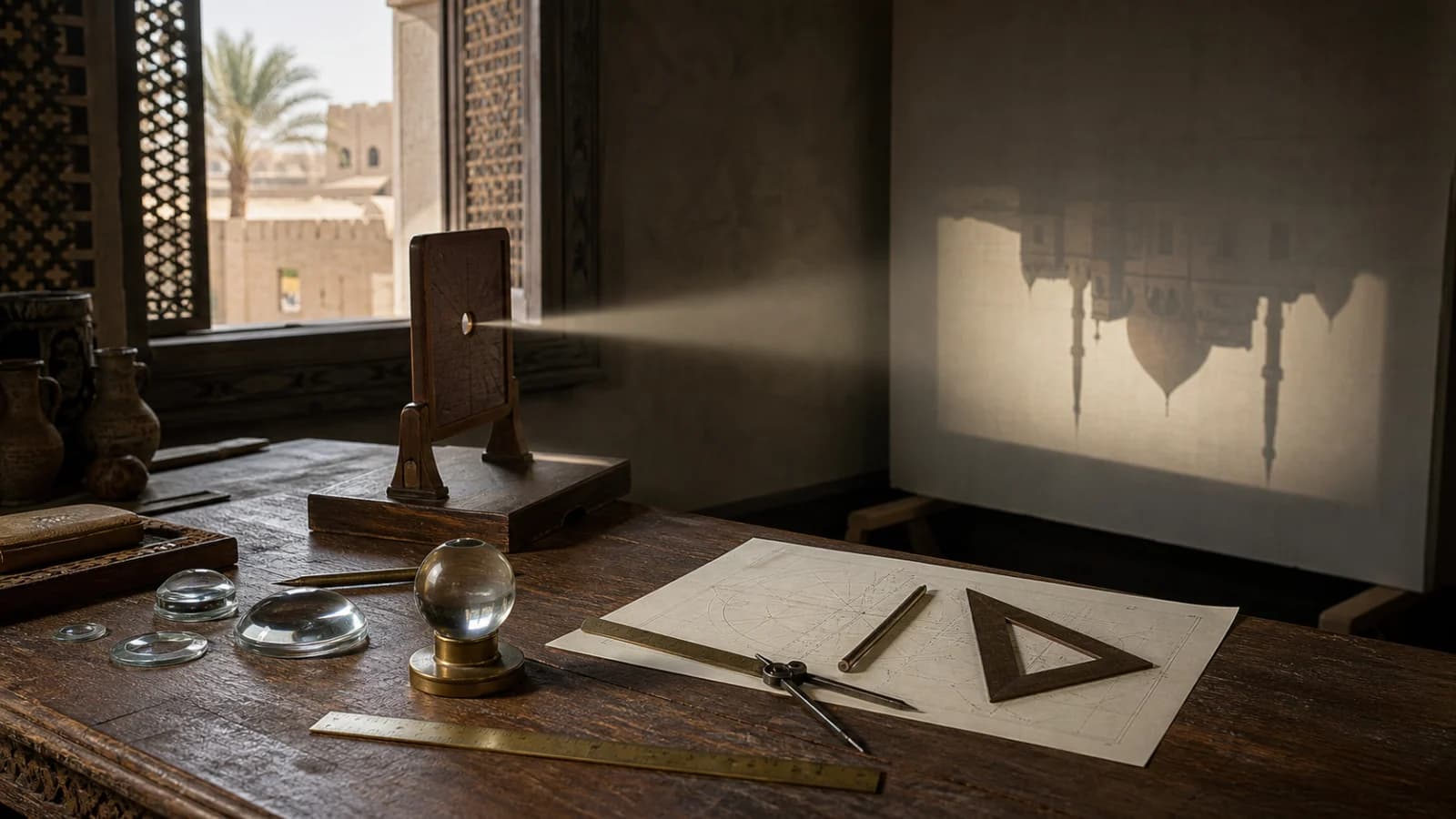
The phrase al-bayt al-muzlim, literally “the dark room,” occurs repeatedly in Book I. Ibn al-Haytham allowed sunlight to enter a darkened space through a small hole. In another arrangement, a row of lamps outside sent patches of light through the aperture onto the opposite wall. The patches appeared in reversed order. Blocking or moving one source changed its corresponding patch, helping show that lights travelling on different straight paths could cross without blending into one another.
These experiments establish a core principle of pinhole projection: light and colour from separate source-points continue along their own straight lines after meeting at an aperture. They are strong evidence for controlled optical investigation. They are not, however, a description of a complete picture of the outdoor world. In his study “Alhazen’s Optics in Europe: Some Notes on What It Said and What It Did Not Say”, Sabra states that the Optics reports no composed image inside the room. He identifies a clear Arabic description of projected clouds and flying birds in the later commentary of Kamal al-Din al-Farisi.
Ibn al-Haytham did analyze a special projection problem in a separate treatise, On the Shape of the Eclipse. That work and the dark-room chapters make him central to the history of pinhole optics. The precise conclusion is that he explained and used aperture projection in specific optical and astronomical problems—not that he built photography, recorded a complete scene in the Optics, or originated every earlier dark-room observation.
Did Ibn al-Haytham invent the scientific method?
No. “The scientific method” is not one unchanging procedure that waited for a single inventor. Observation, mathematical proof, measurement, experiment and criticism had earlier histories, and later communities changed the roles of instruments, replication, statistics, journals and peer review.
Ibn al-Haytham’s real methodological contribution is specific and substantial. He argued that optics had to be physical as well as mathematical. Geometry could model rays, angles and surfaces, but a physical account also had to agree with deliberately arranged phenomena. His apertures, lamps, mirrors and transparent media were used to isolate paths or compare predicted effects. Gérard Simon’s comparison with Ptolemaic optics highlights experimental work on rectilinear propagation, intromission, the eye and refraction.
Calling this a major program of mathematical and experimental optics is historically meaningful. Calling him the sole inventor of modern science converts a family of practices into a ceremonial title and makes it harder to see the particular problems he solved—and the ones he did not.
Reflection, refraction and Alhazen’s problem
The later books study images seen in plane, spherical, cylindrical and conical mirrors and the bending of light across transparent media. The problem later called “Alhazen’s problem” asks where a ray from a given object must strike a curved mirror so that it reaches a given observer. Sabra’s study of the lemmas behind the solution shows that the problem occupied a substantial part of Book V and was not merely a detached puzzle.
Ibn al-Haytham’s refraction work was also important, but it did not state the later sine law associated with Snell and Descartes. The historically useful question is not whether he secretly possessed every modern formula. It is how his geometrical constructions, measuring arrangements and physical explanations altered the questions later optical writers inherited.
Seeing involved inference and could go wrong
The Book of Optics extends beyond ray paths. Ibn al-Haytham argued that many perceptions depend on rapid inferences that occur too quickly to be noticed. Distance, size, shape, position, illumination, familiarity and comparison affect what an observer takes an object to be. Optical error therefore can arise even when light reaches the eye.
The Stanford Encyclopedia of Philosophy highlights two examples: the Moon appears larger near the horizon, and trees on a riverbank can seem to move when the observer is in a moving boat. These examples do not make Ibn al-Haytham a modern psychologist. They show that his optics contained a theory of cognition and error, which helps explain its later philosophical influence.
His work beyond the Book of Optics
Ibn al-Haytham wrote separate works on light, astronomical observation, the apparent size and surface of celestial bodies, geometrical problems and the configuration of the world. A sixteenth-century Arabic manuscript of his Discourse on Light, now held by the British Library and digitized by the Qatar Digital Library, includes two diagrams. Its existence is a useful reminder that “Ibn al-Haytham’s optics” does not always mean the seven-book work.
In Doubts Concerning Ptolemy, he criticized conflicts between mathematical astronomical models and physically plausible arrangements. He did not simply reject all Ptolemaic learning: different writings could preserve, revise or oppose different parts of it. Readers can compare this relationship between mathematics and observation with al-Biruni’s work on astronomy and measurement.
How the optics travelled into Latin scholarship
The Book of Optics circulated through Arabic manuscripts, although its availability was uneven. A Latin translation was produced in the late twelfth or early thirteenth century and circulated under titles including De aspectibus and Perspectiva. The first three chapters of Arabic Book I are absent from the extant medieval Latin manuscripts, which is one reason the Arabic dark-room evidence must not be reconstructed casually from the Latin tradition.
Roger Bacon, John Pecham and Witelo used and reorganized Alhazen’s optics in the thirteenth century. A Cambridge study of medieval optical reception places the translation in the late twelfth to early thirteenth century and the major Latin optical works in the 1260s and 1270s. Friedrich Risner’s 1572 Basel edition later printed Alhazen and Witelo together.
Transmission was not a simple relay in which “Europe copied Islamic science.” Translators changed terminology; readers selected arguments; commentators condensed and combined texts; later authors corrected eye anatomy and image formation. Influence is visible precisely because the work could be translated, disputed and revised.
Six popular claims, corrected
- “He invented optics.” Optics had Greek, Hellenistic and Arabic-language histories before him. He produced a major new synthesis and transformed central problems.
- “He discovered that light enters the eye from nothing.” Intromission had predecessors. His achievement was a powerful mathematical and physical reformulation that displaced eye-emitted rays as the cause of ordinary sight.
- “He invented the camera.” He established pinhole principles and analyzed aperture projection, but the Optics does not describe a complete scenic image or a recording device.
- “His eye worked like a modern camera.” His physiology centered on the crystalline humour and did not contain Kepler’s later lens-and-retina model.
- “He invented the scientific method.” He made major use of mathematical demonstration and designed physical tests; no individual invented every practice now grouped under that label.
- “The Nile and house-arrest story is settled fact.” Later biographical reports disagree, so the episode needs explicit source qualification.
How to research Ibn al-Haytham responsibly
Begin by naming the work and claim. Is the evidence in the Arabic Book of Optics, its medieval Latin translation, a separate treatise, a later commentary, a biographical report or a modern commemoration? Then check whether the source is a manuscript record, critical edition, translation or historical interpretation. These categories answer different questions.
Search under Ibn al-Haytham, Ibn al-Haytham, Alhazen and Alhacen, and record the book, chapter, paragraph, edition and language. A statement true of al-Farisi’s commentary or Risner’s printed Latin volume should not be attributed automatically to Ibn al-Haytham’s Arabic text. The same source discipline is useful when reading about Ibn Sina and the Canon of Medicine or al-Khwarizmi’s algebra and algorithms.
Frequently asked questions
When did Ibn al-Haytham live?
He is usually dated about 965–1040. Basra and Cairo are the principal places in the standard biographical outline, but several dramatic life episodes survive only in later, conflicting reports.
What was Ibn al-Haytham’s main contribution?
His largest contribution was a systematic mathematical and physical optics that joined the propagation of light, the eye, reflection, refraction and visual perception. He rejected extramission as the physical cause of sight and made observation constrain geometrical explanation.
Did Ibn al-Haytham invent the camera obscura?
No. He performed important dark-room aperture experiments and stated a principle essential to pinhole projection. The Book of Optics describes sunlight and reversed light patches from separate lamps, not a complete outdoor picture or photographic camera.
Was Ibn al-Haytham the first scientist?
That is a modern honorific, not a defensible exclusive rank. He was an exceptionally important mathematical and experimental investigator, but scientific practices had earlier histories and continued to change after him.
Why is he also called Alhazen?
Alhazen and Alhacen are Latinized forms associated with the medieval transmission of his name and works. Searching multiple name forms is necessary when following manuscript and publication history.
Sources and how they are used
- A. I. Sabra, ed. and trans., The Optics of Ibn al-Haytham, Books I–III — critical Arabic/English basis for direct vision, light, the eye and perception.
- A. I. Sabra, “Alhazen’s Optics in Europe: Some Notes on What It Said and What It Did Not Say” — dark-room experiments, the pinhole principle, the absence of a composed picture in the Optics, eye terminology and experimental reasoning.
- A. Mark Smith, “Alhacen and the Grand Synthesis” — Ptolemaic inheritance, intromission, perception, reflection and refraction.
- Gérard Simon, “L’optique d’Ibn al-Haytham et la tradition ptoléméenne” — comparison with Ptolemy and major experimental and theoretical innovations.
- ISMI, Kitab al-manazir work record — work identity, manuscript witnesses, editions and specialist bibliography.
- ISMI / Biographical Encyclopedia of Astronomers, “Ibn al-Haytham” — biographical uncertainty, astronomy and works beyond optics.
- Stanford Encyclopedia of Philosophy, “Medieval Skepticism,” section 3.1.1 — perceptual inference, illusions and later philosophical influence.
- Oxford Bibliographies, “Medieval Optics” — ancient and Arabic sources, Latin transmission and the perspectivist tradition.
- Heather Phillips, “John Wyclif and the Optics of the Eucharist” — translation chronology, Roger Bacon, Pecham, Witelo and Risner’s 1572 edition.
- Qatar Digital Library / British Library, Discourse on Light manuscript record — primary material evidence for a separate optical work and its manuscript context.
- A. I. Sabra, “Ibn al-Haytham’s Lemmas for Solving ‘Alhazen’s Problem’” — the reflection problem and its place in Book V.


