What Ibn al-Nafis Actually Said About Blood Passing Through the Lungs
A manuscript-led account of Ibn al-Nafis, pulmonary transit, the solid heart septum, his Canon commentaries, the 1924 recovery and the unproved Harvey link.
Quick answer: what did Ibn al-Nafis discover?
- He denied that blood crosses directly from the right to the left ventricle through visible or invisible pores in the septum.
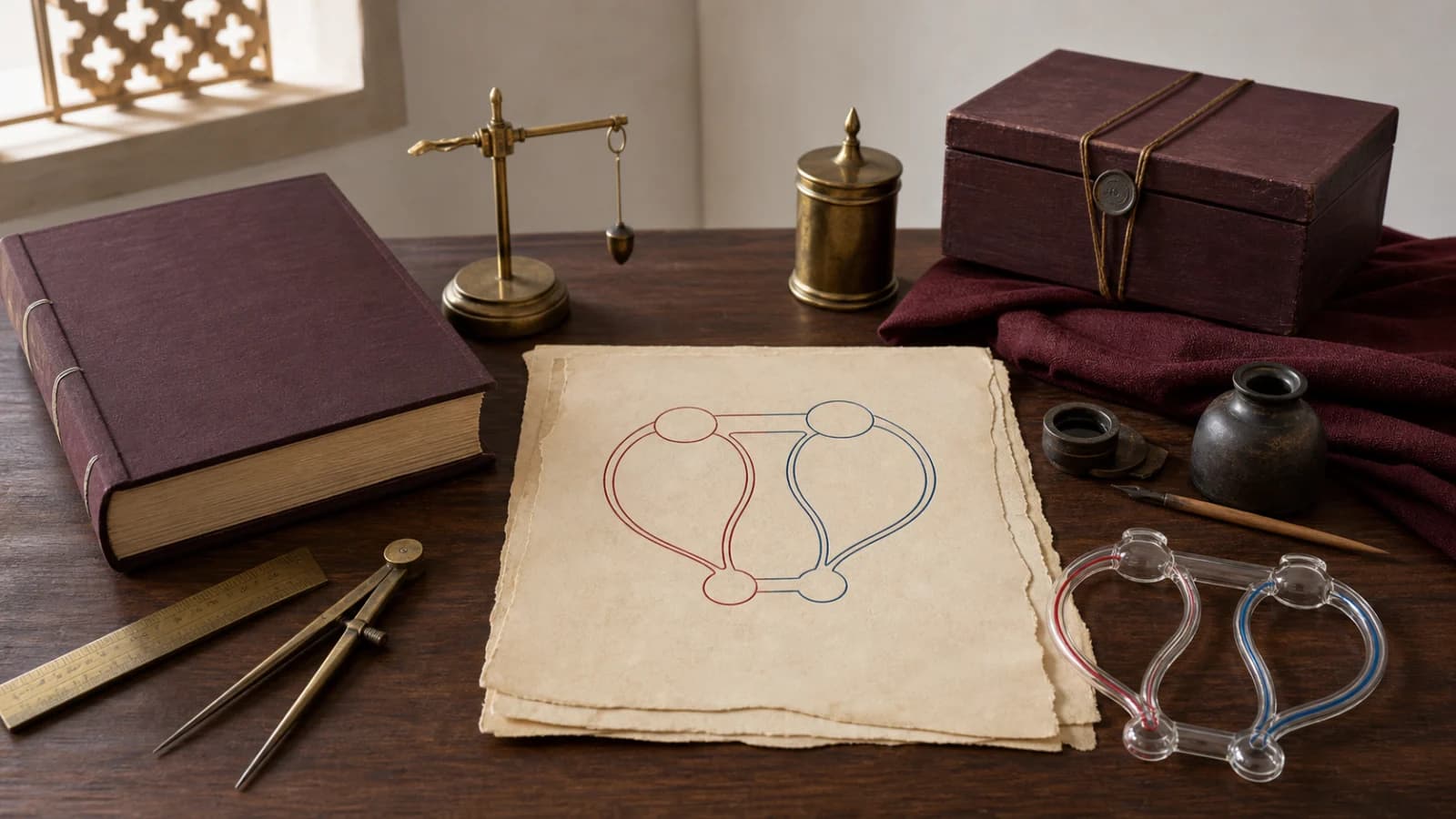
- He argued that blood passes from the right side of the heart through the pulmonary artery to the lungs and returns by the pulmonary vein.
- He proposed small communications between branches of the pulmonary vessels, before capillaries could be observed microscopically.
- His account remained embedded in medieval ideas about air and pneuma and was not a full modern account of systemic circulation.
- The safest description is a landmark medieval formulation of pulmonary circulation or pulmonary transit.
Biography: from Damascus to Cairo
Ibn al-Nafis, whose full name was Ala al-Din Ali ibn Abi al-Hazm al-Qarshi, was born around 1210 or 1213 near Damascus. He received medical education there and moved to Cairo as a young physician. Sources connect him with major hospitals and with teaching Shafi'i law as well as medicine. He wrote on medicine, ophthalmology, law, theology and philosophy, and he died in Cairo in 1288. Exact appointments and dates differ across later biographies, so the surviving books and manuscript catalogues remain the strongest anchors.
The Mujiz and the commentaries on Ibn Sina's Canon
Ibn al-Nafis did not write only one commentary. His Mujiz was a concise and widely read epitome of Ibn Sina's Canon of Medicine. He also wrote a broader commentary and a separate work on the Canon's anatomical portions. The National Library of Medicine notes that he criticized Ibn Sina for scattering anatomy across organ-specific sections. Keeping these works distinct matters: a cataloged copy of the Mujiz is not automatically the same manuscript that contains the famous pulmonary argument.
What did the pulmonary passage actually say?
Galenic physiology required blood to move from the right ventricle to the left through supposed pores in the interventricular septum. Ibn al-Nafis stated that the septum was solid and contained no such path. Blood therefore had to enter the pulmonary artery, spread through the lung and pass through small communications to the pulmonary vein before reaching the left side. He also placed an important part of the interaction between blood and inhaled air in the lungs rather than relying on direct passage through the heart wall.
Was this the modern circulation of the blood?
It was a decisive pulmonary route, but not every element of modern cardiovascular physiology. Ibn al-Nafis still discussed pneuma and the transformation of blood within a medieval framework. He did not observe capillaries through a microscope, measure cardiac output or demonstrate a closed systemic circuit in Harvey's later quantitative manner. Calling him the first known describer of pulmonary circulation is defensible when the claim is defined. Saying that he completed all modern circulation theory centuries early is not.
What happened in 1924?
The pulmonary passage was not written in 1924. Egyptian physician Muhyi al-Din al-Tatawi drew scholarly attention to a manuscript while preparing a dissertation in Germany, leading historians to reassess the chronology of circulation theory. Modern summaries often call this a rediscovery because the text had fallen outside dominant European histories of physiology. Other manuscript copies and marginal excerpts also matter. The episode shows how cataloging and philology can change a scientific narrative without changing the medieval date of the source.
Did Servetus or Harvey copy Ibn al-Nafis?
Similarity does not establish a transmission route. The National Library of Medicine records a known Latin translation by Andrea Alpago of a different part of Ibn al-Nafis's Canon commentary, concerning compound remedies. Historians have debated whether the anatomy commentary might also have circulated through an unpublished translation. No conclusive chain currently proves that Servetus, Colombo or Harvey read it. The accurate formulation is that Ibn al-Nafis wrote earlier, while direct influence on those authors remains unresolved.
Common claims that need qualification
- 'He discovered the entire circulation system': his surviving achievement concerns the pulmonary route, not every modern systemic mechanism.
- 'He saw capillaries': he inferred small communications; microscopic capillaries were observed later.
- 'Harvey stole his work': direct access or copying has not been demonstrated.
- 'His work was completely forgotten everywhere': manuscript copies, epitomes and commentaries continued even if modern European histories overlooked the passage.
- 'The passage proves all medieval anatomy was experimental dissection': the text shows critical reasoning, but the extent of his dissection practice is debated.
How to research Ibn al-Nafis responsibly
Identify whether a source discusses the Mujiz, the general Canon commentary or the separate anatomy commentary. Quote the pulmonary argument in context and translate medieval vessel names carefully. Compare the claim with Galen, Ibn Sina, Servetus, Colombo, Malpighi and Harvey without turning history into a race with one finish line. Finally, keep historical physiology separate from health guidance: the article explains a manuscript argument, not diagnosis or treatment.
Why pulmonary transit is the most precise historical term
Modern pulmonary circulation means a repeating circuit in which the right side of the heart sends oxygen-poor blood to the lungs and the left side receives oxygenated blood for systemic distribution. Ibn al-Nafis did not use this oxygen-based account. In his physiology, a portion of blood passed through the lungs, mixed with air and contributed to the production of vital spirit in the left ventricle. His larger model still treated blood as consumed by body tissues rather than continuously returned in a closed loop.
“Pulmonary transit” therefore captures both the achievement and its boundary. It identifies the path from the right ventricle, through the pulmonary vessels and lung, to the left ventricle without importing Harvey's seventeenth-century demonstration of a complete circulation. “Pulmonary circulation” remains a useful search term and a common scholarly description, provided the article defines it rather than implying that every part of present cardiovascular physiology was already in place.
How Ibn al-Nafis replaced the invisible septal pores
The argument was more than a corrected diagram. In Galenic and Avicennian physiology, the septum between the heart's ventricles was thought to permit a subtle passage that could not be seen. Ibn al-Nafis rejected this solution because the wall was thick and solid. If blood could not cross the septum, it had to leave the right ventricle by the vessel he called the artery-like vein, pass into the lung, move through small passages in the lung's substance and return through the vein-like artery.
Those medieval vessel names describe structure differently from modern nomenclature. The artery-like vein corresponds broadly to the pulmonary artery, and the vein-like artery to the pulmonary vein. Translating the labels into current terms makes the route legible, but it can also hide the original physiology of vessel tunics, air, heat and spirit. A responsible explanation gives both sets of terms and does not quietly substitute a modern account of oxygen exchange for the text's own claim.
Reasoning, observation and the dissection question
Ibn al-Nafis's denial of pores agreed with what could be seen in the heart, and recent scholarship places his anatomical revision within a broader method of verification. He compared inherited propositions with philosophical consistency, medical utility and empirical observations; some work discusses observation and animal dissection as part of that intellectual practice. This is stronger than portraying the passage as a lucky guess or a passive repetition of an authority.
It does not prove that he personally dissected the particular human heart from which every statement arose. Medieval objections to dissection, the genres of the surviving texts and the absence of a laboratory notebook make that claim difficult to establish. His result can be historically significant whether it emerged from direct observation, critical reading, animal anatomy, logical reconstruction or a combination of these. The evidence supports a method of systematic criticism, not a cinematic scene that no source records.
The manuscript evidence is more than the 1924 Berlin copy
The modern recovery story usually begins with Muhyi al-Din al-Tatawi's doctoral research on a Berlin manuscript in 1924. That episode is important because it brought the pulmonary passage into a European history of medicine that had credited sixteenth-century writers with the first description. But “rediscovered in 1924” can wrongly imply that one unique text had vanished from all reading communities.
Wellcome Library manuscript WMS Or. 51 preserves Ibn al-Nafis's commentary on Ibn Sina's Canon, and later Arabic writers also excerpted or debated aspects of his physiology. Catalogued copies of the Mujiz and commentaries on that epitome show another line of reception. These objects are not interchangeable: the Mujiz is an abridgment, a commentary on it is a later author's work, and the anatomy commentary contains the best-known pulmonary argument. Manuscript shelf marks and work titles matter because a generic image labelled “Ibn al-Nafis book” cannot prove which text a claim comes from.
What is known about transmission to Renaissance Europe
Chronological priority and direct influence are separate questions. Ibn al-Nafis wrote his pulmonary account in the thirteenth century, before Michael Servetus and Realdo Colombo described pulmonary transit in sixteenth-century Europe. A different portion of Ibn al-Nafis's Canon commentary, concerning compound drugs, was translated into Latin by Andrea Alpago. That known translation demonstrates that some of his writing could enter Latin medical networks.
No surviving Latin translation of the anatomy commentary, ownership record or citation chain proves that Servetus, Colombo or Harvey read the pulmonary passage. A historical route is conceivable, but possibility is not documentation. Research on the longer history of Galen's pulmonary-vessel doctrine has therefore treated the sixteenth-century European formulation as independent in the absence of transmission evidence. The balanced conclusion is not that Europe was isolated from Arabic medicine; it is that this particular dependency remains unproved.
Why commentary was a vehicle for innovation
The word “commentary” can sound secondary to a modern reader, as though Ibn al-Nafis merely paraphrased Ibn Sina. Post-Avicennian commentary was also a setting for verification: authors isolated a proposition, tested its coherence, compared authorities and proposed revisions. In Ibn al-Nafis's case, that process altered important parts of inherited anatomy and physiology. His criticism of where Ibn Sina distributed anatomical material across the Canon was organizational as well as doctrinal.
The Mujiz served a different function as a compact medical epitome and became the subject of its own commentaries. Keeping the genres apart explains how a scholar could summarize an authoritative encyclopedia for instruction while challenging it in a fuller analytical work. It also corrects the myth of an age divided between unquestioning preservation and sudden modern discovery. Manuscript cultures could transmit, condense, dispute and reorganize knowledge at the same time.
Related research guides
- Islamic Golden Age history timeline — Place medicine, surgery and alchemy inside changing networks of courts, manuscripts, hospitals and languages.
- Al-Zahrawi, al-Tasrif and surgery — Read the surgical volume, instrument illustrations and later reception without treating every object as a solitary invention.
- Jabir ibn Hayyan and the Jabirian corpus — Separate a historical figure, an attributed Arabic corpus, Latin Geber texts and later chemistry myths.
- Ibn al-Haytham, optics and experiment — Compare another major scholar whose modern father and inventor labels require precise definitions.
- Ibn Sina and the Canon of Medicine — Understand the Canon that Ibn al-Nafis summarized and criticized, and keep medieval medicine separate from clinical advice.
- Al-Biruni, Earth measurement and India — Compare multilingual observation and calculation with another biography shaped by modern superlatives.
- House of Wisdom in Baghdad — Keep Abbasid translation networks separate from claims that every famous scholar belonged to one institution.
- Al-Khwarizmi, algebra and algorithms — Compare manuscript evidence, uncertain biography and the routes by which Arabic works acquired Latin names.
- Bimaristan and medieval Islamic hospitals — Connect medical writing to institutions of care without projecting modern hospital systems backward.
- Islamic history timeline — Place intellectual history inside a wider political and regional chronology.
Sources
- US National Library of Medicine, Ibn al-Nafis and anatomy — The manuscript guide distinguishes the Mujiz, general Canon commentary and anatomy commentary, summarizes the pulmonary route and identifies the proven Alpago translation as a different section.
- Library of Congress, Compendium of the Canon of Medicine — This catalogued manuscript record supports the Cairo biography, major works, epitome tradition and modern account of the 1924 recovery while identifying the displayed item precisely.
- Wellcome Collection, Ibn al-Nafis Commentary on Avicenna's Canon, WMS Or. 51 — The digitized collection record supplies a concrete surviving manuscript witness for the anatomy commentary and prevents generic manuscript images from being treated as proof.
- Qatar Digital Library, Ibn al-Nafis and Pulmonary Transit — Historian Nahyan Fancy reconstructs the invisible-pore problem, medieval vessel terminology, spirit physiology, verification methods and the distinction between transit and full circulation.
- Journal of Applied Physiology, Ibn al-Nafis, the pulmonary circulation, and the Islamic Golden Age — The open review provides translated anatomical details, the 1924 dissertation context and a comparison with Harvey while retaining the medieval model's limits.
- Medical History, The Chequered Career of Galen's Doctrine on the Pulmonary Veins — Bylebyl and Pagel compare Galen, Ibn Sina, Ibn al-Nafis and Renaissance authors and state that direct European knowledge of Ibn al-Nafis was not evidenced.
- Journal of the History of Medicine and Allied Sciences, Verification and Utility in Arabic Commentaries on the Canon — The scholarly abstract and repository record explain how commentary practices enabled systematic criticism, empirical observation and changes to Avicennian medical theory.
- Brill, The Nature of the Soul and the Passage of Blood through the Lungs — This comparative scholarly chapter places Ibn al-Nafis's pulmonary theory within a longer history of physiology rather than presenting it as an isolated modern discovery.


