Al-Zahrawi: Al-Tasrif, Surgery, Instruments, Biography and Legacy
A source-aware guide to al-Zahrawi (Abulcasis): biography, thirty-part al-Tasrif, surgical volume and instruments, influence, father-of-surgery label, limits and myths.
Quick answer: who was al-Zahrawi?
- Full name: Abu al-Qasim Khalaf ibn al-Abbas al-Zahrawi; Abulcasis or Albucasis in many Latin sources.
- Dates: commonly given as about 936 to 1013, although the Library of Congress notes firmer early evidence only for death after 1009.
- Place: linked by name to Madinat al-Zahra near Cordoba in Umayyad al-Andalus.
- Major work: al-Tasrif li-man ajiza an al-talif, an encyclopedia in thirty parts covering medicine, drugs, diet, measures and surgery.
- Historical caution: later court biographies and modern father-of-surgery titles are not equal to contemporary documentary evidence.
What do we know about his life?
Very little secure narrative biography survives. The nisba al-Zahrawi connects him with Madinat al-Zahra, the palatine city west of Cordoba. Later writers place him at the courts of Abd al-Rahman III, al-Hakam II or al-Mansur, but those statements are not all equally early. It is safer to describe him as a practicing physician in the Cordoban world around the late tenth and early eleventh centuries than to repeat an exact fifty-year career or every royal appointment as settled fact. His work tells us more reliably about his learning and medical priorities than later anecdotes do.
What is al-Tasrif?
Al-Tasrif is not simply a surgery manual. Its thirty parts address general medical principles, symptoms and treatments, pharmacology, diet, preparation of medicines, weights, measures and substitutions as well as operative care. The scale reflects the encyclopedic organization common in learned medieval medicine. Al-Zahrawi used earlier Greek and Arabic authorities, including Paulus of Aegina, Ibn Masawayh, al-Razi and others, while also referring to practical experience. Calling the whole work a single book of inventions hides both its breadth and its dependence on a long medical tradition.
The surgical volume and its illustrated instruments
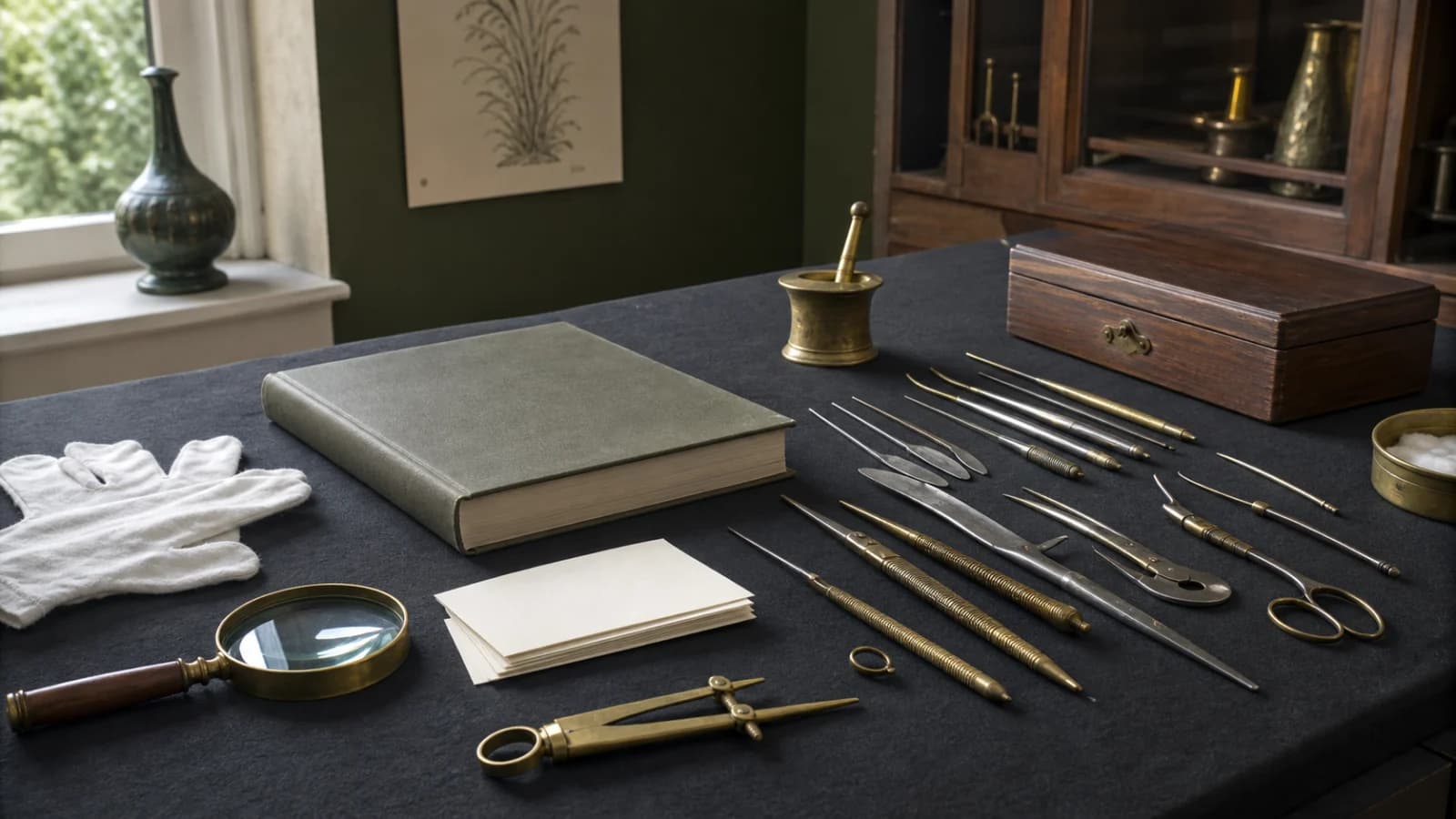
The final surgical section discusses cauterization, incisions, wounds, bloodletting, fractures, dental work, obstetric tools and other procedures. Instrument drawings help readers connect a named tool with a form and use. A manuscript held by Morocco's national library contains 198 color illustrations. This supports the importance of visual explanation, but it does not establish that al-Zahrawi personally invented every instrument. Some forms had predecessors; others may reflect adaptation, selection or clearer documentation. The evidence is strongest when an individual tool and passage are compared with earlier and later texts.
Was al-Zahrawi only copying Greek surgery?
No, but the opposite slogan is also misleading. Comparisons show substantial inheritance from Paulus of Aegina and other authorities. They also identify changes in incisions, medicines, instruments and practical instructions, sometimes accompanied by warnings or cases that suggest experience. Medieval authorship commonly included compilation, criticism and reorganization alongside novelty. Al-Zahrawi's achievement is clearer when those activities are named rather than forced into a choice between passive translator and isolated inventor.
How did al-Tasrif travel?
Sections of the encyclopedia circulated in Arabic and were translated into Hebrew and Latin. The surgical material became associated with the Latin name Albucasis, appeared with other medical works and entered print. A 1541 Basel compendium cataloged by the Library of Congress places the translated surgical text beside works from European medical traditions. That object demonstrates reception and reuse; it does not prove that one identical curriculum governed every European university for a fixed number of centuries. Influence varied by work, place and period.
Does 'father of surgery' mean modern surgery?
The title recognizes an unusually comprehensive and illustrated surgical text, its practical orientation and its later reach. It should not imply sterile operating rooms, modern anesthesia, germ theory, imaging, blood typing, regulated devices or clinical trials. Medieval procedures could be painful and dangerous, and historical drug recipes are not validated modern treatments. The correct use of al-Tasrif today is historical study. Anyone needing medical or surgical care should rely on current licensed clinicians and evidence-based guidance.
Common claims that need qualification
- 'He invented 200 surgical instruments': a manuscript illustrates about 198; invention must be tested tool by tool.
- 'Al-Tasrif is only about surgery': surgery is the famous final section of a much broader encyclopedia.
- 'He worked at the House of Wisdom': his documented setting is al-Andalus, not ninth-century Baghdad.
- 'Every European surgeon used his book until the seventeenth century': reception was important but curricula and dates varied.
- 'His remedies are proven because similar substances are used today': historical resemblance is not modern evidence of safety or efficacy.
How to research al-Zahrawi responsibly
Start with a cataloged manuscript or printed witness and identify which part of al-Tasrif it contains. Separate the Arabic encyclopedia from later Hebrew, Latin and vernacular versions. For a claimed invention, compare the exact drawing and passage with Paulus of Aegina and other predecessors. For biography, state whether evidence is early or a later court tradition. This method keeps al-Zahrawi's major contribution visible without turning admiration into a list of unsupported firsts.
Related research guides
- Islamic Golden Age history timeline: Place medicine, surgery and alchemy inside changing networks of courts, manuscripts, hospitals and languages.
- Ibn al-Nafis and pulmonary circulation: Distinguish his rejection of invisible septal pores and pulmonary route from a complete modern circulation model.
- Jabir ibn Hayyan and the Jabirian corpus: Separate a historical figure, an attributed Arabic corpus, Latin Geber texts and later chemistry myths.
- Ibn al-Haytham, optics and experiment: Compare another major scholar whose modern father and inventor labels require precise definitions.
- Ibn Sina and the Canon of Medicine: Understand the Canon that Ibn al-Nafis summarized and criticized, and keep medieval medicine separate from clinical advice.
- Al-Biruni, Earth measurement and India: Compare multilingual observation and calculation with another biography shaped by modern superlatives.
- House of Wisdom in Baghdad: Keep Abbasid translation networks separate from claims that every famous scholar belonged to one institution.
- Al-Khwarizmi, algebra and algorithms: Compare manuscript evidence, uncertain biography and the routes by which Arabic works acquired Latin names.
- Bimaristan and medieval Islamic hospitals: Connect medical writing to institutions of care without projecting modern hospital systems backward.
- Islamic history timeline: Place intellectual history inside a wider political and regional chronology.
Sources
- Library of Congress: The Method of Medicine: Used for the limited biography, the thirty-part structure of al-Tasrif, earlier authorities, practical experience and the Latin printed surgical text.
- UNESCO Memory of the World nomination: Al-Zahrawi's Surgery manuscript: Used for the Moroccan manuscript, its 165 pages, 198 color instrument illustrations and the documentary significance claimed by its custodian.
- Wellcome Collection: Chyrurgia Albucasim: Used as cataloged visual evidence of the later Latin manuscript and print reception of the surgical treatise.
- PubMed: Al-Zahrawi and operative surgery: Used for modern medical-historical analysis of the surgical chapters while treating father-of-surgery language as an honorific.
- PubMed Central: Surgery in al-Tasrif: Used for comparison with Paulus of Aegina, evidence of modification and case-based practice, and caution about isolated first-invention claims.
- US National Library of Medicine: Medieval Islam and medicine: Used to place al-Tasrif within Greek-Arabic medical synthesis, systematic encyclopedias and later Latin transmission.
- The Metropolitan Museum of Art: Umayyad al-Andalus: Used for the political and cultural setting of tenth-century Cordoba and Madinat al-Zahra rather than unsupported court anecdotes.


