Taqi al-Din and the Istanbul Observatory: Instruments, Clock and 1580 Closure
A source-aware guide to Taqi al-Din and the Istanbul Observatory: 1575/1577 dates, instruments, astronomical clock, comet observations, 1580 demolition and common myths.
The Ottoman scholar Taqi al-Din (1526-1585) directed an observatory in Istanbul that was planned in the mid-1570s, operating by 1577 and demolished by order of Sultan Murad III in 1580. Its brief life makes it easy to use as a symbol: either proof of an unbroken scientific triumph or proof that religion destroyed science. Neither slogan explains the evidence. The observatory joined mathematical astronomy, instrument design, mechanical timekeeping, calendar work and court astrology inside a competitive imperial setting.
Quick facts
- Taqi al-Din was born in Damascus in 1526 and worked in Egypt and Istanbul as a scholar, judge, teacher, astronomer and mechanic.
- He became the Ottoman chief astronomer or chief astrologer, an office responsible for calendars, auspicious timing and court advice as well as astronomy.
- Sources use 1575 for proposal or authorization and 1577 for an operating or completed observatory; the dates describe different stages.
- The program used armillary spheres, quadrants, rulers and large sighting instruments, plus mechanical time measurement described by Taqi al-Din.
- Murad III ordered demolition in 1580 after court, political and astrological disputes converged around the institution.
Who was Taqi al-Din?
Taqi al-Din Muhammad ibn Ma'ruf trained in the scholarly worlds of Damascus and Cairo before entering Ottoman service. His surviving works span astronomical tables, observational instruments, mechanical clocks, mathematics, optics and machines. He also held religious-legal and educational posts. This combination was not contradictory in his setting. Mathematical astronomy supplied calendars and planetary positions; court astrology interpreted selected configurations; timekeeping served prayer, administration and observation; mechanical study moved between practical devices and learned writing.
Was the observatory founded in 1575 or 1577?
Both dates can be useful when labeled. Around 1575 Taqi al-Din presented the need for fresh observations and received court support for an observatory. Construction, instrument preparation and recruitment followed. Cambridge's institutional history dates the observatory to 1577, when it was active and visible in court culture. A source saying founded in 1575 may mean authorization; one saying established in 1577 may mean completion or operation. Collapsing the process into an exact opening ceremony creates a conflict the records do not require.
Where was it, and what did it contain?
The complex stood on elevated ground in Istanbul, often associated with the Tophane or Galata area, and included a principal building plus a smaller observation space. Illustrated manuscripts depict Taqi al-Din and assistants using large instruments. The inventory included established devices known from earlier Islamic observatories as well as instruments he described or modified. Images are invaluable for names, arrangement and court presentation, but they are not measured architectural plans; exact modern coordinates and full building reconstructions remain less secure than the institutional record.
Instruments and the observational clock
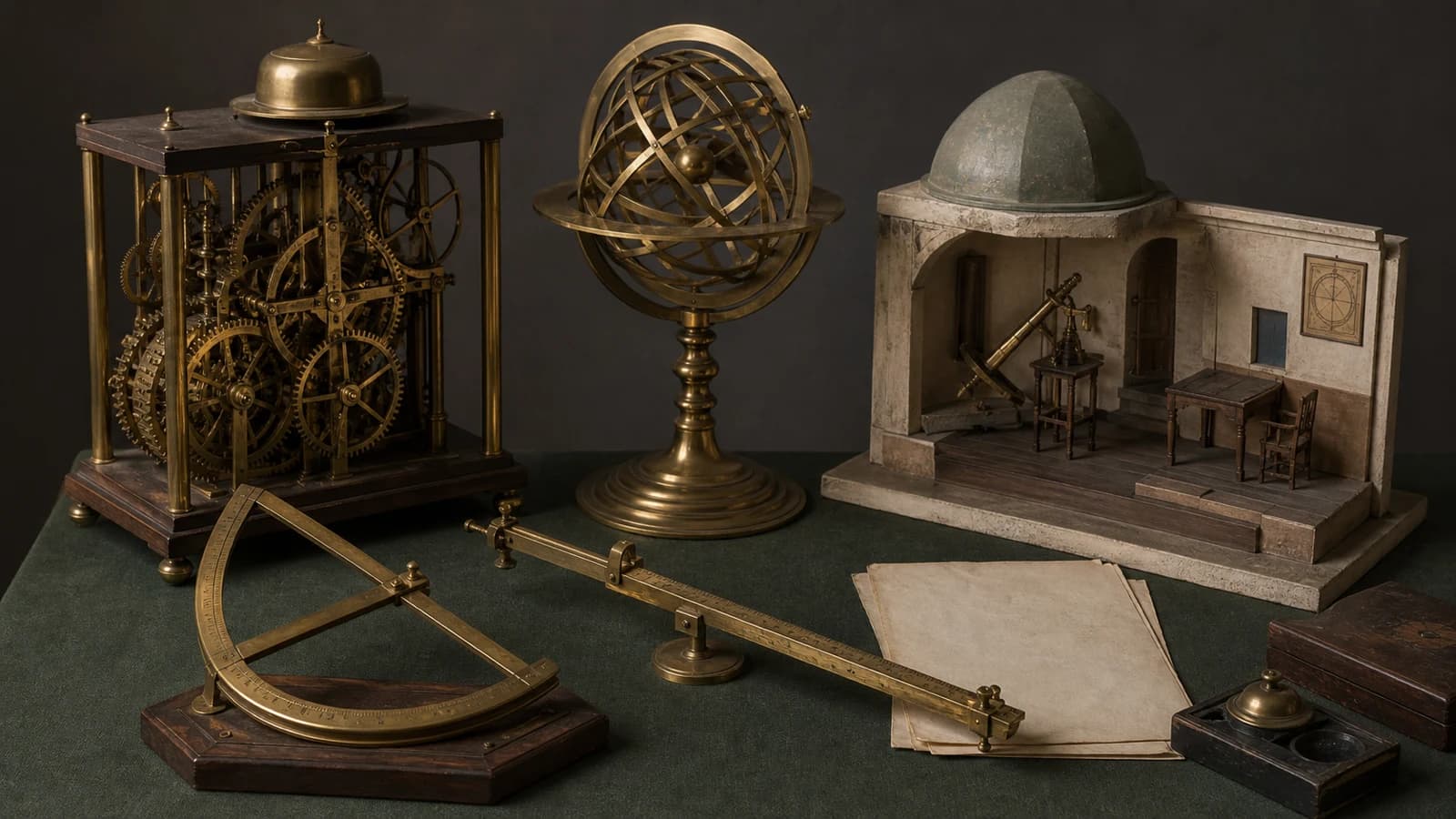
Observers used armillary spheres, quadrants, parallactic rulers and other sighting devices to measure angles and positions. Taqi al-Din emphasized a mechanical clock divided finely enough to time astronomical events more consistently than broad hour intervals. Modern summaries sometimes call it the first astronomical clock or assign an exact seconds hand without defining the manuscript claim. The safer point is substantial: he integrated sophisticated clockwork into an observational program and wrote extensively about mechanical time measurement.
What did the observatory study?
The team sought new values for astronomical tables rather than relying indefinitely on inherited parameters. It observed the Sun, Moon, planets and a prominent comet in 1577. Taqi al-Din worked on a new zij and compared methods with earlier traditions, including Samarkand. The observatory did not use telescopes, which entered astronomy elsewhere in the next century. Its program belonged to high-precision naked-eye astronomy supported by geometry, repeated observation, large instruments and increasingly refined timekeeping.
Astronomy, astrology and the 1577 comet
In the Ottoman court, the chief astrologer's office joined calculations with interpretations about auspicious dates and political outcomes. The 1577 comet was therefore both an observational object and a source of prediction. Reports associate optimistic interpretations with later military and public misfortunes, damaging Taqi al-Din's position. This does not mean all observations were astrology, nor that astrology was an external superstition imposed on an otherwise modern laboratory. The same court structure funded and judged both practices.
Why was the observatory demolished in 1580?
Murad III ordered the institution destroyed after only a few years. Historians discuss several interacting pressures: rivalry around Taqi al-Din, disappointment with predictions, war and plague, the cost and visibility of court patronage, and objections voiced by influential religious-political figures. Later narratives often isolate a single fatwa or claim that observing the sky itself was prohibited. The record supports a court decision in a charged context more clearly than a universal theological ban on astronomy.
Did Ottoman astronomy end?
No. The demolition ended this particular court observatory and interrupted its planned observation cycle. Astronomers continued to compile calendars, teach, copy tables, make instruments and serve mosques and the state. Ottoman scholars engaged with Samarkand traditions and later European astronomical works. The Kandilli manuscript collection documented by UNESCO preserves a much longer record. Institutional loss was real, but it should not be converted into three centuries of intellectual emptiness.
Claims to qualify
- 'The observatory opened on one settled date': 1575 and 1577 usually refer to proposal, construction and operation stages.
- 'It was identical to Tycho Brahe's Uraniborg': the projects were near-contemporary but had different courts, instruments, records and institutional trajectories.
- 'Taqi al-Din invented the first clock with seconds': his fine time divisions matter, but universal first claims depend on definitions and manuscript interpretation.
- 'A cleric banned astronomy in Islam': the demolition was a specific Ottoman court order in a contested political and astrological setting.
- 'Nothing survived': Taqi al-Din's writings, instrument images and broader Ottoman astronomical manuscripts remain available for study.
How to research the closure responsibly
Build a dated sequence from proposal to operation, comet observation and demolition. Identify whether a source describes mathematical astronomy, court astrology, architecture or later memory. Do not turn a manuscript miniature into a blueprint or a later moral story into a cabinet minute. Compare Turkish institutional scholarship, the surviving works and wider observatory histories. The result is a more useful account of how knowledge depends on patronage, offices and political trust.
Related research guides
- History of astronomy in the Islamic world: Follow observatories, instruments, star tables and manuscript transmission from Abbasid foundations to Maragha, Samarkand and Istanbul.
- Nasir al-Din al-Tusi, Maragha and the Tusi couple: Connect a geometric device to a collaborative observatory, surviving manuscripts and debates about later transmission.
- Ulugh Beg, Samarkand and the Zij-i Sultani: See how a large meridian instrument and a team of mathematicians produced influential tables and a star catalog.
- Islamic Golden Age history timeline: Place astronomy inside wider histories of translation, mathematics, medicine, institutions and regional patronage.
- Al-Biruni, measurement and astronomy: Compare observational and mathematical methods across a different Central Asian scholarly setting.
- Ibn al-Haytham, optics and experiment: Follow mathematical criticism, observation and the limits of modern invention labels.
- Al-Khwarizmi, algebra and astronomical tables: Link calculation and zij-making to the earlier Abbasid scholarly environment.
- House of Wisdom and Abbasid translation networks: Separate court libraries from the wider multilingual movement that supplied astronomical texts and methods.
- Fall of Baghdad in 1258: Understand a catastrophic conquest without treating it as the end of astronomy across all Muslim-ruled regions.
Sources
- Cambridge Core: The observatory in Istanbul: Used for the 1577 observatory, its place after Samarkand and comparison with early-modern observatories.
- UNESCO-ICOMOS thematic study on astronomical heritage: Used for the Maragha-Samarkand-Istanbul sequence and source-critical institutional chronology.
- UNESCO World Heritage nomination dossier for Jantar Mantar: Used for comparative descriptions of Taqi al-Din's observatory instruments and clock-based measurement; nomination claims are labeled as such.
- Turkish World Encyclopedia: Takiyuddin: Used for an official Turkish institutional biography and the range of Taqi al-Din's astronomical, mechanical and optical works.
- Belleten: Chief astrologers of the Ottoman palace: Used for the Ottoman office context in which astronomy, calendars and court astrology overlapped.
- Belleten: Taqi al-Din's astronomical observations: Used for observational work, instruments and the historical evidence surrounding the Istanbul program.
- Istanbul Kultur University: Taqi al-Din and the Istanbul Observatory: Used for scholarly discussion of the observatory's foundation, program and termination.
- McGill RASI: Taqi al-Din biographical entry: Used for cross-checking the corpus, career, instruments and chronology while privileging primary and institutional sources for core claims.


