Ulugh Beg Observatory: Samarkand, the Zij-i Sultani and Its Star Catalog
A source-aware guide to Ulugh Beg's Samarkand Observatory: the giant meridian arc, al-Kashi and Ali Qushji, Zij-i Sultani, star catalog, accuracy claims, decline and rediscovery.
The Ulugh Beg Observatory in Samarkand was built in the 1420s under the Timurid ruler and astronomer Ulugh Beg. Its researchers used monumental naked-eye instruments and demanding mathematical computation to produce the Zij-i Sultani, one of the most widely copied astronomical table collections of the early modern period. The surviving underground arc is real; the lost upper building must be reconstructed cautiously. The achievement was also collective, involving figures such as Qadi Zada al-Rumi, Jamshid al-Kashi and Ali Qushji.
Quick facts
- Ulugh Beg governed Transoxiana from Samarkand and combined dynastic patronage with sustained mathematical study.
- The observatory was constructed in the 1420s on a hill northeast of the old city.
- Its best-preserved feature is the below-ground portion of a huge north-south meridian instrument, not a modern sextant with a telescope.
- The Zij-i Sultani was completed around 1438-1440 and includes tables, parameters, chronology and a catalog commonly counted at about 1,018 stars.
- The building declined after Ulugh Beg's death in 1449; the buried instrument was identified again in 1908.
Who was Ulugh Beg?
Born Muhammad Taraghay in 1394, Ulugh Beg was a grandson of Timur and a Timurid prince whose authority centered on Samarkand. He sponsored madrasas and recruited mathematicians while studying astronomy himself. Calling him only a ruler understates his participation; calling the entire program his personal discovery erases the specialists who designed methods, computed tables, trained students and continued the work. His brief final rule over the wider Timurid realm ended in conflict and his death in 1449.
What survives of the observatory?
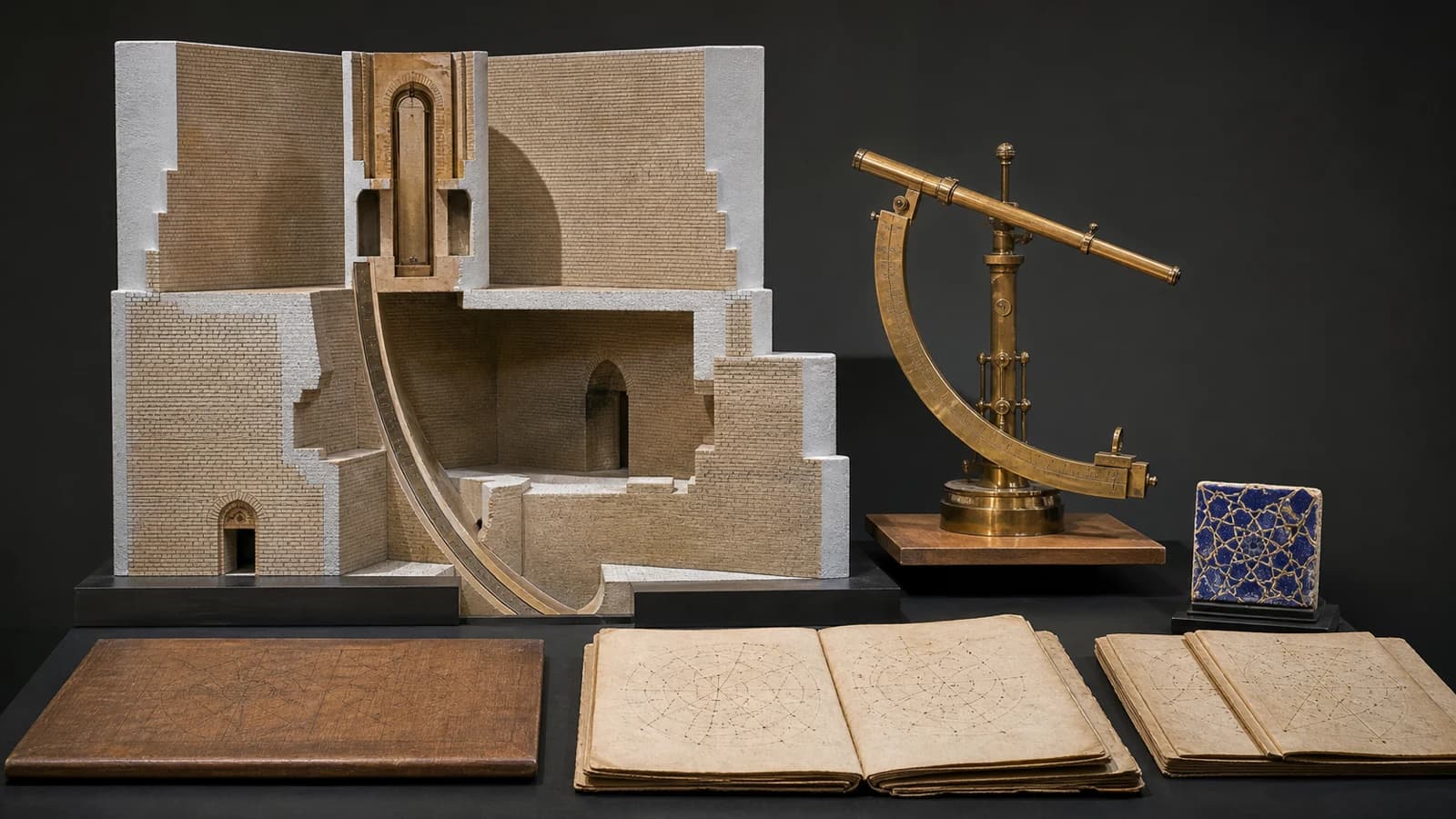
Excavation exposed two parallel masonry tracks forming the lower portion of a giant meridian arc, sunk roughly eleven meters below the modern surface. The full instrument continued upward through a multi-storey structure that no longer survives. Sources use terms such as quadrant, sextant or Fakhri instrument, but these labels are not perfectly interchangeable. Its purpose was to measure the altitude or meridian passage of celestial bodies with a much larger graduated scale than a portable instrument could provide.
How did the giant instrument work?
Because the arc was aligned north-south, observers could record where a star or the Sun crossed the local meridian. A large radius spreads angular divisions across more physical space, allowing finer readings when construction, alignment and sighting are controlled. Assistants were essential: one observer did not casually look through a telescope. Teams managed sight lines, illumination, repeated readings, seasonal observations and the arithmetic needed to reduce measurements into parameters and tables.
The Samarkand research team
Qadi Zada al-Rumi was a senior teacher and mathematician. Jamshid al-Kashi brought exceptional numerical methods and described instruments; his work on the sine of one degree shows the precision of the computational program. Ali Qushji became another important astronomer and later carried Samarkand learning west into Ottoman intellectual life. Ulugh Beg supplied patronage, studied the results and attached his authority to the project. The Zij therefore represents an institution and a school, not a solitary night of observation.
What is the Zij-i Sultani?
A zij is more than a list of stars. The Sultani collection contains instructions and tables for chronology, trigonometry, planetary positions and other astronomical calculations, together with a star catalog. Its values were copied, adapted and translated. The work is often dated 1437, 1438-1439 or 1440 because sources may refer to phases of observation, compilation or completion. A careful page gives a range and identifies which edition or manuscript it is discussing.
Were all 1,018 stars newly observed?
No simple total answers that question. Catalog traditions commonly count about 1,018 entries, but exact totals vary with duplicated or disputed entries and manuscript conventions. Most accessible stars could be checked at Samarkand, while a group of far-southern stars below the local horizon necessarily depended on inherited information, especially Ptolemy and al-Sufi. The strongest claim is that the program produced a major revised catalog and new parameter values, not that every coordinate began from zero at one site.
How accurate were the results?
Some parameters compare remarkably well with modern values, but viral rankings often select one measurement, silently change units or ignore precession and manuscript variation. Accuracy should name the quantity: obliquity, year length, stellar longitude, latitude or trigonometric value. It should also say whether the comparison uses the original epoch or a modern correction. The observatory's significance does not depend on winning a universal accuracy contest; it lies in systematic observation, large instruments, fresh computation and broad circulation.
Decline, circulation and rediscovery
After Ulugh Beg's death, court support collapsed and the observatory became ruinous. The tables did not disappear. Manuscripts circulated in Persian, Arabic and Turkish; portions entered Latin publication in seventeenth-century Oxford and London. Ali Qushji's career helped connect Timurid and Ottoman scholarly settings. In 1908 archaeologist Vasily Vyatkin located the buried arc using endowment and topographic evidence. Today the observatory is a protected component of UNESCO's Samarkand property, while conservation debates continue around how the lost building should be interpreted.
Claims to qualify
- 'It was a giant telescope': the program used naked-eye sighting and graduated architectural instruments before telescopic astronomy.
- 'Ulugh Beg personally observed every star': the catalog was a team product and some southern entries came from inherited data.
- 'The building shown in every model is certain': the buried arc survives, but upper-storey reconstructions depend on archaeology and texts.
- 'It was the first accurate catalog since Ptolemy': al-Sufi and other astronomers revised stellar knowledge in the intervening centuries.
- 'The observatory vanished without influence': its tables and trained scholars traveled long after the institution declined.
How to research Samarkand responsibly
Begin with the UNESCO-listed remains, then separate the instrument, the lost building, the working team and the Zij manuscripts. Define every star count and accuracy comparison. Treat a museum model as interpretation, not a photograph of the fifteenth century. Finally, follow copies and translations after 1449. That path shows why Samarkand matters both as a physical observatory and as a mobile mathematical tradition.
Related research guides
- History of astronomy in the Islamic world: Follow observatories, instruments, star tables and manuscript transmission from Abbasid foundations to Maragha, Samarkand and Istanbul.
- Nasir al-Din al-Tusi, Maragha and the Tusi couple: Connect a geometric device to a collaborative observatory, surviving manuscripts and debates about later transmission.
- Taqi al-Din and the Istanbul Observatory: Examine the observatory's dates, instruments, clockwork, observations and politically contested closure without a simple religion-versus-science slogan.
- Islamic Golden Age history timeline: Place astronomy inside wider histories of translation, mathematics, medicine, institutions and regional patronage.
- Al-Biruni, measurement and astronomy: Compare observational and mathematical methods across a different Central Asian scholarly setting.
- Ibn al-Haytham, optics and experiment: Follow mathematical criticism, observation and the limits of modern invention labels.
- Al-Khwarizmi, algebra and astronomical tables: Link calculation and zij-making to the earlier Abbasid scholarly environment.
- House of Wisdom and Abbasid translation networks: Separate court libraries from the wider multilingual movement that supplied astronomical texts and methods.
- Fall of Baghdad in 1258: Understand a catastrophic conquest without treating it as the end of astronomy across all Muslim-ruled regions.
Sources
- UNESCO World Heritage Centre: Samarkand - Crossroad of Cultures: Used for the observatory remains as a major protected component of Timurid Samarkand.
- UNESCO-ICOMOS thematic study on astronomical heritage: Used for the meridian arc, observatory team, Zij-i Sultani, manuscript circulation and 1908 rediscovery.
- UNESCO-ICOMOS advisory mission report for Samarkand: Used for the 1420s construction, research institution, surviving sextant and current interpretation of the site.
- Qatar Digital Library: Zij-i Jadid-i Sultani manuscript: Used as cataloged manuscript evidence for the astronomical tables associated with Ulugh Beg's program.
- Library of Congress: Latin translations of Persian astronomical tables: Used for the seventeenth-century Latin reception of Ulugh Beg's chronological and astronomical tables.
- Cambridge Core: The observatory in Samarqand: Used for the observatory's institutional history, construction chronology and relation to earlier Islamic astronomy.
- Encyclopaedia Iranica: Jamshid al-Kashi: Used for al-Kashi's mathematical role and evidence that the Samarkand program was collective rather than the work of one patron alone.
- Encyclopaedia Iranica: Ali Qushji: Used for the movement of a Samarkand-trained astronomer into Ottoman scholarly networks.


