Risorsa
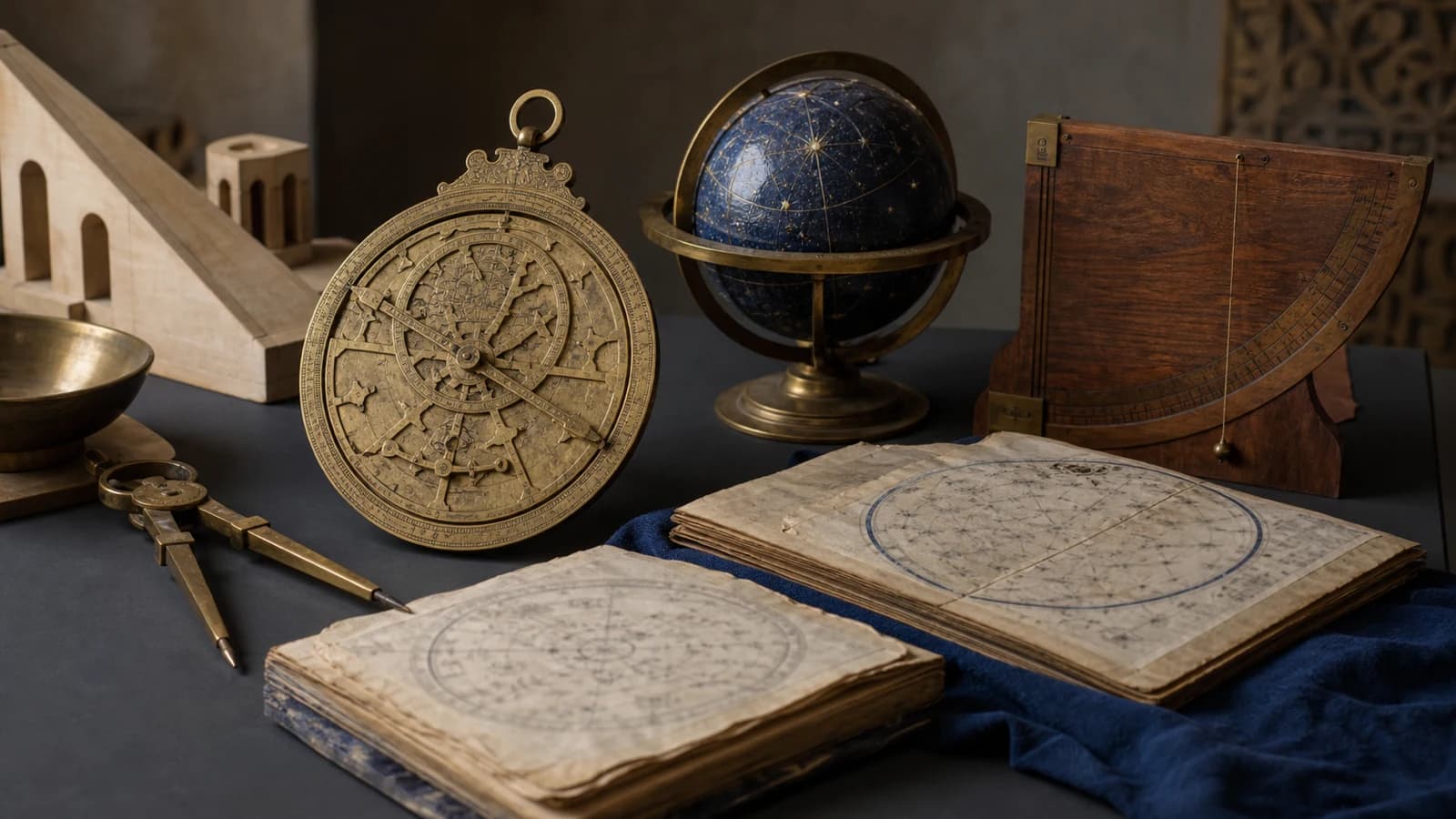
Storia dell'astronomia nel mondo islamico: osservatori, strumenti e tavole stellari
Cronologia critica dell'astronomia nelle società musulmane, dalle tavole e dagli astrolabi abbasidi a Maragha, Samarcanda, Istanbul e ai manoscritti.
Periodo
c. 750-1908 CE
Tappe
24
Metodo
Come leggere le fonti
Ultima revisione
11 July 2026
Cronologia critica dell'astronomia nelle società musulmane, dalle tavole e dagli astrolabi abbasidi a Maragha, Samarcanda, Istanbul e ai manoscritti.
Distingui il testo coranico, le tradizioni musulmane compilate più tardi e l'analisi accademica moderna. Non trasformare date o percorsi approssimativi in falsa certezza.
Sequenza breve
Cronologia critica dell'astronomia nelle società musulmane, dalle tavole e dagli astrolabi abbasidi a Maragha, Samarcanda, Istanbul e ai manoscritti.
- Fondamenti e strumenti, ca. 750-1050
- Maragha e osservatori istituzionali, ca. 1050-1300
- Samarcanda e il programma timuride, ca. 1400-1500
- Istanbul e sviluppi successivi, ca. 1500-1908
Come leggere le fonti
Distingui il testo coranico, le tradizioni musulmane compilate più tardi e l'analisi accademica moderna. Non trasformare date o percorsi approssimativi in falsa certezza.
Eventi chiave della storia islamica - Fondamenti e strumenti, ca. 750-1050
Distingui il testo coranico, le tradizioni musulmane compilate più tardi e l'analisi accademica moderna. Non trasformare date o percorsi approssimativi in falsa certezza.
| Data | Evento | Contesto | Tipo di fonte |
|---|---|---|---|
| c. 750-800 | Arabic astronomical translation expands | Fondamenti e strumenti, ca. 750-1050 | Manuscripts, bibliographies and translation histories |
| c. 770 | Sanskrit-derived tables reach the Abbasid court | Fondamenti e strumenti, ca. 750-1050 | Later bibliographic reports and revised table traditions |
| c. 800 | Astrolabe making develops in Arabic scholarly settings | Fondamenti e strumenti, ca. 750-1050 | Dated and attributed instruments, technical treatises |
| 813-833 | Al-Ma'mun sponsors observation and measurement | Fondamenti e strumenti, ca. 750-1050 | Historical reports, tables and later scientific works |
| 9th-10th c. | Prayer-time and qibla methods become specialized fields | Fondamenti e strumenti, ca. 750-1050 | Legal-astronomical texts, instruments and tables |
| c. 964 | Al-Sufi completes the Book of Fixed Stars | Fondamenti e strumenti, ca. 750-1050 | Surviving dated and later manuscript copies |
Eventi chiave della storia islamica - Maragha e osservatori istituzionali, ca. 1050-1300
Distingui il testo coranico, le tradizioni musulmane compilate più tardi e l'analisi accademica moderna. Non trasformare date o percorsi approssimativi in falsa certezza.
| Data | Evento | Contesto | Tipo di fonte |
|---|---|---|---|
| 1074-1079 | Malik Shah's Isfahan program and calendar reform | Maragha e osservatori istituzionali, ca. 1050-1300 | Chronicles, calendar history and later accounts |
| 11th c. | Al-Biruni links observation, trigonometry and geography | Maragha e osservatori istituzionali, ca. 1050-1300 | Surviving works and manuscript traditions |
| 1258 | Mongol forces devastate Baghdad | Maragha e osservatori istituzionali, ca. 1050-1300 | Chronicles and regional institutional history |
| 1259 | Construction begins at Maragha Observatory | Maragha e osservatori istituzionali, ca. 1050-1300 | Historical texts, archaeology and manuscript colophons |
| 1260s | Maragha team develops instruments and model reforms | Maragha e osservatori istituzionali, ca. 1050-1300 | Technical treatises, diagrams and excavated instrument remains |
| 1270s | Ilkhanic Tables circulate | Maragha e osservatori istituzionali, ca. 1050-1300 | Zij manuscripts and later references |
Eventi chiave della storia islamica - Samarcanda e il programma timuride, ca. 1400-1500
Distingui il testo coranico, le tradizioni musulmane compilate più tardi e l'analisi accademica moderna. Non trasformare date o percorsi approssimativi in falsa certezza.
| Data | Evento | Contesto | Tipo di fonte |
|---|---|---|---|
| 1409 | Ulugh Beg governs from Samarkand | Samarcanda e il programma timuride, ca. 1400-1500 | Chronicles, architecture and biographical sources |
| 1420s | Samarkand Observatory is constructed | Samarcanda e il programma timuride, ca. 1400-1500 | UNESCO site study, archaeology and technical texts |
| 1420s-1430s | Al-Kashi, Qadi Zada and Ali Qushji work in the program | Samarcanda e il programma timuride, ca. 1400-1500 | Biographies, letters and mathematical works |
| 1438-1440 | Zij-i Sultani is compiled | Samarcanda e il programma timuride, ca. 1400-1500 | Persian manuscripts and later Arabic, Turkish and Latin versions |
| 1449 | Ulugh Beg dies and observatory patronage collapses | Samarcanda e il programma timuride, ca. 1400-1500 | Chronicles, site archaeology and manuscript circulation |
| 15th-16th c. | Samarkand traditions enter Ottoman scholarship | Samarcanda e il programma timuride, ca. 1400-1500 | Biographies, commentaries and institutional histories |
Eventi chiave della storia islamica - Istanbul e sviluppi successivi, ca. 1500-1908
Distingui il testo coranico, le tradizioni musulmane compilate più tardi e l'analisi accademica moderna. Non trasformare date o percorsi approssimativi in falsa certezza.
| Data | Evento | Contesto | Tipo di fonte |
|---|---|---|---|
| c. 1575 | Taqi al-Din secures support for an Istanbul observatory | Istanbul e sviluppi successivi, ca. 1500-1908 | Ottoman histories and modern institutional studies |
| 1577 | Istanbul Observatory is operating | Istanbul e sviluppi successivi, ca. 1500-1908 | Illustrated manuscripts, treatises and court records |
| 1577 | The team observes a prominent comet | Istanbul e sviluppi successivi, ca. 1500-1908 | Ottoman chronicles and astronomical writings |
| 1580 | Murad III orders the observatory demolished | Istanbul e sviluppi successivi, ca. 1500-1908 | Ottoman narrative sources and modern historical analysis |
| 1650-1665 | Ulugh Beg's tables appear in Latin print | Istanbul e sviluppi successivi, ca. 1500-1908 | Cataloged Oxford and London editions |
| 1908 | Samarkand's buried meridian arc is rediscovered | Istanbul e sviluppi successivi, ca. 1500-1908 | Excavation history and UNESCO documentation |
FAQ
Questa cronologia è completa?
No. È un orientamento verso studi regionali e tematici più profondi.
Tutte le date tradizionali sono esatte?
No. Date approssimative e tradizioni tarde sono indicate.
Perché EC e AH?
EC facilita il confronto regionale; AH conserva la cronologia lunare islamica.
Letture correlate
- Nasir al-Din al-Tusi, l'Osservatorio di Maragha e la coppia di Tusi spiegati
- Osservatorio di Ulugh Beg: Samarcanda, lo Zij-i Sultani e il catalogo stellare
- Taqi al-Din e l'Osservatorio di Istanbul: strumenti, orologio e chiusura del 1580
- Cronologia dell'età d'oro islamica: Baghdad, traduzione, scienza e medicina
- Al-Biruni: raggio terrestre, India, astronomia e metodi
- Ibn al-Haytham: ottica, camera oscura, metodo e biografia
- Al-Khwarizmi: algebra, algoritmi, biografia, opere ed eredità
- Casa della Sapienza di Baghdad: storia, traduzione e mito del 1258
- Caduta di Baghdad nel 1258: data, assedio, conseguenze e fonti
Fonti
- Science Museum: Astronomy and cosmology
- Oxford History of Science Museum: The astrolabe
- UNESCO-ICOMOS thematic study on astronomical heritage
- UNESCO Memory of the World: Kandilli Observatory manuscripts
- Smithsonian Institution via GovInfo: Islamicate celestial globes
- Cambridge Core: The observatory in Maragha
- Cambridge Core: The observatory in Samarqand
- Cambridge Core: The observatory in Istanbul
- Library of Congress: al-Tusi's Tadhkira
- Qatar Digital Library: Zij-i Jadid-i Sultani
- UNESCO World Heritage Centre: Samarkand
- Turkish World Encyclopedia: Taqi al-Din
Lingue
- تاريخ علم الفلك في العالم الإسلامي: المراصد والأدوات والجداول النجمية
- ইসলামি বিশ্বের জ্যোতির্বিজ্ঞানের ইতিহাস: মানমন্দির, যন্ত্র ও নক্ষত্র সারণি
- Història de l'astronomia al món islàmic: observatoris, instruments i taules estel·lars
- Dějiny astronomie v islámském světě: observatoře, přístroje a hvězdné tabulky
- Astronomiens historie i den islamiske verden: observatorier, instrumenter og stjernetabeller
- Geschichte der Astronomie in der islamischen Welt: Observatorien, Instrumente und Sterntafeln
- Ιστορία της αστρονομίας στον ισλαμικό κόσμο: αστεροσκοπεία, όργανα και αστρικοί πίνακες
- History of Astronomy in the Islamic World: Observatories, Instruments and Star Tables
- Historia de la astronomía en el mundo islámico: observatorios, instrumentos y tablas estelares
- Tähtitieteen historia islamilaisessa maailmassa: observatoriot, välineet ja tähtitaulukot
- Histoire de l'astronomie dans le monde islamique : observatoires, instruments et tables d'étoiles
- Sejarah astronomi di dunia Islam: observatorium, instrumen, dan tabel bintang
- Storia dell'astronomia nel mondo islamico: osservatori, strumenti e tavole stellari
- イスラーム世界の天文学史:天文台、観測器具、星表の系譜
- 이슬람 세계 천문학의 역사: 천문대, 관측 기구와 성표
- Sejarah astronomi di dunia Islam: balai cerap, alat dan jadual bintang
- Geschiedenis van astronomie in de islamitische wereld: observatoria, instrumenten en sterrentabellen
- Astronomiens historie i den islamske verden: observatorier, instrumenter og stjernetabeller
- Historia astronomii w świecie islamu: obserwatoria, instrumenty i tablice gwiazd
- História da astronomia no mundo islâmico: observatórios, instrumentos e tabelas estelares
- История астрономии в исламском мире: обсерватории, инструменты и звездные таблицы
- Dejiny astronómie v islamskom svete: observatóriá, prístroje a hviezdne tabuľky
- Astronomins historia i den islamiska världen: observatorier, instrument och stjärntabeller
- ประวัติศาสตร์ดาราศาสตร์ในโลกอิสลาม: หอดูดาว เครื่องมือ และตารางดาว
- İslam dünyasında astronomi tarihi: rasathaneler, aletler ve yıldız cetvelleri
- ئىسلام دۇنياسىدىكى ئاسترونومىيە تارىخى: رەسەتخانىلار، ئەسۋابلار ۋە يۇلتۇز جەدۋەللىرى
- Lịch sử thiên văn học trong thế giới Hồi giáo: đài quan sát, dụng cụ và bảng sao
- 伊斯兰世界天文学史:天文台、观测仪器与星表时间线
- 伊斯蘭世界天文學史:天文台、觀測儀器與星表時間線
- 伊斯蘭世界天文學史:天文臺、觀測儀器與星表時間線