Bron
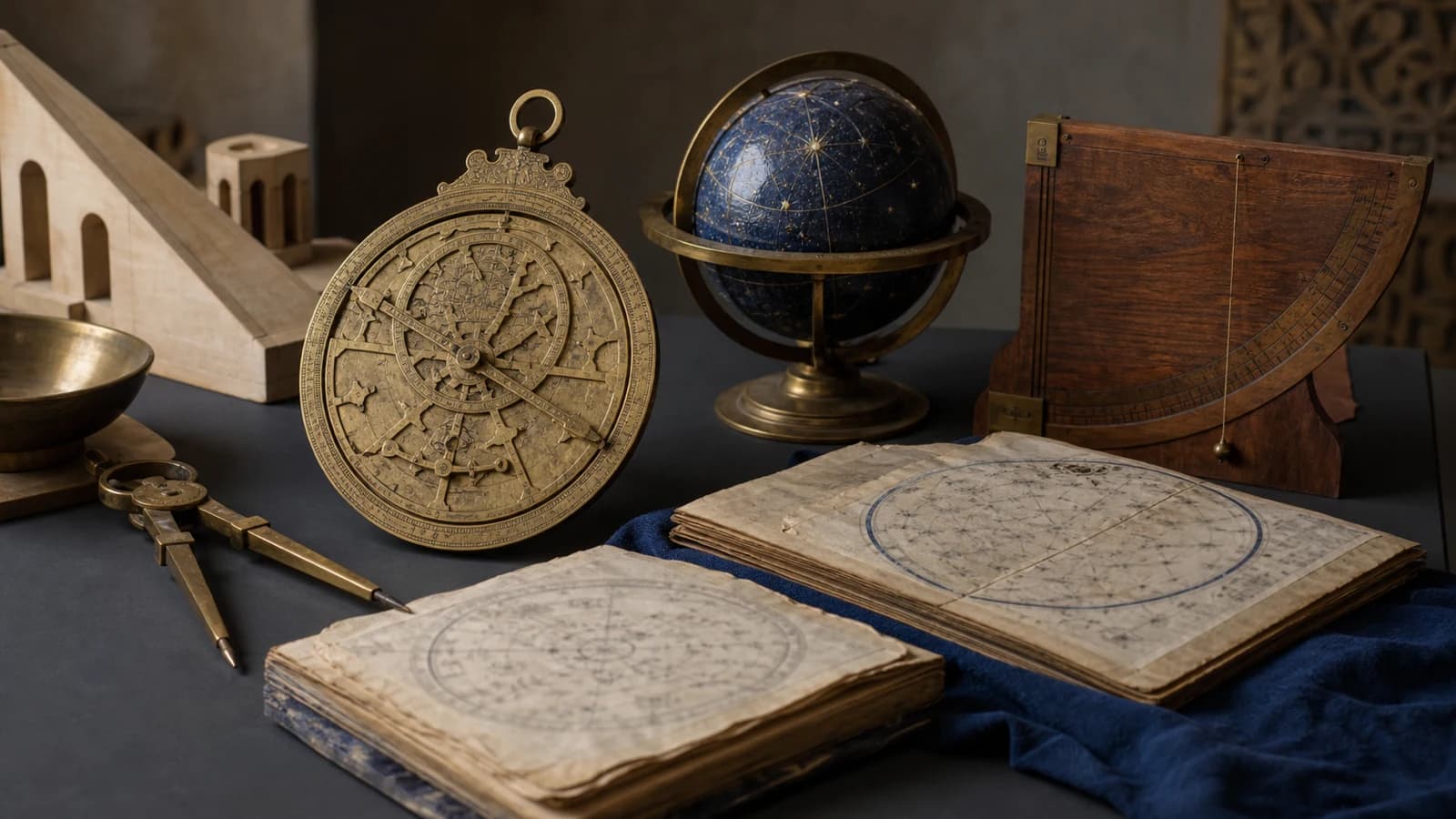
Geschiedenis van astronomie in de islamitische wereld: observatoria, instrumenten en sterrentabellen
Bronkritische tijdlijn van astronomie in moslimsamenlevingen, van Abbasidische tabellen en astrolabia tot Maragha, Samarkand, Istanbul en manuscripten.
Periode
c. 750-1908 CE
Mijlpalen
24
Methode
Bronnen lezen
Laatst beoordeeld
11 July 2026
Bronkritische tijdlijn van astronomie in moslimsamenlevingen, van Abbasidische tabellen en astrolabia tot Maragha, Samarkand, Istanbul en manuscripten.
Onderscheid de Korantekst, later samengestelde islamitische overleveringen en moderne wetenschap. Maak van een geschatte datum of route geen schijnzekerheid.
Korte volgorde
Bronkritische tijdlijn van astronomie in moslimsamenlevingen, van Abbasidische tabellen en astrolabia tot Maragha, Samarkand, Istanbul en manuscripten.
- Grondslagen en instrumenten, ca. 750-1050
- Maragha en institutionele observatoria, ca. 1050-1300
- Samarkand en het Timoeridische programma, ca. 1400-1500
- Istanbul en latere nalatenschap, ca. 1500-1908
Bronnen lezen
Onderscheid de Korantekst, later samengestelde islamitische overleveringen en moderne wetenschap. Maak van een geschatte datum of route geen schijnzekerheid.
Kerngebeurtenissen in de islamitische geschiedenis - Grondslagen en instrumenten, ca. 750-1050
Onderscheid de Korantekst, later samengestelde islamitische overleveringen en moderne wetenschap. Maak van een geschatte datum of route geen schijnzekerheid.
| Datum | Gebeurtenis | Context | Brontype |
|---|---|---|---|
| c. 750-800 | Arabic astronomical translation expands | Grondslagen en instrumenten, ca. 750-1050 | Manuscripts, bibliographies and translation histories |
| c. 770 | Sanskrit-derived tables reach the Abbasid court | Grondslagen en instrumenten, ca. 750-1050 | Later bibliographic reports and revised table traditions |
| c. 800 | Astrolabe making develops in Arabic scholarly settings | Grondslagen en instrumenten, ca. 750-1050 | Dated and attributed instruments, technical treatises |
| 813-833 | Al-Ma'mun sponsors observation and measurement | Grondslagen en instrumenten, ca. 750-1050 | Historical reports, tables and later scientific works |
| 9th-10th c. | Prayer-time and qibla methods become specialized fields | Grondslagen en instrumenten, ca. 750-1050 | Legal-astronomical texts, instruments and tables |
| c. 964 | Al-Sufi completes the Book of Fixed Stars | Grondslagen en instrumenten, ca. 750-1050 | Surviving dated and later manuscript copies |
Kerngebeurtenissen in de islamitische geschiedenis - Maragha en institutionele observatoria, ca. 1050-1300
Onderscheid de Korantekst, later samengestelde islamitische overleveringen en moderne wetenschap. Maak van een geschatte datum of route geen schijnzekerheid.
| Datum | Gebeurtenis | Context | Brontype |
|---|---|---|---|
| 1074-1079 | Malik Shah's Isfahan program and calendar reform | Maragha en institutionele observatoria, ca. 1050-1300 | Chronicles, calendar history and later accounts |
| 11th c. | Al-Biruni links observation, trigonometry and geography | Maragha en institutionele observatoria, ca. 1050-1300 | Surviving works and manuscript traditions |
| 1258 | Mongol forces devastate Baghdad | Maragha en institutionele observatoria, ca. 1050-1300 | Chronicles and regional institutional history |
| 1259 | Construction begins at Maragha Observatory | Maragha en institutionele observatoria, ca. 1050-1300 | Historical texts, archaeology and manuscript colophons |
| 1260s | Maragha team develops instruments and model reforms | Maragha en institutionele observatoria, ca. 1050-1300 | Technical treatises, diagrams and excavated instrument remains |
| 1270s | Ilkhanic Tables circulate | Maragha en institutionele observatoria, ca. 1050-1300 | Zij manuscripts and later references |
Kerngebeurtenissen in de islamitische geschiedenis - Samarkand en het Timoeridische programma, ca. 1400-1500
Onderscheid de Korantekst, later samengestelde islamitische overleveringen en moderne wetenschap. Maak van een geschatte datum of route geen schijnzekerheid.
| Datum | Gebeurtenis | Context | Brontype |
|---|---|---|---|
| 1409 | Ulugh Beg governs from Samarkand | Samarkand en het Timoeridische programma, ca. 1400-1500 | Chronicles, architecture and biographical sources |
| 1420s | Samarkand Observatory is constructed | Samarkand en het Timoeridische programma, ca. 1400-1500 | UNESCO site study, archaeology and technical texts |
| 1420s-1430s | Al-Kashi, Qadi Zada and Ali Qushji work in the program | Samarkand en het Timoeridische programma, ca. 1400-1500 | Biographies, letters and mathematical works |
| 1438-1440 | Zij-i Sultani is compiled | Samarkand en het Timoeridische programma, ca. 1400-1500 | Persian manuscripts and later Arabic, Turkish and Latin versions |
| 1449 | Ulugh Beg dies and observatory patronage collapses | Samarkand en het Timoeridische programma, ca. 1400-1500 | Chronicles, site archaeology and manuscript circulation |
| 15th-16th c. | Samarkand traditions enter Ottoman scholarship | Samarkand en het Timoeridische programma, ca. 1400-1500 | Biographies, commentaries and institutional histories |
Kerngebeurtenissen in de islamitische geschiedenis - Istanbul en latere nalatenschap, ca. 1500-1908
Onderscheid de Korantekst, later samengestelde islamitische overleveringen en moderne wetenschap. Maak van een geschatte datum of route geen schijnzekerheid.
| Datum | Gebeurtenis | Context | Brontype |
|---|---|---|---|
| c. 1575 | Taqi al-Din secures support for an Istanbul observatory | Istanbul en latere nalatenschap, ca. 1500-1908 | Ottoman histories and modern institutional studies |
| 1577 | Istanbul Observatory is operating | Istanbul en latere nalatenschap, ca. 1500-1908 | Illustrated manuscripts, treatises and court records |
| 1577 | The team observes a prominent comet | Istanbul en latere nalatenschap, ca. 1500-1908 | Ottoman chronicles and astronomical writings |
| 1580 | Murad III orders the observatory demolished | Istanbul en latere nalatenschap, ca. 1500-1908 | Ottoman narrative sources and modern historical analysis |
| 1650-1665 | Ulugh Beg's tables appear in Latin print | Istanbul en latere nalatenschap, ca. 1500-1908 | Cataloged Oxford and London editions |
| 1908 | Samarkand's buried meridian arc is rediscovered | Istanbul en latere nalatenschap, ca. 1500-1908 | Excavation history and UNESCO documentation |
Veelgestelde vragen
Is deze tijdlijn volledig?
Nee. Het is een ingang naar diepere regionale en thematische studie.
Zijn alle traditionele data exact?
Nee. Geschatte data en latere overleveringen worden gemarkeerd.
Waarom CE en AH?
CE helpt regio's vergelijken; AH bewaart de islamitische maankalender.
Gerelateerd lezen
- Nasir al-Din al-Tusi, het Maragha-observatorium en het Tusi-koppel uitgelegd
- Ulugh Beg-observatorium: Samarkand, de Zij-i Sultani en zijn sterrencatalogus
- Taqi al-Din en het observatorium van Istanbul: instrumenten, klok en sluiting in 1580
- Tijdlijn van de islamitische gouden eeuw: Bagdad, vertaling, wetenschap en geneeskunde
- Al-Biruni: aardstraal, India, astronomie en methoden
- Ibn al-Haytham: optica, camera obscura, methode en biografie
- Al-Khwarizmi: algebra, algoritmen, biografie, werken en nalatenschap
- Huis der Wijsheid in Bagdad: geschiedenis, vertaling en de mythe van 1258
- Val van Bagdad in 1258: datum, beleg, gevolgen en bronnen
Bronnen
- Science Museum: Astronomy and cosmology
- Oxford History of Science Museum: The astrolabe
- UNESCO-ICOMOS thematic study on astronomical heritage
- UNESCO Memory of the World: Kandilli Observatory manuscripts
- Smithsonian Institution via GovInfo: Islamicate celestial globes
- Cambridge Core: The observatory in Maragha
- Cambridge Core: The observatory in Samarqand
- Cambridge Core: The observatory in Istanbul
- Library of Congress: al-Tusi's Tadhkira
- Qatar Digital Library: Zij-i Jadid-i Sultani
- UNESCO World Heritage Centre: Samarkand
- Turkish World Encyclopedia: Taqi al-Din
Talen
- تاريخ علم الفلك في العالم الإسلامي: المراصد والأدوات والجداول النجمية
- ইসলামি বিশ্বের জ্যোতির্বিজ্ঞানের ইতিহাস: মানমন্দির, যন্ত্র ও নক্ষত্র সারণি
- Història de l'astronomia al món islàmic: observatoris, instruments i taules estel·lars
- Dějiny astronomie v islámském světě: observatoře, přístroje a hvězdné tabulky
- Astronomiens historie i den islamiske verden: observatorier, instrumenter og stjernetabeller
- Geschichte der Astronomie in der islamischen Welt: Observatorien, Instrumente und Sterntafeln
- Ιστορία της αστρονομίας στον ισλαμικό κόσμο: αστεροσκοπεία, όργανα και αστρικοί πίνακες
- History of Astronomy in the Islamic World: Observatories, Instruments and Star Tables
- Historia de la astronomía en el mundo islámico: observatorios, instrumentos y tablas estelares
- Tähtitieteen historia islamilaisessa maailmassa: observatoriot, välineet ja tähtitaulukot
- Histoire de l'astronomie dans le monde islamique : observatoires, instruments et tables d'étoiles
- Sejarah astronomi di dunia Islam: observatorium, instrumen, dan tabel bintang
- Storia dell'astronomia nel mondo islamico: osservatori, strumenti e tavole stellari
- イスラーム世界の天文学史:天文台、観測器具、星表の系譜
- 이슬람 세계 천문학의 역사: 천문대, 관측 기구와 성표
- Sejarah astronomi di dunia Islam: balai cerap, alat dan jadual bintang
- Geschiedenis van astronomie in de islamitische wereld: observatoria, instrumenten en sterrentabellen
- Astronomiens historie i den islamske verden: observatorier, instrumenter og stjernetabeller
- Historia astronomii w świecie islamu: obserwatoria, instrumenty i tablice gwiazd
- História da astronomia no mundo islâmico: observatórios, instrumentos e tabelas estelares
- История астрономии в исламском мире: обсерватории, инструменты и звездные таблицы
- Dejiny astronómie v islamskom svete: observatóriá, prístroje a hviezdne tabuľky
- Astronomins historia i den islamiska världen: observatorier, instrument och stjärntabeller
- ประวัติศาสตร์ดาราศาสตร์ในโลกอิสลาม: หอดูดาว เครื่องมือ และตารางดาว
- İslam dünyasında astronomi tarihi: rasathaneler, aletler ve yıldız cetvelleri
- ئىسلام دۇنياسىدىكى ئاسترونومىيە تارىخى: رەسەتخانىلار، ئەسۋابلار ۋە يۇلتۇز جەدۋەللىرى
- Lịch sử thiên văn học trong thế giới Hồi giáo: đài quan sát, dụng cụ và bảng sao
- 伊斯兰世界天文学史:天文台、观测仪器与星表时间线
- 伊斯蘭世界天文學史:天文台、觀測儀器與星表時間線
- 伊斯蘭世界天文學史:天文臺、觀測儀器與星表時間線