What Is Mashq? How to Read Ottoman Calligraphy Practice Sheets
See how Ottoman calligraphers repeated strokes, marked proportions and mounted exercises, and how an icazetname recorded permission to sign.
Several named works at the Sakıp Sabancı Museum make the differences visible. Ahmed Karahisarî’s repeated sayings occupy a sheet with a gold border. Abdurrahman Hilmi’s scaled exercise uses dots and lines. A diploma for Mir Mustafa Celaleddin contains endorsements that grant permission to sign work in specified scripts.
Where to look for practice on a sheet
Begin by finding a shape or group of letters that occurs more than once. Follow the repeated sequence across the sheet. Look at the distance between strokes, where two letters join and how the space around a word changes. Repetition can occupy a line or extend across much of a page. In a scaled exercise, marks near a letter may explain a proportion. If an annotation is unfamiliar, the museum’s reading can establish its role. A dot may be part of a letter or a measurement mark, depending on its position and the context of the sheet.
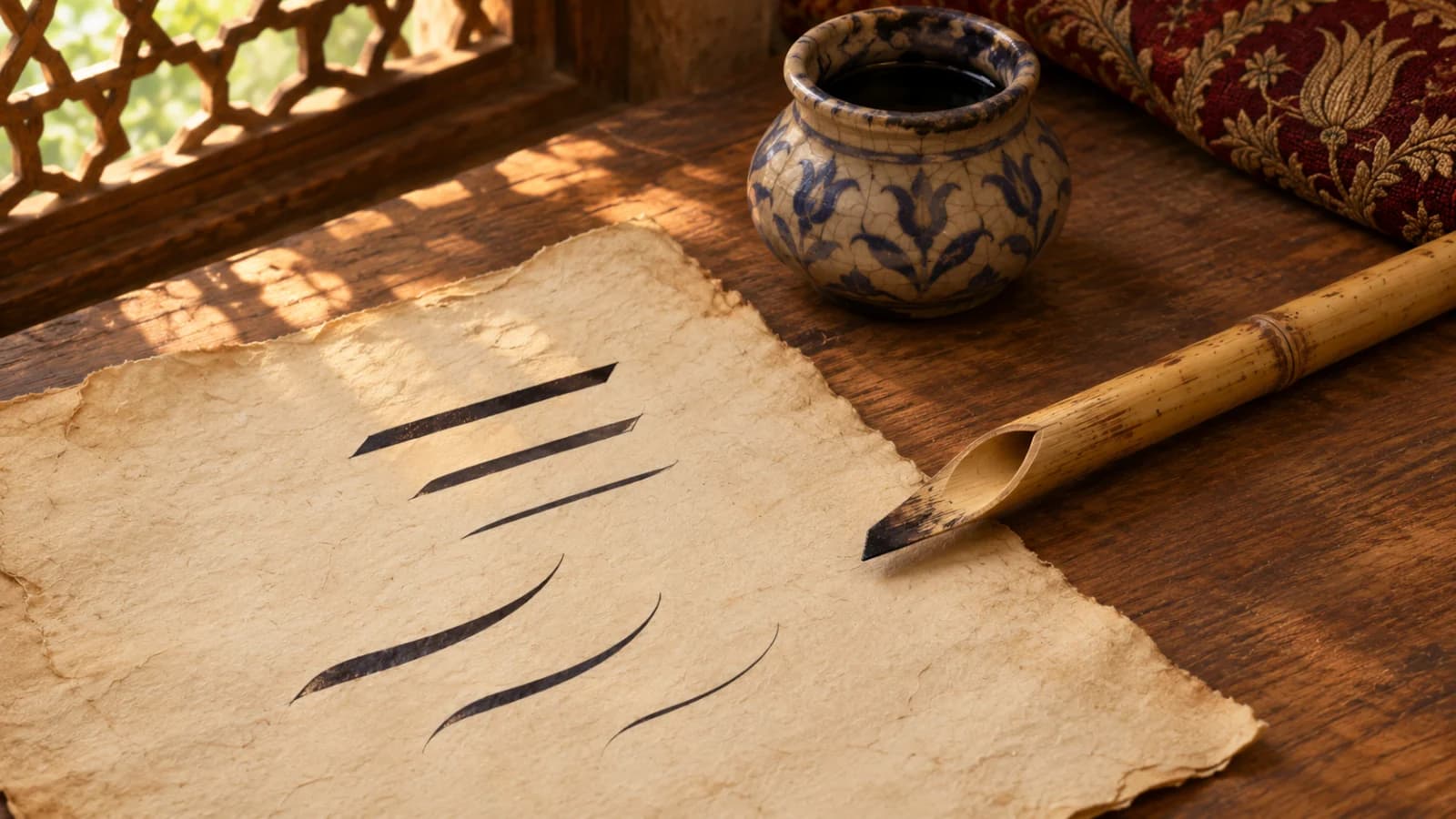
The museum’s exhibition Scribbled Exercises, Practice Pages brings together examples from Ottoman calligraphers working across several centuries. Its descriptions connect exercises with learning letter shapes, maintaining dexterity and trying out forms. A reed pen or qalam provides a writing edge, while repeated work on the sheet makes differences in the stroke visible. The guide to Arabic calligraphic scripts gives context for the names of different scripts found in the catalogues. Sakıp Sabancı Museum, Scribbled Exercises, Practice Pages
Ahmed Karahisarî’s repeated phrases and gold border
The Sakıp Sabancı Museum identifies 190-0456-AK as a sixteenth-century scribbled exercise by Ahmed Karahisarî. The sheet is 35 by 26.3 centimetres. The catalogue lists sized paper and black ink and describes repetitions of literary sayings and adages. It also describes a narrow gold frame and small gold roses between letters and words. A colophon identifies the calligrapher’s work as an exercise. In this example the repeated writing and the arrangement of the decoration belong on the same page. Sakıp Sabancı Museum, Karahisarî’s scribbled exercise, 190-0456-AK
Compare an image of the whole sheet with a closer view. At full size, the frame and the shape of the writing field are apparent. In a detail, the individual repetitions and the spaces holding the gold ornament are easier to see. The catalogue provides evidence for identifying what was repeated and for reading the colophon. A description can mention both the working exercise and the care with which it is presented.
Abdurrahman Hilmi’s scaled exercise
For the scaled practice sheet 190-0522-ARE, the museum uses the term ölçülü talim meşki. It dates the piece to the second half of the eighteenth century and gives dimensions of 18.5 by 26 centimetres. It describes dots and lines as aids for showing the size and form of letters and the links between them. Small flowers and leaves occupy some of the spaces between the writing. The museum interprets this work as a likely teaching example. The colophon identifies Hilmi’s teacher as Mehmed Rasim Efendi of Eğrikapı, and the museum records that Hilmi taught as well. Sakıp Sabancı Museum, scaled exercise 190-0522-ARE
When comparing the scaled sheet with the Karahisarî example, first identify the evidence in each. One catalogue explains repetitions of sayings, a signature and gold roses. The other explains proportion marks and a teacher named in the colophon. They can both be discussed as examples of practice, with different details about what the page shows. Attribution of a particular teaching use belongs to the evidence given for the individual object.
How exercises became part of an album
The museum’s Calligraphic album, 120-0243-SH, measures 30 by 21.7 centimetres. It contains works by Şeyh Hamdullah. The record identifies both kıt’a, calligraphic compositions, and meşk, exercises, compiled into a murakka, or album. It assigns the coloured and marbled paper in the margins, the illumination and the binding to the eighteenth century. The album therefore brings together writing by a calligrapher who died in 1520 and later work on the presentation. Sakıp Sabancı Museum, album 120-0243-SH
To describe an album page, look first at the writing field, then at the surrounding paper and the binding. The date given for one part may apply to that part alone. The account of manuscript workshops provides context for the different kinds of work involved in making a book. The guide to shamsa rosettes offers another example of how the place of a decorated surface matters. An album can give a practice sheet a new setting long after the writing itself was made.
How a diploma records permission to sign
The museum identifies 110-0597 as the icazetname of Mir Mustafa Celaleddin, dated 1270 AH or 1853–1854. It is 27 by 36.5 centimetres. The museum describes the pupil’s calligraphy in sülüs and nesih, the Turkish names for thuluth and naskh. Below it, in two oval cartouches, are endorsements in rıka script by Ali Rıza of Manisa and Abdullah Zühdî. The catalogue identifies those endorsements as permission to sign work in the two scripts. Their text and placement establish the function of this particular sheet. Sakıp Sabancı Museum, Mir Mustafa Celaleddin’s diploma, 110-0597
A colophon can name the person who wrote a sheet. A teacher’s endorsement in a diploma can state an authorisation. To explain which kind of writing you are looking at, check what the museum says about the person named, what was signed and where the entry appears on the page. The guide to manuscript provenance and colophons gives other examples of how a name or note can document a role.
In its survey of Ottoman calligraphy, the Sadberk Hanım Museum describes the icazetname as a diploma given when students were judged proficient. It also discusses the murakka as an album assembled from individual works. The format of the paper and the role of the document are separate things to observe. An album preserves and arranges pieces, while the named diploma includes an endorsement. For the Celaleddin example, the catalogue’s identification of two teachers and two scripts gives the general term a concrete meaning. Sadberk Hanım Museum, Harmony of Line and Color
Compare late examples across collections
The Sakıp Sabancı Museum also catalogues a scribbled exercise by Hasan Rıza, 190-0580-HR. It dates the work to 1298 AH, or 1880–1881, and measures it at 23.5 by 34 centimetres. Its date provides a specific late Ottoman comparison with the earlier Karahisarî sheet. The museum’s 1998 exhibition catalogue published by the Met places exercises among a broader collection of calligraphic albums, manuscripts and panels. Sakıp Sabancı Museum, Hasan Rıza exercise 190-0580-HR and Metropolitan Museum of Art, Letters in Gold
The Met’s Iranian album leaf 2016.536 by Asadullah Shirazi is a separate comparison. The museum identifies it as siyah mashq and dates it to 1258 AH, or 1842–1843. Its record explains how repetition became a feature of some composed practice pages and how such sheets could be mounted and placed in albums. Compare the medium and album treatment while retaining the Iranian attribution and the museum’s specific term for the leaf. Met, Album Leaf with Calligraphic Exercise, 2016.536
Decorated borders can frame other forms of calligraphy too. For instance, the Aga Khan Museum’s AKM254 is catalogued as a page of nasta‘liq calligraphy and has a blue and gold marbled border. Place its field and border beside those of the Şeyh Hamdullah album as a visual comparison. The object titles and catalogue descriptions establish whether each field contains an exercise, a composition or another kind of writing. Similar materials around the field offer evidence about presentation. Aga Khan Museum, Page of Nasta‘liq Calligraphy, AKM254
How to caption a practice sheet
Write down the object number, writer or attribution and date. Then describe one visible feature, such as repeated words, proportion marks, a later border or an endorsement in a separate field. Identify the feature with the collection’s description when it explains the writing. For an album page, indicate which date applies to the script and which applies to the mount or binding. A short caption can distinguish the evidence for practice, presentation and teaching by giving one precise detail for each claim it makes. When there are multiple photos, keep the full page and one detail together so readers can see how the lines, border and annotations relate.
Museum records and an exhibition catalogue
- Sakıp Sabancı Museum, Scribbled Exercises, Practice Pages documents the exhibition’s range of Ottoman calligraphers and practice forms.
- Karahisarî, 190-0456-AK records the repeated sayings, colophon and gold decoration.
- Abdurrahman Hilmi, 190-0522-ARE documents proportion marks and names the writer’s teacher.
- Şeyh Hamdullah album, 120-0243-SH describes exercises, compositions and later album work.
- Mir Mustafa Celaleddin, 110-0597 identifies the endorsement cartouches and the scripts they cover.
- Hasan Rıza, 190-0580-HR gives the dated late Ottoman exercise and its dimensions.
- Met, Letters in Gold surveys Ottoman calligraphy in the Sabancı collection.
- Met, 2016.536 documents an Iranian album leaf for a distinct comparison.