How to Recognize Kufic, Naskh, Thuluth and Nasta’liq
Compare Kufic, Naskh, Thuluth and Nasta’liq through dated museum works, letter proportions, page layouts and the difference between script and language.
Kufic, Naskh, Thuluth and Nasta’liq name different traditions of Arabic-script calligraphy. Angular forms and extended horizontal strokes help identify many works labelled Kufic. Smaller Naskh and larger Thuluth can share a single page, while Nasta’liq is especially associated with Persian poetry and a rhythm of curved, sloping groups. These are useful starting points, but a reliable identification also needs the work’s date, language, layout and catalogue description. A gold letter, a diagonal line or an elaborate border cannot identify a script by itself.
Separate the writing style from the language and text
“Arabic calligraphy” can describe a writing tradition without establishing that the words are Arabic. The distinction matters particularly for Nasta’liq: the Smithsonian places its development in fourteenth-century Iran and its history within Persian literary culture. Calling a Persian poem Arabic because its letters look familiar would misidentify the text before any comparison of handwriting begins.
Our guide to African-language Ajami manuscripts explains another setting in which adapted Arabic letters carry languages other than Arabic. Language, spelling conventions and calligraphic style answer different questions. Record them separately, and retain an unidentified language as unidentified when the catalogue does not resolve it.
Content also needs its own description. The V&A’s account of calligraphy includes poetry, praise of rulers and aphorisms alongside Qur’anic writing. A religious-looking presentation therefore does not supply a translation. Start with an institution’s transcription or description before naming a quotation. The text might be a poem, a blessing, a chapter heading or a mixture of several kinds of writing, each occupying a different part of the object.
For comparison, keep a note of the accession number and the part you are studying. “The central text of this panel” is a more precise observation than assigning one label to its headings, margins, signatures and later inscriptions together. It also makes your identification easier to check against the same image.
Kufic becomes clearer through a particular manuscript leaf
Kufic is a useful category with internal variety. The Met’s teaching diagrams distinguish ordinary, floriated and knotted or plaited examples. Angular structure and extended horizontal strokes are better starting points than a rule that every letter must be square. Ornament can alter how a letter looks without turning every decorated inscription into a separate language.
A concrete example is the Met’s Blue Qur’an folio, 2004.88. The museum dates it from the second half of the ninth to the middle of the tenth century and records gold and silver on indigo-dyed parchment. It proposes Tunisia, possibly Qairawan. That last qualification is part of the identification, not an optional detail to drop from a caption.
The record also explains a difficulty in reading this leaf: letters were adjusted to equalize line lengths, and distinguishing marks were omitted. A page can therefore have a deliberate visual order while demanding substantial knowledge from its reader. Gold on blue does not make the words self-explanatory, and the presence or absence of modern-looking punctuation is not a sufficient dating test.
Compare the letter structure with the spacing across an entire line. Ask where a horizontal has been extended and how neighboring letters occupy the available width. Then separate what the catalogue records about the material from what it proposes about the workshop. Our Blue Qur’an study compares other collections whose dates and proposed places differ. It is especially useful when a search result gives a confident origin for every surviving leaf.
Rhombic dots measure proportion within a chosen script
In the Met’s Arabic Script and the Art of Calligraphy unit, a proportional letter is described through a fixed number of rhombic dots. The dot is the diamond-like impression made by the pen. The unit lists six proportional scripts: Naskh, Thuluth, Muhaqqaq, Rayhani, Tawqi‘ and Riqa‘. These names provide a fuller framework than treating all rounded writing as Naskh.
Here, a dot is a measuring unit. It should not be confused with the written dots that distinguish letters or with vowel signs. A diagram explaining measurement does not mean that the finished word must visibly carry a row of construction dots beside every stroke.
The practical point is a relationship between parts. Enlarging an example while keeping its proportions can preserve a design; stretching only its height changes that relationship. This is also why a comparison should use images at a consistent scale. A tall letter in a tightly cropped photograph may appear more imposing than the same letter shown within its complete page.
Use the institution’s labelled diagrams as comparisons, rather than assigning a universal point count to an unfamiliar historical hand. The chosen script and the specific model matter. The diagrams help explain what disciplined proportion means; they do not authenticate an unsigned object, settle its date or replace a teacher’s correction of a student’s work.
Naskh and Thuluth can perform different jobs on the same page
The Met’s Album of Calligraphies Including Poetry and Prophetic Traditions, 1982.120.3, supplies a useful comparison within one object. Its calligrapher is Shaikh Hamdullah ibn Mustafa Dede, and its date is approximately 1500. The museum places its production in Turkey, probably Istanbul. Several lines of small Naskh are framed by one or two larger lines in Thuluth or Muhaqqaq, with the samples mounted on marbled paper.
This arrangement gives the viewer two scales to compare without relying on unrelated screenshots. Examine the repeated small lines, then the larger writing around them. The contrast shows how a page can establish a hierarchy while retaining several calligraphic systems. It also supplies a useful correction: the catalogue identifies the larger hands as Thuluth or Muhaqqaq, so size alone cannot decide between them.
Conservator Yana van Dyke’s study of the album’s marbled paper describes large horizontal headings and smaller Naskh arranged horizontally or diagonally. A diagonal line is therefore not enough to identify Nasta’liq. Notice the writing first and the direction of its placement second. Treat the decorative paper strips and marbled borders as parts of the page’s construction, rather than properties of the letterforms.
A later comparison is the Library of Congress hilye, 2019714648. The record names Dihya Salim al-Fahim and dates the work to 1130 AH/1718 CE at the Galata Palace in Istanbul. It identifies Thuluth and Naskh on a calligraphic description of the Prophet Muhammad mounted on a wooden board with folding side panels. The object lets readers compare script, textual function and physical format. Its verbal description should not be mistaken for a painted portrait.
Nasta’liq connects letter rhythm with Persian literary use
The Smithsonian’s Masters & Pupils account describes Nasta’liq through curves, short vertical strokes and the relationship between letters and their placement. Its association with Persian verse is a historical context, rather than a claim that every sloping line is a poem. The same account presents the attribution of the script’s invention to Mir Ali Tabrizi as a traditional or alleged attribution. It should retain that qualification.
For a dated example, examine the Gulistan by Sa‘di signed by Sultan Ali Mashhadi, Freer F1998.5, folios 44v–45r. The museum places this copy in Herat and dates it to 1468 CE/873 AH. Its discussion draws attention to words rising at a steeper pitch above the baseline and to variation in stroke width. These are specific features to compare, rather than a general impression that the writing “floats.”
Look at a group of words before isolating a flourish. Compare how compact forms sit beside extended ones, and where a line appears to gather or open out. These viewing questions follow the museum’s emphasis on rhythm; they are not a mechanical test that makes every similarly arranged sample the work of the same master.
The Smithsonian exhibition’s album folio S1986.30 adds a different lesson. It dates Sultan Ali Mashhadi’s writing to approximately 1510–15 and the paintings ascribed to Muhammad Sadiqi and Muhammad Qasim to about 1590. The calligraphy and its later artistic setting thus require separate dates. A richly finished album page need not have been made in a single campaign, and a border cannot by itself date the writing mounted inside it.
Pens, surfaces and teaching belong to the comparison
The Smithsonian’s Masters & Pupils material describes reeds selected for pens and tips trimmed to suit different strokes. It also discusses Sultan Ali Mashhadi’s 1514 treatise, The Path of Writing, as evidence for preparation of materials. These records help explain why a traditional hand is more than a font name: the writer works with a cut tool, ink, a surface and a learned model.
The same letters reproduced at different resolutions can hide that material relationship. A compressed thumbnail may erase fine joins and small marks. Before interpreting a thin area as a deliberate feature, open the collection’s larger image and inspect the surrounding strokes. If the image cannot resolve the detail, retain the uncertainty instead of turning a blur into a stylistic diagnosis.
Our guide to sizing and burnishing manuscript paper distinguishes surface treatment from mechanical polishing and explains why gloss cannot identify an exact recipe. That distinction is useful here: a smooth-looking sheet is an observation, while a claim about its ingredients requires stronger evidence. The Blue Qur’an example also reminds readers to check whether the support is parchment or paper before generalizing about preparation.
Learning has a documentary side too. A model copied by a pupil and an authorization granted by a teacher are different kinds of evidence. Our guide to ijaza and its scope explains why a license should be read for who authorized whom, for which activity and on what basis. A recognizable hand alone cannot establish an unnamed writer’s training history.
Read the whole object before settling on a script name
Begin a description with the named work and the area under examination. Add the language identified by the catalogue, the script or scripts it records, and the object’s date and material. Keep words such as “approximately,” “probably” and “possibly” attached to the relevant claim. They distinguish a proposed date or place from a signed and dated statement.
Then describe the feature that supports the comparison: extended horizontals on the Blue Qur’an leaf; small and large writing sharing Hamdullah’s album; word groups and stroke widths in the dated Gulistan. These comparisons are more informative than using “ornate” or “beautiful” as if those adjectives identify a hand. When a page has several scripts, name their areas rather than choosing one label for everything.
The Met’s account of calligraphy as ornament emphasizes that writing still transmits a text, even when its decorative potential is prominent. An attractive inscription needs a reliable reading before its words are quoted or interpreted. A catalogue’s identification of script does not itself translate the passage, certify authorship or establish a religious ruling about the object’s use.
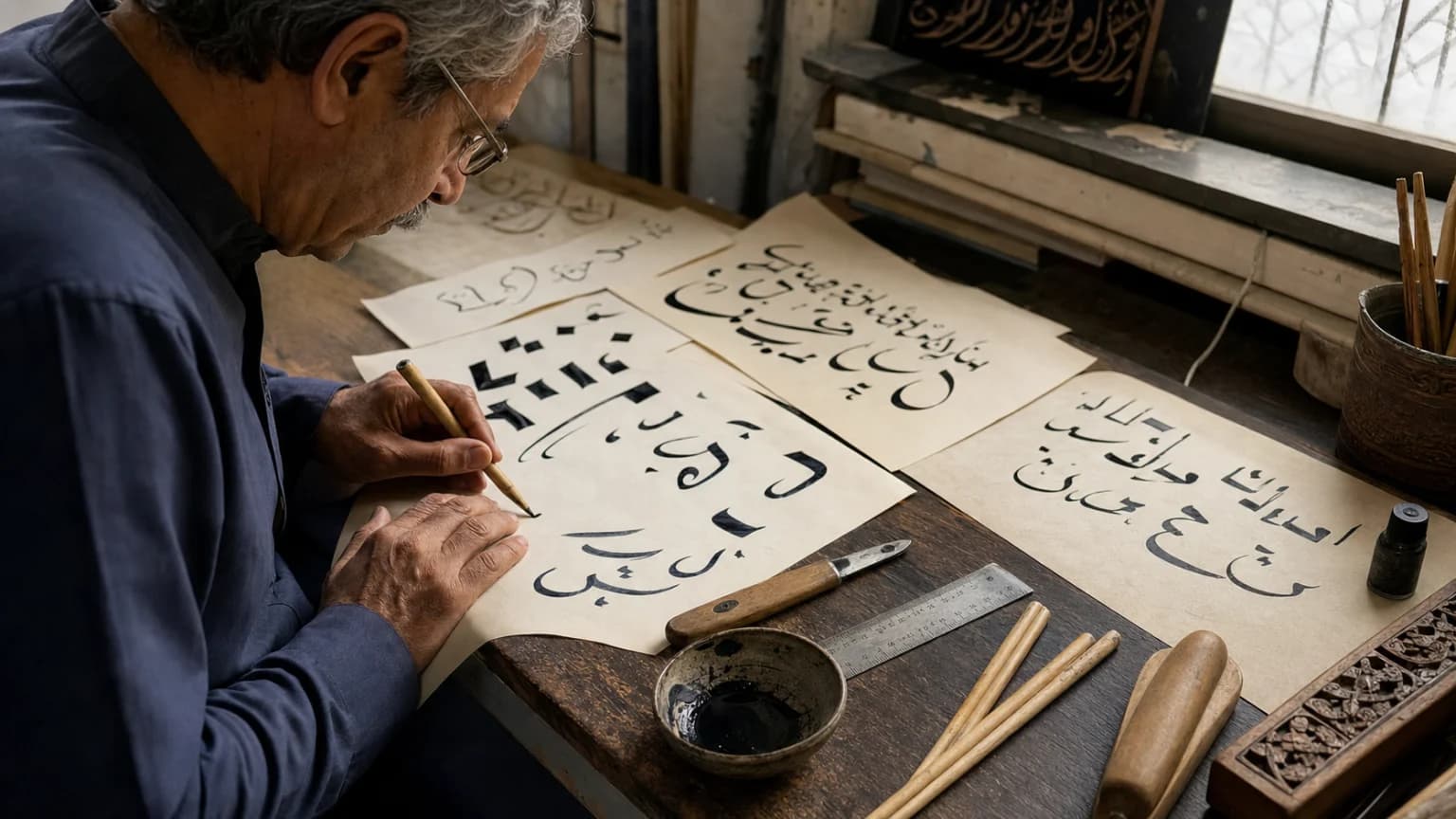
Finally, separate the calligraphy from its mounting and later additions. A signature can occur in one corner while an owner’s note occupies another; the original sample and its album setting may have different histories. Use the linked institutional images and accession numbers to inspect the actual works. The cover accompanying this guide serves as a general illustration, not a facsimile or an identification chart for any of the named manuscripts. Its marks should not be used to transcribe a verse or authenticate a historical hand.
Sources
- The Met, Arabic Script and the Art of Calligraphy, Unit 2 — proportional dots, the Six Pens and Kufic variations.
- The Met, Blue Qur’an folio 2004.88 — date range, parchment, metals and qualified geographic attribution.
- The Met, Hamdullah album 1982.120.3 — small Naskh alongside larger Thuluth or Muhaqqaq.
- The Met, The Art of Marbled Paper — Yana van Dyke’s 2015 analysis of page layout and assembled borders.
- Library of Congress, hilye 2019714648 — maker, 1130 AH/1718 CE date, scripts and folding wooden format.
- Smithsonian, Nasta’liq: The Genius of Persian Calligraphy — literary context and separately dated writing and paintings on S1986.30.
- Smithsonian, Sultan Ali Mashhadi — the dated Gulistan F1998.5 and its specific letter rhythm.
- Smithsonian, Masters & Pupils — Nasta’liq characteristics, qualified invention attribution, reed pens and material preparation.
- V&A, Calligraphy in Islamic Art — religious and secular content, materials and decoration.
- The Met, Calligraphy in Islamic Art — the relationship between transmitting a text and creating ornament.


