What an Ijaza Actually Authorized in Islamic Education
What an ijaza meant, who granted it, what it authorized, how isnad and manuscripts recorded it, and why it was not one standardized university degree.
An ijaza is a teacher's authorization for a named person to transmit, teach, recite, copy, or practise something within a stated or understood scope. It is not one uniform diploma used across every place and century. A surviving ijaza may concern a particular book, a collection of traditions, Quran recitation, legal teaching, Sufi instruction, calligraphy, medicine, or a broader course of study. To understand one, the first question is therefore not “What degree did this person earn?” but “Who authorized whom to do what, on what basis, and when?”
The Arabic root behind ijaza carries the sense of permitting or authorizing. In scholarly life, that permission helped connect oral instruction to a record that could travel beyond the lesson. Some authorizations occupy a few lines at the end of a manuscript; others are separate, elaborately written documents. Some name a chain of teachers. Others emphasize the student's competence, the exact text, a style of writing, a place, witnesses, or conditions on future transmission.
What an ijaza does—and what it does not do
An ijaza establishes a relationship and a scope. It can record that a student read a book to a teacher, heard it read, received permission to transmit it, demonstrated a calligraphic hand, or was allowed to take pupils. The exact verbs matter. “He heard,” “she read,” “I permit,” and “I certify mastery” do not necessarily describe the same activity.
It does not automatically prove that the holder completed a standardized curriculum comparable to a modern university degree. Premodern Islamic education had institutions, conventions, reputations, examinations and demanding study, but no single authority imposed one ijaza format across the Muslim world. A license might be narrow and text-specific or unusually broad. Its significance depended on the teacher's standing, the student's work, the field, local custom and the document's credibility.
| Question | What to look for in the document | Why it matters |
|---|---|---|
| Who grants permission? | Teacher's name, titles, signature, seal, handwriting | Identifies the authorizing scholar or master |
| Who receives it? | Student's name, lineage, place of origin, honorifics | Connects the license to a particular person |
| Permission for what? | Book title, discipline, recitation, script or teaching activity | Defines the scope; prevents a narrow license being treated as universal |
| How was competence shown? | Reading, audition, copying, examination, sample page, sustained study | Explains the basis of authorization |
| When and where? | Date, city, school, mosque, household or court | Places the relationship in a historical network |
| What chain is supplied? | Earlier teachers, transmitters or calligraphic masters | Shows the lineage claimed by the authorizer |
The 1687 license names a text but also gives wider, conditional permission
The HMML description and partial translation of SAV ABS 03135 make its scope unusually clear. The manuscript contains Ahmad Zarruq's commentary on Ibn Askar's legal treatise Irshad al-salik. The license appears on the page after the colophon: copying the book and receiving authorization were separate events. HMML dates the authorization to 9 May 1687, the month after the copy was made in Medina, and identifies the document on page 54 of the digitized manuscript.
The translated passage then extends permission beyond this copy to other works by Zarruq and to material that al-Kurani himself was authorized to transmit, subject to the discipline's conditions. This is broader than a one-book receipt, but it is not an unlimited license for every subject. The contrast illustrates why a catalogue title alone cannot settle an ijaza's meaning: identify the named text, read the extension of permission and retain its conditions. The document records a particular teacher's authority being passed to a particular student, rather than a standardized institutional degree.
Why the form varies so much
“Ijaza” names a function rather than a single stationery format. A teacher could write authorization in the same codex that a student had read, using a blank page, colophon or margin. A calligrapher might produce a decorated certificate containing model scripts and the approvals of masters. A scholar could also issue a separate letter. Paper quality and ornament alone do not determine importance: a brief note in a working manuscript may preserve direct evidence of an actual reading session.
Scope also varies. Historians sometimes organize licenses into categories such as permission for a particular book, a group of works, a discipline or a more general authorization. These labels are useful only if they do not flatten the wording of the source. The document itself must lead. A teacher who permits transmission of one commentary has not necessarily licensed every subject that teacher knew.
Women as well as men participated in traditions of teaching and transmission, although survival and cataloguing are uneven. Household study, travel, mosque circles, madrasas and courtly workshops all leave different documentary traces. An archive built only from monumental certificates would miss authorizations written into ordinary teaching manuscripts.
How a text-based ijaza worked
Imagine a student studying a commentary. The student may read the text aloud while the teacher checks it, or listen while the teacher or another qualified reader recites. Corrections, variant readings and explanations can be recorded in the manuscript. When the teacher is satisfied, an authorization states the work studied and the kind of transmission allowed. That record makes the copy more than a container of text: it becomes evidence of a teaching event.
The physical manuscript is therefore crucial. A license copied into a later catalogue is useful, but the original position of the note can reveal who owned the book, whether the same hand made corrections, and whether dates or names were altered. Codicology—the study of books as material objects—works alongside reading the words. Ink, paper, bindings, ownership notes and page sequence can confirm or complicate the story told by the authorization.
For a broader view of how books moved through scholarly communities, see our guide to tracing Islamic manuscripts through colophons, waqf notes and provenance. The Islamic history timeline can then place a dated license within larger political and institutional changes without treating politics as the sole driver of learning.
Chains of transmission: what an isnad adds
Some ijazas list a sequence from the authorizing teacher through earlier teachers to an author, a master of a discipline or, in hadith contexts, through transmitters associated with a report. Such a chain can show how the issuer understood intellectual descent and where scholarly connections crossed cities or regions.
A chain is evidence, not a magic guarantee. Historians still ask whether the document is contemporary, whether the names and dates are plausible, whether a claimed meeting could have occurred, and whether the chain belongs to the exact work in question. Chains could be abbreviated, conventional or copied. The strongest analysis combines wording, material evidence, biographies and other dated records.
It is also important to distinguish the chain in a teaching license from the chain attached to an individual hadith. They may overlap in scholarly culture, but they do not perform an identical documentary task. The history of the Timbuktu manuscripts and Sankore learning provides a concrete regional context for the preservation and movement of scholarly texts.
Case study: a 1687 teaching license linking Medina and Timbuktu
The Hill Museum & Manuscript Library has described a striking postscript in manuscript SAV ABS03135. The codex contains a commentary copied in Medina in 1687. On 9 May of that year, the Medinan scholar Ibrahim al-Kurani wrote an ijaza for Ahmad al-Masini al-Tinbukti. The note identifies the work, records permission to teach it and traces al-Kurani's chain of learning.
This example turns an abstract definition into a set of historical facts. A named teacher and student met in a named city; a particular manuscript was present; a precise date survives; and the student's nisba links him to Timbuktu. It is evidence for scholarly mobility between West Africa and the Hijaz without requiring the claim that every West African scholar followed the same path.
It also shows why the end of a manuscript deserves attention. A catalogue focused only on the main commentary could overlook the later postscript, even though the postscript documents a real educational relationship. Researchers should examine opening leaves, end leaves, margins and ownership statements rather than treating the central text as the only historical evidence.
Case study: an Ottoman calligraphy ijaza from 1791
The Library of Congress holds a calligraphic diploma made for 'Ali Ra'if Efendi in 1791. The object includes approvals by two masters and examples associated with thuluth and naskh scripts. According to the Library's catalogue and essay, authorization allowed the calligrapher to sign works and take pupils, while the named master-disciple line situated his practice within an Ottoman calligraphic tradition.
This is not simply a book-transmission license with prettier decoration. Calligraphy is a trained bodily practice: proportion, pen angle, rhythm and letter joining have to be demonstrated on the page. A master's approval evaluates visible execution. The certificate may therefore preserve both the candidate's sample and the authorization, joining artwork, assessment and professional identity in one object.
A second comparative object, Walters manuscript W.674, dates to 1804–05 and records authorization by four calligraphic masters for Muhammad Hilmi. The Walters Art Museum catalogues its inks and pigments on paper and identifies it as an Ottoman calligraphy diploma. Comparing these two objects helps prevent one lavish document from being mistaken for the universal form of every ijaza.
Ijaza and the madrasa: related, but not identical
Madrasas provided endowed spaces, teaching positions, lodging and intellectual communities in many periods. Yet an ijaza was normally personal: a teacher authorized a student. A person might study inside a madrasa, mosque, home or while travelling, and the permission did not necessarily come from an institution as a corporate degree-awarding body.
This distinction explains an apparent puzzle. Institutional history can tell us where teaching was supported, while ijazas reveal specific teacher-student relationships that crossed institutional boundaries. For a closer look at the buildings and endowments involved, consult the history of madrasas, teaching and residential space.
Modern comparisons are still possible if phrased carefully. Both an ijaza and a diploma can attest achievement. Both can affect reputation and access to further work. But the issuing authority, standardization, legal status and scope differ. “Premodern degree” is a quick analogy, not a full definition.
How to read a digitized ijaza step by step
- Record the repository and shelf mark. A stable identifier is more useful than an image detached from its catalogue.
- Identify the object type. Is it a separate certificate, a manuscript note, a calligraphic exercise or a later copy?
- Transcribe names before translating titles. Honorifics can obscure where one personal name ends and another begins.
- Find the authorization verb and its object. What exactly is permitted?
- Extract dates in both calendars if present. Check whether a modern catalogue has converted them correctly.
- Map places and teacher links. Treat a nisba as a clue to association, not automatic proof of birthplace.
- Inspect material features. Compare ink, hand, paper and placement with the rest of the object.
- Separate catalogue fact from interpretation. A museum description may identify the document; broader claims need additional evidence.
When the script is difficult, a specialist's transcription is safer than guessing from a low-resolution image. Search results frequently repeat incorrect personal names because one early caption was copied without checking the repository. Returning to the holding institution is the quickest way to reduce that error.
Common misconceptions
“Every ijaza covers all Islamic sciences”
Many are limited to a text, reading, practice or field. Broad authorization exists, but scope has to be established from the wording and context.
“An ijaza is just an oral tradition with no documents”
Oral instruction is central, yet thousands of written traces survive in manuscripts and separate certificates. The relationship between oral event and written record is precisely what makes them valuable.
“A long chain proves every claim in the document”
A chain records an asserted lineage. Its historical strength depends on dating, provenance, internal consistency and comparison with other evidence.
“Only religious scholars received ijazas”
The word appears in religious learning, but licenses also document calligraphy and other learned or professional practices. The 1791 Library of Congress object and the Walters diploma make that range visible.
“Ijazas disappeared when universities appeared”
Teacher authorization continues in Quran recitation, hadith study, calligraphy and other fields, sometimes alongside school and university credentials. A modern ijaza should be described according to its present issuer and scope, not assumed to reproduce every premodern convention.
What an ijaza reveals about Islamic intellectual history
Read carefully, an ijaza is a small-scale map of knowledge. It names people, places, texts and practices. Multiple documents can reconstruct travel routes, regional concentrations and links between scholars who do not appear together in political chronicles. They can also expose gaps: whose teaching was remembered, whose names were abbreviated, and which everyday licenses did not survive?
The most useful conclusion is specific. The 1687 Medina postscript supports a documented connection between al-Kurani and al-Tinbukti around one manuscript and permission. The 1791 Ottoman diploma supports a documented calligraphic authorization. Neither object alone proves a universal theory of Islamic education. Together, they show a flexible institution grounded in accountable teacher-student relations.
The calligraphic examples become easier to interpret alongside our guide to Kufic, naskh, thuluth and nasta'liq scripts. Script identification does not authenticate a certificate by itself, but it helps a reader understand what kind of performance a master was evaluating.
Related Muslim Post guides
- Madrasa: How Islamic Colleges Joined Teaching and Residence
- What Is a Fatwa? Meaning, Authority and Legal Effect
- Qur’an Illumination: How Gold and Geometry Guided the Reader
Sources
- Hill Museum & Manuscript Library: “Postscript: A Teaching License” — the 1687 Medina ijaza in SAV ABS03135.
- Library of Congress: Calligraphic ijazah for 'Ali Ra'if Efendi — catalogue record, images and object data for the 1791 diploma.
- Library of Congress: Ottoman Calligraphers and Their Works — context for authorization, signatures and master-pupil lines.
- Walters Art Museum: Calligraphy Diploma (Ijazah), W.674 — an Ottoman certificate authorized by four masters in 1804–05.
- Cambridge University Press: “Permission to Teach” the Law — translates and analyzes an Algerian legal ijaza issued in 1800, showing how praise, study, genealogy and authorization could appear together.
- Metropolitan Museum of Art: Islamic Calligraphy — supports the distinction between long master-pupil training, permission to sign a work and the modern academic-degree analogy.
- Princeton University Press: Recentring Islam, chapter 1 — explains why an ijaza was principally a bond to a particular shaykh rather than a standardized institutional transcript or corporate degree.
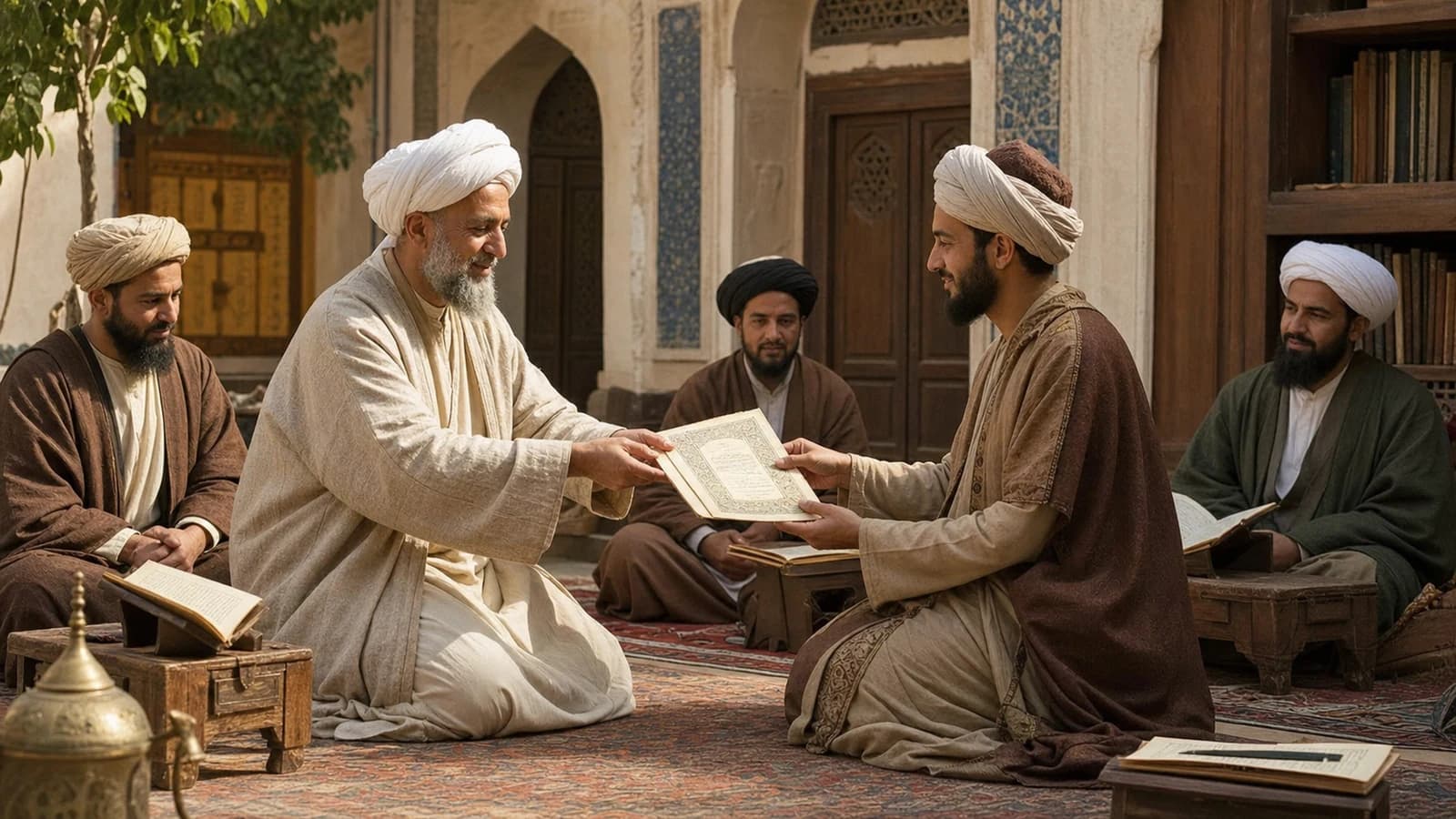
The header image was created with AI assistance as an editorial illustration. Use the linked repository images, shelf marks and catalogue descriptions when identifying a historical ijaza.


