Madrasa: How Islamic Colleges Joined Teaching and Residence
What madrasas taught, how endowments sustained them, and why student cells, courtyards and iwans never formed one universal architectural plan.
A madrasa is an institution of learning, especially associated historically with advanced Islamic study. The same word can also describe the building that housed teaching, resident students, worship, books and administration. Because institutions and buildings varied widely, translating every madrasa simply as “seminary” or identifying one only by a courtyard plan can mislead.
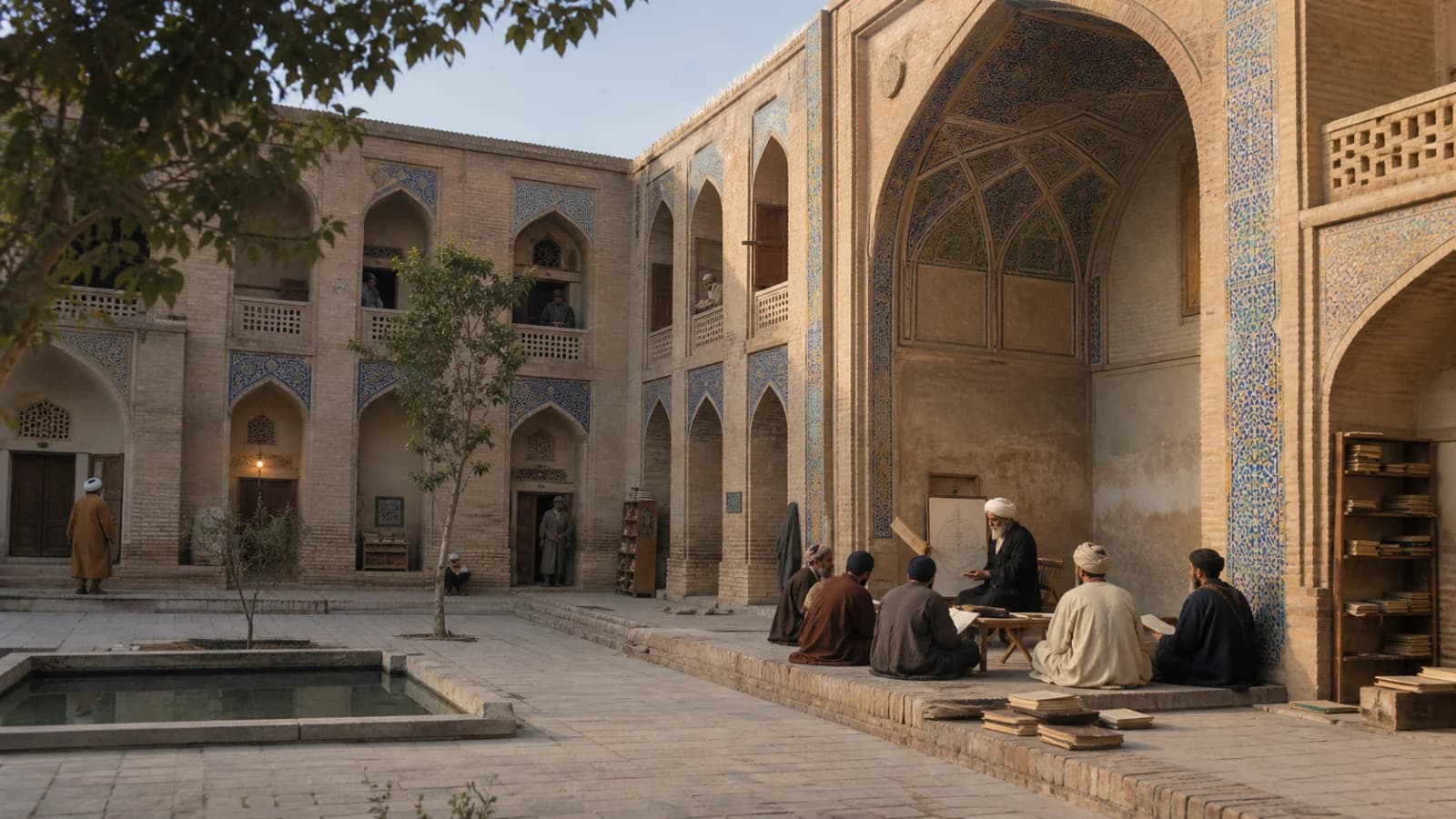
The cover image is an original AI-assisted historical reconstruction, not a photograph of a specific madrasa.
Teaching was organized around people, not only rooms
Study centered on teachers, texts, recitation, commentary, debate and the authorization to transmit knowledge. Law and its methods were prominent in many madrasas, but curricula could also include Arabic grammar, hadith, Qur’anic studies, logic, mathematics and other subjects depending on place, period, teacher and patron.
Not all learning took place in madrasas. Mosques, homes, libraries, hospitals, courts and scholars’ circles also supported education. Nor did the emergence of the madrasa create one centralized university system with standardized degrees. Institutional comparison must respect different legal and scholarly traditions.
Endowment and daily life
Many madrasas were supported by a waqf, a charitable endowment whose deed could specify salaries, maintenance, food, student places, teaching appointments and the use of attached property. The deed’s terms and actual practice did not always remain identical. Political change, repair costs and control of revenue could reshape an institution.
Resident cells made study an everyday rhythm rather than an occasional lecture. Heating, water, light, food, sanitation and access to books mattered as much as the monumental portal. A beautiful façade reveals patronage and urban presence, but not by itself what was taught inside.
There is no single madrasa plan
In Iran and Central Asia, a courtyard with one or four iwans and rows of student cells became important. Archnet describes the seventeenth-century Shir Dar Madrasa as a residential school with two storeys of cells around a central court; several iwans served as open classrooms. Ottoman madrasas often placed domed cells and a larger classroom around a porticoed court. In Cairo, madrasas could be compressed into dense urban and funerary complexes.
Some included a mosque, tomb, library or service rooms; others did not. The function of a particular chamber must be established from plans, fittings, inscriptions and documents rather than from symmetry alone.
How to read a madrasa
- Separate the educational institution from the surviving building.
- Identify student cells, teaching spaces, prayer areas and circulation from evidence.
- Read the foundation inscription or waqf deed where available.
- Ask who taught, who studied and how they were supported.
- Track rebuilding and later uses before assigning every room an original function.
The madrasa joined architecture to a chain of human transmission. Courtyards and cells mattered because they gave teachers, students and books a durable setting—not because one plan defined all Islamic education.
Sources
- Archnet: Shir Dar Madrasa — teaching institution, student cells and courtyard iwans.
- Archnet: Yeşil Medrese — Ottoman courtyard, study hall and residential spaces.
- Archnet: Madrasa-i Ghiyathiyya — four-iwan organization, chambers and environmental design.
- Archnet: Atik Valide Külliyesi — Ottoman cells, classroom and daily amenities.
Related reading
- What is an iwan?
- How waqf endowments worked


