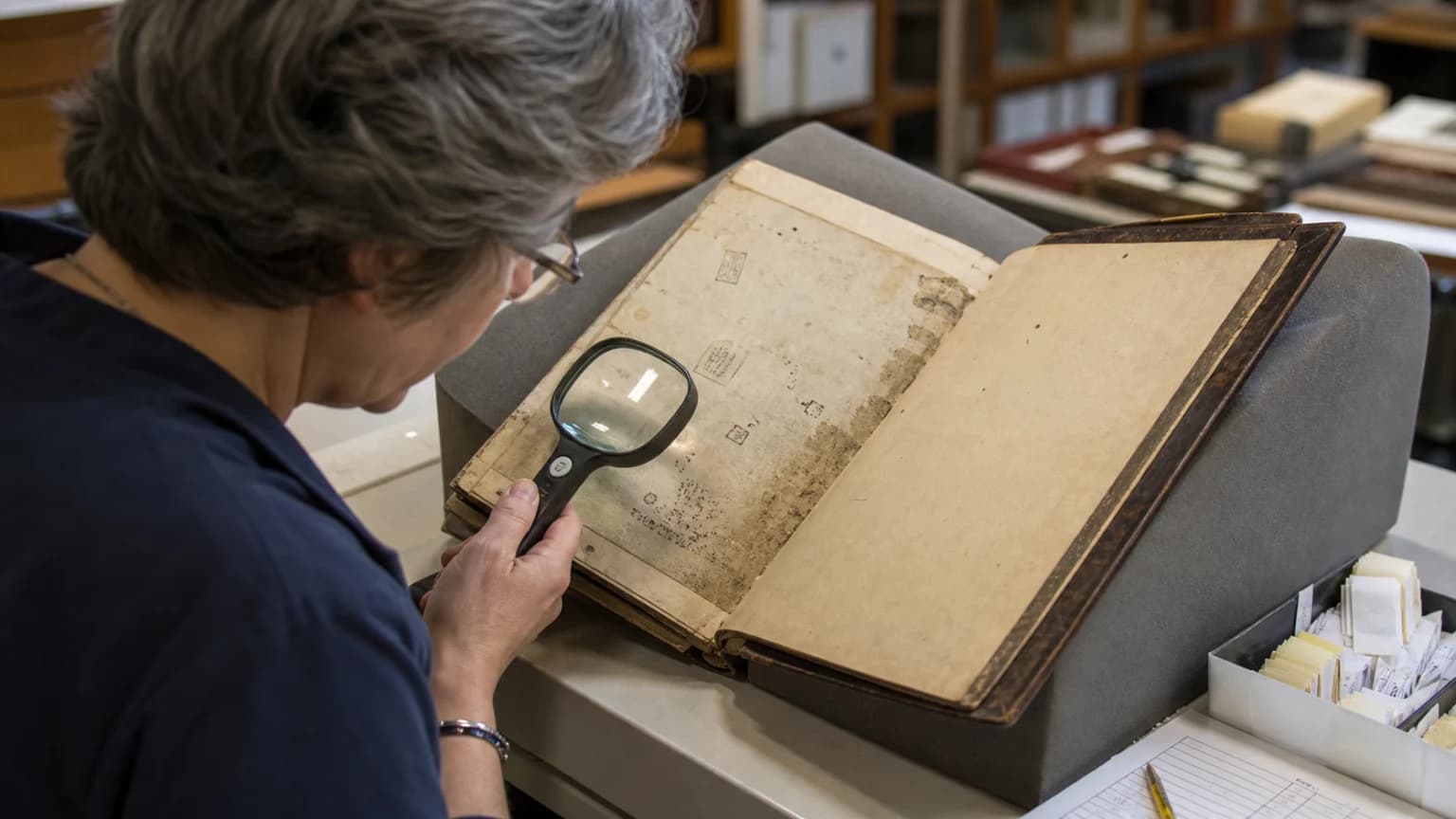
How to Trace an Islamic Manuscript: Colophons, Waqf Notes and Provenance
A practical research guide to colophons, ownership marks, waqf statements, seals, bindings, catalog records and responsible digitization.
A manuscript rarely tells its whole history in one place. The main text may preserve an author's work, while the final folio, margins, flyleaves, binding and library record preserve clues about the people and institutions that copied, owned, endowed, repaired, sold or catalogued the volume.
Provenance is the documented chain of custody and movement. It is built by connecting evidence, not by treating one stamp or attractive binding as proof of an uninterrupted story.
Begin with the colophon
A colophon at the end of a text may name the scribe, patron, place and date of copying. It can also contain prayers, corrections or statements about the exemplar. Record the wording and physical position before translating it.
Not every manuscript has a colophon, and not every colophon belongs to the volume in its current form. Leaves can be replaced, texts rebound together or copied from an earlier exemplar whose date was repeated.
Read ownership and waqf evidence in layers
Ownership notes, ex-libris statements, seals and waqf inscriptions may show later custody. A waqf note can identify an endowed collection and conditions of use, but it must be read with the seal, handwriting, ink, placement and institutional history.
Marginal reading notes, prices and inheritance statements can reveal circulation outside elite libraries. Photograph recto and verso, keep scale and colour reference, and preserve the relationship between each mark and the page.
The object itself is evidence
Paper, watermarks, ruling, pigments, sewing, endbands and binding structures can support or challenge a written date. A luxurious later binding does not prove the text was produced for the same patron or in the same century.
Compare current and historical catalogues, accession registers, dealer descriptions and digitization metadata. Catalogue language may repeat older errors, so record which claim comes from which record.
- Transcribe and photograph colophons before interpretation.
- Treat seals, ownership notes and waqf marks as separate evidence layers.
- Compare textual clues with paper, binding and conservation evidence.
- Document gaps in custody instead of inventing a continuous chain.
Digitization should preserve context
A useful digital record includes covers, flyleaves, blank pages, scale, foliation and colour reference—not only decorated openings. Communities connected to displaced or sacred collections should be part of decisions about description, access and reuse.
Sources
- Library of Congress: Qur'anic Fragments — Discusses colophons, ownership evidence, scripts and the risks of remounting or misattribution.
- Library of Congress: Islamic Manuscripts from Mali — Provides collection and digitization context for West African Islamic manuscripts.
- Library of Congress: Conservation of a Rumi Manuscript — Shows how material and conservation evidence contribute to manuscript understanding.
- Princeton University Library: The al-Madani Library — Provides a collection-level provenance and digitization case study.
- British Library: Middle Eastern Collections — Provides institutional context for cataloguing and access to Middle Eastern manuscripts.
- The Metropolitan Museum of Art: Paper Conservation Studio — Explains material examination and conservation evidence, including Islamic manuscript leaves.


