How Sizing and Burnishing Prepared Islamic Manuscript Paper
A material guide to āhār sizing, stone and glass burnishing, paper fibres, workshop order, visual evidence and conservation risks in Islamic manuscripts.
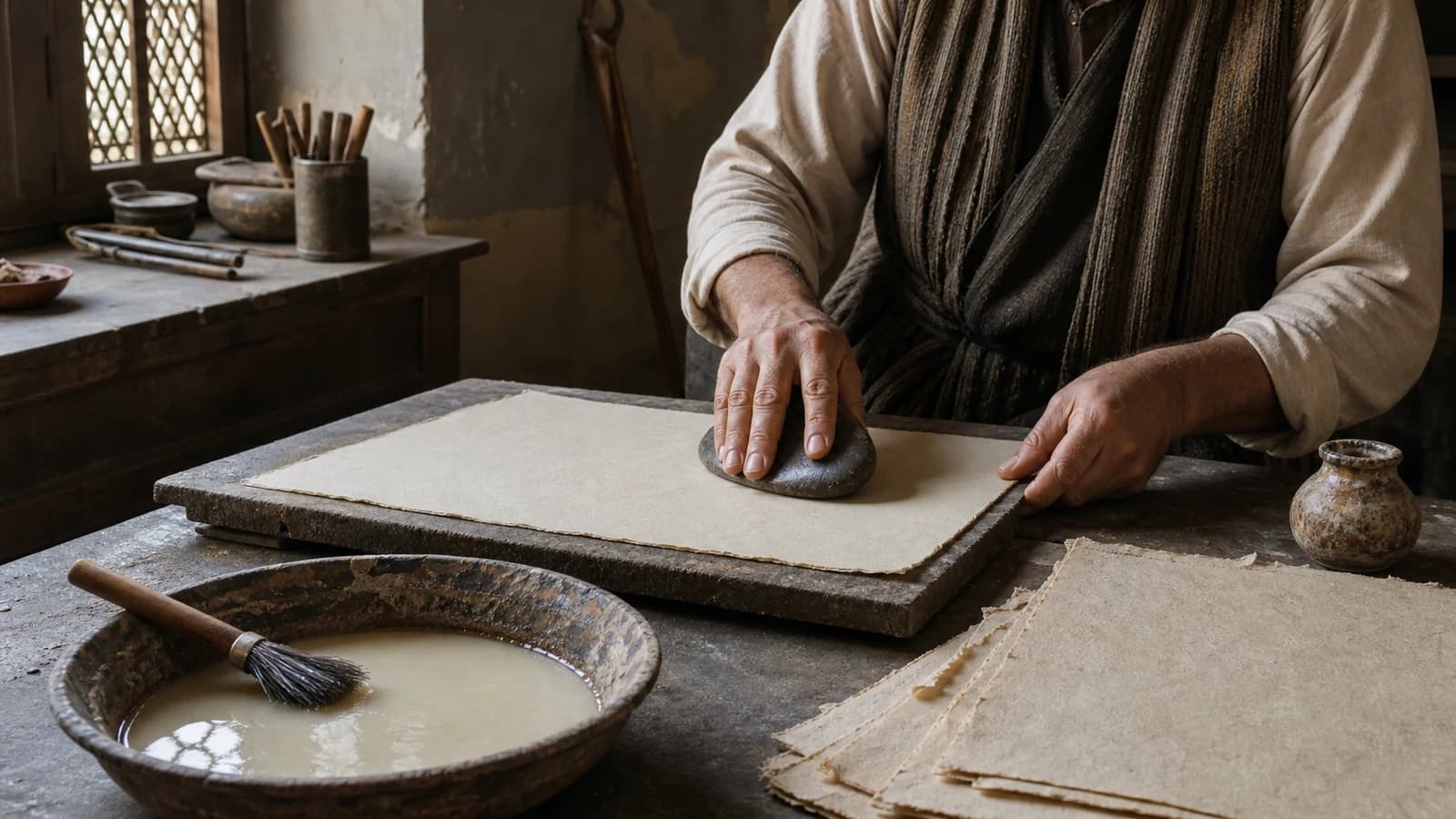
How sizing and burnishing prepared Islamic manuscript paper can be stated simply: sizing placed a controlled, often starch-based barrier in or on an absorbent sheet, while burnishing compressed and polished the surface with a hard, smooth tool. Together they could keep ink nearer the surface, reduce feathering, sharpen a reed pen's stroke and create the sheen associated with many calligraphic and painted pages. They were separate operations, however, and neither a glossy photograph nor a historical recipe can prove what was used on a particular folio. “Islamic paper” also names a broad manuscript tradition, not one fibre recipe, one workshop sequence or one universally used coating.
The short answer in five distinctions
- Sizing is not burnishing: sizing changes how liquid meets the sheet; burnishing changes the surface mechanically.
- Āhār is not one formula: the term can refer to a prepared coating or the practice of applying it, but recipes varied by place, period and intended use.
- Smooth does not mean modern: a hand-made rag sheet can become remarkably even and reflective after coating and repeated polishing.
- Gloss is not a material identification: visual examination can suggest treatment, but microscopy and analysis are needed to identify components reliably.
- There was no single production order: paper might be prepared before writing, while gold, pigments or later mounting could introduce additional polishing stages.
What sizing changed at the fibre surface
Unprepared paper contains a network of cellulose fibres and voids that draws a water-based liquid inward. A sizing material can penetrate that network, remain concentrated at the surface, or do both, depending on its viscosity and method of application. The result is not waterproof paper. It is a change in the rate and pattern of wetting. A calligrapher gains time for the ink to sit as a defined stroke instead of spreading immediately along fibres.
This distinction matters when describing historical sheets. “Internally sized” refers to material introduced into the pulp or fibre mass; “surface sized” refers to a treatment applied after sheet formation. A manuscript page may also have more than one layer, such as a coloured preparation beneath a clearer coating. Without examination, it is safer to say that the surface appears prepared than to assert that a particular substance fills every pore.
Burnishing was a mechanical operation
Burnishing pressed and rubbed the dry or conditioned sheet against a firm support with a smooth tool. Institutional descriptions mention polished stones, stone pestles, glass balls, agate and rock crystal. Pressure flattened projecting fibres and levelled irregularities in the coating. Repeated passes could produce a denser, glossier face and a more predictable path for the cut edge of a qalam.
The process did not simply make a page attractive. A smoother contact zone changes friction between nib and support, helping the scribe control thick and thin strokes. It can also make corrections by careful scraping or lifting more feasible because less colour has penetrated deeply. Yet excessive pressure, uneven support or polishing over brittle layers can create damage. The historical craft operation and a conservator's intervention are therefore not interchangeable.
What āhār means and why one recipe cannot define it
Āhār, also written ahar, occurs in discussions of Persianate and Ottoman paper preparation. In practice it may denote a sizing or coating mixture and, by extension, the prepared surface. A translated Persian technical account preserved by the Smithsonian describes starch combined with sirish adhesive, strained and spread onto lightly moistened paper before the sheet is polished on a clean board. This is valuable evidence for a documented procedure, not a universal recipe for every Arabic, Persian, Ottoman, South Asian or Southeast Asian manuscript.
Other written traditions and modern craft accounts mention different starches, gums, glues and proteinaceous ingredients. The names themselves may be unstable in translation. “Starch” does not establish whether wheat, rice or another plant was used; “gum” does not identify a botanical source. A responsible catalogue separates the wording of a recipe, the place and date of the manuscript containing it, and the analytical result from the object being catalogued.
The underlying paper was not one uniform material
Many papers used across the Middle East and Central or South Asia were made from processed linen, hemp or cotton rags, but raw material, fibre preparation, mould construction, drying and finishing varied. Imported sheets also entered workshops through trade. In later periods, European paper with watermarks circulated widely in Muslim societies. A smooth surface therefore says little by itself about where the sheet was made.
The category becomes still broader in Southeast Asia. A British Library catalogue, for example, describes a Javanese manuscript support made from dluwang, a beaten bark material, and records its burnished surface. That object is a useful warning: burnishing is a technique, not proof of rag paper. Fibre identification, laid or chain lines, sheet dimensions, watermarks, joins and local terminology must be recorded independently.
How sizing affected carbon ink, iron gall ink and paint
Carbon ink consists of fine particles held in a binder. On a well-prepared surface, much of that dark material remains close to the top and produces a crisp, dense line. A poorly controlled or degraded surface can allow feathering, abrasion or loss of particles. Iron gall ink behaves differently because soluble components penetrate and chemically interact with cellulose; a smooth sheet cannot eliminate the corrosion risks associated with some formulations.
Opaque watercolours and gold introduce additional interfaces. Pigment must adhere to the prepared page, sometimes through its own binder or an applied ground. A highly polished support may aid minute painting but can also present adhesion challenges if coating, paint and later handling respond differently to moisture. Material claims should therefore distinguish writing ink, ruling ink, opaque colour and metallic decoration rather than treating every mark as “ink.”
A likely workflow without pretending it was universal
- The papermaker formed and dried a sheet, or a workshop acquired paper through a merchant or storehouse.
- The sheet was selected, cut, paired or otherwise prepared for its intended manuscript format.
- A size or coating was mixed, strained and applied according to a local recipe.
- The treated sheet dried or was conditioned so that it could be polished without sticking or tearing.
- The surface was burnished on a clean, resistant support, sometimes on both faces.
- Margins, columns and lines were planned or ruled; the calligrapher then wrote the text.
- Illumination and painting followed the workshop's division of labour, with further smoothing or burnishing possible around gold and decorated passages.
- Leaves were gathered, mounted, trimmed and bound, or later remounted in albums.
This is a working sequence assembled from technical texts and surviving objects. It should not be turned into a rigid template. A royal kitabkhana could divide labour among paper preparers, rulers, calligraphers, illuminators, painters and binders. Reuse, repair, album mounting and later rebinding could alter the order and obscure the original edges.
Ruling came after surface preparation in many workshop contexts
Ruling organised writing blocks, columns and borders before text or decoration occupied the page. Lines might be drawn in ink or colour, impressed without pigment, or transferred with a ruling board. The Metropolitan Museum's seventeenth-century Iranian board preserves strings arranged so that dampened paper pressed against them would receive raised guidelines. The object makes the planning stage materially visible.
Ruling evidence should be read in raking light as well as direct light. A blind line may disappear in a flat scan, while later trimming can remove the outer frame. The order of ruling and writing can often be inferred where a line passes beneath or stops at ink, but a photographed crossing is not always decisive. Surface abrasion, retouching and digital contrast may conceal the sequence.
Calligraphy depended on the partnership of page, ink and qalam
A prepared surface did not create fine calligraphy automatically. The reed's species, maturity, cut angle, nib width and slit affected ink delivery; the hand controlled pressure, rotation and pace; the ink's binder and concentration affected flow. Sizing and polishing made those variables more repeatable by reducing unexpected absorption and surface drag. They are best understood as part of a writing system rather than as decorative finishing alone.
This is why a manuscript study should connect paper evidence to script and tool marks. A broad, crisp stroke may be consistent with a cut reed pen on a prepared sheet, but it cannot identify a recipe. Readers can compare the page surface with our guides to cutting a qalam reed pen, major Arabic calligraphic scripts and carbon, iron gall, red and gold manuscript inks.
Painting and gilding could add new burnished layers
In an illustrated manuscript, preparation continued beyond the blank writing surface. Gold might be applied as leaf or powdered metal with a ground or binder and then polished to increase reflection. Opaque paint layers could be compacted or locally worked. The Met's description of book production between 1600 and 1800 places burnished paper within a wider sequence of calligraphy, painting, illumination and binding, while its teaching resource notes later burnishing of gilded passages with agate or rock crystal.
Consequently, the phrase “the page was burnished” can hide several events. The paper may have been polished before writing; selected gold may have been burnished afterward; an album border may belong to a later workshop. Compare these layers with the production of Qur'an illumination and gold page design, the Safavid evidence in Shah Tahmasp's dispersed Shahnama, and Ottoman imperial manuscript painting.
What can be seen with the eye and what requires analysis
Begin with non-invasive observation. Under normal light, record colour, gloss, cockling, stains, abrasions and differences between recto and verso. Raking light can reveal polishing direction, compressed zones, blind ruling and raised paint. Transmitted light may show fibre distribution, laid and chain lines, watermarks, repairs or laminated sheets. Magnification can distinguish exposed fibres from a continuous coating and show whether ink sits on top or has spread into the sheet.
These observations support hypotheses, not chemical identifications. Reflected gloss may result from burnishing, a coating, pressure during binding, later mounting or photography. Analytical methods such as microscopy, spectroscopy and chromatography may identify starch, protein, gum, pigments or degradation products, but sampling carries ethical and practical limits. A catalogue should state the method and uncertainty: “surface preparation visible in raking light” is different from “wheat starch identified by analysis.”
Why the familiar paper-origin story needs restraint
Paper technology moved westward from East and Central Asia and became established in Abbasid territories by the early Islamic centuries. The old story that prisoners captured at the Battle of Talas in 751 suddenly taught an otherwise unknown craft is too neat to explain a long technological transfer. Surviving objects, administrative demand, trade, artisan mobility and regional workshops point to adoption and adaptation over time rather than one dramatic handover.
Nor did paper immediately replace every other support. Parchment continued in use, papyrus remained important in some documentary settings, and local supports persisted. Once paper became widespread, craftspeople adjusted fibre preparation, sizing, polishing, format and decoration to different markets. The Smithsonian's history of paper in the Islamic world is useful here because it links rag-paper production with surface treatment without reducing the entire history to a single date.
Regional labels should follow evidence, not sheen
Words such as Persian, Arab, Ottoman, Mughal or Javanese describe different combinations of geography, language, polity, workshop and later cataloguing. They are not interchangeable material recipes. A sheet used in Istanbul might have been imported; a Persian text might have been copied in India; a European watermarked paper could carry Arabic-script writing; a Javanese manuscript might use burnished bark support.
Attribution should combine colophon, script, orthography, decoration, paper structure, dimensions, watermarks, pigments, binding and provenance. Surface gloss can join that evidence but should not lead it. This method also helps separate a complete codex from later albums assembled with cut calligraphy, paintings and new border papers. For the workshop setting, see how a royal kitabkhana coordinated manuscript production.
Conservation risks arise at the boundaries between layers
Prepared manuscript paper is a layered system whose components may react differently to humidity, water and handling. A starch or gum-rich surface can swell, soften, stain or attract biological activity under poor conditions. Burnished fibres may retain folds or become brittle at heavily compressed areas. Paint and gold can crack or flake where their binder loses adhesion or where the support moves beneath them.
The Smithsonian conservation project on Islamic folios documents the difficulty of stabilising burnished paint layers and metallic decoration. The Library of Congress treatment record for an Islamic binding likewise shows that even historically informed burnishing belongs within a documented conservation plan. Owners should not test a suspected size with water, rub a dull passage to “restore” gloss, apply household starch, or flatten a cockled folio under weight. Condition photography, stable storage and a qualified paper conservator come first.
A checklist for cataloguing a prepared manuscript page
- Identify whether the support is paper, parchment, bark material or a laminated construction.
- Record both faces under normal, raking and transmitted light where safe.
- Describe gloss and surface texture without turning appearance into a chemical claim.
- Separate evidence for sheet sizing, surface coating, paper burnishing and polished gold.
- Name the analytical method whenever a material such as starch, gum or protein is identified.
- Document laid lines, chain lines, watermarks, fibre distribution, sheet edges and repairs.
- Relate ruling, writing, paint, gold, mounting and binding through observed overlaps.
- Cite the exact recipe manuscript if using āhār terminology, including date and region.
- Keep manufacture, place of use, text language and present provenance as separate fields.
- Record uncertainty and avoid treatment advice based only on an online image.
Related reading
- How the qalam's cut nib controls a calligraphic stroke — The writing tool that interacted directly with the prepared page.
- How Islamic manuscript inks differ — Why carbon particles, iron gall compounds and metallic decoration do not behave alike.
- How Qur'an illumination organised gold, pigment and reading — Page design after the support was prepared.
- How Shah Tahmasp's Shahnama was made and dispersed — A large Safavid project with calligraphy, painting and gold-sprinkled paper.
- How Ottoman miniature painting worked — A comparison of court workshop roles and manuscript layers.
- What material evidence reveals about the Blue Qur'an — A reminder that parchment and paper require different technical histories.
Sources
- Smithsonian Libraries, When the Middle East Met the West — The institutional history supports the discussion of rag paper, plant-starch sizing and polishing with stone pestles or glass balls while placing these practices in the wider movement of papermaking.
- Smithsonian National Museum of Asian Art, Calligraphers and Painters — Translated Persian technical instructions document one specific āhār procedure using starch and sirish, application to lightly moistened paper and polishing on a clean board.
- Smithsonian conservation research on Islamic folios — The conservation project supplies evidence for the adhesion, cracking and flaking problems encountered in layered and burnished manuscript surfaces.
- Metropolitan Museum of Art, The Arts of the Book in the Islamic World 1600–1800 — The museum overview links linen- and hemp-rag paper, hard-stone or glass burnishing, calligraphy, painting, illumination and binding in workshop production.
- Metropolitan Museum of Art, Board for Ruling Paper — This catalogued Iranian tool explains how strings on a board could transfer raised guidelines to damp paper before writing and decoration.
- Library of Congress, Islamic Partial Leather Rebinding and Conservation — The treatment record documents smooth-stone burnishing within a controlled conservation workflow and helps distinguish professional treatment from informal repolishing.
- British Library Archives and Manuscripts, Add MS 12312 — The catalogue's identification of burnished Javanese dluwang provides an object-based counterexample to the assumption that every polished Islamic manuscript support is rag paper.
- British Museum, painting on handmade wasli paper — The object record describes a South Asian support made by joining fine sheets and polishing them to a highly burnished finish, illustrating a distinct regional construction.


