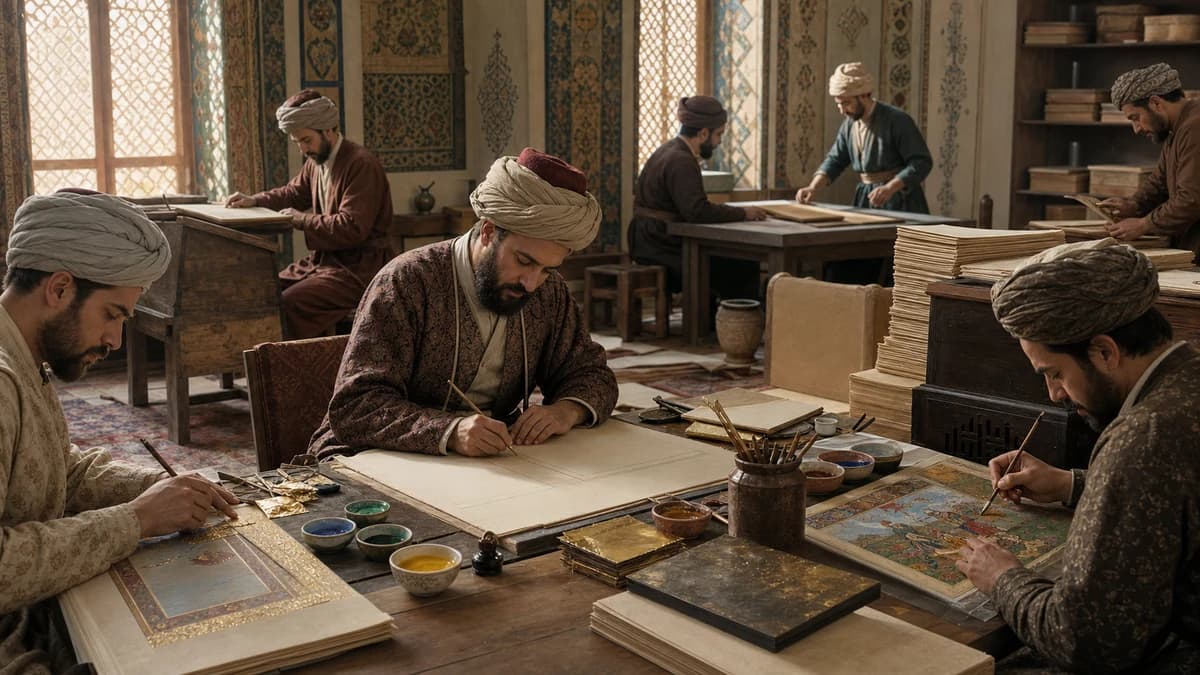
How Shah Tahmasp's Shahnama Became a Dispersed Safavid Masterpiece
A folio-by-folio guide to Shah Tahmasp's Shahnama, its 258 paintings, Tabriz workshop, 1568 Ottoman gift, Houghton breakup, 1994 Tehran return and dispersed pages.
The Shahnama made for Shah Tahmasp is a monumental sixteenth-century Safavid copy of Ferdowsi's Persian Book of Kings. Produced at Tabriz over more than a decade, it originally combined 759 folios of Persian verse with 258 paintings, gold-sprinkled paper, illumination and binding. Its precise starting patron is debated, but the project flourished under Tahmasp I. The complete codex travelled to the Ottoman court as a diplomatic gift in 1568, acquired Ottoman annotations, entered the Rothschild and Houghton collections, and was broken apart in the twentieth century. Today its paintings and text leaves are divided among Tehran, museums and private collections. A detached page is therefore both a Safavid artwork and evidence of a manuscript whose sequence was materially disrupted.
Key facts about the manuscript
- Text: Ferdowsi's Shahnama, an epic of Iran's legendary and historical kings completed around 1010.
- Production: Tabriz, principally from the 1520s into the 1530s, with some scholarship extending work into the early 1540s.
- Scale: 759 folios and 258 paintings in the complete manuscript, with large leaves approximately 47 by 32 centimetres.
- Patronage: possibly initiated under Shah Ismail I and continued as a defining court project under his son Shah Tahmasp I.
- Diplomatic transfer: presented to the Ottoman sultan Selim II by a Safavid embassy that reached Edirne on 21 February 1568.
- Present condition: dispersed; 78 paintings are at the Metropolitan Museum of Art, 118 remained with the text block returned to Tehran in 1994, and other folios are in public and private collections.
What the Shahnama is and what this copy is not
Ferdowsi's poem narrates a vast history of Iranian kingship from creation and legendary rulers through heroic cycles and the fall of the Sasanian dynasty. It existed in many manuscripts, recitations and later editions. “The Shah Tahmasp Shahnama” names one particular illustrated copy, also called the Shahnama-yi Shahi or Houghton Shahnama. It is not Ferdowsi's original manuscript, and a page from another Shahnama does not belong to it merely because the episode or painting style looks similar.
Identification depends on codicology and provenance: folio dimensions, paper and ruling, Persian script, text position, painting technique, old folio numbers, inscriptions and a documented ownership chain. Museum catalogues describe a detached leaf as “from the Shahnama of Shah Tahmasp” only after relating these features to the dispersed codex. Search images often omit the recto, verso and text around a painting, but those parts can be crucial to locating the leaf in the epic.
When production began and why the patron remains debated
The manuscript is generally dated from the 1520s through at least the 1530s. One proposal makes Shah Ismail I, founder of the Safavid dynasty, the initiating patron before his death in 1524; another emphasizes Tahmasp, who succeeded as a child and became deeply involved in the arts of the book. The evidence does not preserve a simple commission contract naming a single start date. Museum records therefore use careful formulations such as “possibly begun under Ismail” and “completed for Tahmasp.”
One painted folio, number 516, carries a date of 934 AH, equivalent to 1527–28 CE. It anchors that leaf, not the completion of all 759 folios. Stylistic groupings and the careers of participating artists show that the project extended across changing personnel and phases. Statements that the whole manuscript was “made in 1527” confuse the only dated painting with a production campaign lasting more than a decade.
A royal workshop made the book collectively
A manuscript this large required calligraphers, painters, designers, illuminators, gold sprinklers, paper specialists, margin rulers and binders. Three successive supervisors and artists associated with different regional traditions are named in modern scholarship. Sultan Muhammad, Mir Musavvir, Aqa Mirak and Dust Muhammad are among the best-known figures, but workshop practice did not require every participant to sign every task. A composition could pass through design, drawing, colour and finishing stages.
Attribution is consequently an argument based on style, documentary notes and comparison rather than a complete payroll. UNESCO's history of Safavid book arts notes that only two paintings bear old attribution notes naming artists, while most assignments were reconstructed by scholars. “Attributed to Sultan Muhammad” is not the same as “signed by Sultan Muhammad.” That distinction protects both the collaborative character of the object and the uncertainty around individual hands.
How 759 folios and 258 paintings worked together
The leaves were large, written in fine nasta'liq script and set within coloured, heavily gold-sprinkled margins. Paintings do not form a uniform rectangular series. Each composition negotiates with the text columns differently: some remain bounded by written areas, while others interrupt columns or expand into margins. Opaque watercolour, ink, gold and sometimes silver created layered surfaces whose scale and reflective effects are hard to reproduce on a phone screen.
The count of 258 refers to paintings, not 258 pages in the entire book. A folio has two sides, recto and verso, and may carry only text, text plus an illustration, or decorated headings. Museum descriptions sometimes count illustrated folios while collection summaries count paintings, which can produce apparent discrepancies such as 76 or 77 donated folios containing 78 paintings. A reliable inventory records the unit being counted.
The paintings interpret legendary Iran through Safavid visual culture
The images do not attempt archaeological reconstruction of Iran's mythical kings. Heroes and courtiers appear in sixteenth-century clothing, armour, architecture, gardens and courtly settings. This visual translation made Ferdowsi's past legible to Safavid viewers and linked ideal kingship, ceremony, conflict and moral choice to the world of Tahmasp's court. It is evidence for Safavid material culture as well as an interpretation of the poem.
Landscape is active rather than decorative. Rocks, trees, animals, tents and crowds establish hierarchy, conceal action or guide the eye toward a narrative centre. A reader should first identify the episode and the surrounding verse, then ask what the painter selected, combined or altered. Isolating the image from its text can turn an interpretive scene into a generic “Persian miniature” and erase why it occupied that position in the book.
The Court of Gayumars shows why attribution needs evidence
The celebrated Court of Gayumars, now at the Aga Khan Museum, depicts the first king enthroned in a mountain setting surrounded by courtiers, animals and densely observed vegetation. It is attributed to Sultan Muhammad, a leading Tabriz painter connected with the royal library and Tahmasp's artistic education. The attribution is highly influential, but museum wording still signals that it is an attribution rather than a surviving signature on the face of the work.
The page also demonstrates why reproductions flatten the object. Minute figures, patterned garments and gold details invite close viewing, while text panels connect the court assembly to Ferdowsi's narrative. Its fame should not make it a stand-in for all 258 paintings. Different workshop phases display different compositional habits and artistic lineages, including the meeting of Herat and Tabriz traditions.
The 1568 embassy turned the codex into a diplomatic object
Contemporary Ottoman and European reports place the Safavid embassy's arrival in Edirne on 21 February 1568. The delegation brought 34 camels bearing gifts for Sultan Selim II. An Ottoman account explicitly describes a sumptuous Shahnama made in Shah Tahmasp's name, although it records 259 miniatures rather than the accepted 258. This near-contemporary inventory is stronger evidence than a later romantic story about why the gift was chosen.
The gift marked relations between rival Muslim empires after Selim's accession. It could display Safavid resources, literary authority and workshop excellence while participating in diplomatic etiquette. The exact motives remain open to interpretation. It is safer to say the manuscript functioned as a royal diplomatic gift than to claim it was an apology, peace treaty or personal rejection of painting without direct documentation.
Ottoman readers added another layer around 1800
The manuscript remained in the Topkapi Palace library for centuries. Around 1800, Ottoman Turkish descriptions and commentaries on its paintings were inserted into the codex. These additions show continued reading and curatorial interest rather than passive storage. They also make the object a history of reception: Persian verse and Safavid pictures were interpreted within a later Ottoman court environment.
An insert is not part of the original sixteenth-century production merely because it travelled inside the same binding. Conservators and cataloguers distinguish paper, hand, language and date so that later reception is not mistaken for the Safavid workshop. Digital reconstruction should preserve that layered history by labelling additions rather than silently removing them or presenting every leaf as contemporaneous.
How the complete manuscript entered modern collections
By 1903 the codex was in the collection of Edmond de Rothschild. A descendant sold it in 1959 to Arthur A. Houghton Jr. In 1970, Houghton gave illustrated folios to the Metropolitan Museum during its centennial; institutional accounts describe 78 paintings on 76 or 77 illustrated folios, depending on how the leaves are counted. Individual pages then entered auctions, dealers' stocks, museums and private collections.
This history created the modern name “Houghton Shahnama,” but it also marks the moment at which a bound book became a market of individual works. Detachment made specific paintings easier to display and collect. It severed text-image sequences, physical conjugates and page-turning rhythm. Provenance after 1959 is therefore not an optional appendix: it explains why a leaf is now in New York, Toronto, Washington, Berlin or another collection.
Dispersal was an intervention, not a neutral change of format
Calling the pages “miniatures” can encourage viewers to treat them as independent pictures that happened to be bound once. They were designed within a codex. Removing folios changed relationships between fronts and backs, illustrations and adjacent episodes, decorated openings and the weight of accumulated pages. It also enabled price and authorship hierarchies to reorganize a collaborative manuscript around a few famous paintings.
In 1994, the surviving text block, binding and 118 remaining paintings were exchanged with Tehran's Museum of Contemporary Art for Willem de Kooning's Woman III. That transfer returned the largest surviving body to Iran but did not reassemble the leaves already distributed. Claims that “the whole Shahnama is back in Tehran” are therefore false. The Tehran group and dispersed folios together constitute the manuscript's surviving material history.
How to verify a detached Shah Tahmasp folio
- Record the museum or collection accession number, not only a copied image caption.
- Identify the episode, folio number, recto or verso and the Persian text surrounding the painting.
- Separate a signed or inscribed name from a modern stylistic attribution.
- Check measurements, materials, script, ruling and margin treatment against codex records.
- Trace ownership from the Ottoman, Rothschild and Houghton stages to the present holder.
- State whether a count refers to paintings, illustrated folios, leaves or pages.
These checks also prevent confusion with the earlier Great Mongol Shahnama, other Safavid royal copies and later manuscripts illustrating the same episodes. A reputable object record should be specific enough that another reader can locate the same physical leaf.
What digital reconstruction can and cannot restore
A shared digital sequence can reunite high-resolution images, text locations, folio numbers and catalogue histories across collections. It lets readers compare workshop phases and follow Ferdowsi's narrative more coherently than a gallery of disconnected masterpieces. It can also expose missing leaves and inconsistent old numbering instead of pretending that the record is complete.
A screen cannot restore original binding structure, thickness, scale, reflected metal, pigment texture or the exact rhythm of turning pages. Nor can an online montage erase the legal and market histories of the detached objects. The best digital reconstruction is transparent about image sources, colour calibration, cropping and gaps. It is a research model of the codex, not the codex itself.
Related reading
- How Shah Ismail I founded the Safavid state — Political background for the possible first patron and Tahmasp's succession.
- How Safavid Iran became Twelver Shi'i — The religious and institutional setting behind Safavid royal culture.
- How Ottoman manuscript paintings were made — A comparison with the court that received the book in 1568.
- How to read the Ardabil Carpet — Another Safavid court object requiring material, inscription and provenance analysis.
- Shah Abbas I, Isfahan and Safavid silk — The later dynasty's movement of workshops, merchants and capital.
Related Muslim Post guides
- People and Animals in Islamic Art: What Museum Objects Show
- Arabesque Art Explained: Leaves, Scrolls and Repeating Patterns
- Qur’an Illumination: How Gold and Geometry Guided the Reader
Sources
- Metropolitan Museum of Art, The Shahnama of Shah Tahmasp — The museum's manuscript history supplies the 759 folios, 258 paintings, 1568 embassy evidence, Ottoman additions and its own holding of 78 paintings.
- Aga Khan Museum, The Death of Zahhak from the Shahnameh of Shah Tahmasp — The object record gives the debated commission, workshop phases, 1970 breakup and 1994 exchange of the remaining text block and 118 illustrations.
- Aga Khan Museum, The Court of Kayumars — This catalogued folio supports the discussion of Sultan Muhammad's attribution, royal-library context and the need to distinguish a museum attribution from a signature.
- Smithsonian National Museum of Asian Art, Faridun Strikes Zahhak — The detached-folio record demonstrates how recto, verso, script, dimensions, materials, patron and artist attribution are documented for one physical leaf.
- Khalili Collections, Ten Folios from the Shah Tahmasp Shahnama — The collection record explains large-format materials, the dated folio 516, collaborative production, stylistic diversity and the 1520s–1540s range.
- Fitzwilliam Museum, Qaran Slays Barman — This folio entry connects the 759-leaf and 258-image counts with the diplomatic gift, Topkapi history and twentieth-century dispersal.
- Museum for Islamic Art Berlin, A Painting from the Shahnameh — The institutional feature describes the Tabriz workshop, nasta'liq, costly pigments, artist network and the manuscript's later royal and museum history.
- UNESCO Silk Roads, Arts of the Book, Painting and Calligraphy — The scholarly chapter records the 258 miniatures, large format, gold-sprinkled margins, date range, limited old attribution notes and the 1994 return of 118 paintings to Iran.
- Museum With No Frontiers, Ten Folios from the Shahnamah of Shah Tahmasp — The cross-collection record clarifies that independent painting formats required coordination among scribes, painters and marginators and summarizes present dispersal.


