Ottoman Miniature Painting: Chronicle, Ceremony and City
How Ottoman manuscript painters documented campaigns, ceremonies, portraits and urban space through coordinated imperial workshops and selective observation.
Ottoman miniature painting developed within a manuscript culture that served history writing, dynastic ceremony, geography, biography and literature. Painters at the imperial court worked with calligraphers, authors and binders, but Ottoman visual practice was never confined to one workshop or one style.
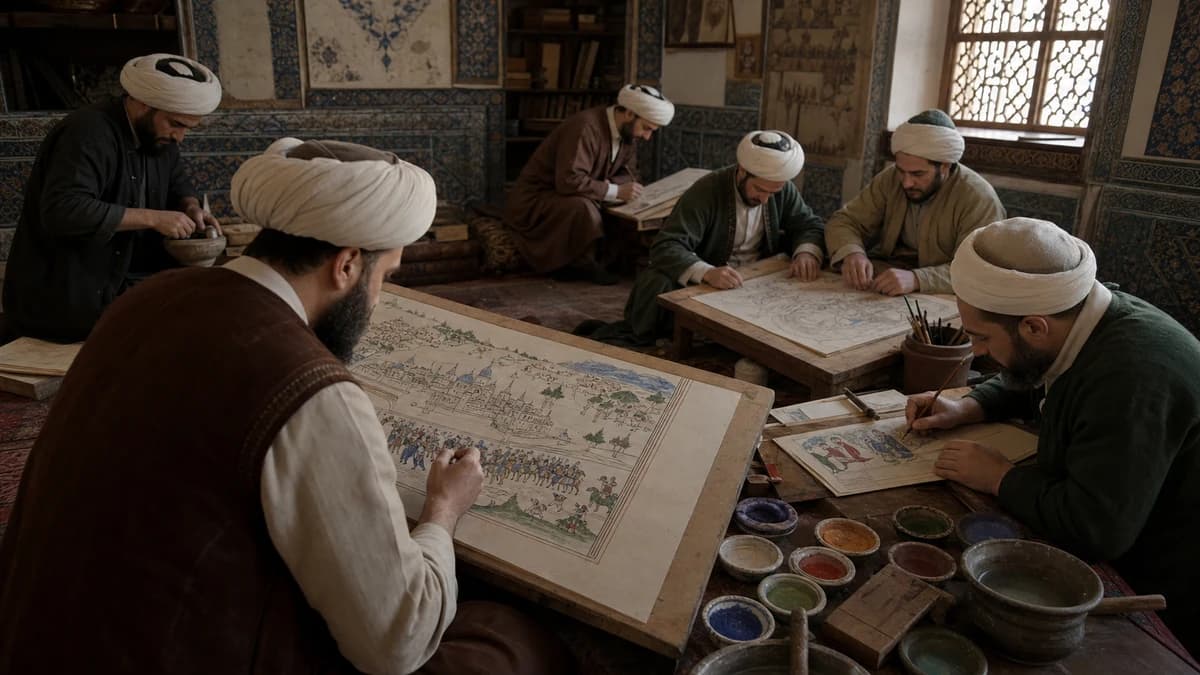
The cover image is an original AI-assisted imperial workshop reconstruction, not a reproduction of a historical Ottoman miniature.
Images made official history visible
Illustrated chronicles recorded accessions, campaigns, festivals and receptions. A painting could identify ranks through costume and position, arrange the sultan as the focus of a ceremony, or show stages of an event across a page. Its documentary value lies in selected detail, not camera-like neutrality.
Authors and patrons shaped what deserved representation. Repeated court formulas can communicate political order even when individual faces are not portraits from life.
Topography could matter more than optical perspective
Ottoman painters represented cities, roads and encampments by combining viewpoints. Important monuments may be enlarged; walls unfold so gates remain legible; a route can cross a landscape without obeying a single horizon. This is organized information, not failed European perspective.
Contacts with Persian painting, Mediterranean prints and maps enriched the visual vocabulary. Artists adapted sources to the purpose of an Ottoman book rather than merely copying a foreign style.
The workshop distributed labor
A project could involve a designer, outline painter, colorists, calligrapher, illuminator and binder. The head of a workshop or celebrated named artist did not necessarily execute every detail attributed to a manuscript. Payment registers and inscriptions help, but many hands remain anonymous.
Pigments, gold and burnished paper also changed over time. Exposure can darken silver or fade organic colors, while later repainting may sharpen damaged faces. Digital reproductions rarely convey page texture or metallic reflection.
How to read an Ottoman miniature
- Identify the manuscript’s genre and the passage beside the image.
- Read scale and position as signs of hierarchy.
- Follow routes and architecture without imposing one-point perspective.
- Distinguish a named workshop, attributed designer and documented painter.
Ottoman miniatures do more than decorate text. They structure memory by deciding which people, places and gestures become visible within the official book.
Sources
- The Met: Turkish Miniature Paintings and Manuscripts — catalogued examples and workshop history.
- The Met: The Art of the Ottomans before 1600 — imperial artistic context.
- Library of Congress: Piri Reis, Book on Navigation — an Ottoman manuscript joining text, maps and coastal observation.


