The Ardabil Carpet: Design, Inscription and Safavid Weaving
A guide to the Ardabil Carpet’s medallion, lamps, poetic inscription, dense knots and the restoration that shaped what visitors see today.
The Ardabil Carpet at the Victoria and Albert Museum is one of the most celebrated surviving Persian carpets. Dated 946 AH, corresponding to 1539–40 CE, it combines an enormous central medallion, radiating cartouches, floral fields and two hanging lamps with a signed poetic inscription. Its fame should not hide its complicated material history.
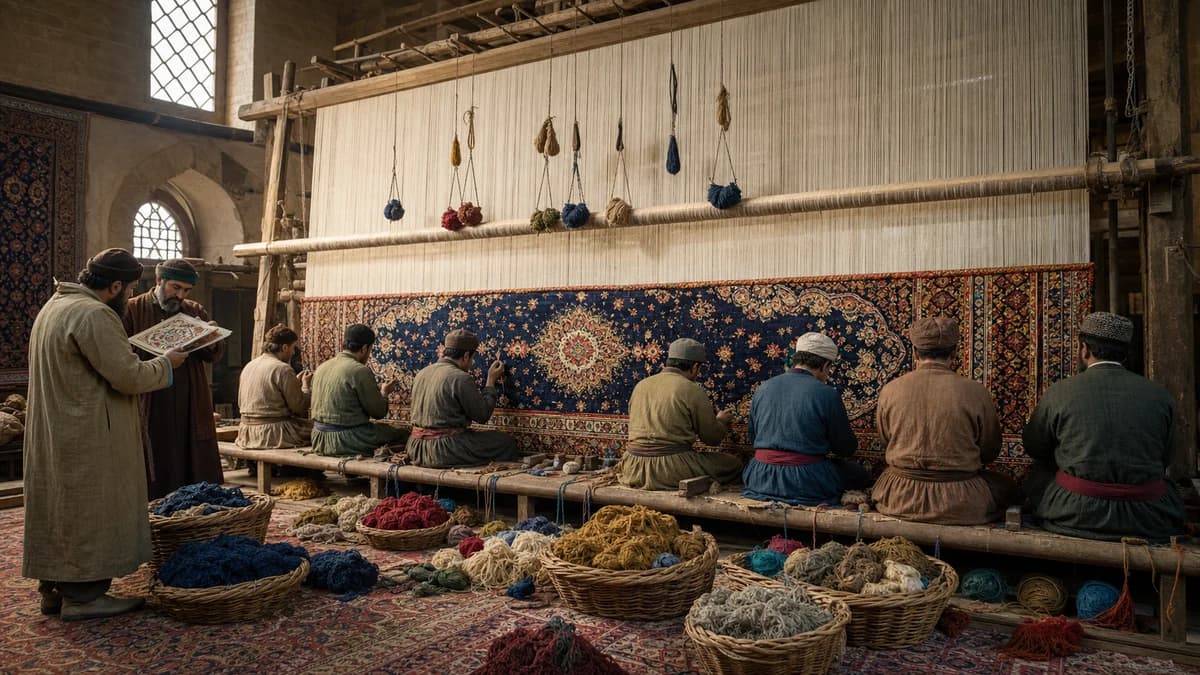
The cover image is an original AI-assisted workshop reconstruction, not a photograph or replica of the Ardabil Carpet.
A ceiling-like composition unfolds across the floor
A large yellow medallion dominates the deep blue field. Sixteen oval forms surround it, while smaller medallions mark the corners. Flowers and scrolling stems fill the ground without erasing the strong hierarchy of the center. The two lamps differ in size; their meaning remains debated, and a familiar story that perspective corrects the mismatch is an interpretation rather than a documented fact.
The design rewards two viewpoints. From a distance the geometry controls the field. Up close, color changes and small plant forms reveal the labor of knotting and finishing.
The inscription supplies a date and a named maker
A cartouche quotes a verse by the Persian poet Hafez, gives the name Maqsud of Kashan and records the year. “Maqsud” may identify the person responsible for the commission or production, but the exact role is uncertain. The carpet was a collective achievement requiring design, dye preparation, knotting and supervision.
The V&A counts roughly 26 million knots in the carpet. Such a figure conveys scale, yet knot density alone does not determine quality. Drawing, controlled tension, durable dyes and the coordination of a large workshop were equally important.
There were two related carpets
The London carpet and a companion now in Los Angeles once formed a pair. By the late nineteenth century both were damaged. Dealers used material from one to complete the other before sale, so the V&A carpet’s present edges include historical restoration. This intervention preserved a spectacular object while complicating claims about its original dimensions.
The carpets are traditionally linked to the shrine at Ardabil, but early documentation of their location is limited. Responsible interpretation separates the dated inscription from the later provenance story.
How to look closely
- Begin with the medallion and corner quarters to understand the overall geometry.
- Compare the lamps without treating an attractive theory as settled evidence.
- Read the inscription as poetry, signature and date.
- Notice restored borders and ask how conservation changed the object now displayed.
The Ardabil Carpet is not merely a masterpiece image. It is a designed surface, a record of coordinated labor and an object repeatedly altered by movement, damage and preservation.
Sources
- Victoria and Albert Museum: The Ardabil Carpet — design, inscription, manufacture and restoration history.
- Victoria and Albert Museum: Islamic Middle East Collection — broader Safavid and textile context.
- UNESCO: Sheikh Safi al-Din Khānegāh and Shrine Ensemble — the Ardabil shrine’s historical setting.


