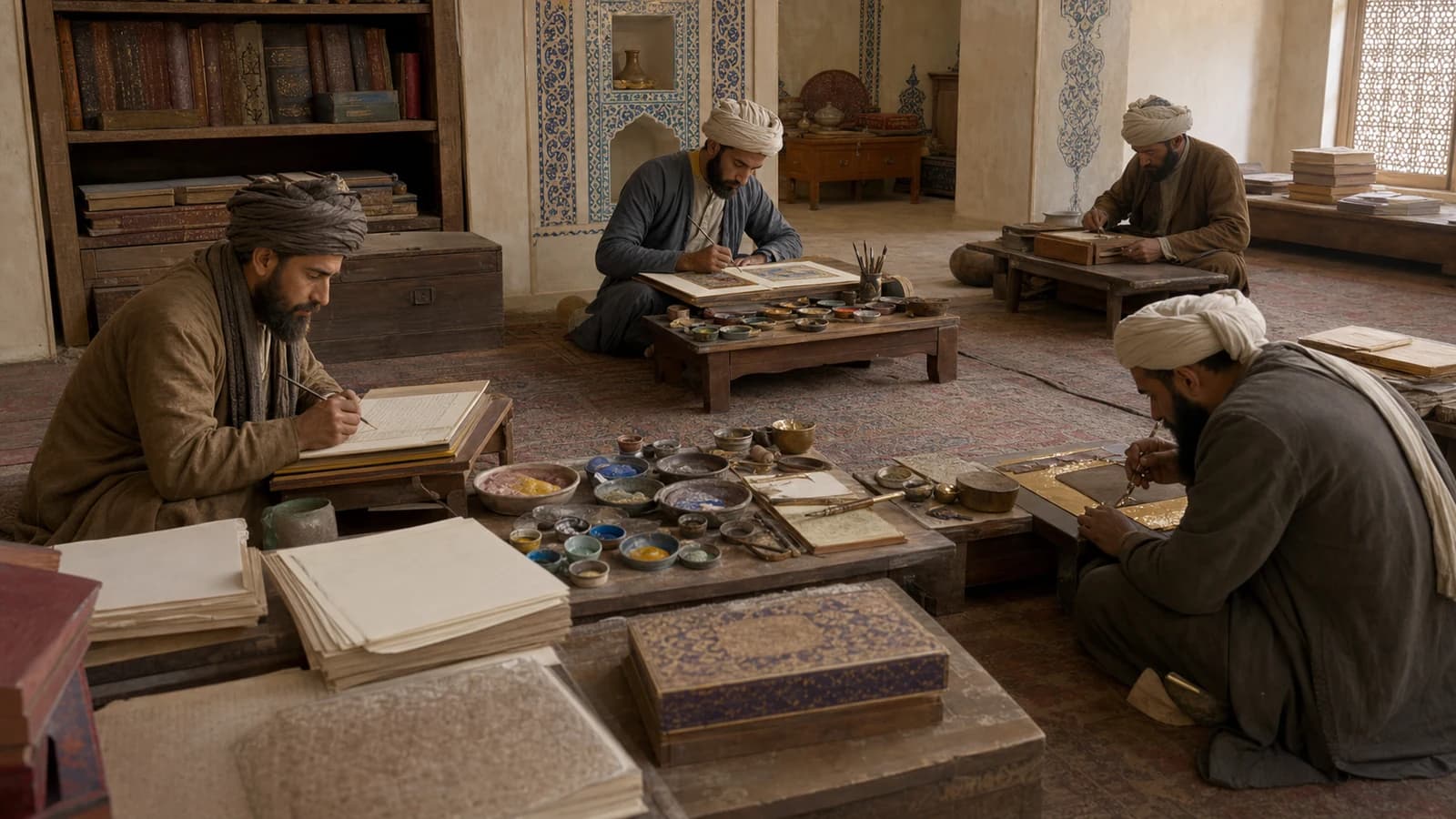
Kitabkhana: Inside a Royal Manuscript Workshop
How court libraries coordinated paper, calligraphy, painting, illumination and binding, and why a famous manuscript was usually collaborative work.
The term kitabkhana literally translates to "book house," designating a multifaceted institution within Persianate courts that functioned simultaneously as a library for holding texts and a coordinated workshop for producing manuscripts. This dual nature reflects a sophisticated administrative structure where the preservation of knowledge and the active creation of new works were integrated processes rather than separate activities.
Composition of the Workshop
Production within the kitabkhana relied on a diverse array of specialists, each contributing distinct skills to the final object. The primary creative forces included authors who composed texts, calligraphers who executed the handwriting, and painters who provided illustrations. Supporting these core artists were illuminators who decorated margins with geometric or floral patterns, margin rulers who ensured consistent line placement, and binders who assembled the finished folios.
Supervisors played a critical role in coordinating this labor, ensuring that the various stages of production aligned with the patron’s expectations. The workshop was not a monolithic entity; rather, it operated through a complex network of specialized roles that could vary significantly depending on the specific needs of the commission and the resources available at the time.
The Manufacturing Sequence
The physical creation of a manuscript followed a rigorous sequence of steps that allowed for both precision and error correction. The process typically began with the planning of quires, which are folded gatherings of paper sheets. Scribes would then copy the text line by line, often leaving deliberate blank spaces within the layout for subsequent illustrations.
Once the text was established, illuminators would add decorative elements, followed by painters who filled these designated areas with narrative images. The final stages involved correcting any scribal errors, assembling the quires into a codex, and binding the volume. Objects reveal that this timeline was rarely linear; delays in material supply or changes in artistic direction often left visible traces in the physical manuscript.
Patronage and Mobility
The nature of the kitabkhana was heavily influenced by its patron. Royal support dictated the quality of materials, such as gold leaf or fine paper, and determined the subject matter, which ranged from religious texts to historical chronicles. However, this system did not imply that every court manuscript was produced under one roof in a modern factory setting.
Artists and calligraphers often moved between different courts, carrying techniques and stylistic preferences with them. This mobility meant that the kitabkhana should be understood as a flexible network of expertise rather than a static building. The Met’s depiction of painters at work serves as a representative illustration of this environment, but it must not be interpreted as a documentary record of a specific day.
Attribution and Verification
Determining the origin of a manuscript requires careful analysis rather than assumption. Scholars rely on colophons, which are notes often found at the end of a text, to identify the scribe or patron. Stylistic analysis compares the brushwork and composition to known works, while material study examines the paper, ink, and binding techniques.
- Examine the colophon for named artists or dates.
- Analyze the script style against regional standards.
- Check the paper type for watermarks or pulp texture.
- Compare illumination patterns with documented examples.
This multi-layered approach allows historians to reconstruct the history of a book even when written records are lost. The kitabkhana was thus a dynamic engine of cultural production, where individual skill met institutional support to create objects of enduring historical value.
The cover image is an original AI-assisted court workshop reconstruction, not a photograph or exact view of one historical kitabkhana.
Sources
- The Met: Art of the Islamic World, Unit 5 — courtly manuscript production and painting.
- The Met: The Kitabkhana of the Royal Palace — object depicting stages of book production.
- The Met: Islamic Art and the Art of the Book — bookmaking, patronage and collaboration.


