Islamic Manuscript Colophons and the Evidence of Ownership
How colophons, seals, waqf notes and readers’ marks reconstruct a manuscript’s journey—and why no single inscription proves a complete provenance.
An Islamic manuscript colophon is a textual statement traditionally placed at the conclusion of a copied work, serving as the primary locus for information regarding the scribe, the date and place of production, and the immediate circumstances of the text’s creation. In modern provenance research, these notes are frequently conflated with subsequent ownership inscriptions, library seals, or binding annotations. Distinguishing the original colophon from later accretions is essential for establishing a reliable chain of custody, as each layer of inscription carries distinct evidentiary weight and potential for manipulation or error.
Defining the Original Colophat
The colophon functions as a snapshot of the production event. It often names the scribe (nasakh), the patron who commissioned the work, and the location where the labor was undertaken. While standard formulas exist, variations in phrasing can reveal regional scribal schools or specific workshop practices. Crucially, the colophon must be differentiated from later additions such as reading certificates (ijaza), which attest to a reader’s mastery of the text rather than its creation, or commercial marks like prices and catalog numbers added by booksellers.
Layering Provenance
Provenance reconstruction requires separating the original production evidence from later ownership traces. Ownership notes may appear on end leaves, margins, or within bindings. These additions can track the movement of a manuscript across generations but are often difficult to date accurately without paleographic analysis. Seals and inscriptions on flyleaves provide tangible links to previous holders, yet they do not necessarily confirm the identity of the original owner or the integrity of the text’s journey.
Evidence Verification
Physical verification is indispensable for validating textual claims. Paper analysis can reveal the origin and age of the support material, while ink examination may detect anachronistic chemical compositions indicating forgery. Bindings often undergo rearrangement; leaves from different manuscripts or periods may be bound together in later centuries, creating a false sense of continuity. Scholars must examine the physical structure to ensure that colophons belong to the specific text they precede.
Digital Limitations
Digitization has democratized access to manuscripts but introduces epistemological risks. High-resolution images facilitate comparison of textual variants across distant collections. However, digital surrogates frequently omit three-dimensional cues such as paper texture, ink depth, and binding stiffness, which are critical for assessing authenticity. Researchers must remain cautious of assuming that a digitized colophon represents the complete physical reality of the artifact.
- Verify the paleographic style of the colophon matches the purported date and region.
- Analyze paper fibers and ink chemistry to detect anachronisms or later additions.
- Examine binding structure for rearranged leaves or inserted flyleaves.
- Compare ownership seals with known historical catalogues to trace post-production movement.
The history of a manuscript is rarely a seamless chain. Gaps in provenance are common and must be acknowledged rather than filled with speculation. Responsible scholarship emphasizes the limits of available evidence, recognizing that a colophon provides only one point in a complex trajectory of transmission and transformation.
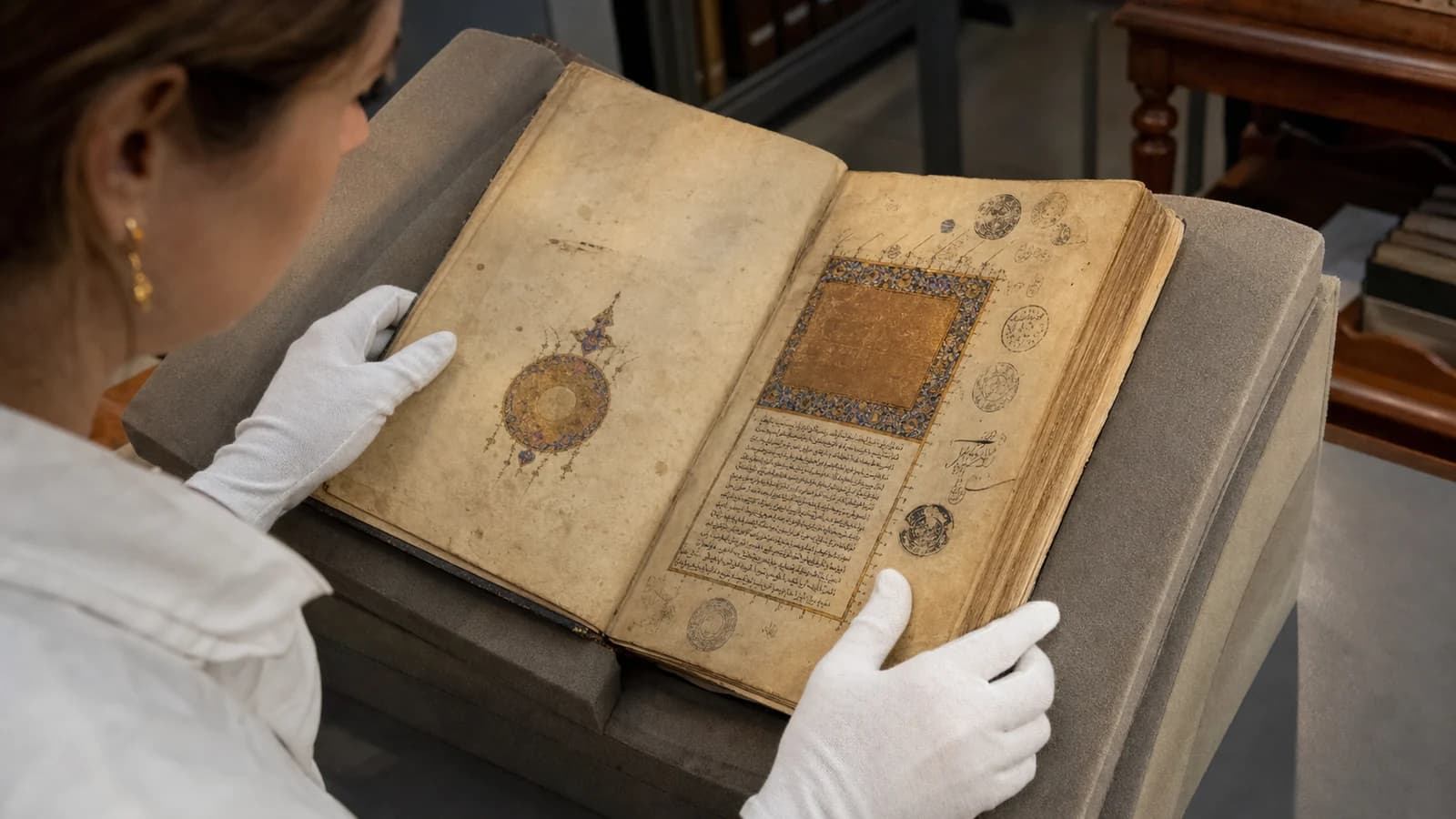
The cover image is an original AI-assisted manuscript study, not a facsimile or provenance record of a real codex.
Sources
- Kislak Center: Islamic Manuscript Notes — types of notes and provenance evidence.
- The Met: Manuscript with Ownership and Marginal Notes — object-level evidence for accumulated use.
- Encyclopaedia Iranica: Forgeries of Islamic Manuscripts — altered colophons and authentication cautions.


