Qalam Reed Pen: Cutting a Nib for Arabic Calligraphy
How calligraphers season, shape and cut a qalam, why nib angle changes the stroke, and what manuscript evidence reveals about disciplined pen control.
The qalam functions as a reed pen central to the discipline of Arabic-script calligraphy. Its rigid structure distinguishes it from flexible metal nibs, requiring the scribe to modulate stroke width through mechanical angle, pressure, and direction rather than material flex. Understanding the tool requires observing museum objects that connect surviving pages to their physical instruments, while acknowledging that many details depend on script, teacher, and tradition.
Selecting and Seasoning the Reed
The process begins with selecting a straight reed suitable for the intended scale of writing. Calligraphic traditions differ in their preferences, so one workshop’s instructions should not be treated as a universal recipe. Seasoning reduces moisture before the reed is cut. The practical aim is a stable shaft and a clean edge, but surviving tools and manuals do not document every choice made for every page.
Trimming and Opening the Slit
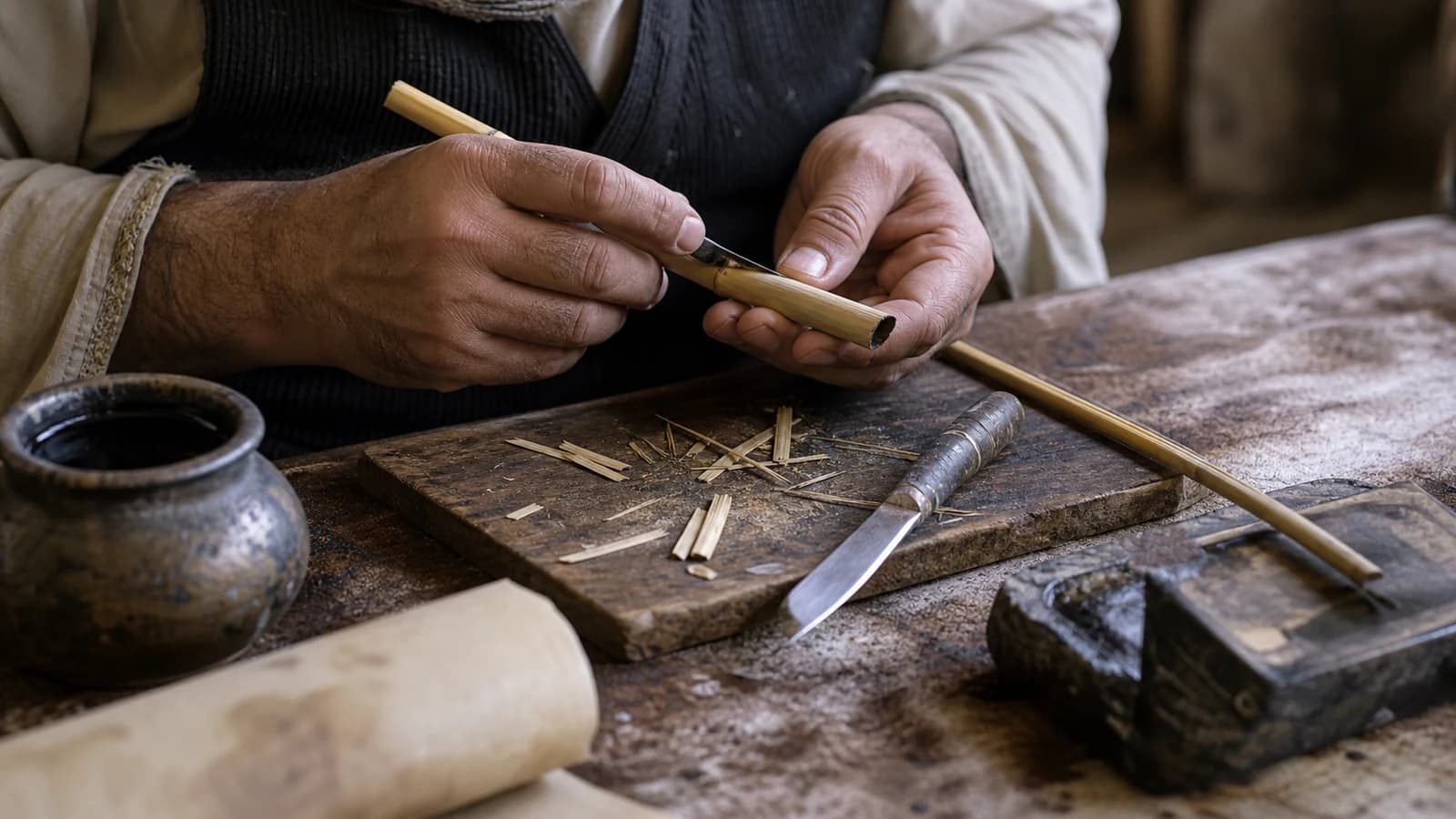
A penknife and cutting board support the initial shaping. The tip is trimmed, opened with a slit and cut to form the nib. Width, angle and the exact sequence depend on the script, the teacher and the working tradition. An inkwell supplies the writing medium. Museum tools make this workflow tangible, while the marks on a finished page rarely identify one exact knife cut by themselves.
Cutting the Nib Profile
The most critical modification is cutting the tip at an angle to expose a broad edge. This rigid edge produces thick downstrokes and thin upstrokes through the orientation of the pen relative to the page surface, not through flexibility. The specific angle is determined by the geometric requirements of the chosen script. Teachers emphasize proportional consistency, ensuring strokes align with underlying grids. There is no single universal cutting procedure; variations exist across different schools and historical periods.
Usage and Historical Context
Scale dictates tool size: monumental Quran pages require large reeds for bold strokes, while small scripts need finer tools. Surviving manuscripts demonstrate the range of outputs but do not guarantee a specific pen was used for every page. Modern reconstruction often fills gaps in the historical record, so distinctions between surviving evidence, written prescriptions, and later copies must remain explicit. Mastery relies on trained movement, proportions, and repeated practice, avoiding mystical claims about a single perfect cut.
- Identify which script and scale the pen was intended to serve
- Separate surviving tools from later workshop demonstrations
- Compare stroke width and angle across more than one folio
- Treat one teacher’s cutting method as a tradition, not a universal rule
The cover image is an original AI-assisted studio reconstruction, not a demonstration by a named historical calligrapher.
Sources
- The Met: Art of the Islamic World, Unit 2 — calligraphy tools, scripts and teaching material.
- The Met: Folio from an Early Qur’an Manuscript — object evidence for early large-scale reed-pen writing.
- The Met: Folio from a Monumental Qur’an — scale, ink and calligraphic material evidence.


