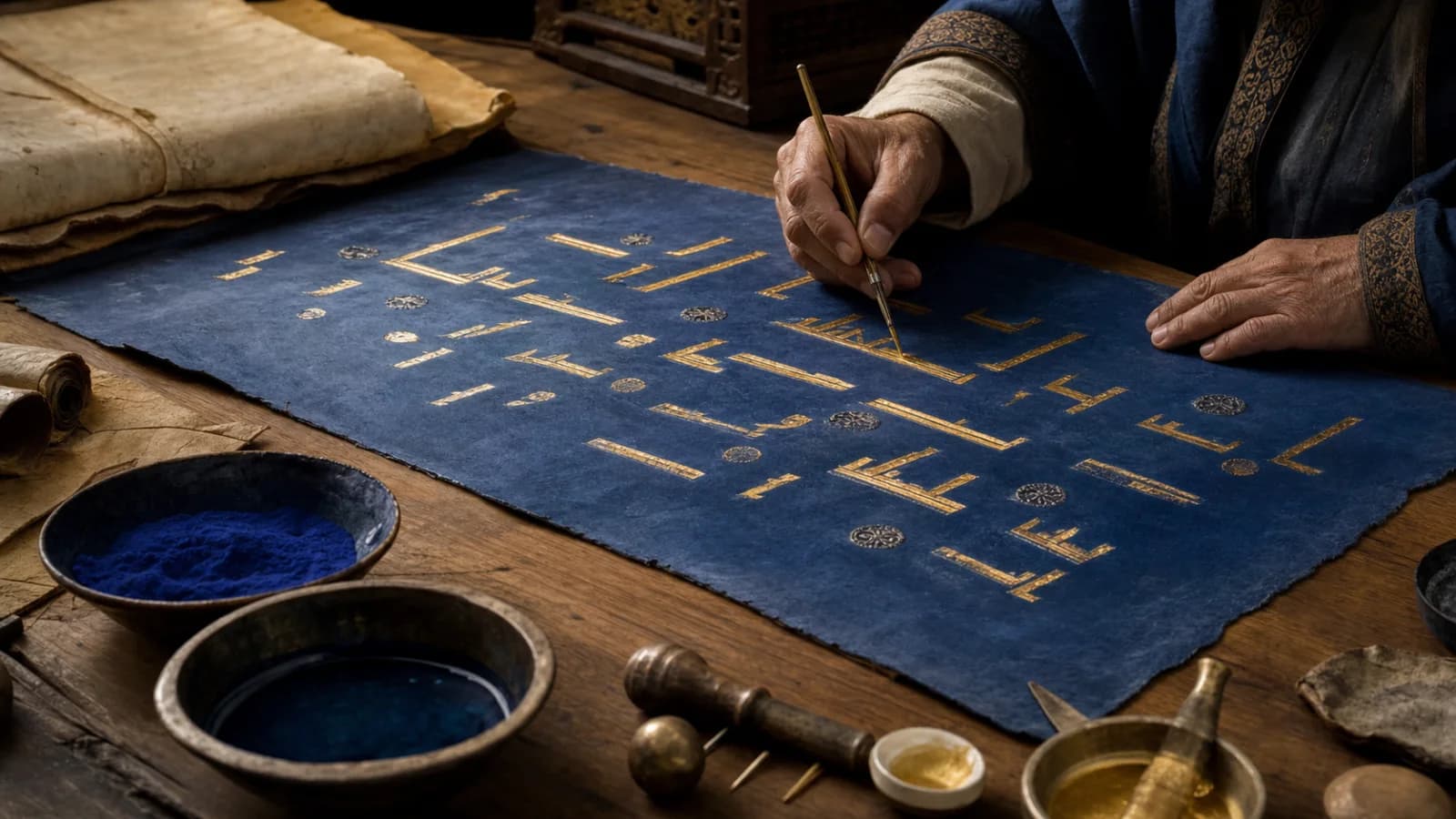
The Blue Qur’an and the Evidence Behind Its Gold Script
Examine the Blue Qur’an’s indigo parchment, gold Kufic script and silver verse markers through museum folios, and see why its date, origin and patron remain debated.
The safest answer is therefore material before biography: the blue writing surface, metallic lettering, broad horizontal pages and text sequence can be examined directly. A proposed Abbasid, Aghlabid or Fatimid commission is an argument built from style, history and later provenance. These hypotheses are useful, but they should not be printed as a maker’s signature. The header image accompanying this article is an educational visual reconstruction, not a photograph or facsimile of an extant Blue Qur’an leaf, and its marks should not be used to identify Qur’anic verses.
Key facts, with their limits
| Question | What the surviving evidence supports | What remains open |
|---|---|---|
| What is the Blue Qur’an? | Folios from a costly Qur’an copied on deep blue parchment in angular gold script | The modern nickname is not a surviving original title |
| When was it made? | Most catalog dates fall in the ninth or tenth century | Scholars dispute whether an earlier Abbasid or later North African context best explains it |
| Where was it made? | Several important groups of leaves were historically kept in Tunisia | Present location and later ownership do not by themselves identify a workshop |
| How was it made? | Indigo color, gold lettering and silver verse markers are visible on surviving leaves | The exact workshop sequence and recipe require technical evidence for each object |
| Who paid for it? | Its scale and precious materials point to exceptional resources | No cited folio names a patron in a secure colophon |
| How many volumes existed? | A multivolume manuscript is widely accepted | Particular reconstructions of seven volumes and leaf totals are scholarly estimates |
What can a single museum folio establish?
The Metropolitan Museum’s folio 2004.88 measures about 30.4 by 40.2 centimeters. Its record identifies gold and silver on indigo-dyed parchment, a broad format and a date from the second half of the ninth to the middle of the tenth century. These are cataloged observations and curatorial judgments about one physical leaf. They are stronger evidence for its material and dimensions than for a specific court that might have commissioned the complete book.
The Khalili Collections’ two folios KFQ 53 are recorded at roughly 28.3 by 37.7 centimeters, with fifteen lines per page, and are assigned to “North Africa or Spain” in the tenth century. Their catalog identifies passages from surahs 2 and 3. The Aga Khan Museum’s bifolium AKM477 records passages from surahs 25 and 26. Named verses let researchers compare sequence across collections rather than treating every blue fragment as a decorative specimen without textual position.
Object numbers matter here. A catalog description for one accession cannot automatically be transferred to every surviving leaf. Measurements may differ because of trimming, preservation or catalog practice; an object record may also be revised as research develops. The reader can test a claim by asking which accession number, side of the leaf and exact feature support it.
Why blue parchment and gold letters were difficult choices
Parchment is prepared animal skin, not ordinary paper. Coloring a large number of leaves consistently, keeping the surface workable for writing, and maintaining legible metallic script required coordinated labor. The Aga Khan Museum identifies the pigment as indigo and describes a proposed sequence in which an adhesive holds very thin gold leaf, excess metal is brushed away and dark outlines sharpen the letters. The museum also explains that powdered gold could be made into ink; the relative use of leaf and ink must be argued from technical examination, not assumed from a photograph.
The difference between parchment and prepared paper is material, not a ranking of cultures or periods. Our guide to sizing and burnishing Islamic manuscript paper concerns a different writing surface and helps readers understand why a recipe for paper cannot simply be projected onto dyed skin. When a museum record names gold and silver on indigo-dyed parchment, those words describe observable materials; the identity of every craftsman remains another question.
The expense also needs careful language. Multiple large skins, gold, silver, dye and trained hands indicate unusually substantial resources. The Aga Khan catalog reconstructs a manuscript of several bound volumes and argues for a wealthy patron. That is a reasoned inference from scale and surviving history, not a surviving payment record naming a ruler. Saying only “a king made it” converts production cost into an unsupported biography.
What do the silver disks and fifteen lines do?
Gold letters carry the Qur’anic text. Silver markers punctuate verses, and some leaves have larger marginal signs for counting or navigation. On AKM477, the museum identifies small silver disks at verse ends and a marker connected to a group of verses. Much of the silver has tarnished to a dark color; a viewer seeing black spots today should not infer that the original design used black pigment for every marker. The contrast of blue, gold and bright silver was different when the book was new.
The broad pages and fifteen-line arrangement are also purposeful. Letter spacing and elongation could keep lines visually balanced, sometimes making a word harder for an untrained modern reader to identify. The Met explicitly notes manipulated letter forms and the omission of marks that distinguish some consonants. “Hard to read” in that catalog is not a claim that the text was careless or that its readers could not recite it. The page belongs to a culture in which written form and learned recitation worked together.
The text is not a freeform pattern. Chapter and verse positions can be compared among surviving folios. Our separate account of Ajami manuscripts that use Arabic script for African languages illustrates why script, language and text must be identified separately: the Blue Qur’an carries Arabic Qur’anic text; the visual category “Arabic script” alone does not tell a viewer what a manuscript says.
Is “Kufic” a precise identification of the script?
Museum records describe the Blue Qur’an’s lettering as angular or Kufic. The label helps a general reader distinguish this broad, carefully proportioned early Qur’anic hand from later cursive book scripts. It does not identify a named calligrapher or a workshop in the Iraqi city of Kufa. Script categories are tools for comparing forms, not passports proving where a book was written.
The surviving letters are elongated and spaced to manage the width of each line. The David Collection’s cataloged folio 77/2004 notes the difficulty created by similar spacing within and between words and describes the deliberate extension of letters, often termed mashq. These features can be studied directly against an actual leaf. A digitally recreated “Kufic” design or a modern typeface can evoke the look but cannot supply manuscript evidence, a text sequence or an original date.
Not all early Qur’an folios with angular script and gold details belong to this manuscript. A reliable identification needs the blue parchment, dimensions, text positions and other codicological features together. Mislabeling a different gold-ink leaf as part of the Blue Qur’an would inflate the known corpus and distort a proposed reconstruction.
When was the manuscript made, and why do catalogs differ?
The Met gives a range from the later ninth to the middle of the tenth century and proposes Tunisia, possibly Qairawan. The Khalili Collections gives a tenth-century date and “North Africa or Spain.” The David Collection places its leaf around 900 and explains that Iraq, Tunisia, Spain and Sicily have all been proposed, while some features favor Tunisia under the Aghlabids or early Fatimids. Harvard Art Museums’ folio 1967.23 records a ninth-century date and “Iraq?” These labels are not four independent dated colophons; they are catalog interpretations of related physical material.
The scholarly disagreement is explicit. Alain George’s 2009 study, cataloged by the University of Edinburgh, says the then-common view favored an early Fatimid court before the conquest of Egypt in 969, but argues for an earlier Abbasid date based on script chronology and the color scheme. The Aga Khan Museum catalog instead judges tenth-century Tunisia most likely, citing the concentration and recorded history of folios there. A reader should understand these as competing explanations, not combine “Abbasid Baghdad” and “Fatimid Qairawan” into one asserted birthplace.
Later ownership is one part of a provenance argument. It shows where leaves were kept or acquired, which can support a hypothesis. It does not prove where the parchment was prepared or where the scribe wrote. An explicit dated production note, securely attributable to the same manuscript, would change the evidentiary picture; the object records cited here do not supply one.
Did Byzantine luxury books inspire the palette?
The Met compares the Blue Qur’an’s gold on colored parchment with purple-dyed, gilded Byzantine manuscripts. Such a comparison makes historical contact and shared luxury-book techniques worth investigating. It does not show a specific Byzantine book laid on the copyist’s desk. Similar color choices can arise through several routes, and a surviving object does not normally record what its makers looked at.
The Aga Khan Museum describes a possible imperial gift of a gold-and-silver manuscript as one proposed source of inspiration. Dagmar Riedel’s Columbia University essay on the Blue Qur’an explains how exhibition pairings themselves can imply influence without proving it; she also notes that scholars have compared other traditions of metallic writing on dark surfaces. These are hypotheses about visual relationships, not chemical tests or direct records of an individual craftsman’s model.
Nor does the blue necessarily encode one agreed religious symbolism. The manuscript’s Qur’anic text is its central religious content. Claims that blue “must” mean a particular theological idea need contemporary textual evidence; a modern response to color cannot stand in for the intention of an unnamed ninth- or tenth-century patron.
What happened when a multivolume book became separate leaves?
The Blue Qur’an did not begin as isolated framed artworks. The Aga Khan Museum reconstructs a multivolume book and discusses missing leaves by comparing the sequence of Qur’anic passages on its bifolium. Detached folios now circulate through museums and private collections. A single page can reveal material and calligraphy but cannot show every original opening, binding, text division or pace of reading.
The sequence of sales and collections must be documented leaf by leaf. Riedel identifies a substantial Tunisian holding and detached leaves in several collections, while the museums above provide exact accession records for individual objects. This is a case in which tracing dispersed manuscripts through physical and catalog evidence has a useful parallel in a much later Persian illustrated book. The two books are unrelated historically; the comparison is about how separation can erase the experience of reading a complete volume.
Preservation also changes the appearance of evidence. Silver can darken, parchment can be trimmed, and later mounting can hide edges or the reverse of a leaf. The history of Timbuktu manuscripts and preservation concerns a different region and corpus, but it shows why physical condition, custody and documentation should be recorded before drawing conclusions from a modern display. For the Blue Qur’an specifically, cataloged recto and verso texts, dimensions and provenance entries carry more weight than an attractive photograph alone.
How should a reader use a museum image or a reconstruction?
Start with the accession number and institution. Ask whether the image shows an actual leaf, both sides of it, a digitally adjusted photograph or a new illustration. Read the catalog’s material and dating language literally: “possibly Qairawan” is a proposal, “Iraq?” is explicitly uncertain, and “gold on indigo-dyed parchment” is a material description. Then compare another institution’s folio and the text passage it contains.
The header illustration here is a reconstruction made to evoke the manuscript’s material choices. It is not evidence that a particular surviving folio has those exact marks, words or verse divisions. Actual object pages from the Met, Aga Khan Museum, Khalili Collections, David Collection and Harvard are linked below so the reader can examine the surviving evidence and the institutions’ different judgments.
The Blue Qur’an deserves close attention without a fabricated answer to every question. Its gold letters, dyed parchment and tarnished silver make a demanding physical book visible today; its dispersed text lets researchers test proposed relationships among leaves. The narrower conclusion is the stronger one: it is an extraordinary early Qur’an manuscript with a still-contested date and place, not an anonymous puzzle already solved by a confident caption.
Sources
- The Metropolitan Museum of Art, folio 2004.88 — object record for dimensions, gold and silver on indigo parchment, broad date range and curatorial proposal of Tunisia or Qairawan; its Byzantine comparison is presented as an interpretation.
- Aga Khan Museum, bifolium AKM477 — detailed object and collection account for indigo, gold-leaf technique, silver markers, text sequence, Tunisian provenance and a proposed multivolume reconstruction; patronage claims are treated as inference.
- Khalili Collections, folios KFQ 53 — independent catalog for two identified Qur’anic passages, fifteen lines, materials, dimensions and the broader “North Africa or Spain” attribution.
- The David Collection, folio 77/2004 — physical and script observations, including line-spacing and elongated letters, and an explicit list of competing geographic attributions.
- Harvard Art Museums, folio 1967.23 — accession record whose ninth-century “Iraq?” attribution documents catalog uncertainty rather than settling the whole manuscript’s origin.
- University of Edinburgh, Alain George, “Calligraphy, Colour and Light in the Blue Qur’an” — peer-reviewed research record and abstract for the argument favoring an earlier Abbasid date over the previously common early Fatimid attribution.
- Columbia University, Dagmar Riedel, “The Anxiety of Influence” — scholarly analysis of dispersed folios, collection history and the limits of inferring direct visual influence from exhibition comparisons.


