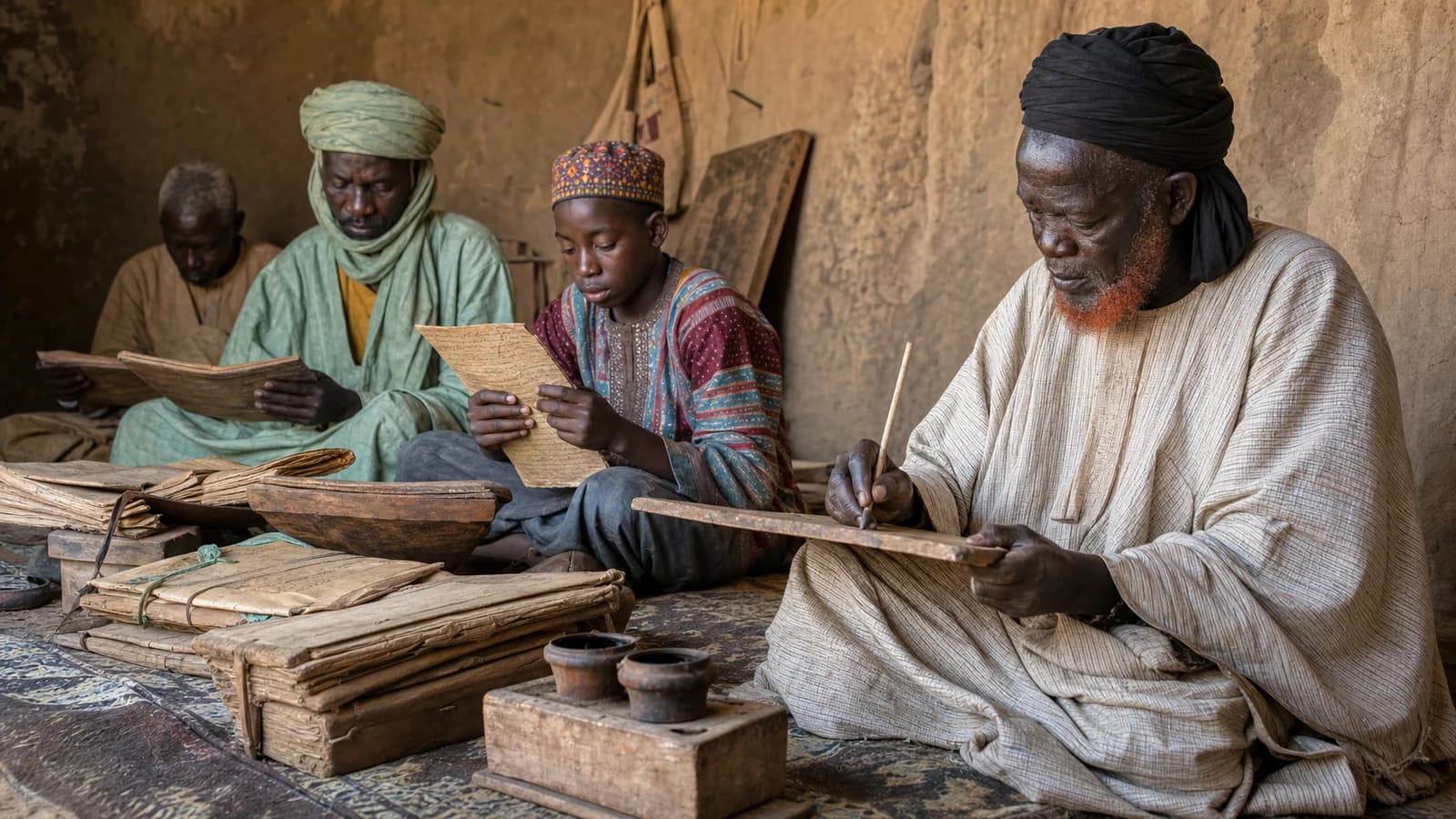
How Ajami Manuscripts Wrote African Languages in Arabic Script
A source-based guide to Ajami manuscripts, African languages, adapted Arabic letters, Wolofal and Mandinka cases, archives, Unicode, transcription and custody.
Ajami manuscripts are texts in African languages written with adapted Arabic letters. They are not defective Arabic and they do not form one continental alphabet. Hausa, Wolof, Fula, Mandinka and many other language communities developed conventions suited to their own sounds, genres and teaching practices. A page may also combine Qur'anic Arabic, an African-language translation, local commentary and owners' notes. To identify it correctly, a reader must record language and script separately, then examine spelling, provenance, genre and local terminology. These manuscripts preserve devotional poetry and law, but also letters, trade records, medicine, genealogy, biography, public events and everyday concerns that Arabic-only cataloguing can hide.
Ajami in one minute
- Definition: an Arabic-derived writing practice used for languages other than Arabic, especially African languages in the present discussion.
- Not one script: each language and sometimes each region uses a different repertoire of letters, dots, vowel marks and spelling conventions.
- Not one genre: Ajami carries religious, historical, commercial, medical, poetic and personal writing.
- Not only historical: handwritten traditions continue, while teachers and developers also create readers, fonts and digital keyboards.
- Not necessarily monolingual: Arabic and one or more African languages can share a page, line or text.
What the word Ajami does and does not identify
The label derives from the Arabic root associated with non-Arab or non-Arabic speech. In African manuscript studies, Ajami is a practical umbrella for writing African languages in Arabic-derived script. That umbrella helps collections become searchable, but it can flatten names used within communities. Wolof written this way is commonly called Wolofal; Fula may appear under Fula, Fulfulde or Pular depending on region and catalogue; Manding varieties require more precise language identification than “Mande Ajami.”
The term identifies neither a language nor a single graphic standard. “Arabic” may describe the script while the words are Wolof. “Ajami” may describe the writing practice while leaving the language unidentified. Good metadata therefore has separate fields for language, script, local orthography, place, date and genre. It should preserve a community's preferred name alongside the wider searchable label.
Ajami is an adaptation of Arabic script, not imperfect Arabic
Arabic letters were familiar through Qur'anic education, devotional reading, scholarship and correspondence. Writers used that graphic knowledge to represent languages with different sound systems and grammatical structures. They might reuse an Arabic letter for a new value, add dots, combine existing marks, or write vowels more explicitly than unvocalised Arabic usually does. These choices are evidence of linguistic analysis and teaching, not mistakes caused by inadequate Arabic.
A single page can nevertheless contain actual Arabic. A prayer may be quoted in Arabic and explained in Hausa; an Arabic legal or devotional text may carry a Soninke or Mandinka gloss; a Wolof poem may alternate with Arabic praise. The researcher must identify the language of each segment rather than assign the whole object to the language suggested by its letter shapes.
There is no universal Ajami alphabet
Arabic does not supply a one-to-one letter for every consonant or vowel in African languages. Communities developed their own solutions. Three-dot forms are prominent in some Hausa and Wolof conventions, while other systems assign familiar Arabic shapes new sound values or depend on context. Vowel marking may be dense, selective or absent. Even within one language, spelling can vary across teachers, Sufi networks, towns, periods and individual scribes.
A chart from one modern workbook cannot decode every historical manuscript. The same glyph may function differently in another orthography, and handwriting may obscure the number or position of dots. Start with an alphabet or reader produced for the relevant language and region, then test it against repeated words in the document. Any transcription should preserve uncertain readings rather than silently normalise them.
Ajami history cannot be reduced to one invention date
Arabic literacy expanded through trade, scholarship, Islamic education, pilgrimage and religious networks across different parts of Africa. Writing local languages in Arabic script emerged through multiple communities rather than through one inventor or decree. Surviving dates are uneven because many manuscripts remained in family libraries, mosques or teachers' collections; some texts are copies of older compositions; colophons may be missing; climate, conflict and handling have destroyed evidence.
It is therefore reasonable to describe Ajami traditions as centuries old, but risky to give all African Ajami a single beginning. Date the physical witness, the composition and the copy separately when evidence permits. A poem composed around one event may survive only in a later handwritten copy. A digitisation date records when images were made, not when the text was written.
West Africa is central but not the whole map
Hausa, Wolof, Fula and Mandinka are four major West African traditions studied comparatively by Boston University's NEH Ajami project. The African Ajami Library also lists materials in Kanuri, Nupe, Dagbanli, Amharic and Malagasy, among others. Repositories in Mali catalogue Fulfulde, Songhai and sometimes “unidentified Ajami.” The broad record also includes Arabic-script practices for languages in East Africa and the Horn.
This range does not mean all of these literatures share one history. Hausa networks in northern Nigeria and Niger, Wolofal in Senegal, Pular in Fuuta Jalon, and Mandinka writing in Casamance developed under different political, educational and religious conditions. An article called “West African Ajami” must not use a Wolof spelling rule as if it applied to Hausa, or use a Senegalese archive to prove a chronology for Ethiopia.
Religious learning supported Ajami but did not limit its subjects
Many writers learned Arabic letters through Qur'anic schooling and used Ajami for praise poetry, Sufi instruction, jurisprudence, ethics and accounts of religious teachers. That history explains frequent Arabic quotations and Islamic vocabulary. It does not make every Ajami text a Qur'an, nor does it confine the archive to theology.
The comparative Boston University collection identifies astrology, divination, medicine, commercial records, personal letters, genealogies, village foundations, births, deaths, weddings, heroes, biographies, customs, elegies, law and ethics. These genres document local intellectual and social life. Calling them “religious notes” can erase the very historical evidence that makes the material valuable.
A Wolofal manuscript shows how several languages share one codex
The Endangered Archives Programme record EAP334/13/2 describes a 163-page collection associated with Serigne Samba Diarra Mbaye and dated around 1903. Its contents include Arabic poems, Wolofal poems and mixed Arabic-Wolof passages. The catalogue records red, black, purple, blue and green inks, with red used for vocalisation and for important words, phrases and verses. The original is held by Serigne Abdoulaye Sarr in Saint-Louis, Senegal.
This one record corrects several shortcuts. Arabic script does not determine language; colour can organise reading rather than merely decorate; a codex can be multilingual; the current custodian remains part of the object's provenance; and the catalogue's date is approximate. A researcher should cite EAP334/13/2, not a cropped image found without its file record.
The Mandinka archive preserves everyday and multilingual evidence
Boston University Libraries reported that the EAP1042 project released more than 18,000 pages from 58 Mandinka scholars in Senegal's Casamance region. Fieldwork revealed Arabic texts, Arabic texts with Arabic glosses, texts glossed in Arabic and local languages such as Soninke and Mandinka, and Mandinka Ajami compositions. That classification is more informative than labelling every image “Mandinka manuscript.”
An individual OpenBU item, Kanjamaalu Kitaaboolu III, combines Arabic, Mandinka and Fuuta Jalon Fula Ajami. It includes devotional material, a letter and personal notes. Its record names the fieldwork and technical teams, custodial history, access licence and citation. These details show why digitisation is not just scanning: language expertise, owner permission, metadata and durable identifiers determine whether images can be interpreted and responsibly reused.
Fula, Hausa and Wolof collections reveal different trajectories
The NEH Ajami project's Fula collection includes praise poems, teachings on worship and ethics, biographies, accounts of named scholars and meeting minutes. Hausa project work combines collection, transcription and translation with specialists familiar with northern Nigerian manuscripts. Wolofal materials are tied to distinct scholarly and Sufi networks in Senegal. Comparing them reveals shared use of Arabic-derived script without pretending that their spelling or social histories are identical.
Genre and audience can shape orthography. A memorised poem, private letter, teaching text and merchant's account do not need the same degree of explicit vowel marking or formal layout. A scribe writing for readers trained in the same school may rely on conventions outsiders cannot infer. Variation is therefore data about community and use, not simply noise to be corrected.
How to identify the language of an Ajami page
- Begin with provenance: record the town, owner, collector, teacher or religious network associated with the object.
- Separate clearly Arabic quotations from surrounding text by formulae, vocabulary, syntax, ink or layout.
- List unusual letters and dot patterns without assigning sound values too early.
- Compare recurring function words, affixes and names with a reader or corpus for the candidate language.
- Check whether the catalogue's language label was supplied by a speaker, inferred by a cataloguer or left unidentified.
- Consult a fluent reader familiar with the relevant local orthography and historical vocabulary.
- Preserve a line image beside diplomatic transcription, normalised transcription and translation so others can review decisions.
Script recognition software may say “Arabic” because the characters belong to the Arabic Unicode script. That is not language identification. The distinction is similar to recognising Latin letters without knowing whether the text is English, Swahili or Hausa.
Transliteration, transcription and translation are different outputs
A diplomatic transcription tries to retain what the scribe wrote, including spelling variation and uncertain dots. A normalised transcription maps that writing into a chosen standard, often in Latin script. Transliteration maps characters by rule, while translation renders meaning in another language. A digital edition may supply all four, but they should not be collapsed into one clean-looking line.
Normalisation can make searching and teaching easier, yet it also removes evidence about pronunciation, dialect, school and scribal practice. Editors should publish their mapping table, mark supplied vowels or letters, retain line and folio references, and explain how Arabic quotations are handled. When audio or community commentary exists, it can preserve readings that a page image alone does not reveal.
Unicode supports many characters but does not create an orthography
The Unicode Standard encodes Arabic letters used beyond Arabic. Its Arabic Supplement and Arabic Extended-A charts include letters used in African orthographies, and the core specification discusses specialised Hausa and Wolof Ajami forms. Unicode stores characters and their joining behaviour; fonts determine glyph design; keyboards provide input. Those are separate layers.
A valid code point does not prove that a character belongs in a particular manuscript tradition. Conversely, a historical letter may be represented inconsistently through a visually similar character, a private-use glyph or an image because the appropriate keyboard or font was unavailable. Digital projects should record the Unicode sequence, font, language tag, writing direction and normalisation policy, then test search and copy-paste behaviour.
Why OCR and search remain difficult
Handwritten Ajami combines cursive joining, context-dependent letter shapes, variable dots, optional vowel marks, page damage and non-standardised spelling. A model trained on printed Arabic may recognise the script family but misread African letters or convert a local word into a familiar Arabic one. Mixed-language lines and marginal notes add layout and language-detection problems.
Searchable text therefore requires human-reviewed transcription, not an unlabelled OCR dump. A useful workflow keeps the untouched image, records line coordinates, transcribes at character level, identifies language spans, normalises in a separate field and attaches a confidence or uncertainty note. Evaluation must use manuscripts from the same language and handwriting tradition; high accuracy on modern printed Arabic is not meaningful evidence.
Private custody changes how preservation should work
Many Ajami materials remain with families, scholars and religious communities rather than state archives. Their survival may depend on custodians who know the author, recitation, local title and chain of ownership. Removing a manuscript from that setting can strip away context even when the pages are physically secured elsewhere. Digital preservation should begin with consent, agreed access conditions and accurate attribution.
Open images do not automatically place an object in the public domain. The OpenBU item record specifies a non-commercial Creative Commons licence and asks users to cite the author and source; the EAP Wolof record limits access to research. Repository terms, the manuscript owner's rights and the underlying text may differ. Researchers should cite the stable item record, respect restrictions and avoid exposing private correspondence or sensitive personal information merely because it has been photographed.
Timbuktu catalogues show both the scale and the identification gap
HMML's record for the al-Wangari manuscript library at Timbuktu lists 2,343 digital surrogates photographed in 2018–2019. Its language field includes Arabic, French, Fulfulde, Songhai and “Ajami (unidentified).” The last label is honest evidence of a cataloguing limit: recognising non-Arabic material in Arabic script may be easier than identifying the language without a specialist.
Timbuktu is important, but it should not stand for every African manuscript culture. Senegalese family collections, northern Nigerian scholarly networks, Guinean Pular materials and East African traditions require their own histories. For the city and its collections, use the separate guide to Timbuktu manuscripts, Sankore and preservation; do not relocate every Ajami manuscript there.
A reliable catalogue record keeps five identities separate
- Object: shelfmark, physical extent, material, condition, binding and digital file relationship.
- Text: title, opening and closing words, author, copyist, genre and whether the witness is complete.
- Language: language or languages by folio or segment, including uncertainty and code-switching.
- Script and orthography: Arabic-derived script, local name, special letters, vocalisation and regional convention.
- History: date of composition, date of this copy, place of copying, owners, current custodian and digitisation event.
Colophons and ownership notes may answer some of these questions, but neither should be treated as automatically original or complete. Compare the guide to colophons and ownership evidence and the field method for tracing manuscript provenance.
Four recurring myths to remove from Ajami articles
- “Ajami is broken Arabic.” The language may not be Arabic at all; adapted letters encode another language's sounds and words.
- “Ajami is one alphabet.” Hausa, Wolof, Fula, Mandinka and other traditions differ internally and from one another.
- “The manuscripts are only religious.” Religious learning is foundational, but surviving genres include commerce, medicine, history, correspondence and social life.
- “Digitisation solves access.” Images without language-specific metadata, transcription, community knowledge, rights information and durable links may remain unreadable.
A fifth error is to describe Latin-script literacy as simply replacing Ajami. The two can coexist, serve different institutions and carry different kinds of authority. Modern workbooks and Unicode development show continued adaptation rather than a sealed precolonial archive.
Related reading
- What Timbuktu's manuscript collections contain — A city-specific history that should not be generalised to all Ajami traditions.
- How colophons and ownership notes work — Evidence for copyists, dates and transmission.
- How to trace an Islamic manuscript — A practical chain-of-custody and catalogue method.
- How to distinguish major Arabic calligraphic scripts — Script style must not be confused with text language.
- How a qalam reed pen was cut — The physical tool behind many Arabic-script manuscript traditions.
- How Balochi varies across dialects and scripts — A comparison showing why language, ethnicity, region and writing system require separate evidence.
Sources
- Boston University Libraries, African Ajami Library — The repository defines the collection's collaborative scope and documents Ajami holdings across numerous West and East African languages rather than presenting Ajami as one alphabet.
- Boston University NEH Ajami Project, The Four Languages — The comparative project supports the distinct Hausa, Mandinka, Fula and Wolof trajectories and its genre list supplies the evidence beyond religious literature.
- Boston University Libraries, Endangered Manuscripts Digitization Project Completed — The project report gives the more than 18,000 pages, 58 scholars and four-part classification of Arabic, glossed, bilingual and Mandinka Ajami materials from Casamance.
- OpenBU, Kanjamaalu Kitaaboolu III — This item-level record documents Arabic, Mandinka and Pular content, several everyday genres, the fieldwork team, custodial history and reuse licence.
- British Library Endangered Archives Programme, EAP334/13/2 — The Wolofal object record supplies the circa-1903 date, 163-page extent, multilingual contents, ink functions, owner and access conditions used in the case study.
- The Unicode Standard 16.0, Chapter 9 — The specification explains Arabic-script extension, joining and ijam principles and records specialised characters used for African and Ajami orthographies.
- Hill Museum & Manuscript Library, Bibliothèque des Manuscrits al-Wangari — The repository record provides the 2,343 digital objects and the catalogue's separate Arabic, French, Fulfulde, Songhai and unidentified-Ajami labels.
- UNESCO Memory of the World, African Documentary Heritage — UNESCO places indigenous-language Ajami beside Arabic, African-origin scripts and colonial languages, supporting a multilingual rather than Arabic-only view of African documentary heritage.
- Library of Congress, Transmission of Knowledge in Islamic Manuscripts from Senegambia and Mali — This scholarly collection supplies object-based evidence for local-language glosses and warns that the language of a gloss need not be the scribe's first language.


