What Is a Mabkhara? How to Read Historical Incense Burners
Compare open incense bowls, pierced lids, suspension loops and replacement parts in documented museum examples.
An incense burner can be an open bowl, a vessel with a pierced lid or a container designed to hang. Start with the part that held material. Then look for the path through which scent could escape, and for the feet, handle or loops that show how the vessel was supported. Museum records can add information about parts that are now missing, repairs, and possible uses.
Names such as mabkhara and majmar appear in discussions of incense vessels. This guide compares documented objects by their form. One vessel in Doha is called an incense burner in its title, while its curators propose that it held scented candles. Reading the title with the physical description and interpretation helps explain why the same broad name can cover different designs.
What mabkhara means in a hospitality setting
In Abu Dhabi’s Department of Culture and Tourism materials, mabkhara is the name of an incense burner associated with hospitality. Its description of Union Square identifies a monument in the form of an incense burner alongside a coffee pot and a rosewater sprinkler. The Bait Al Gahwa heritage account uses the spelling mibkhara for a vessel that can be part of welcoming guests. The two records help identify the word and its setting. Abu Dhabi Department of Culture and Tourism, Union Square and Bait Al Gahwa heritage account
The word names a kind of vessel. When looking at an older object, the collection label may use the English term incense burner or a different regional word, such as majmar in the Omani example. Record the term used by the institution alongside the shape. A vessel can be recognised as part of hospitality from one record, as a find with residue from another, or as an object with moving parts from a technical description.
What an open bowl reveals
The National Museum in Oman publishes a limestone burner from Ra’s al-Jinz dated to 2500–2000 BCE. Its photograph shows a shallow open bowl and four short feet. The museum reports that fire residue remained when it was found and identifies it as a majmar. The find offers an early Arabian comparison with later metalwork. The visible bowl shows where material could rest, and the residue belongs to the excavated object. Each observation contributes to the identification. National Museum, Oman, Ra’s al-Jinz limestone burner
In a photograph, an open rim is the first part to trace. Then look at the junction between the bowl and its feet. A side view shows how far the vessel stands above the surface beneath it. A view from above shows how much of the interior can be seen. For an archaeological object, the collection record can explain whether the open bowl was found that way and what material was present. The open form alone does not identify a particular aromatic substance.
How a pierced lid changes the form
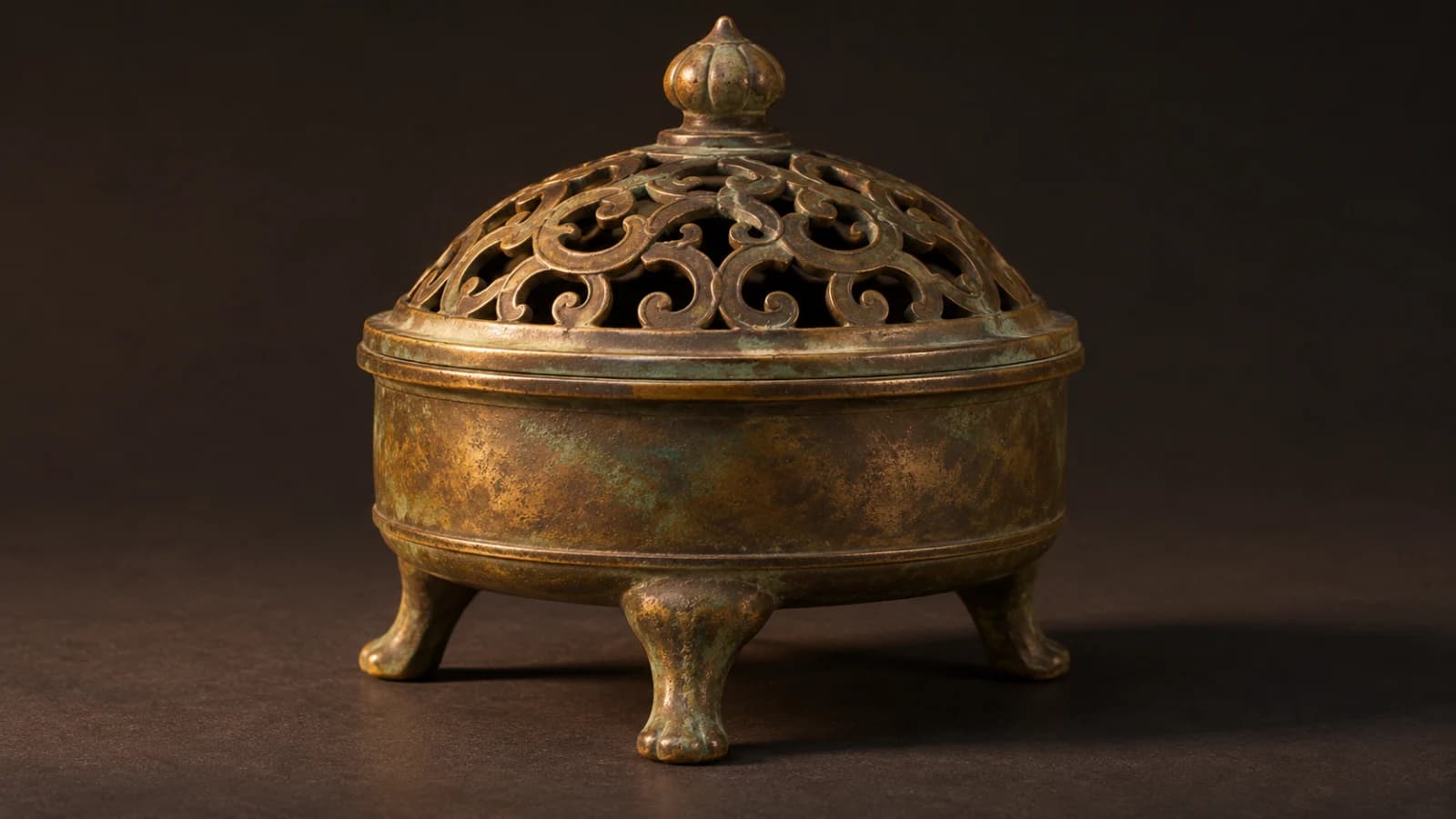
The Met’s 1976.102, dated to the eighth or ninth century, has a low cylindrical body, three legs and a hinged domed cover. The cast bronze cover is pierced, with designs that include wings and plants. The museum explains that smoke could pass through the holes and describes the legs as shaped like feline paws. Its listed height is 13.6 centimetres and its greatest length is 24.2 centimetres. With a view of the hinge, you can distinguish the lid that opens from the fixed body it covers. Met, Incense Burner with Domed Cover, 1976.102
A different bronze piece at the Met, 67.178.3a, b, is dated to the eleventh century and attributed to Andalusia. It has a square body, feet, a long handle and a high domed lid. The museum notes the horseshoe arches on the lower register among the features that inform its attribution. It records dimensions of 24.8 by 25.4 by 10.8 centimetres. Set this object beside the cylindrical example and look at the body before comparing the lids. The guide to figures and animals in Islamic art offers context for describing motifs such as the feline paws on the earlier object. Met, burner attributed to Andalusia, 67.178.3a, b
Loops, clasps and a cup that can move
The British Museum records 1992,0715.1 as a polygonal vessel made in northern India, around the sixteenth or seventeenth century. It has a domed top, a lotus finial, and loops and clasps for suspension. It measures 15 by 16 by 12 centimetres. The catalogue notes that one foot is bent and suggests an architectural comparison with northern Indian tombs. The loops tell you how it could be hung. The bent foot is part of its present condition. The architectural comparison concerns the shape. British Museum, northern Indian incense burner 1992,0715.1
The Met’s 17.190.2095a, b is a pierced globe dated to the late thirteenth or early fourteenth century and attributed to Damascus. The globe is 15.9 centimetres high and the record gives 22.2 centimetres with its chain. Inside the hinged hemispheres is a small cup suspended on three rings. The museum explains that the rings helped keep the cup stable as the outer globe moved. A picture from outside shows perforations and the seam between the halves. An open view is needed to see the mechanism. Met, Pierced Globe, 17.190.2095a, b
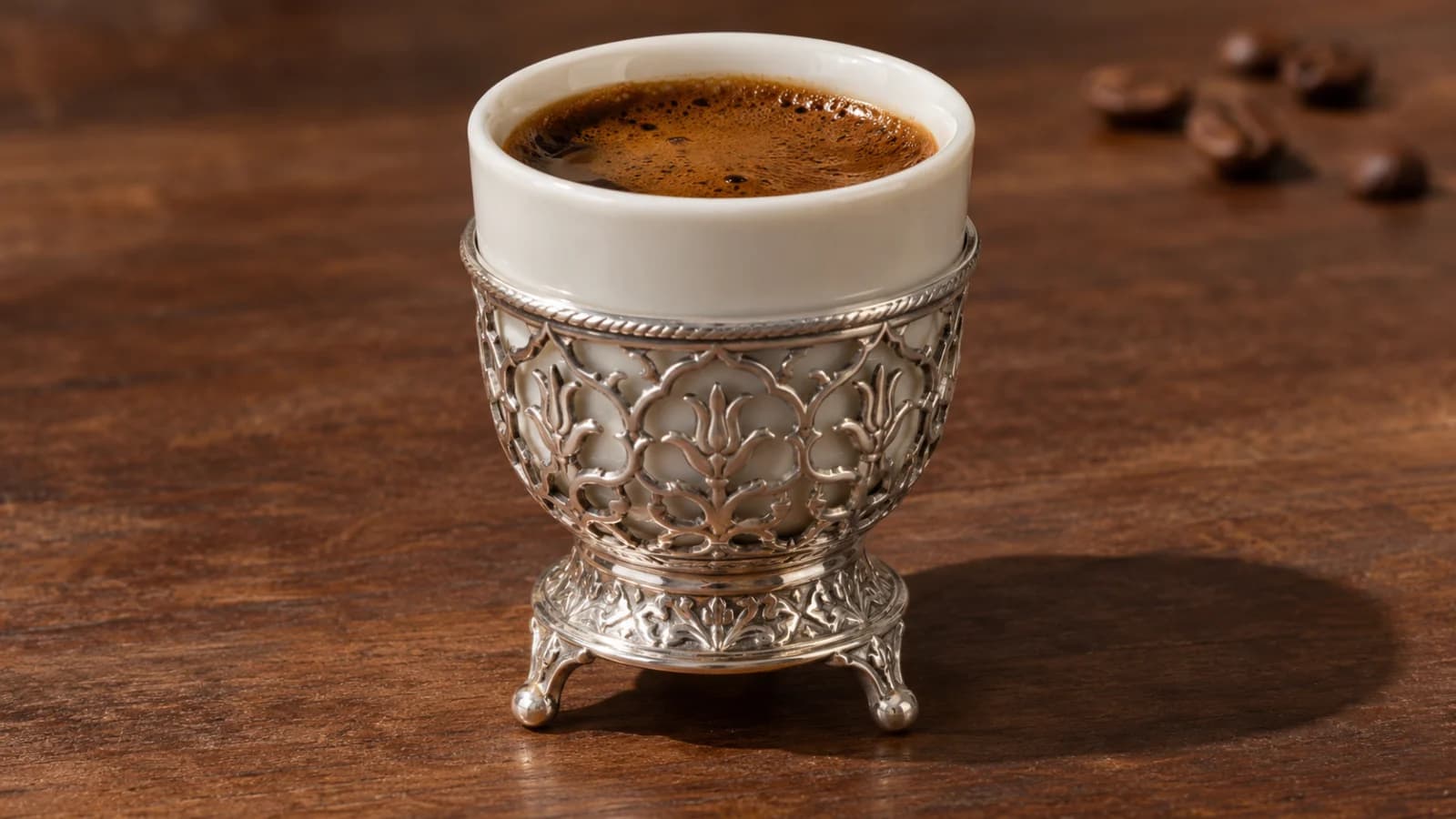
The word cup can refer to a component with a specific purpose. In the globe it is an interior part connected to rings. An Ottoman zarf has a different relationship between components: the outer holder supports a cup used for serving. The comparison makes it easier to ask what moves, what is held and which parts the collection record actually documents.
How museums describe a replacement lid
National Museums Scotland holds the bronze burner A.1956.518, described through Museum With No Frontiers. It is 16.51 centimetres high and dated to the middle or later thirteenth century, with Syria or Iraq given as its provenance. The catalogue describes a cylindrical body with three legs. The hinged dome now on the vessel is described as a modern replacement. The entry proposes that an earlier lid screwed onto the body by a flange and ring. It also identifies the area where a long handle would originally have attached. Museum With No Frontiers, National Museums Scotland A.1956.518
When describing the piece, keep the photographed hinge with the replacement and the proposed screw fitting with the interpretation of its earlier form. The catalogue also suggests a possible church context based on imagery and comparisons. That interpretation remains specific to this object. A related question of form comes up when comparing the Met’s incense globe with brass celestial globes. On a celestial globe, markings show how the surface was used. The hinge and rings on the Met’s incense vessel give evidence about the container and its interior.
Why a vessel called an incense burner may have held candles
Qatar Museums catalogues MW.467.2007 as the Mamluk Incense Burner. It is 36.5 centimetres high and 16.5 centimetres in diameter. The record describes a cylindrical brass body, three stylised legs and a pierced domed lid, with silver and gold inlay. It identifies the patron as Sultan al-Nasir Muhammad ibn Qalawun. The museum’s collection overview gives Egypt or Syria and the fourteenth century, while the detailed Qatar Museums entry gives Egypt and a range of 1294–1340. Keep the attribution with the record that supplies it. Qatar Museums, MW.467.2007 and Museum of Islamic Art, collection highlights
The detailed record proposes that the vessel was designed for perfumed candles. Its title, described form and interpretation of use are all parts of the catalogue. A photograph can show the openings and the decoration. The explanation about the contents is a curatorial judgement. The article on Qalawun’s hospital in Cairo gives a separate example of how records attach names and institutions to Mamluk objects and buildings. The patron named for this vessel is al-Nasir Muhammad ibn Qalawun.
What to look for in a collection photograph
Start with a full view to see whether the vessel is open, lidded or enclosed. Look for an exposed bowl or cup. Locate the feet, handle or suspension points, then see if a second photograph shows how the lid attaches. A straight-on view may hide the openings behind an ornamental band. A photograph from above can reveal a perforated surface. A view of the interior can show an inner cup or indicate that a piece is missing.
After observing the shape, compare it with the record. For the Ra’s al-Jinz bowl the excavation description adds information about residue. For the Met globe an open view and the catalogue explain the rings. For the Scottish vessel the catalogue separates the current lid from the proposed original fitting. For the Doha piece the object description distinguishes the catalogue name from the interpretation of what it held. Include the inventory number with any of these statements so the reader can check the exact object.
Museum records for further comparison
- Bait Al Gahwa heritage account places the mibkhara among the objects associated with welcoming guests.
- National Museum, Oman describes the Ra’s al-Jinz limestone bowl and its excavation context.
- Met, 1976.102 documents a hinged pierced cover and three feet.
- Met, 67.178.3a, b documents a square form attributed to Andalusia.
- British Museum, 1992,0715.1 gives measurements and describes loops and clasps.
- Met, 17.190.2095a, b shows a pierced globe and explains its suspended cup.
- National Museums Scotland A.1956.518 documents the replacement lid and proposed original fittings.
- Qatar Museums, MW.467.2007 describes the inlaid vessel and the scented-candle interpretation.