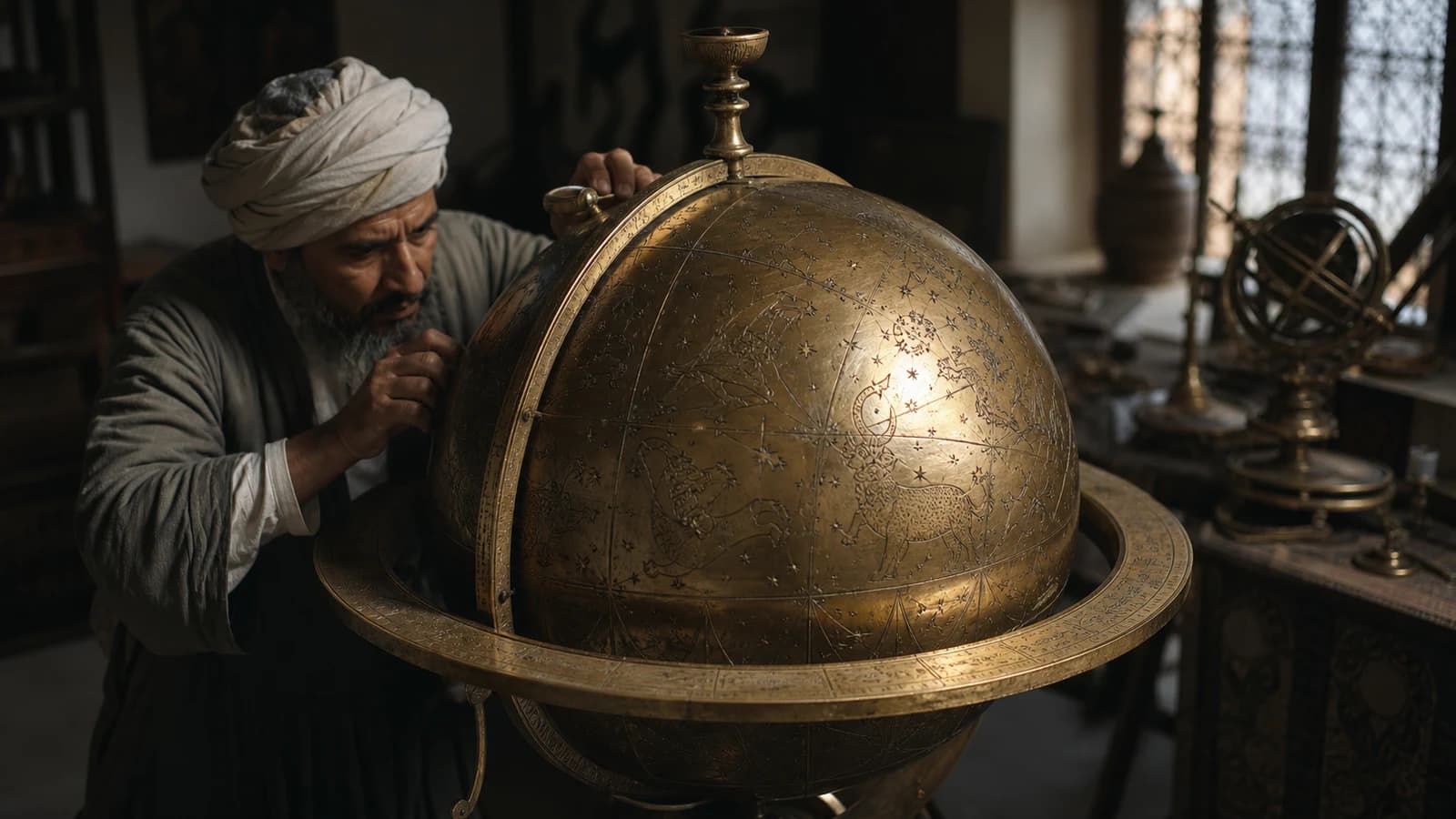
Islamic Celestial Globes: Mapping Stars on Brass
How astronomers placed constellations on a spherical sky model, why figures appear reversed, and what inscriptions reveal about makers and use.
An Islamic celestial globe functions as a physical model of the starry sphere when viewed from the outside. This external perspective causes constellation figures to appear reversed relative to their appearance from Earth. These brass instruments typically mark stars, coordinate circles, and zodiac outlines while rotating within a meridian ring or standing on a base.
Visual Representation
The design of these globes prioritizes astronomical geometry over artistic realism. Stars are marked by dots or crosses, with positions calculated according to prevailing star catalogs. Coordinate circles engraved on the surface allow users to locate celestial bodies relative to the ecliptic, though these represent astronomical coordinates rather than terrestrial latitude and longitude.
Constellation outlines connect these points, often accompanied by symbolic figures. The reversal of images results from the external viewing perspective, distinguishing celestial globes from terrestrial ones which map the Earth’s surface from the inside out. This distinction is crucial for understanding the instrument’s structural logic.
Construction and Materials
Brass was the primary material, chosen for durability and fine engraving capabilities. The sphere usually mounted in a meridian ring simulates the diurnal motion of stars through rotation on an axis. Some globes rested on elaborate stands featuring animal or human figures.
A documented museum object from the Islamic world may bear inscriptions naming the maker, date, and place of creation. However, these details cannot be generalized to all globes produced in the region. Many instruments remained anonymous, and craftsmanship varied widely according to patronage and technical expertise.
Educational and Computational Use
Celestial globes offered educational, demonstrative, and computational possibilities. Evidence for actual use differs by object; some show wear from frequent handling, while others appear as decorative commissions for wealthy patrons. Distinguishing a working instrument from a luxury object requires close inspection of mounting and precision.
The creation of these globes was informed by the broader tradition of Islamic astronomy, including al-Sufi’s star catalog. Yet, every globe did not copy one exact manuscript; they represent a synthesis of observational data and geometric theory rather than a single textual source.
How to read the evidence
- Identify constellation figures by their reversed orientation due to external viewing.
- Check meridian rings for rotation mechanisms that simulate stellar motion.
- Examine inscriptions on specific museum objects cautiously without generalizing.
- Distinguish astronomical coordinate circles from decorative terrestrial terms.
These objects bridge the gap between abstract astronomical theory and tangible human experience. They reflect the empirical approach of medieval astronomers who synthesized observation with geometric models to navigate the heavens.
The cover image is an original AI-assisted object reconstruction, not a photograph or exact copy of a museum celestial globe.
Sources
- British Museum: Islamic Celestial Globe — object, inscriptions and constellation imagery.
- Smithsonian: Celestial Globe — instrument construction and collection record.
- Smithsonian Repository: Islamicate Celestial Globes — scholarly catalog and object history.


