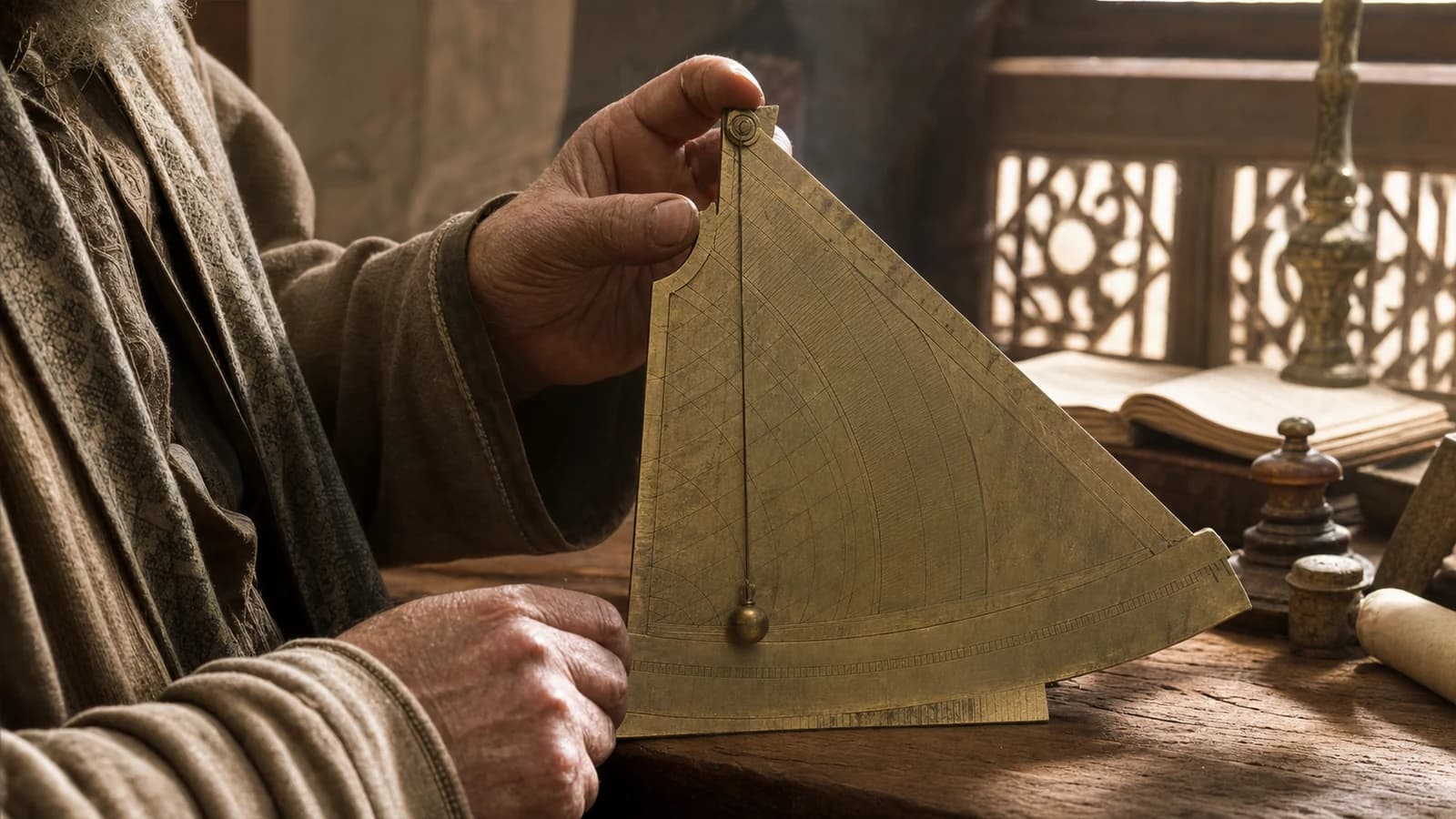
Astrolabic Quadrant: A Folded Sky in One Quarter-Circle
How an astrolabic quadrant compresses astrolabe geometry, what its grids and plumb line calculate, and why one instrument cannot represent every use.
The astrolabic quadrant operates as a quarter-circle instrument that compresses select functions of the planispheric astrolabe through folded projection geometry. By mapping celestial coordinates onto a ninety-degree arc, this device allows for specialized astronomical computation while significantly reducing material mass and bulk compared to its full circular predecessor.
Geometric Compression
The structural innovation lies in folding the stereographic projection of the celestial sphere onto a simplified arc. This geometric reduction retains critical computational utility without the complexity of movable rete components. The quarter-circle form enables users to align specific degrees of altitude with corresponding coordinate grids, effectively translating sky movement onto a linear readout surface.
Operational Mechanics
Measurement relies on a plumb line and bead suspended from the central pivot. As the user sights a celestial body along the alidade, the bead indicates an altitude reading on the outer scale. This angle is then transferred to internal grids engraved for latitude-specific calculations. The specific capabilities of the instrument depend entirely on its individual engravings, requiring the operator to solve for variables using the measured altitude as input.
- Identify the instrument’s target latitude from inscriptions or edge markings.
- Align the alidade with the observed celestial altitude.
- Read the plumb line position on the outer scale.
- Trace this value to the corresponding internal grid lines.
The Damascus Object
A surviving example held by the British Museum, manufactured in Damascus, provides evidence of these mechanisms. Inscribed for a muwaqqit at the Umayyad Mosque, it reveals its specialized purpose through precise Arabic script and specific coordinate scales. The inscriptions confirm that such instruments were tailored to individual users and locations, rather than being generic tools. The presence of latitude-specific features indicates that the user’s geographic context was integral to its calibration.
Distinction from Simple Quadrants
Scholars must distinguish the astrolabic quadrant from simple altitude quadrants or horary quadrants. The former measure only elevation, while the latter typically calculate local time based solely on solar position. The astrolabic variant integrates both dimensions. It allows for directional determination alongside temporal data. This complexity demands a steeper learning curve for reading but offers greater utility for professional users.
The portability of the astrolabic quadrant made it valuable for travelers and scholars who could not carry full astrolabes. However, its compactness requires careful handling to maintain the integrity of the plumb line suspension. The instrument reflects a broader trend in medieval science toward practical application. It bridges theoretical astronomy and daily religious life, demonstrating how abstract mathematical models were translated into tangible tools.
Modern reconstructions often simplify these scales, obscuring the original intent. By examining the specific inscriptions and grid types on historical examples, historians can reconstruct the intended user profile. The Damascus example shows a professional grade of precision, with finely divided scales that allow for minute adjustments.
Understanding the astrolabic quadrant requires recognizing its role as a specialized interface between the observer and the cosmos. It is not merely a measuring device but a computational engine that translates angular data into temporal and spatial coordinates.
The cover image is an original AI-assisted instrument reconstruction, not a photograph or calibrated copy of a surviving quadrant.
Sources
- British Museum: Astrolabic Quadrant — dated Damascus object and muwaqqit inscription.
- Smithsonian: Plane Trigonometry and Surveying — quadrants, angular measurement and instrument context.
- The Met: Art of the Islamic World, Unit 4 — Islamicate scientific instruments and mathematics.


