Muwaqqit: The Mosque Astronomer Who Kept Prayer Time
What a muwaqqit calculated with tables, sundials and instruments, how the role varied by institution, and why astronomical precision met local practice.
The muwaqqit functioned as a specialist timekeeper associated with major mosques and madrasas from the medieval period onward. This role required calculating prayer times, maintaining tables, observing celestial bodies, preparing calendars or instruments, and sometimes addressing qibla directions. However, actual duties varied significantly by context. It is essential to distinguish these calculations from the muezzin’s public call and from everyday time determination by simpler means, as precision astronomy did not automatically govern every local practice.
Calculation and Observation Methods
The muwaqqit engaged in complex astronomical work to determine prayer times. This involved observing the Sun and stars, utilizing latitude-specific data, and consulting zij tables for pre-calculated values. These tasks required sophisticated knowledge of spherical astronomy. The role also included preparing instruments and calendars, though the extent of technical maintenance is less clear than the calculation work itself.
Institutional Settings and Instruments
Specialists were typically attached to major institutions like mosques or madrasas. Documented cases include Ibn al-Shatir at the Umayyad Mosque. The British Museum holds a quadrant made for that institution, illustrating the type of equipment used. While these experts provided calculated times, the muezzin handled the public call to prayer. This separation highlights distinct roles within religious institutions.
Limitations of Astronomical Precision
Astronomical precision did not automatically dictate local timekeeping practices. Many communities relied on simpler methods or visual cues for daily time. The presence of an expert in a grand mosque did not mean all Muslims relied on his calculations for everyday life. Local customs and practical necessities often influenced how time was perceived, creating a complex landscape of temporal practices.
Late Institutional Developments
The Ottoman muwaqqitkhana represents a later institutional development. These dedicated rooms housed instruments and records, reflecting formalized interest in religious observance. This structure differed from earlier periods where duties were less standardized. The role adapted to local needs and available technologies rather than dominating all aspects of timekeeping.
- Distinguish between the astronomical calculations of the muwaqqit and the liturgical role of the muezzin.
- Note that precision astronomy was a specialized skill, not a universal standard for local timekeeping.
- Recognize the use of specific instruments like quadrants and astrolabes for celestial observation.
- Acknowledge that later institutional developments varied by region and period.
The muwaqqit represents a significant intersection of science and religion in Islamicate history. Understanding this role requires avoiding the assumption that astronomical knowledge was uniformly applied or that the position was identical across all times and places. Instead, it should be seen as a dynamic profession.
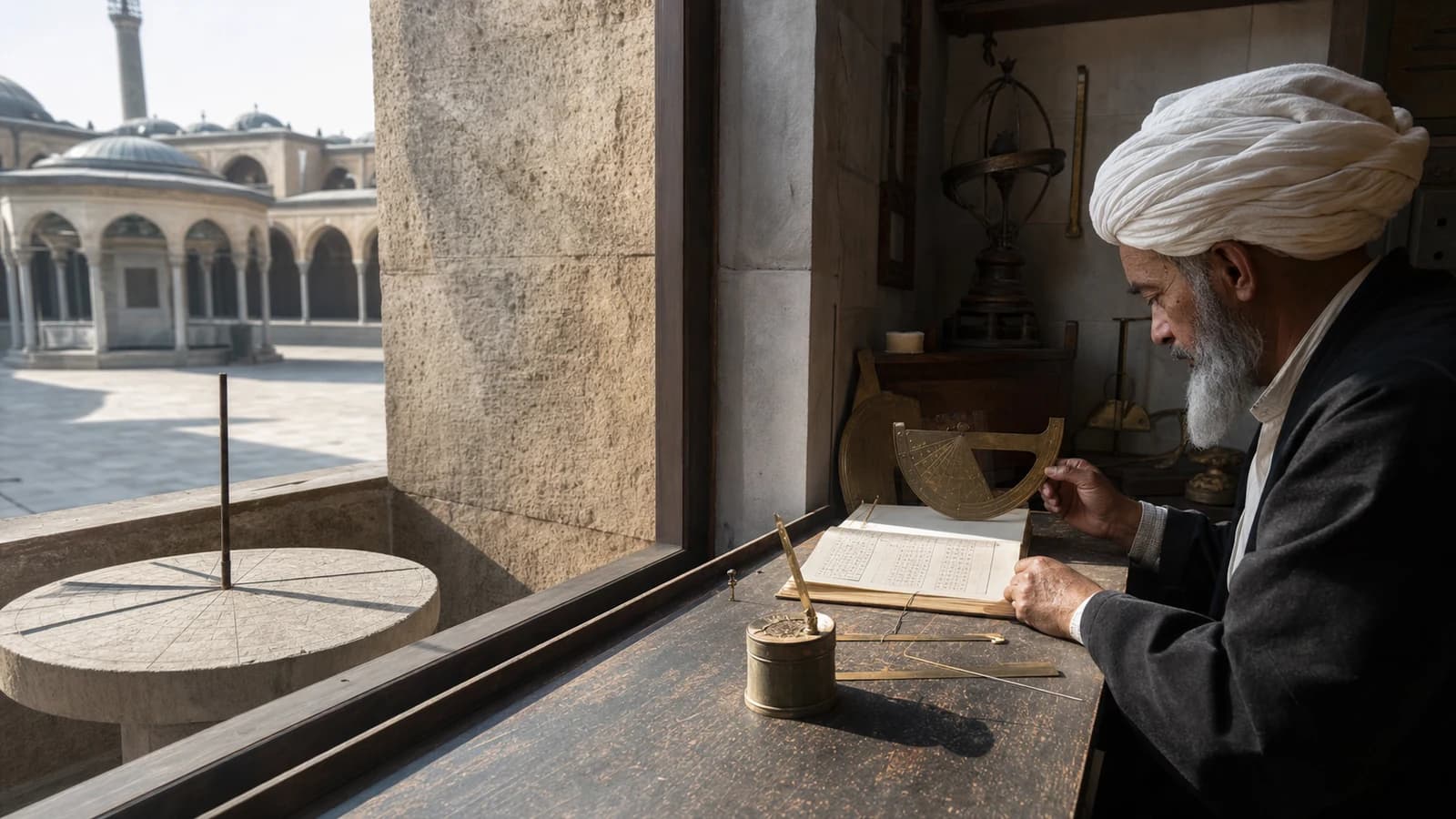
The cover image is an original AI-assisted mosque study reconstruction, not a portrait or record of a named historical muwaqqit.
Sources
- Hill Museum & Manuscript Library: Astronomical Technology and Religious Practice — timekeepers, texts and institutional practice.
- British Museum: Astrolabic Quadrant for a Muwaqqit — dated object and occupational inscription.
- Library of Congress: Zij Manuscript Page on Timekeeping — tables, sunrise, sunset and practical reckoning.


