Resource
Muslim Mosque Quiet Voice Adab Guide
A practical Muslim guide for lowering the voice in mosque spaces without becoming cold, harsh or unwelcoming.
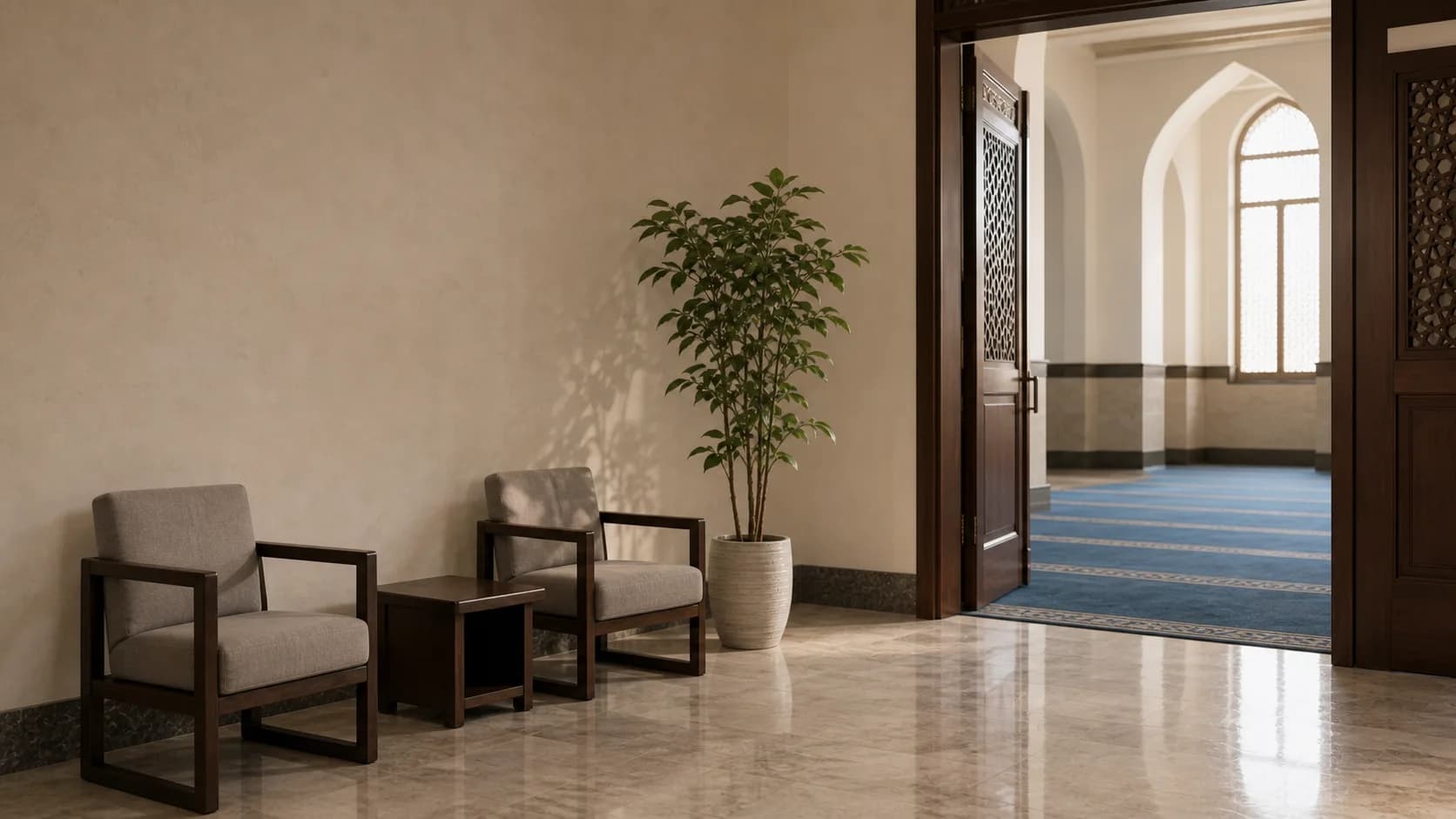
Use case
Prayer halls, mosque hallways, study rooms, wudu queues, Eid venues, community classes and post-prayer gatherings
Adab focus
Lower voice, kind greeting, no hallway debates, no public shaming, move long talks and protect worshippers' focus
Best time
Before prayer, during khutbah or lessons, after salah when people are making dhikr, and in crowded hallways
Boundary
Does not replace mosque policy, safeguarding procedures, accessibility needs, mediation or religious counsel
A mosque needs warmth, but warmth does not require every voice to fill the room. Loud greetings, hallway debates, speakerphone calls or jokes near prayer rows can make worship, learning and rest harder for others.
The Quran teaches measured speech, warns against raising voices in sacred contexts, honors houses where Allah is remembered, commands justice and excellence, and forbids mockery. In mosque spaces, that becomes practical: greet kindly but softly, move long conversations away from prayer areas, avoid public correction as performance and protect quiet without humiliating people.
This guide is educational and does not replace mosque policy, safeguarding procedures, accessibility needs, conflict mediation or qualified religious counsel. It helps a Muslim make the mosque calmer without turning quietness into rudeness.
Mosque Quiet Voice Adab Checklist
| Mosque moment | Adab question | Practical action |
|---|---|---|
| Greeting | Can I be warm without filling the room? | Greet gently, step aside for longer talk and avoid calling across rows. |
| Before worship | Is my conversation harder to leave than to lower? | End or move conversations before prayer, khutbah, class or dhikr begins. |
| Correction | Am I protecting quiet or showing authority? | Use a gentle private reminder or ask a responsible volunteer when possible. |
| Hallway | Does the sound carry into prayer or class? | Move calls, debates and social talk outside the sensitive area. |
FAQ
Does quiet voice mean I should avoid greeting people?
No. Warm greetings are good, but the volume and timing should fit the worship space.
What if children are naturally noisy?
Respond with mercy and structure. Help families find suitable spaces instead of shaming children or parents.
Should I publicly tell people to be quiet?
Only when urgent safety or worship disruption requires it. Otherwise, prefer a gentle private reminder or a responsible volunteer.
Related reading
- Muslim Neighbor Noise Quiet Adab Guide
Use when quiet adab extends to shared walls, homes or neighborhood spaces.
- Mosque Etiquette First Visit Guide
Use for broader mosque movement, greeting and visitor expectations.
- Paris Muslim Travel Guide for Prayer Spaces Halal Food and Metro Planning
A practical Paris Muslim travel guide with mosque anchors, halal verification, RATP ticket planning, neighborhood buffers and a one-day workflow.
Connected by mosque.
- What Happened at Al-Aqsa and the Ibrahimi Mosque in May 2026?
A dated account of May 2026 reports from Al-Aqsa in Jerusalem and the Ibrahimi Mosque in Hebron, separating Palestinian, Jordanian and Israeli police accounts from independently documented access conditions.
Connected by mosque.
- Hypostyle Mosque Plan: Columns, Courtyard and Qibla Hall
How hypostyle mosques use repeated columns and roof bays, why the plan expanded easily, and how Kairouan and Córdoba turned repetition into monumentality.
Connected by mosque.
- Uyghur Islam: Religious Practice, Mosques and Community Life
A source-based guide to Uyghur Sunni practice, mosque life, Ramadan, shrines and the difference between lived religion, law and political claims.
Connected by mosque and community.
- Mosque Architecture Terms Explained by Function
A practical glossary of qibla walls, mihrabs, minbars, minarets, domes, courtyards, iwans, hypostyle halls and related mosque spaces, with regional examples and common identification errors.
Connected by mosque.
- How the Hijra from Mecca to Medina Unfolded in 622
A source-critical guide to the Hijra in 622: its date, Mecca-to-Medina route, cave tradition, arrival, community change, calendar epoch and common myths.
Connected by community.
Languages
- دليل آداب المسجد quiet voice الأدب
- Guia de mesquita adab
- Průvodce: mešita adab
- Guide til moské adab
- Leitfaden zu Moschee adab
- Οδηγός για τζαμί adab
- Muslim Mosque Quiet Voice Adab Guide
- Guide de mosquée adab
- Guida a moschea adab
- ガイド: モスク adab
- 가이드: 모스크 adab
- Gids voor moskee adab
- Veiledning om moské adab
- Przewodnik po meczet adab
- Руководство по теме mosque adab
- Sprievodca: mešita adab
- Guide till moské adab
- คู่มือ มัสยิด adab
- مۇسۇلمان مەسچىتتە پەس ئاۋاز Adab قوللانمىسى
- Hướng dẫn về thánh đường adab
- 穆斯林清真寺低声说话 Adab 指南
- 指南: 清真寺 adab
- 指南: 清真寺 adab