What Is a Zij? Astronomical Tables for Calculation
How zij handbooks combine instructions, parameters and tables for calendars and planets, why locations matter, and how users corrected copied numbers.
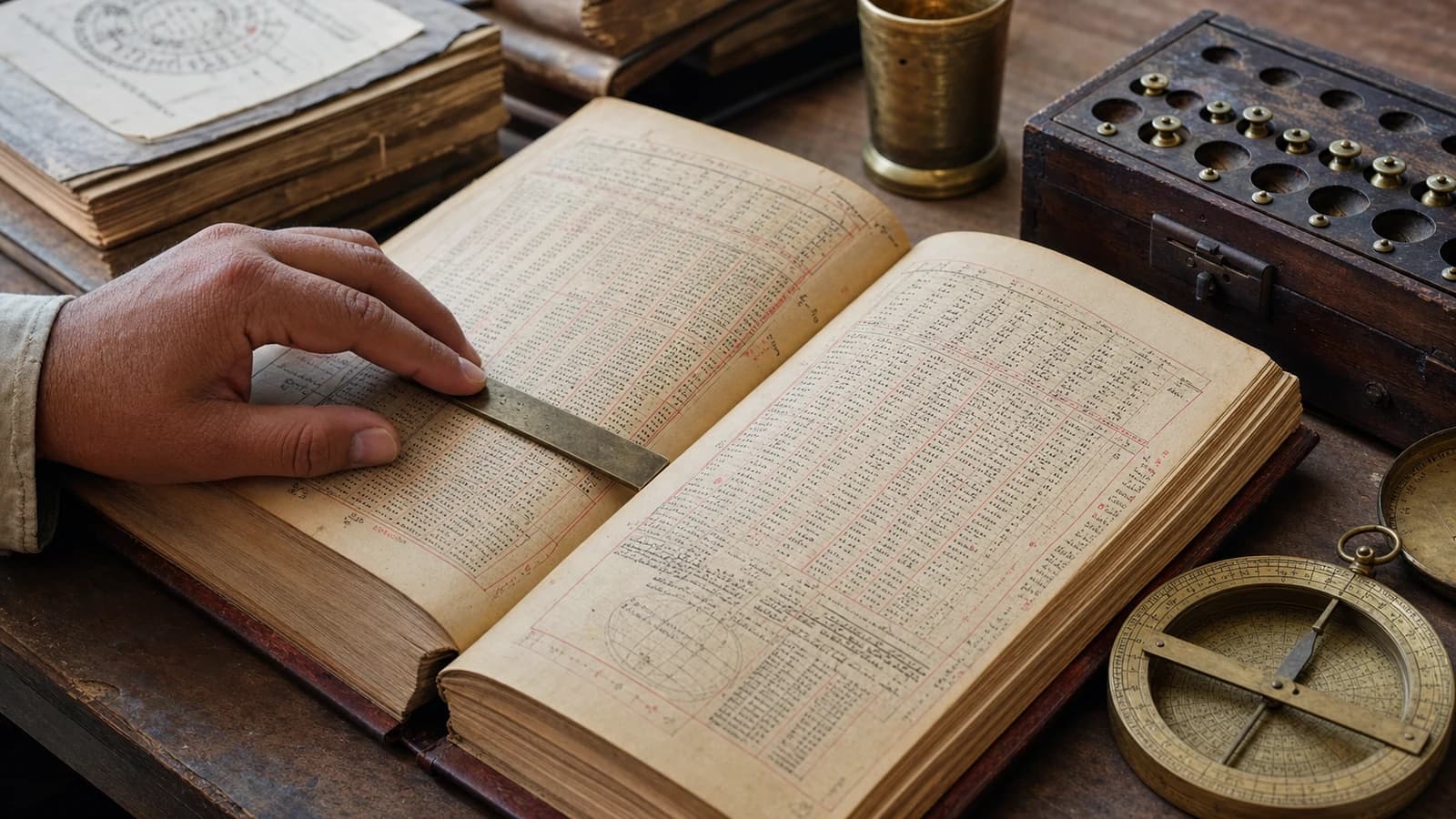
A zij is a genre of Islamic astronomical handbook that combines explanatory canons with numerical tables, serving as a primary tool for calculation in medieval science. These works are not uniform compilations but vary significantly in content and structure depending on the author’s purpose. They typically include data on calendar computation, planetary motion, star positions, and timekeeping, enabling astronomers to predict celestial events with precision.
Genre Characteristics
Zij works function as practical guides rather than theoretical treatises or observational logs. They provide the parameters and rules necessary for performing calculations, such as determining the time of prayer or the beginning of a month. The structure often begins with general canons explaining the underlying astronomy before presenting specific tables. This format allows users to apply the data to their local conditions without requiring extensive mathematical derivation.
Ephemeris and Parameters
Central to any zij are its epochs, reference points from which time is measured, and parameters describing celestial orbits. These values may be adjusted for local longitude or latitude to improve accuracy for a specific region. Users interpolate between tabulated values to obtain results for intermediate dates. The reliance on interpolated numbers highlights the ingenuity of pre-computational astronomy in managing complex periodic motions.
Manuscript Transmission
Copying numerical tables is prone to error, leading to variations across manuscripts. Marginal corrections and computational notes in surviving copies provide evidence of how scholars engaged with these texts over time. Distinguishing a zij from an observational log is critical; the former contains theoretical models and predictions, while the latter records actual sightings. The relationship to modern ephemerides is structural rather than functional, as zij tables served both scientific and religious communities.
Historical Examples
Works associated with al-Battani and Ibn Yunus illustrate diversity within the genre. Their handbooks differ in date, setting, observations, parameters and later transmission. Placing them side by side is useful only when those distinctions remain visible; the zij tradition was not one school with a single table set or method copied unchanged across the medieval Islamic world.
- Identify whether the text contains numerical tables alongside explanatory canons.
- Check for epochs and parameters that define the computational framework.
- Determine if interpolation instructions are provided for non-tabulated values.
- Assess marginalia to distinguish original content from later scholarly corrections.
Zij tables represent a sophisticated synthesis of mathematics and observation. They facilitated the practical application of astronomy in daily life, reflecting a tradition of knowledge that was dynamic, regional, and deeply integrated into cultural practices.
The cover image is an original AI-assisted scholarly reconstruction, not a facsimile of one surviving zij manuscript.
Sources
- Library of Congress: Digitized Zij Manuscript — primary manuscript object and catalog record.
- University of Chicago: al-Zij al-Jadid and Timekeeping — material study of a table manuscript.
- MacTutor: Ibn Yunus — example of a major zij and observational sources.


