Equatorium: Calculating Planetary Positions with an Instrument
How an equatorium turns geometrical planetary models into a physical calculation, what surviving instruments show, and why designs differ widely.
The equatorium is an analog computing device designed to determine planetary positions by mechanically embodying Ptolemaic geometric models. It allows users to calculate longitude without performing the extensive numerical arithmetic required by traditional astronomical tables. By using rotating rules, discs, and scales to represent deferents and epicycles, the instrument translates abstract mathematical relationships into physical manipulation, providing an estimated position within the underlying cosmological framework.
Mechanical Representation of Geometry
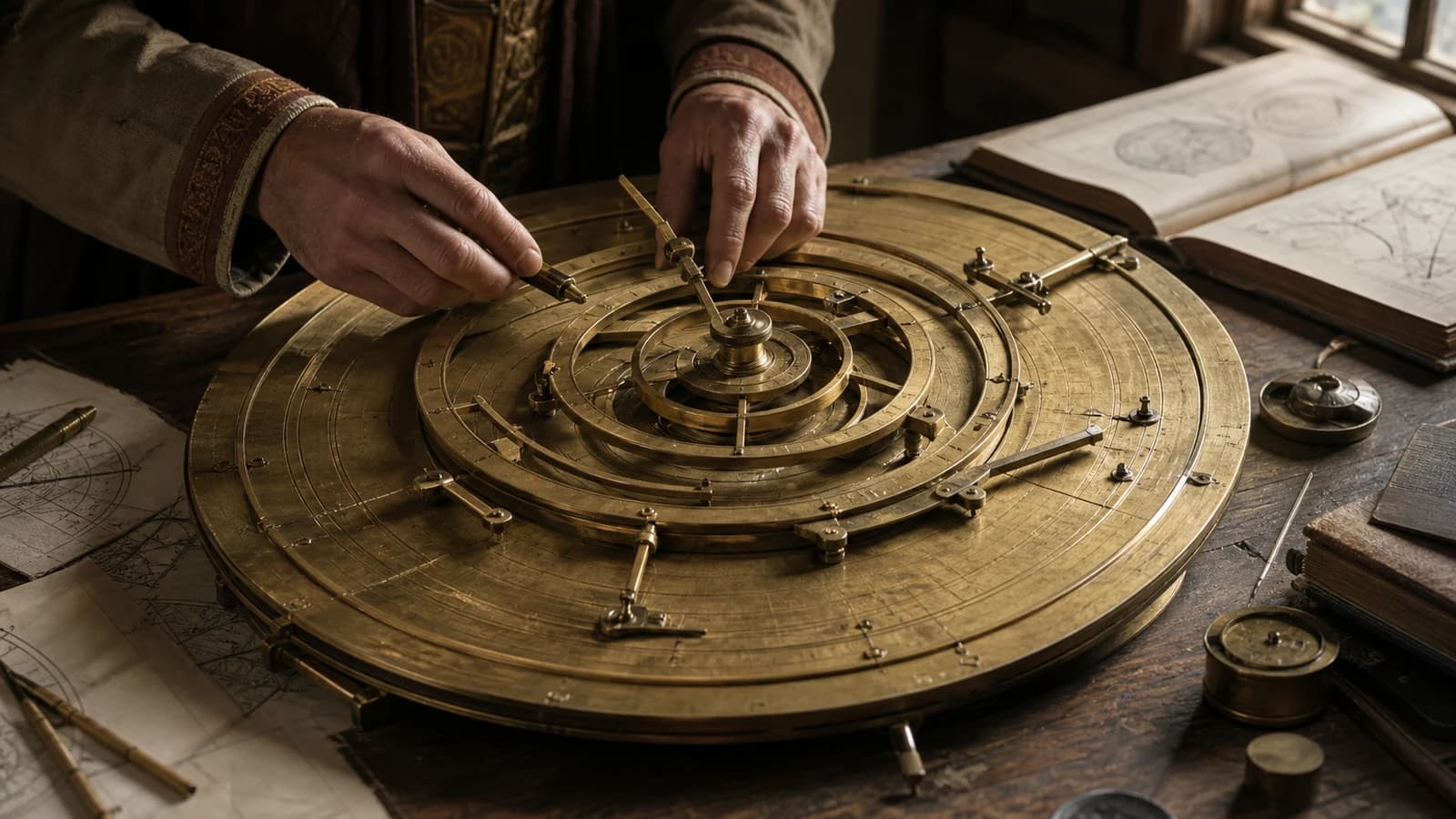
The core function of the equatorium is to visualize planetary motion through physical components. Rotating discs often represent the deferent circle, while smaller attached arms or threads model the epicycle. These elements move relative to a central earth point, mirroring the geocentric system’s structure. The device does not predict observations directly but calculates theoretical positions based on established geometrical rules. This distinction is crucial for understanding its historical role as a computational aid rather than an observational instrument.
Input and Output Processes
Users input known variables such as the current date or the mean position of a planet via set screws, sliding scales, or aligned indices. The mechanical interaction of the deferent and epicycle components then reveals the planet’s calculated longitude on a graduated scale. This output represents the planet’s location within the model, not its apparent position in the sky. The process reduces calculation time by automating complex trigonometric steps through geometry.
- Set the device to the current date or lunar station.
- Align the sun and moon indices to their mean positions.
- Rotate the planetary discs to their respective mean longitudes.
- Transfer the epicycle center’s position via sliding rules.
- Read the final planet longitude from the calibrated scale.
The Oxford Instrument
The equatorium cataloged in the Oxford Museum of the History of Science serves as a primary reference for this technology. Its surviving structure reveals intricate brass work and adjustable components that embody complex orbital mechanics. The object’s design suggests it was used by scholars familiar with Ptolemaic principles, allowing them to verify table calculations or estimate positions for future dates. The instrument’s precision reflects the advanced craftsmanship of its era.
Cross-Cultural Development
Equatoria were developed across medieval Arabic, Persian, and Latin traditions, with designs varying significantly by region and period. Some versions used threads to represent lines of sight, while others employed complex gear systems. The Oxford example highlights the Latin tradition’s emphasis on mechanical precision, while other surviving instruments show different approaches to representing eccentricity. These variations illustrate the diverse ways scholars addressed the same astronomical problems.
The term computer is sometimes applied to equatoria, but this analogy requires definition. The device automates specific geometric transformations rather than performing universal computation. It solves a limited class of problems defined by Ptolemaic astronomy. Calling it a computer without this nuance misrepresents its historical context and functional scope.
Medieval astronomers used equatoria to bridge the gap between theoretical models and practical application. The instruments allowed for rapid verification of planetary positions, which was essential for astrology and calendar making. They did not replace tables but complemented them, offering a visual check on numerical results.
The survival of these devices is rare, making each example valuable for understanding medieval scientific practice. The Oxford instrument’s preservation allows historians to study the mechanical ingenuity applied to astronomical problems. It demonstrates how physical models were used to explore abstract concepts in celestial mechanics.
The equatorium remains a testament to the sophistication of pre-modern science. It shows that computation did not rely solely on arithmetic but also on mechanical simulation. The device’s enduring legacy lies in its ability to make complex astronomy accessible through tangible, interactive tools.
The cover image is an original AI-assisted instrument reconstruction, not a photograph or working copy of a specific surviving equatorium.
Sources
- Oxford Museum of the History of Science: Equatorium — surviving instrument record and components.
- Cambridge University Library: Equatorie of the Planetis — manuscript, reconstruction and planetary computation.
- The Met: Art of the Islamic World, Unit 4 — astronomical and mathematical context.


