How Al-Battani Turned Decades of Observation into Better Astronomy
A source-critical account of al-Battani's work at Raqqa, his 57-chapter Zij, solar year and obliquity measurements, trigonometry, eclipses, manuscripts and Latin reception.
Claims about him need limits. His birth year is not known precisely; “before 858” is safer than a single confident date. He did not replace the Ptolemaic universe with heliocentrism, invent trigonometry alone or calculate the modern solar year once and for all. His achievement was a sustained program of instruments, observations, mathematical comparison and usable tables. The work later circulated in Arabic, Latin, Castilian and Hebrew settings, giving later astronomers access to results that were better than several inherited ancient parameters.
Al-Battani at a glance
| Question | Evidence-based answer | Necessary qualification |
|---|---|---|
| When did he live? | Born before 858; died near Samarra in 929 | An exact birth year is not preserved |
| Where did he work? | Mainly at Raqqa on the Euphrates; eclipses were also observed at Antioch in 901 | Modern national labels should not replace the Abbasid-era geography |
| Observation period | Sources report regular work from 877 to 918 | Not every surviving table comes from one observation session |
| Principal book | A 57-chapter Zij with instructions and astronomical tables | A zij is not merely a star list |
| Solar year | 365 days, 5 hours, 46 minutes and 24 seconds | Comparison with a modern tropical year must account for epoch and definition |
| Ecliptic obliquity | 23°35′ | The calculated value applied to his own period, not all eras |
| Trigonometry | Practical use of sines, tangents and related tables in astronomical problems | He developed an existing multi-author tradition rather than creating it from nothing |
| Later transmission | Latin, Castilian and Hebrew versions or reworkings; printed Latin editions in 1537 and 1645 | “Influenced Europe” should be tied to identifiable texts and users |
What can be said about his life
Al-Battani’s full name is transmitted as Abu Abd Allah Muhammad ibn Jabir ibn Sinan al-Battani al-Harrani al-Sabi, with al-Raqqi also appearing in the biographical tradition. “Albategnius,” “Albategni” and “Albatenius” are Latinized forms readers may meet in European catalogues. The Biographical Encyclopedia of Astronomers places his birth at Harran before 858. This cautious formulation follows the evidence better than the frequently repeated years 850, 858 or 868, which can give a false impression of precision.
His family came from the Harranian Sabian environment, but his personal name and kunya identify al-Battani himself as Muslim in the scholarly biographies. His father was probably the instrument maker Jabir ibn Sinan, although “probably” matters because the relationship is reconstructed from names and technical context rather than a surviving family record. Older European works also called al-Battani a prince or Syrian ruler. The Arabic biographical evidence gives no basis for that title. He was an astronomer with resources and connections, not a monarch whose rank explains his science.
Raqqa and a forty-year observation program
Most of al-Battani’s observations were made at Raqqa, an important settlement on the Euphrates. The sources place his active observational span between 877 and 918. In 901 he recorded a solar eclipse on January 23 and a lunar eclipse on August 2 while at Antioch. These dated observations matter because they connect tables and parameters to actual sky events instead of presenting the Zij as a purely literary rearrangement of Ptolemy.
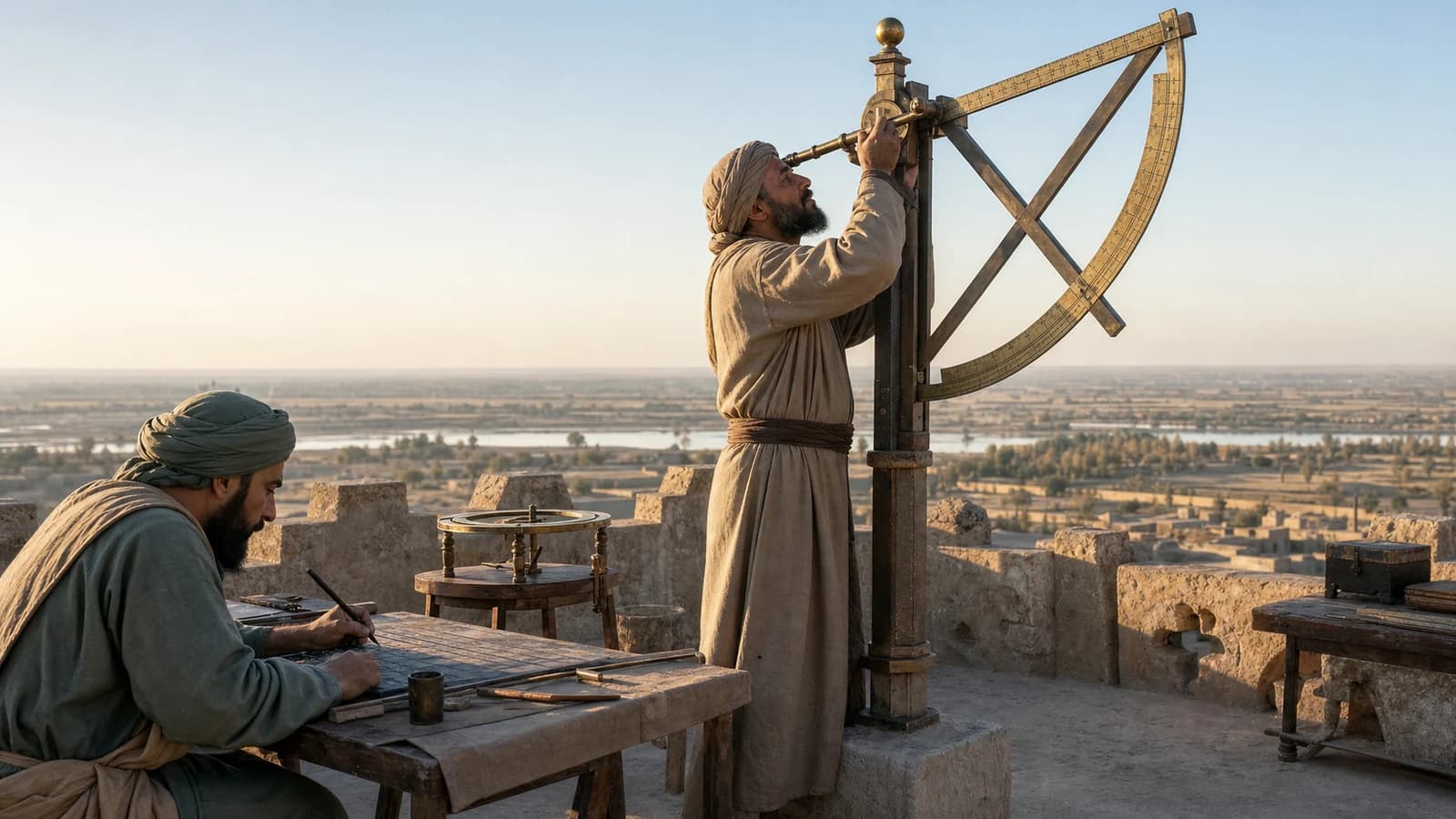
The encyclopedia account describes a private observing installation funded by al-Battani and a group of substantial instruments: gnomon, horizontal and vertical sundials, astrolabe, triquetrum, parallactic rulers, mural quadrant and a new armillary-sphere design. Some recommended dimensions exceeded one meter. Size alone does not guarantee accuracy, but a larger, carefully divided and aligned instrument can make angular readings easier. Repeated observations and a sophisticated way of combining them were at least as important as the hardware. This is why his work belongs with the observational history explained in our guide to Ibn al-Haytham’s mathematical and experimental methods, while remaining a distinct astronomical program.
What a zij is and what his book contains
The word zij came to designate an astronomical handbook centered on tables and procedures. It is broader than a catalogue of stars. Al-Battani’s surviving major work contains 57 chapters plus tables. It begins with divisions of the celestial sphere, sexagesimal arithmetic and trigonometric tools. Chapter 4 presents observational results. Chapters 5 through 26 develop problems in spherical astronomy; chapters 27 through 31 address the motions of the Sun, Moon and five visible planets within a Ptolemaic framework.
Chapter 32 treats conversions among chronological eras. Sixteen following chapters explain how to use the tables, including lunar parallax, distance and eclipse calculations. Chapters 49 through 55 address astrological problems, while the last chapters discuss a sundial and astronomical instruments. The layout is practical: a reader is repeatedly shown how to turn parameters into a calculation. The book therefore joins theory, observation, computation, chronology, instrumentation and astrology. Reducing it to “a book that found the solar year” removes most of what made a zij useful.
How he worked with rather than simply against Ptolemy
Al-Battani did not abandon Ptolemy’s geocentric kinematics. His planetary schemes remained deeply Ptolemaic, and the Dictionary of Scientific Biography points out weaknesses and compression in parts of his planetary exposition. Yet his preface explains that discrepancies in earlier works made renewed observation necessary. That position is more interesting than the familiar “ancient authority versus modern rebel” story: Ptolemy supplied both a model and an instruction to improve inherited conclusions when new observations required it.
Al-Battani was particularly willing to revise practical parameters. Solar motion, the lengths of seasons, obliquity and the position of the solar apogee could be tested against observations made at a later epoch and different latitude. Some inherited results held; others did not. This evidence-led correction is also why a reader should compare his work with al-Biruni’s measurement and astronomy. Neither scholar was “modern” in every assumption, but both show that mathematical astronomy in Arabic was not passive preservation.
His solar year value and what it does not prove
Al-Battani gave the year as 365 days, 5 hours, 46 minutes and 24 seconds. Popular summaries often compare that number with a contemporary mean tropical year and announce an error of only a little over two minutes. The proximity is impressive, but the comparison needs discipline. A tropical year is tied to the seasonal cycle, its length is not absolutely constant across all epochs, and a historical result is inseparable from the observations, solar model and numerical procedures used to derive it.
The stronger conclusion is that repeated equinox and solstice work let al-Battani refine the seasonal year and the unequal lengths of the seasons beyond several values then circulating. A modern calculator does not turn his result into a timeless constant; it lets us evaluate how well one ninth-century observing program performed. Precision should also not be confused with a modern error budget. The surviving text does not report calibration uncertainty, atmospheric refraction and statistical confidence in today’s format.
Why the obliquity measurement is a clearer accuracy test
The obliquity of the ecliptic is the angle between Earth’s equatorial plane and the plane of its orbit, expressed in geocentric astronomy as the tilt between the celestial equator and ecliptic. Al-Battani obtained 23°35′. The Biographical Encyclopedia of Astronomers gives the value for the year 880 as about 23°35′6″. That six-arcsecond comparison is unusually close and makes this measurement one of the clearest demonstrations of his observational skill.
It also illustrates why epoch labels matter. Earth’s axial orientation changes slowly; Ptolemy’s older value belonged to a different time as well as a different observing program. Al-Battani was not merely choosing which famous number looked better. He measured at his own epoch and found a lower obliquity than the value in the Almagest. His Raqqa latitude result, 36°1′ compared with a modern value near 35°57′, offers a second check on the practical relationship among site, instruments and calculation.
Solar apogee, seasons and precession
Within the geocentric solar model, the apogee is the point where the Sun is treated as farthest from Earth. Al-Battani confirmed that its longitude had shifted since Ptolemy and used a rate of about one degree in 66 Julian years. He connected this motion with the precession of the equinoxes. Modern celestial mechanics describes these phenomena differently, but the observational comparison was real: a supposedly fixed parameter did not fit the later sky.
He also determined the eccentricity used in the Ptolemaic solar model with remarkable numerical success. The encyclopedia assessment notes that this result was better than some later values from Copernicus and Tycho Brahe, whose higher latitudes and treatment of refraction or solar parallax introduced different errors. That does not make al-Battani “more advanced than Copernicus” in every respect. It shows that one observational parameter can be excellent inside a model whose larger physical picture later changed.
What al-Battani contributed to trigonometric astronomy
Greek astronomy frequently expressed angular problems through chords of a circle. By al-Battani’s period, Indian and Arabic mathematical traditions had developed sine-based computation, and astronomers were expanding tangent, cotangent and related tables. Al-Battani used these tools consciously in right-triangle and spherical-astronomy problems. They helped transform observations of altitude, time and celestial position into entries that could be calculated and tabulated.
He should not be called the sole inventor of sine, tangent or trigonometry. Those ideas have longer, multi-language histories, and later mathematicians such as Abu al-Wafa, Abu Nasr Mansur and al-Biruni developed additional rules. His specific importance lies in the systematic practical integration of trigonometric functions with a major observational zij. The broader development is outlined in our account of al-Khwarizmi, algebra and numerical procedure, which likewise distinguishes consolidation and transmission from a mythical single moment of invention.
Eclipses, apparent diameters and the possibility of an annular eclipse
Al-Battani measured the apparent diameters of the Sun and Moon and examined how they varied. If the Moon’s apparent disk is smaller than the Sun’s at conjunction, it cannot cover the Sun completely; a bright ring remains. His work therefore recognized the possibility of an annular as well as a total solar eclipse. This was a conclusion from changing apparent sizes within the astronomy of his period, not a modern photograph-based discovery.
His dated eclipse observations also had an afterlife far beyond the tables’ immediate users. In the eighteenth century Richard Dunthorne used historical eclipse observations, including al-Battani’s, while studying the Moon’s secular acceleration. Old observations become valuable when their place, date and phenomenon are recoverable. That later use does not mean the ninth-century observer possessed the eighteenth-century dynamical theory. It demonstrates how a carefully recorded event can answer a question its original recorder did not formulate.
The star catalogue and the danger of treating every number alike
MacTutor reports a catalogue of 489 stars, while scholarly biographies discuss different epochs associated with the observations and fixed-star tables. Readers may encounter 880 in general summaries and 911 in discussion of the catalogue epoch. These statements are not automatically interchangeable: an observation date, a catalogue’s reference epoch and the completion of a recension are different things. The safest presentation identifies which part of the Zij and which scholarly edition supplies a date.
The same caution applies to precession, planetary mean motions and geographical coordinates. A table can preserve a calculated position at a chosen epoch, not a naked measurement made that day. Copyists can also alter sexagesimal digits. Modern historians compare manuscript witnesses, the Latin and Castilian traditions, quotations by later astronomers and the critical edition rather than lifting a number from an unsourced graphic.
Astronomy and astrology occupied the same handbook
Several late chapters of the Zij solve astrological calculation problems, and al-Battani also commented on Ptolemy’s Tetrabiblos. This is not a secret appendix that invalidates the observations. In the medieval setting, predicting celestial positions served calendars, timekeeping, ritual needs and astrology, and the personnel and mathematical tools often overlapped. The Metropolitan Museum’s overview explains both this overlap and the fact that astrology remained religiously and intellectually contested.
Editors should therefore avoid two distortions. Calling al-Battani only an “astrologer” erases his observational and mathematical astronomy. Calling him a modern scientist who had nothing to do with astrology erases the contents and patrons of the surviving works. Ptolemaeus Arabus et Latinus records manuscript evidence for his Tetrabiblos commentary and shows how some chapters circulated within later compilations. Genre labels should follow the particular text being discussed.
How the work survived in manuscripts and editions
The complete Arabic work survives in the twelfth- or thirteenth-century manuscript Escorial árabe 908, copied in the western Islamic world, along with a small number of fragments. Ibn al-Nadim reported two recensions, the second “better than the first,” but modern scholars have not been able to separate every surviving feature neatly into those two versions. The manuscript is not al-Battani’s autograph, so textual transmission belongs to the evidence, not merely to the publishing history.
Carlo Alfonso Nallino published an Arabic text, Latin translation and commentary in three volumes between 1899 and 1907. It remains a foundational scholarly edition, although later research has corrected individual table entries and identified additional fragments or parallel material. A searchable catalogue record or a digitized scan is not identical to a new critical edition. Readers should cite volume, chapter, table and manuscript or edition when making exact numerical claims.
Latin, Castilian and Hebrew reception
Plato of Tivoli translated the work into Latin in the twelfth century. A Castilian translation made under Alfonso X around 1260 survives in part, including tables, in Paris, Arsenal manuscript 8322. Hebrew versions or reworkings were associated with Abraham bar Hiyya and Immanuel ben Jacob Bonfils. The Latin text was printed at Nuremberg in 1537 without the tables and again at Bologna in 1645. These are identifiable routes by which “Albategnius” entered European astronomical reading.
The Biographical Encyclopedia of Astronomers lists Regiomontanus, Copernicus, Brahe, Kepler and Galileo among later users of al-Battani’s work. That is stronger than a vague claim that he “caused the Renaissance,” but it still needs context: different authors used different parameters, editions and arguments. Copernicus cited ancient and Arabic observations within a project whose cosmology diverged from al-Battani’s. Transmission is a chain of translation, manuscript selection, printing, recalculation and disagreement—not a straight handoff of modern science.
Common claims that need correction
- “Al-Battani was born in 858 or 868.” His exact birth year is unknown; scholarly biographies use “before 858,” while general references offer varying approximations.
- “He was a Syrian prince.” The Arabic evidence does not support the princely title found in older European writing.
- “He invented trigonometry.” He made major, systematic use of trigonometric procedures within a longer Greek, Indian and Arabic mathematical history.
- “He discovered that Earth orbits the Sun.” His planetary framework remained Ptolemaic and geocentric, even when observations corrected Ptolemy’s parameters.
- “His solar year was exactly two minutes wrong.” The comparison is approximate because the tropical year varies and historical definitions and methods must be specified.
- “His book is a star catalogue.” The catalogue is one component of a 57-chapter computational handbook with extensive tables.
- “European astronomy simply copied him.” Latin, Castilian and Hebrew readers translated, excerpted, printed, recalculated and sometimes challenged his material.
How to verify an Al-Battani claim
Begin by deciding whether the claim concerns biography, an observation, a computed parameter, a table, a manuscript or later influence. For biography, compare the Fihrist-based encyclopedia entries and keep uncertain dates conditional. For a number, identify its unit, sexagesimal notation, epoch and table. For a textual claim, distinguish Escorial árabe 908, Nallino’s edition, the Latin translation and later printed editions.
Then ask whether a modern comparison uses the appropriate historical epoch. Obliquity changes; tropical-year length changes; apparent coordinates are tied to precession and reference date. Finally, separate “al-Battani wrote” from “a later scholar used.” Our guide to Baghdad translation networks explains why named texts, places and transmission paths are more reliable than the catch-all legend that every Arabic scientific work came from one institution. The Islamic history timeline supplies the larger Abbasid-era chronology.
Frequently asked questions
When and where was al-Battani born?
He was born at or near Harran before 858. The exact year is not known, so a single unqualified date should not be presented as certain.
How long did he observe at Raqqa?
The biographical evidence gives an observational span from 877 to 918, roughly forty years. He also recorded a solar and a lunar eclipse at Antioch in 901.
What was al-Battani’s value for the solar year?
365 days, 5 hours, 46 minutes and 24 seconds. It is impressively close to a modern tropical-year comparison, but the reference epoch and changing year length should accompany any error figure.
Did he invent sine and tangent?
No single person invented the whole trigonometric tradition. Al-Battani’s distinction is the clear, extensive use of sine-, tangent- and related procedures in practical astronomical tables and calculations.
Was al-Battani heliocentric?
No. He worked mainly within Ptolemaic geocentric astronomy while using new observations to revise several inherited parameters.
Why do historians still study his Zij?
It preserves a long observational program, a practical synthesis of astronomy and mathematics, unusually accurate parameters, dated eclipses, and a traceable transmission into several scholarly languages.
Related Muslim Post guides
- Adhan and Iqama Explained: Meaning, Words and Prayer Times
- Muwaqqit: The Mosque Astronomer Who Kept Prayer Time
- What Is a Zij? Astronomical Tables for Calculation
Sources
- Benno van Dalen, “Battani,” Biographical Encyclopedia of Astronomers — used for the cautious birth date, Raqqa observatory and instruments, 877–918 span, obliquity and latitude comparisons, eclipses, complete Escorial manuscript, translations and named later users.
- Willy Hartner, “Al-Battani,” Dictionary of Scientific Biography — used for the Fihrist-based life evidence, structure and practical purpose of the 57-chapter Zij, Ptolemaic framework, solar and planetary parameters, and limits of several traditional claims.
- MacTutor History of Mathematics, Al-Battani biography — used to cross-check the solar-year value, 489-star catalogue, chapter sequence, trigonometric methods, 901 eclipse observations and twelfth-century Latin transmission.
- MacTutor, Arabic mathematics — used to place al-Battani’s sine and tangent methods within a longer mathematical-astronomy tradition involving several authors, rather than crediting one inventor with all trigonometry.
- Cambridge Core, “Trigonometry in Two Sixteenth Century Works” — used for the historical distinction among sine, cosine, tangent and cotangent in Islamic astronomy and for the later separation of trigonometry as an independent subject.
- Metropolitan Museum of Art, astronomy and astrology in the medieval Islamic world — used to explain instruments, ephemerides, Ptolemaic model criticism and the historically overlapping but contested roles of astronomy and astrology.
- Ptolemaeus Arabus et Latinus, al-Battani’s Tetrabiblos commentary — used to verify the commentary’s contents, Berlin and Escorial witnesses, related treatise titles and the later circulation of chapters and tables.
- Heidelberg University Library catalogue, Al-Battani sive Albatenii Opus astronomicum — used to identify the bibliographic record of Nallino’s 1899 Arabic-text volume and distinguish a modern scholarly edition from the medieval manuscript witnesses.
- Library of Congress digitization of an older survey of Arabic scientific literature — used only as evidence of earlier English-language reception, Latin title and print history; its celebratory judgments are not treated as current historical consensus.


